生态环境学报 ›› 2026, Vol. 35 ›› Issue (5): 714-724.DOI: 10.16258/j.cnki.1674-5906.2026.05.005
邱锡香1,2( ), 罗义豪1,2, 周健闪1,2, 张昆1,2,3, 张银烽1,2,3,*()
收稿日期:2025-08-07
修回日期:2025-12-16
接受日期:2025-12-23
出版日期:2026-05-18
发布日期:2026-05-08
通讯作者:
*E-mail: 作者简介:邱锡香(2000年生),女,硕士研究生,研究方向为土壤有机碳。E-mail: qiuxixiang973@163.com
基金资助:
QIU Xixiang1,2(), LUO Yihao1,2, ZHOU Jianshan1,2, ZHANG Kun1,2,3, ZHANG Yinfeng1,2,3,*()
Received:2025-08-07
Revised:2025-12-16
Accepted:2025-12-23
Online:2026-05-18
Published:2026-05-08
摘要:
铁氧化物介导的矿物保护是土壤有机碳长期固存的核心机制。为探究湿地土壤铁结合态有机碳(Fe-OC)含量特征,铁形态及其调控因素,该研究以滇西北弥里塘高原湿地及周边草地、森林为对象,对比分析不同生态系统表层土壤中Fe-OC的含量特征、铁赋存形态及其调控因素。结果表明:1)湿地Fe-OC质量分数[(33.3±42.6)]g∙kg−1]显著高于森林[(12.8±8.7)g∙kg−1,p<0.01]和草地[(17.3±17.0)g∙kg−1,p<0.05];2)Fe-OC与总有机碳(TOC)、碳铁摩尔比(OC/Fe)、Fe-OC占TOC比例(f(Fe-OC))、全氮(TN)均呈显著正相关(p<0.05),表明土壤TOC的空间异质性是影响Fe-OC含量特征的主要因素;3)湿地、草地与森林土壤中的铁均以有机结合态和金属有机物络合态为主,其次为铁-锰氧化物结合态,土壤水分质量分数、OC/Fe和TOC是调控土壤中铁形态的主要因素;4)主成分分析结果显示,湿地与森林之间存在较为明显的差异,其中湿地土壤特征主要由碳指标(Fe-OC,OC/Fe,TOC)驱动,而森林土壤则由有机结合态铁矿物驱动,草地土壤作为二者间的过渡区域则受到碳指标和铁矿物形态的共同影响。该研究揭示了由土壤水分质量分数差异驱动的TOC空间异质性、营养盐和铁形态等关键Fe-OC含量特征驱动因素,为高原湿地碳管理提供科学依据。
中图分类号:
邱锡香, 罗义豪, 周健闪, 张昆, 张银烽. 滇西北典型高原湿地土壤铁结合态有机碳含量特征及调控因素[J]. 生态环境学报, 2026, 35(5): 714-724.
QIU Xixiang, LUO Yihao, ZHOU Jianshan, ZHANG Kun, ZHANG Yinfeng. Characteristics and Controlling Factors of Iron-Bound Organic Carbon in Typical Plateau Wetland of Northwest Yunnan[J]. Ecology and Environmental Sciences, 2026, 35(5): 714-724.
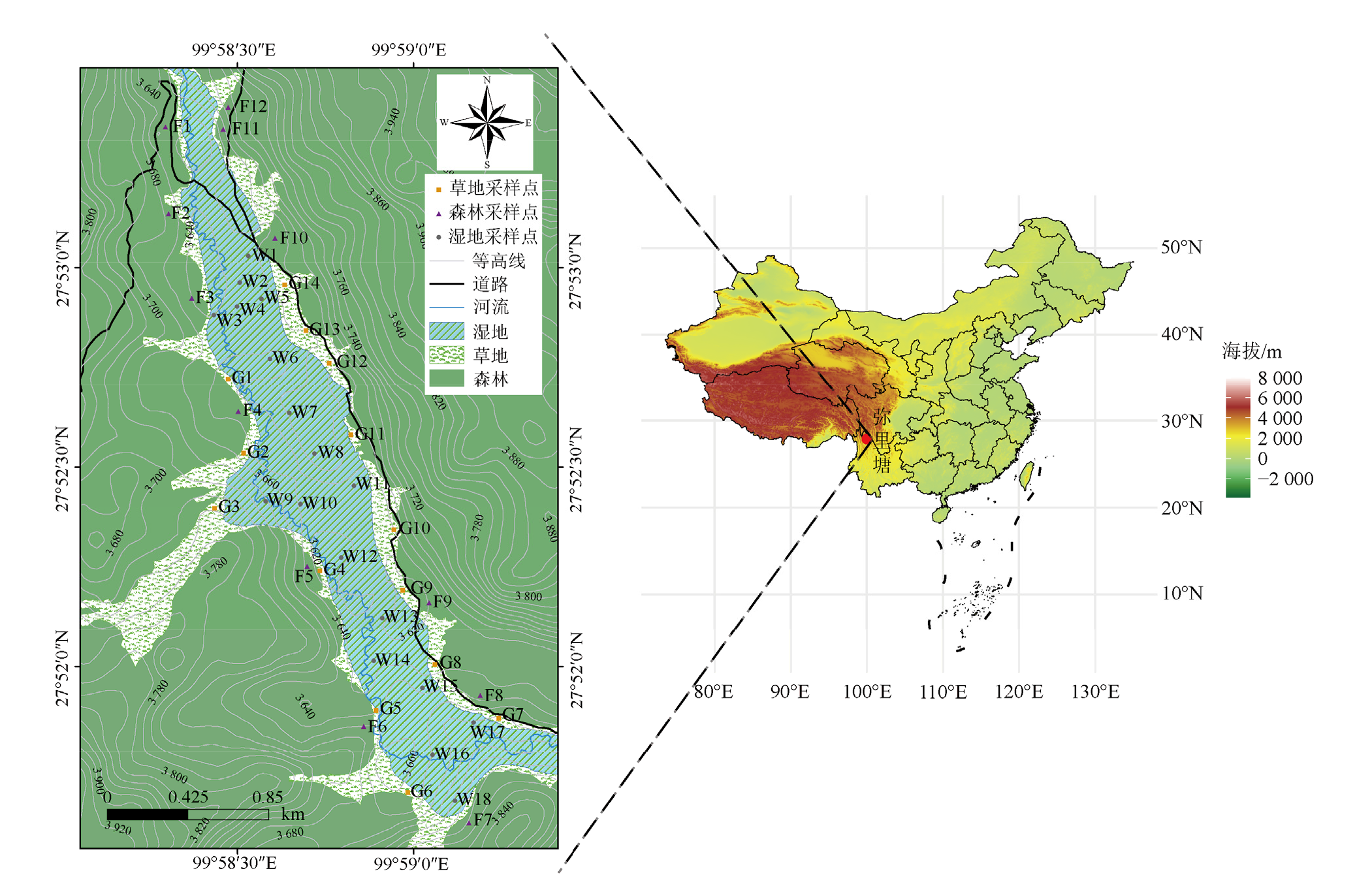
图1 弥里塘各地类采样点分布图 本图基于国家地理信息公共服务平台下载的审图号为GS(2024)0650号的标准地图制作;底图边界无修改
Figure 1 Distribution of sampling sites for each taxon in Militang
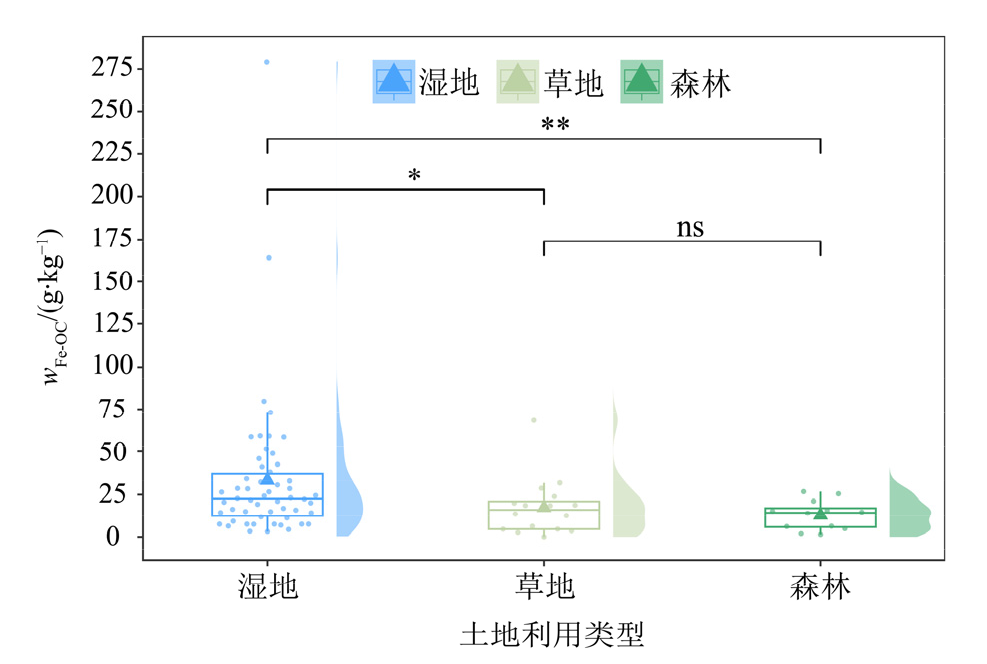
图2 湿地、草地和森林土壤中Fe-OC含量 n=3,下同。*表示二者间含量存在显著差异,p<0.05;**表示二者间含量存在显著差异,p<0.01;ns表示表示二者间含量无显著差异;▲表示平均值
Figure 2 Fe-OC content in wetland, grassland, and forest soils
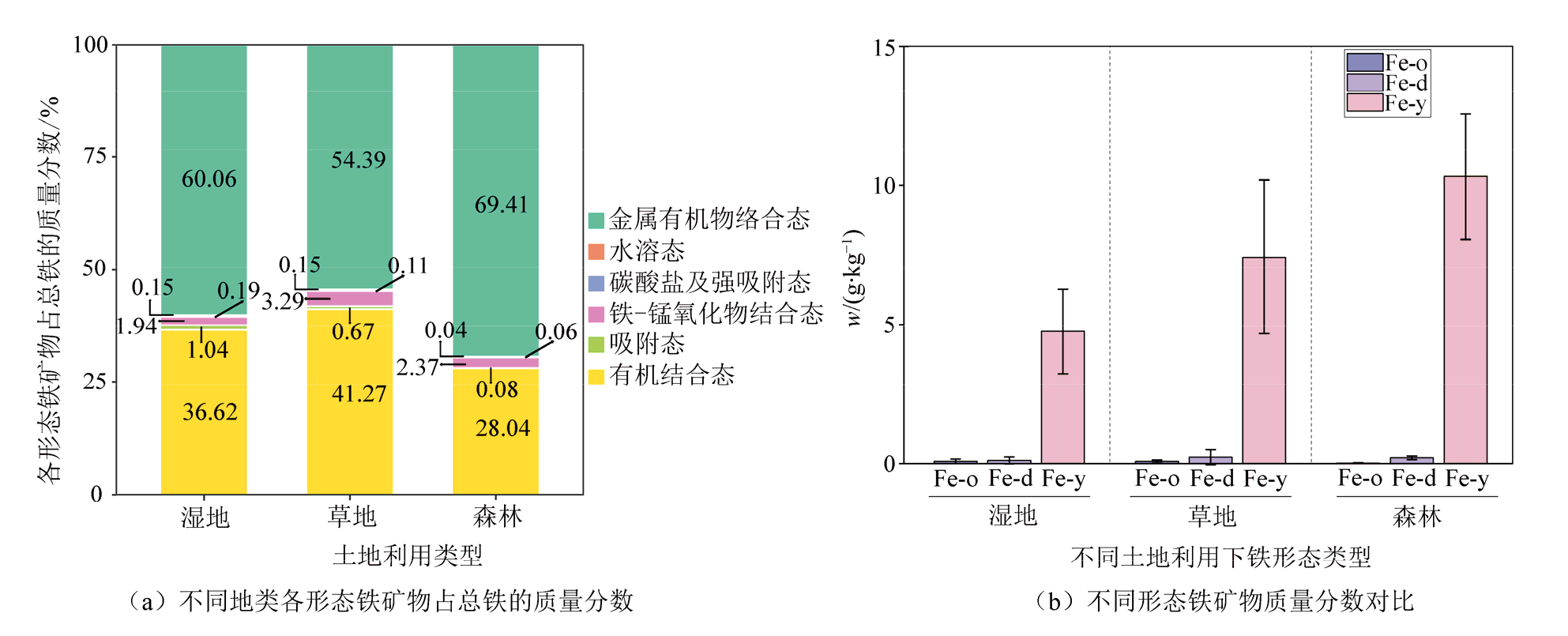
图3 湿地、草地和森林土壤中不同形态铁
Figure 3 Different forms of iron in wetland, grassland, and forest soils
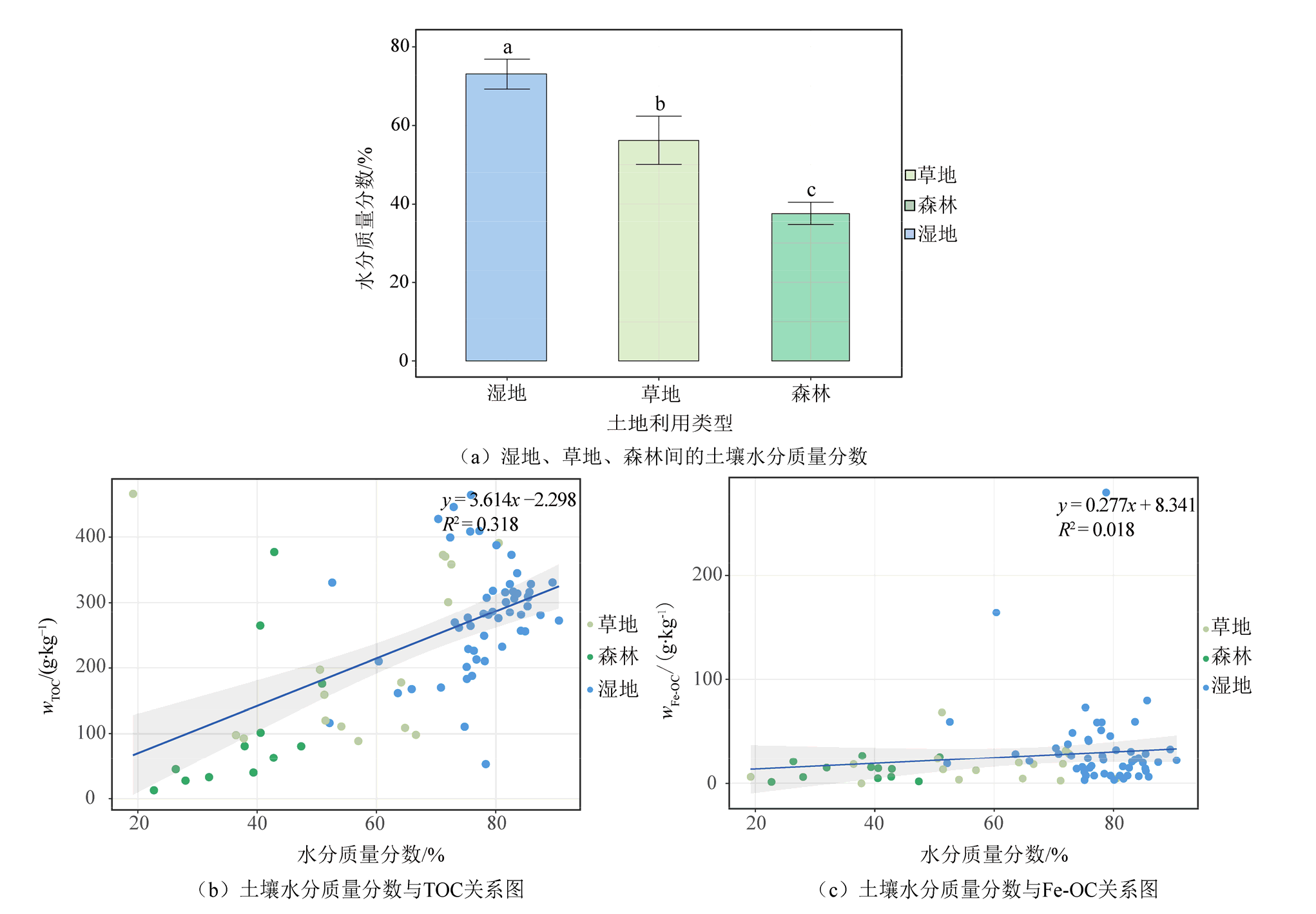
图4 湿地、草地和森林土壤水分质量分数及其与TOC、Fe-OC之间的关系 图4(a)中不同小写字母(a、b、c)表示二者间含量存在显著差异,p<0.05;(b)中x表示土壤水分质量分数,y为土壤TOC质量分数;(c)中x表示土壤水分质量分数,y为土壤Fe-OC的质量分数
Figure 4 Soil moisture content in wetlands, grasslands, and forests and their relationships with TOC and Fe-OC
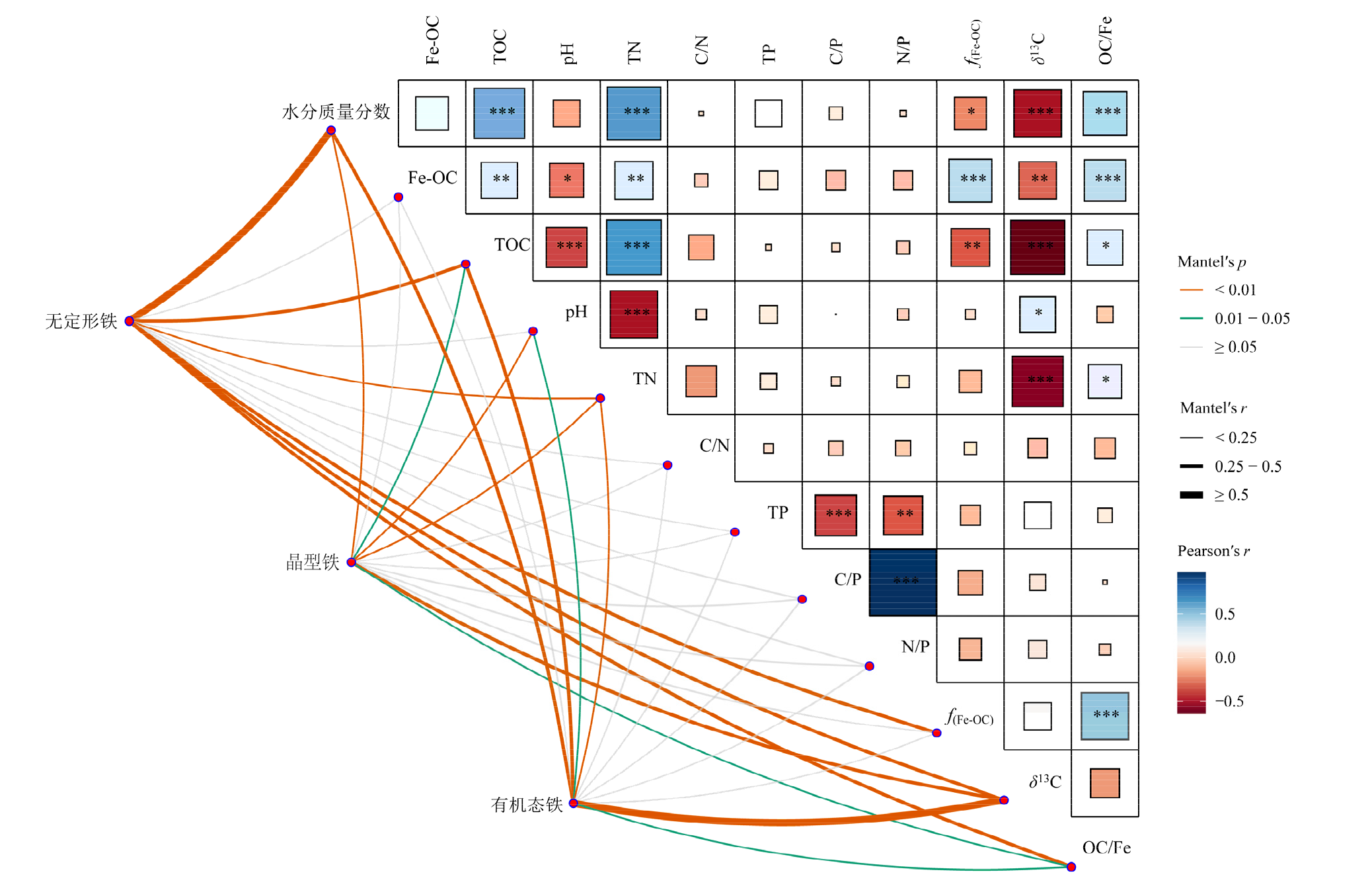
图5 土壤Fe-OC含量与土壤理化性质和铁形态的相关性 *表示二者间含量存在显著相关性,p<0.05;**表示二者间含量存在更显著的相关性,p<0.01;***表示二者间含量存在极显著相关,p<0.001
Figure 5 Correlation between soil Fe-OC content and soil physicochemical properties and iron forms
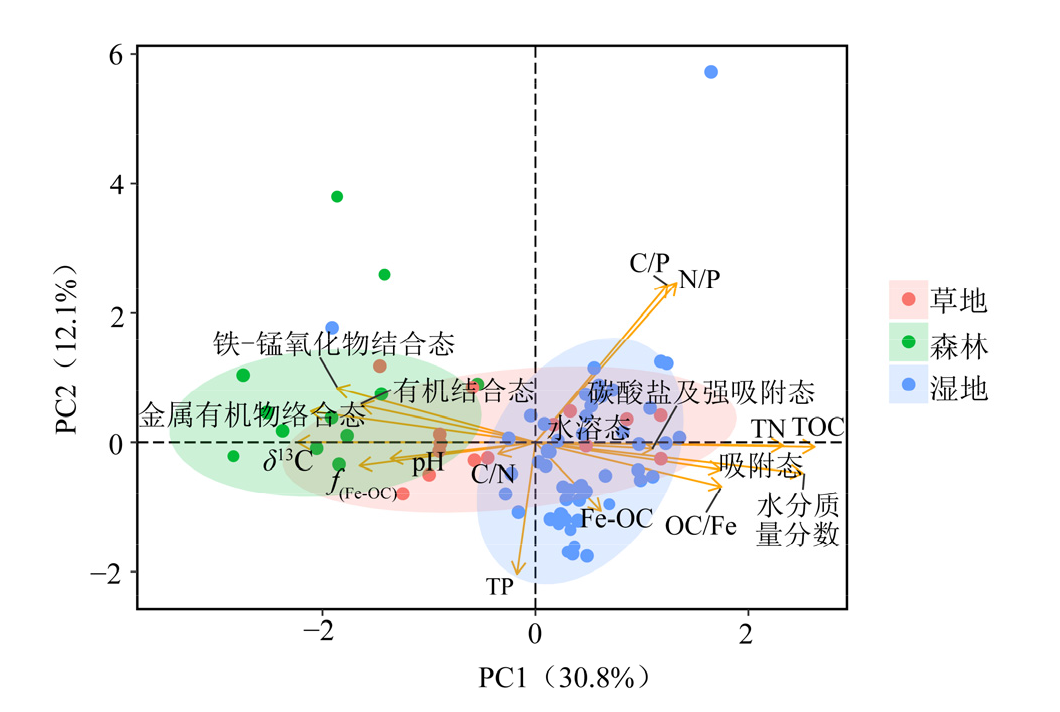
图6 土壤中Fe-OC与理化性质的主成分分析(PCA)
Figure 6 Principal component analysis (PCA) of Fe-OC and physicochemical properties in soil
| 地点 | 类型 | wTOC/(g∙kg−1) | wFe-OC/(g∙kg−1) | 参考文献 |
|---|---|---|---|---|
| 中国南 黄海 | 海底沉积物 | 7.5±3.5 | 0.08±0.08 | Ma et al., |
| 青藏高原 | 泥炭沉积物 | 184-325 | 9.49±6.2 | Huang et al., |
| 滦海子 湿地 | 泥炭沉积物 | 125.1±33.8 | 89.8±3.1 | Wang et al., |
| 闽江河口 湿地 | 潮汐湿地 沉积物 | 27.9±2.6 | 1.8±0.01 | 林于蓝等, |
| 蜡湖三角洲 | 三角洲沉积物 | 6.2±1.1 | 0.7±0.6 | Shields et al., |
| 大兴安岭 湿地 | 泥炭沉积物 | 236.6±11.4 | 51.5±3.1 | Liu et al., |
| 鄱阳湖 湿地 | 湖沼相沉积物(0-10 cm) | 34.7±3.2 | 2.3±0.8 | 徐晨瀛等, |
| 弥里塘 | 森林表层土 | 108.46±110.76 | 12.8±8.7 | 本研究 |
| 弥里塘 | 草地表层土 | 219.39±132.89 | 17.3±17.0 | 本研究 |
| 弥里塘 | 湿地表层土 | 280.32±83.58 | 33.3±42.6 | 本研究 |
表1 本研究土壤TOC和Fe-OC与其他地区比较
Table 1 Comparison of total soil organic carbon and iron-bound organic carbon in this study with other regions
| 地点 | 类型 | wTOC/(g∙kg−1) | wFe-OC/(g∙kg−1) | 参考文献 |
|---|---|---|---|---|
| 中国南 黄海 | 海底沉积物 | 7.5±3.5 | 0.08±0.08 | Ma et al., |
| 青藏高原 | 泥炭沉积物 | 184-325 | 9.49±6.2 | Huang et al., |
| 滦海子 湿地 | 泥炭沉积物 | 125.1±33.8 | 89.8±3.1 | Wang et al., |
| 闽江河口 湿地 | 潮汐湿地 沉积物 | 27.9±2.6 | 1.8±0.01 | 林于蓝等, |
| 蜡湖三角洲 | 三角洲沉积物 | 6.2±1.1 | 0.7±0.6 | Shields et al., |
| 大兴安岭 湿地 | 泥炭沉积物 | 236.6±11.4 | 51.5±3.1 | Liu et al., |
| 鄱阳湖 湿地 | 湖沼相沉积物(0-10 cm) | 34.7±3.2 | 2.3±0.8 | 徐晨瀛等, |
| 弥里塘 | 森林表层土 | 108.46±110.76 | 12.8±8.7 | 本研究 |
| 弥里塘 | 草地表层土 | 219.39±132.89 | 17.3±17.0 | 本研究 |
| 弥里塘 | 湿地表层土 | 280.32±83.58 | 33.3±42.6 | 本研究 |
| [1] | ADHIKARI D, POULSON S R, SUMAILA S, et al., 2016. Asynchronous reductive release of iron and organic carbon from hematite-humic acid complexes[J]. Chemical Geology, 430: 13-20. |
| [2] |
BAI J, LUO M, YANG Y, et al., 2021. Iron-bound carbon increases along a freshwater-oligohaline gradient in a subtropical tidal wetland[J]. Soil Biology and Biochemistry, 154: 108128.
DOI URL |
| [3] |
BOWLES J F W, 1997. The iron oxides: structure, properties reactions occurrence and uses[J]. Mineralogical Magazine, 61(408): 740-741.
DOI URL |
| [4] |
CHEN C, HALL S J, COWARD E, et al., 2020. Iron-mediated organic matter decomposition in humid soils can counteract protection[J]. Nature Communications, 11(1): 2255.
DOI PMID |
| [5] | CHEN C M, THOMPSON A, 2021. The influence of native soil organic matter and minerals on ferrous iron oxidation[J]. Geochimica et Cosmochimica Acta, 292: 254-270. |
| [6] |
CHEN W, CHEN W X, DONG K, et al., 2024. Iron-bound organic carbon distribution in freshwater wetlands with varying vegetation and hydrological regime[J]. Wetlands, 44(6): 71.
DOI |
| [7] |
DICEN G P, NAVARRETE I A, RALLOS R V, et al., 2019. The role of reactive iron in long-term carbon sequestration in mangrove sediments[J]. Journal of Soils and Sediments, 19(1): 501-510.
DOI |
| [8] |
DUAN X, YU X F, LI Z, et al., 2020. Iron-bound organic carbon is conserved in the rhizosphere soil of freshwater wetlands[J]. Soil Biology and Biochemistry, 149: 107949.
DOI URL |
| [9] |
FAN Z X, BRäUNING A, THOMAS A, et al., 2010. Spatial and temporal temperature trends on the Yunnan Plateau (Southwest China) during 1961-2004[J]. International Journal of Climatology, 31(14): 2078-2090.
DOI URL |
| [10] |
FENG X J, ZHAO Y P, WANG H Q, et al., 2025. Iron-organic carbon interactions in wetlands: implications for wetland carbon preservation under global changes[J]. Global Change Biology, 31(6): e70300.
DOI URL |
| [11] | FREEMAN C, JOHN OSTLE N, KANG H, 2001. An enzymic ‘latch’ on a global carbon store - A shortage of oxygen locks up carbon in peatlands by restraining a single enzyme[J]. Nature, 409: 149. |
| [12] |
FRØSETH R B, BLEKEN M A, 2015. Effect of low temperature and soil type on the decomposition rate of soil organic carbon and clover leaves, and related priming effect[J]. Soil Biology and Biochemistry, 80: 156-166.
DOI URL |
| [13] |
GENTSCH N, WILD B, MIKUTTA R, et al., 2018. Temperature response of permafrost soil carbon is attenuated by mineral protection[J]. Global Change Biology, 24(8): 3401-3415.
DOI PMID |
| [14] |
HUANG X Y, LIU X W, LIU J L, et al., 2021. Iron-bound organic carbon and their determinants in peatlands of China[J]. Geoderma, 391: 114974.
DOI URL |
| [15] |
JIA N, LI L, GUO H, et al., 2024. Important role of Fe oxides in global soil carbon stabilization and stocks[J]. Nature Communications, 15(1): 10318.
DOI |
| [16] |
LALONDE K, MUCCI A, OUELLET A, et al., 2012. Preservation of organic matter in sediments promoted by iron[J]. Nature, 483(7388): 198-200.
DOI |
| [17] |
LI Y, HOU Z, ZHANG L, 2023. Long-term spatio-temporal changes of wetlands in Tibetan Plateau and their response to climate change[J]. International Journal of Applied Earth Observation and Geoinformation 121: 103351.
DOI URL |
| [18] | LIU C Z, ZHAO Y P, MA L X, et al., 2024. Metallic protection of soil carbon: divergent drainage effects in Sphagnum vs. non-Sphagnum wetlands[J]. National Science Review, 11(11): nwae178. |
| [19] |
LIU F T, QIN S Q, FANG K, et al., 2022b. Divergent changes in particulate and mineral-associated organic carbon upon permafrost thaw[J]. Nature Communications, 13(1): 5073.
DOI |
| [20] |
LIU F, WU H Y, ZHAO Y G, et al., 2022c. Mapping high resolution National Soil Information Grids of China[J]. Science Bulletin, 67(3): 328-340.
DOI URL |
| [21] | LIU L F, CHEN H, TIAN J Q, 2022a. Varied response of carbon dioxide emissions to warming in oxic, anoxic and transitional soil layers in a drained peatland[J]. Communications Earth & Environment, 3(1): 313. |
| [22] |
MA W W, ZHU M X, YANG G P, et al., 2018. Iron geochemistry and organic carbon preservation by iron (oxyhydr)oxides in surface sediments of the East China Sea and the south Yellow Sea[J]. Journal of Marine Systems, 178: 62-74.
DOI URL |
| [23] |
MITSCH W J, BERNAL B, NAHLIK A M, et al., 2013. Wetlands, carbon, and climate change[J]. Landscape Ecology, 28(4): 583-597.
DOI URL |
| [24] |
NICHOLS J E, PETEET D M, 2019. Rapid expansion of northern peatlands and doubled estimate of carbon storage[J]. Nature Geoscience, 12(11): 917-921.
DOI |
| [25] |
PATZNER M S, MUELLER C W, MALUSOVA M, et al., 2020. Iron mineral dissolution releases iron and associated organic carbon during permafrost thaw[J]. Nature Communications, 11(1): 6329.
DOI PMID |
| [26] |
POULTON S W, RAISWELL R, 2005. Chemical and physical characteristics of iron oxides in riverine and glacial meltwater sediments[J]. Chemical Geology, 218(3): 203-221.
DOI URL |
| [27] |
SHIELDS M R, BIANCHI T S, GÉLINAS Y, et al., 2016. Enhanced terrestrial carbon preservation promoted by reactive iron in deltaic sediments[J]. Geophysical Research Letters, 43(3): 1149-1157.
DOI URL |
| [28] |
ŠKERLEP M, NEHZATI S, JOHANSSON U, et al., 2022. Spruce forest afforestation leading to increased Fe mobilization from soils[J]. Biogeochemistry, 157(3): 273-290.
DOI |
| [29] |
SOKOL N W, WHALEN E D, JILLING A, et al., 2022. Global distribution, formation and fate of mineral- associated soil organic matter under a changing climate: A trait-based perspective[J]. Functional Ecology, 36(6): 1411-1429.
DOI URL |
| [30] | SONG X X, LIU T X, 2021. Effects of soil iron mineral transformation on organic carbon sequestration: A review[J]. Acta Ecologica Sinica, 41(20): 7928-7938. |
| [31] |
SUN J F, YUAN X Z, LIU G D, et al., 2019. Emergy and eco-exergy evaluation of wetland restoration based on the construction of a wetland landscape in the northwest Yunnan Plateau, China[J]. Journal of Environmental Management, 252: 109499.
DOI URL |
| [32] | TEMMINK R J M, LAMERS L P M, ANGELINI C, et al., 2022. Recovering wetland biogeomorphic feedbacks to restore the world’s biotic carbon hotspots[J]. Science, 376(6593): eabn1479. |
| [33] |
VOGGENREITER E, THOMASARRIGO L, KILIAN J, et al., 2025. Reduction of iron-organic carbon associations shifts net greenhouse gas release after initial permafrost thaw[J]. Soil Biology and Biochemistry, 203: 109735.
DOI URL |
| [34] |
WAN D, YE T H, LU Y, et al., 2019. Iron oxides selectively stabilize plant-derived polysaccharides and aliphatic compounds in agricultural soils[J]. European Journal of Soil Science, 70(6): 1153-1163.
DOI URL |
| [35] |
WANG Y Y, LIU X Q, ZHANG X Y, et al., 2022. Evaluating wetland soil carbon stability related to iron transformation during redox oscillations[J]. Geoderma, 428: 116222.
DOI URL |
| [36] |
WANG Y Y, WANG H, HE J S, et al., 2017. Iron-mediated soil carbon response to water-table decline in an alpine wetland[J]. Nature Communications, 8(1): 15972.
DOI URL |
| [37] |
ZHANG Y M, NAAFS B D A, HUANG X Y, et al., 2022. Variations in wetland hydrology drive rapid changes in the microbial community, carbon metabolic activity, and greenhouse gas fluxes[J]. Geochimica et Cosmochimica Acta, 317: 269-285.
DOI URL |
| [38] |
ZHAO B, DOU A M, ZHANG Z W, et al., 2023. Ecosystem-specific patterns and drivers of global reactive iron mineral-associated organic carbon[J]. Biogeosciences, 20(23): 4761-4774.
DOI URL |
| [39] |
ZHAO J J, MINASNY B, SETIA R, et al., 2025. Global distribution and predictors of the mineral-associated to total soil organic carbon ratio: An indicator of soil carbon stability[J]. Earth Critical Zone, 2: 100035.
DOI URL |
| [40] |
ZHAO Q, ADHIKARI D, HUANG R X, et al., 2017. Coupled dynamics of iron and iron-bound organic carbon in forest soils during anaerobic reduction[J]. Chemical Geology, 464: 118-126.
DOI URL |
| [41] |
ZHAO Q, POULSON S R, OBRIST D, et al., 2016. Iron-bound organic carbon in forest soils: quantification and characterization[J]. Biogeosciences, 13(16): 4777-4788.
DOI URL |
| [42] |
段勋, 李哲, 刘淼, 等, 2022. 铁介导的土壤有机碳固持和矿化研究进展[J]. 地球科学进展, 37(2): 202-211.
DOI |
|
DUAN X, LI Z, LIU M, et al., 2022. Progress of the iron-mediated soil organic carbon preservation and mineralization[J]. Advances in Earth Science, 37(2): 202-211.
DOI |
|
| [43] | 林于蓝, 陈钰, 尹晓雷, 等, 2022. 围垦养殖与退塘还湿对闽江河口湿地土壤铁碳结合特征的影响[J]. 环境科学学报, 42(7): 466-477. |
| LIN Y L, CHEN Y, YIN X L, et al., 2022. Effects of reclamation and pond returning on iron-bound organic carbon characteristics in the soil of Minjiang estuarine wetland[J]. Acta Scientiae Circumstantiae, 42(7): 466-477. | |
| [44] | LUO Q, HE Q, WU H Q, et al., 2024. Characteristics of soil organic carbon fractions in Liao River Estuary Wetland and their influencing factors[J]. Ecology and Environmental Sciences, 33(3): 333-340. |
| [45] | 吴旺喜, 余汉年, 李华禄, 2003. 土壤中不同形态铁的浸取条件研究[J]. 江汉大学学报(自然科学版), 31(4): 64-66. |
| WU W X, YU H N, LI H L, 2003. Investigation on extraction conditions for various iron species in soil matrices[J]. Journal of Jianghan University (Natural Sciences), 31(4): 64-66. | |
| [46] |
徐晨瀛, 胡启武, 张桂华, 等, 2024. 鄱阳湖湿地剖面土壤铁结合态有机碳沿高程的分布特征[J]. 应用生态学报, 35(12): 3488-3496.
DOI |
|
XU C Y, HU Q W, ZHANG G H, et al., 2024. Distribution characteristics of soil iron-bound organic carbon in profiles along the elevation in Poyang Lake wetland[J]. Chinese Journal of Applied Ecology, 35(12): 3488-3496.
DOI |
|
| [44] |
罗庆, 何清, 吴慧秋, 等, 2024. 辽河口湿地土壤有机碳组分特征及其影响因素[J]. 生态环境学报, 33(3): 333-340.
DOI |
| [1] | 石含之, 曹怡然, 刘帆, 吴志超, 李富荣, 邓腾灏博, 徐爱平, 李冬琴, 文典, 王旭. 秸秆与细菌联合作用下土壤铅形态转化的调控研究[J]. 生态环境学报, 2026, 35(1): 155-166. |
| [2] | 唐中奥, 淳祯杰, 段兴武, 张瑞环, 荣丽, 刘文旭. 模拟侵蚀对元江流域黄红壤土壤微生物和土壤有机碳的影响[J]. 生态环境学报, 2026, 35(1): 54-61. |
| [3] | 刘卿, 龚雨顺, 王伟, 方贤滔, 吴金水, 沈健林. 湖南典型茶园土壤有机碳及其组分时空特征[J]. 生态环境学报, 2025, 34(9): 1386-1397. |
| [4] | 申佳龙, 吴栎宏, 李林霜, 周远芳, 杨孝民. 典型喀斯特山地小流域土地利用类型对土壤有机碳组分及其固碳效应的影响[J]. 生态环境学报, 2025, 34(3): 358-367. |
| [5] | 李建付, 黄志霖, 和成忠, 姜昕, 宋琳, 刘佳鑫, 陈利顶. 滇东喀斯特断陷盆地土壤有机碳空间分布特征及其关键影响因子[J]. 生态环境学报, 2024, 33(9): 1339-1352. |
| [6] | 石含之, 熊振乾, 曹怡然, 吴志超, 文典, 李富荣, 李冬琴, 王旭. 外源秸秆添加对红壤及黑土有机碳固定的影响[J]. 生态环境学报, 2024, 33(9): 1372-1383. |
| [7] | 罗庆, 何清, 吴慧秋, 寇力月, 方旭, 张鑫雨, 李缘, 柴育廷, 张瑞生, 代文举. 辽河口湿地土壤有机碳组分特征及其影响因素[J]. 生态环境学报, 2024, 33(3): 333-340. |
| [8] | 林丹丹, 毕华兴, 赵丹阳, 管凝, 韩金丹, 郭艳杰. 晋西黄土区不同密度刺槐林土壤有机碳组分及碳库特征[J]. 生态环境学报, 2024, 33(3): 379-388. |
| [9] | 常博然, 陈茹岚, 王彪, 蓝天, 邓琳, 薛会英. 藏东南折拉山不同林分类型土壤有机碳及其组分分布特征[J]. 生态环境学报, 2024, 33(10): 1495-1505. |
| [10] | 梁鑫, 韩亚峰, 郑柯, 王旭刚, 陈志怀, 杜鹃. 磁铁矿对稻田土壤碳矿化的影响[J]. 生态环境学报, 2023, 32(9): 1615-1622. |
| [11] | 张林, 齐实, 周飘, 伍冰晨, 张岱, 张岩. 北京山区针阔混交林地土壤有机碳含量的影响因素研究[J]. 生态环境学报, 2023, 32(3): 450-458. |
| [12] | 秦佳琪, 肖指柔, 明安刚, 朱豪, 滕金倩, 梁泽丽, 陶怡, 覃林. 针阔人工混交林及其纯林对土壤微生物碳循环功能基因丰度的影响[J]. 生态环境学报, 2023, 32(10): 1719-1731. |
| [13] | 肖国举, 李秀静, 郭占强, 胡延斌, 王静. 贺兰山东麓土壤有机碳对玉米生长发育及水分利用的影响[J]. 生态环境学报, 2022, 31(9): 1754-1764. |
| [14] | 马辉英, 李昕竹, 马鑫钰, 贡璐. 新疆天山北麓中段不同植被类型下土壤有机碳组分特征及其影响因素[J]. 生态环境学报, 2022, 31(6): 1124-1131. |
| [15] | 龚玲玄, 王丽丽, 赵建宁, 刘红梅, 杨殿林, 张贵龙. 不同覆盖作物模式对茶园土壤理化性质及有机碳矿化的影响[J]. 生态环境学报, 2022, 31(6): 1141-1150. |
| 阅读次数 | ||||||
|
全文 |
|
|||||
|
摘要 |
|
|||||
