
生态环境学报 ›› 2026, Vol. 35 ›› Issue (3): 378-392.DOI: 10.16258/j.cnki.1674-5906.2026.03.005
刘崇万1,2( ), 朱晓华1,2,*(), 王明华1,*(), 徐志华1,2, 任娣1,2, 杨洪生1,2, 万金娟1
收稿日期:2025-05-14
修回日期:2025-09-29
接受日期:2025-11-17
出版日期:2026-03-18
发布日期:2026-03-13
通讯作者:
*E-mail: 作者简介:刘崇万(1988年生),男,助理研究员,硕士研究生,研究方向为水产品质量安全及水产健康养殖。E-mail: liuchongwanujs@126.com
基金资助:
LIU Chongwan1,2(), ZHU Xiaohua1,2,*(), WANG Minghua1,*(), XU Zhihua1,2, REN Di1,2, YANG Hongsheng1,2, WAN Jinjuan1
Received:2025-05-14
Revised:2025-09-29
Accepted:2025-11-17
Online:2026-03-18
Published:2026-03-13
摘要:
当前关于江苏淡水鱼产业养殖尾水抗生素的污染特征及其生态风险的了解和研究较少。选择江苏10个典型淡水鱼类养殖场,采用固相萃取-液质联用法,分析了养殖尾水中6类42种典型抗生素的含量水平和空间分布特征,并对其生态风险进行评价,同时,探究了抗生素污染与尾水中环境因子的相关性。结果表明,尾水中共检出5类27种抗生素,检出率和检出浓度均较高的有恩诺沙星、氟苯尼考、克林霉素和诺氟沙星;不同采样点抗生素检出浓度相差较大,其中,两个鳊鱼养殖企业(WJ和JS采样点)抗生素检出浓度显著高于其他采样点;单一抗生素而言,高风险及中风险占比达到28.0%,主要是克拉霉素、伊维菌素和阿维菌素,单类抗生素而言,所有采样点的大环内酯类抗生素均为高风险,氟喹诺酮类为高风险或接近高风险;进一步结合Pearson相关性分析可知,尾水中TDS、EC、DO、TP、TN、NH4+-N、NO3−-N、TOC、BOD5及IMn与部分抗生素相关性显著,如克拉霉素、伊维菌素、阿维菌素、磺胺甲基异噁唑、磺胺氯哒嗪、恩诺沙星、环丙沙星、氧氟沙星及氟苯尼考。江苏淡水鱼类养殖尾水中抗生素检出较多,总体上赋存浓度较低,但潜在生态风险较大(尤其是鳊鱼Parabramis pekinensis)。研究结果可为江苏淡水鱼类养殖场抗生素的规范科学使用和风险防控以及尾水安全排放提供基础数据和科学依据。
中图分类号:
刘崇万, 朱晓华, 王明华, 徐志华, 任娣, 杨洪生, 万金娟. 江苏典型淡水鱼类养殖尾水抗生素污染特征、生态风险及其与环境理化因子相关性[J]. 生态环境学报, 2026, 35(3): 378-392.
LIU Chongwan, ZHU Xiaohua, WANG Minghua, XU Zhihua, REN Di, YANG Hongsheng, WAN Jinjuan. Pollution Characteristics, and Ecological Risk of Antibiotics, and Correlation Analysis between Antibiotics and Physical-Chemical Parameters in Typical Freshwater Fish Aquaculture Wastewater in Jiangsu Province, China[J]. Ecology and Environmental Sciences, 2026, 35(3): 378-392.
| 所属种类 | 中文名称 | 英文名称 | 英文简写 | CAS号 | 分子式 | 检出限/(ng·L−1) | 定量限/(ng·L−1) |
|---|---|---|---|---|---|---|---|
| 大环内酯类 | 阿奇霉素 | Azithromycin | AZM | 83905-01-5 | C38H72N2O12 | 1.0 | 4.0 |
| 克拉霉素 | Clarithromycin | CTM | 81103-11-9 | C38H69NO13 | 1.0 | 4.0 | |
| 红霉素 | Erythromycin | ERY | 114-07-8 | C37H67NO13 | 0.2 | 4.0 | |
| 林可霉素 | Lincomycin | LCC | 859-18-7 | C18H34N2O6S | 0.2 | 4.0 | |
| 罗红霉素 | Roxithromycin | ROX | 80214-83-1 | C41H76N2O15 | 0.01 | 4.0 | |
| 克林霉素 | Clindamycin | CLR | 21462-39-5 | C18H33ClN2O5S | 1.0 | 4.0 | |
| 竹桃霉素 | Oleandomycin | ODM | 7060-74-4 | C35H61NO12 | 1.0 | 4.0 | |
| 泰乐菌素 | Tylosin | TYL | 1401-69-0 | C46H77NO17 | 1.0 | 4.0 | |
| 伊维菌素 | Ivermectin | IVE | 70288-86-7 | C48H74O14 | 0.1 | 4.0 | |
| 依普菌素 | Eprinomectin | EPR | 123997-26-2 | C50H75NO14 | 1.0 | 4.0 | |
| 阿维菌素 | Abamectin | ABA | 71751-41-2 | C49H74O14 | 1.0 | 4.0 | |
| 磺胺类 | 磺胺嘧啶 | Sulfadiazine | SDZ | 68-35-9 | C10H10N4O2S | 1.0 | 2.0 |
| 磺胺噻唑 | Sulfathiazole | STZ | 72-14-0 | C9H9N3O2S2 | 0.2 | 2.0 | |
| 磺胺甲基嘧啶 | Sulfamerazine | SMR | 127-79-7 | C11H12N4O2S | 1.0 | 2.0 | |
| 磺胺间甲氧嘧啶 | Sulfamonomethoxine | SMM | 1220-83-3 | C11H12N4O3S | 0.2 | 2.0 | |
| 磺胺甲噻二唑 | Sulfamethizole | SMT | 144-82-1 | C9H10N4O2S2 | 0.1 | 2.0 | |
| 磺胺二甲基嘧啶 | Sulfamethazine | SFM | 57-68-1 | C12H14N4O2S | 0.2 | 2.0 | |
| 磺胺甲基异噁唑 | Sulfamethoxazole | SMZ | 723-46-6 | C10H11N3O3S | 1.0 | 2.0 | |
| 磺胺多辛 | Sulfadoxine | SDM | 2447-57-6 | C12H14N4O4S | 1.0 | 2.0 | |
| 磺胺异噁唑 | Sulfafurazole | SEZ | 127-69-5 | C11H13N3O3S | 0.2 | 2.0 | |
| 磺胺氯哒嗪 | Sulfachloropyridazine | SCP | 80-32-0 | C10H9ClN4O2S | 1.0 | 2.0 | |
| 磺胺间二甲氧嘧啶 | Sulfadimethoxine | SDT | 122-11-2 | C12H14N4O4S | 1.0 | 2.0 | |
| 磺胺喹恶啉 | Sulfaquinoxaline | SQX | 59-40-5 | C14H12N4O2S | 1.0 | 2.0 | |
| 氟喹诺酮类 | 恩诺沙星 | Enrofloxacin | ENR | 93106-60-6 | C19H22 FN3O3 | 1.0 | 2.0 |
| 环丙沙星 | Ciprofloxacin | CIP | 85721-33-1 | C17H18 FN3O3 | 0.2 | 2.0 | |
| 诺氟沙星 | Norfloxacin | NOR | 70458-96-7 | C16H18 FN3O3 | 1.0 | 2.0 | |
| 氧氟沙星 | Ofloxacin | OFL | 82419-36-1 | C18H20 FN3O4 | 1.0 | 2.0 | |
| 培氟沙星 | Pefloxacin | PEF | 70458-92-3 | C17H20FN3O3 | 1.0 | 2.0 | |
| 洛美沙星 | Lomefloxacin | LOM | 98079-51-7 | C17H19F2N3O3 | 1.0 | 2.0 | |
| 氟罗沙星 | Fleroxacin | FLE | 79660-72-3 | C17H18F3N3O3 | 1.0 | 2.0 | |
| 硝基呋喃类代谢物 | 5-甲基吗啉-3-氨基-2-恶唑烷基酮 | 3-Amino-5-morpholinomethyl-2- oxazolidone | AMOZ | 43056-63-9 | C8H15N3O3 | 0.25 | 0.5 |
| 1-氨基-2-内酰脲 | 1-Aminohydantoin | AHD | 2827-56-7 | C3H6ClN3O2 | 0.25 | 0.5 | |
| 氨基脲 | Semicarbazid | SEM | 57-56-7 | CH5N3O | 0.25 | 0.5 | |
| 3-氨基-2-恶唑烷基酮 | 3-Amino-2-oxazolidone | AOZ | 80-65-9 | C3H6N2O2 | 0.25 | 0.5 | |
| 四环素类 | 土霉素 | Oxytetracycline | OTC | 79-57-2 | C22H24N2O9 | 2.0 | 10.0 |
| 四环素 | Tetracycline | TC | 60-54-8 | C22H24N2O8 | 2.0 | 10.0 | |
| 金霉素 | Chlortetracycline | CTC | 57-62-5 | C22H23ClN2O8 | 0.1 | 10.0 | |
| 强力霉素 | Doxycycline | DOC | 564-25-0 | C22H24N2O8 | 0.1 | 10.0 | |
| 氯霉素类 | 氯霉素 | Chloramphenicol | CAP | 56-75-7 | C11H12Cl2N2O5 | 0.1 | 0.3 |
| 甲砜霉素 | Thiamphenicol | TAP | 15318-45-3 | C12H15Cl2NO5S | 0.1 | 0.3 | |
| 氟苯尼考 | Florfenicol | FF | 73231-34-2 | C12H14Cl2FNO4S | 0.1 | 0.3 | |
| 氟苯尼考胺 | Florfenicol amine | FFA | 76639-93-5 | C10H14FNO3S | 0.1 | 0.3 | |
| 内标物质 | D3-磺胺邻二甲氧嘧啶、D6-磺胺间二甲氧嘧啶、D5-恩诺沙星、D8-环丙沙星、D5-诺氟沙星、D5-氯霉素、D7-罗红霉素、D5-5-甲基吗啉-3-氨基-2-恶唑烷基酮、13C3-1-氨基-2-内酰脲、13C-15N2-氨基脲、D4-3-氨基-2-恶唑烷基酮等 | ||||||
表1 目标抗生素的基本信息
Table 1 Basic information of target antibiotics
| 所属种类 | 中文名称 | 英文名称 | 英文简写 | CAS号 | 分子式 | 检出限/(ng·L−1) | 定量限/(ng·L−1) |
|---|---|---|---|---|---|---|---|
| 大环内酯类 | 阿奇霉素 | Azithromycin | AZM | 83905-01-5 | C38H72N2O12 | 1.0 | 4.0 |
| 克拉霉素 | Clarithromycin | CTM | 81103-11-9 | C38H69NO13 | 1.0 | 4.0 | |
| 红霉素 | Erythromycin | ERY | 114-07-8 | C37H67NO13 | 0.2 | 4.0 | |
| 林可霉素 | Lincomycin | LCC | 859-18-7 | C18H34N2O6S | 0.2 | 4.0 | |
| 罗红霉素 | Roxithromycin | ROX | 80214-83-1 | C41H76N2O15 | 0.01 | 4.0 | |
| 克林霉素 | Clindamycin | CLR | 21462-39-5 | C18H33ClN2O5S | 1.0 | 4.0 | |
| 竹桃霉素 | Oleandomycin | ODM | 7060-74-4 | C35H61NO12 | 1.0 | 4.0 | |
| 泰乐菌素 | Tylosin | TYL | 1401-69-0 | C46H77NO17 | 1.0 | 4.0 | |
| 伊维菌素 | Ivermectin | IVE | 70288-86-7 | C48H74O14 | 0.1 | 4.0 | |
| 依普菌素 | Eprinomectin | EPR | 123997-26-2 | C50H75NO14 | 1.0 | 4.0 | |
| 阿维菌素 | Abamectin | ABA | 71751-41-2 | C49H74O14 | 1.0 | 4.0 | |
| 磺胺类 | 磺胺嘧啶 | Sulfadiazine | SDZ | 68-35-9 | C10H10N4O2S | 1.0 | 2.0 |
| 磺胺噻唑 | Sulfathiazole | STZ | 72-14-0 | C9H9N3O2S2 | 0.2 | 2.0 | |
| 磺胺甲基嘧啶 | Sulfamerazine | SMR | 127-79-7 | C11H12N4O2S | 1.0 | 2.0 | |
| 磺胺间甲氧嘧啶 | Sulfamonomethoxine | SMM | 1220-83-3 | C11H12N4O3S | 0.2 | 2.0 | |
| 磺胺甲噻二唑 | Sulfamethizole | SMT | 144-82-1 | C9H10N4O2S2 | 0.1 | 2.0 | |
| 磺胺二甲基嘧啶 | Sulfamethazine | SFM | 57-68-1 | C12H14N4O2S | 0.2 | 2.0 | |
| 磺胺甲基异噁唑 | Sulfamethoxazole | SMZ | 723-46-6 | C10H11N3O3S | 1.0 | 2.0 | |
| 磺胺多辛 | Sulfadoxine | SDM | 2447-57-6 | C12H14N4O4S | 1.0 | 2.0 | |
| 磺胺异噁唑 | Sulfafurazole | SEZ | 127-69-5 | C11H13N3O3S | 0.2 | 2.0 | |
| 磺胺氯哒嗪 | Sulfachloropyridazine | SCP | 80-32-0 | C10H9ClN4O2S | 1.0 | 2.0 | |
| 磺胺间二甲氧嘧啶 | Sulfadimethoxine | SDT | 122-11-2 | C12H14N4O4S | 1.0 | 2.0 | |
| 磺胺喹恶啉 | Sulfaquinoxaline | SQX | 59-40-5 | C14H12N4O2S | 1.0 | 2.0 | |
| 氟喹诺酮类 | 恩诺沙星 | Enrofloxacin | ENR | 93106-60-6 | C19H22 FN3O3 | 1.0 | 2.0 |
| 环丙沙星 | Ciprofloxacin | CIP | 85721-33-1 | C17H18 FN3O3 | 0.2 | 2.0 | |
| 诺氟沙星 | Norfloxacin | NOR | 70458-96-7 | C16H18 FN3O3 | 1.0 | 2.0 | |
| 氧氟沙星 | Ofloxacin | OFL | 82419-36-1 | C18H20 FN3O4 | 1.0 | 2.0 | |
| 培氟沙星 | Pefloxacin | PEF | 70458-92-3 | C17H20FN3O3 | 1.0 | 2.0 | |
| 洛美沙星 | Lomefloxacin | LOM | 98079-51-7 | C17H19F2N3O3 | 1.0 | 2.0 | |
| 氟罗沙星 | Fleroxacin | FLE | 79660-72-3 | C17H18F3N3O3 | 1.0 | 2.0 | |
| 硝基呋喃类代谢物 | 5-甲基吗啉-3-氨基-2-恶唑烷基酮 | 3-Amino-5-morpholinomethyl-2- oxazolidone | AMOZ | 43056-63-9 | C8H15N3O3 | 0.25 | 0.5 |
| 1-氨基-2-内酰脲 | 1-Aminohydantoin | AHD | 2827-56-7 | C3H6ClN3O2 | 0.25 | 0.5 | |
| 氨基脲 | Semicarbazid | SEM | 57-56-7 | CH5N3O | 0.25 | 0.5 | |
| 3-氨基-2-恶唑烷基酮 | 3-Amino-2-oxazolidone | AOZ | 80-65-9 | C3H6N2O2 | 0.25 | 0.5 | |
| 四环素类 | 土霉素 | Oxytetracycline | OTC | 79-57-2 | C22H24N2O9 | 2.0 | 10.0 |
| 四环素 | Tetracycline | TC | 60-54-8 | C22H24N2O8 | 2.0 | 10.0 | |
| 金霉素 | Chlortetracycline | CTC | 57-62-5 | C22H23ClN2O8 | 0.1 | 10.0 | |
| 强力霉素 | Doxycycline | DOC | 564-25-0 | C22H24N2O8 | 0.1 | 10.0 | |
| 氯霉素类 | 氯霉素 | Chloramphenicol | CAP | 56-75-7 | C11H12Cl2N2O5 | 0.1 | 0.3 |
| 甲砜霉素 | Thiamphenicol | TAP | 15318-45-3 | C12H15Cl2NO5S | 0.1 | 0.3 | |
| 氟苯尼考 | Florfenicol | FF | 73231-34-2 | C12H14Cl2FNO4S | 0.1 | 0.3 | |
| 氟苯尼考胺 | Florfenicol amine | FFA | 76639-93-5 | C10H14FNO3S | 0.1 | 0.3 | |
| 内标物质 | D3-磺胺邻二甲氧嘧啶、D6-磺胺间二甲氧嘧啶、D5-恩诺沙星、D8-环丙沙星、D5-诺氟沙星、D5-氯霉素、D7-罗红霉素、D5-5-甲基吗啉-3-氨基-2-恶唑烷基酮、13C3-1-氨基-2-内酰脲、13C-15N2-氨基脲、D4-3-氨基-2-恶唑烷基酮等 | ||||||
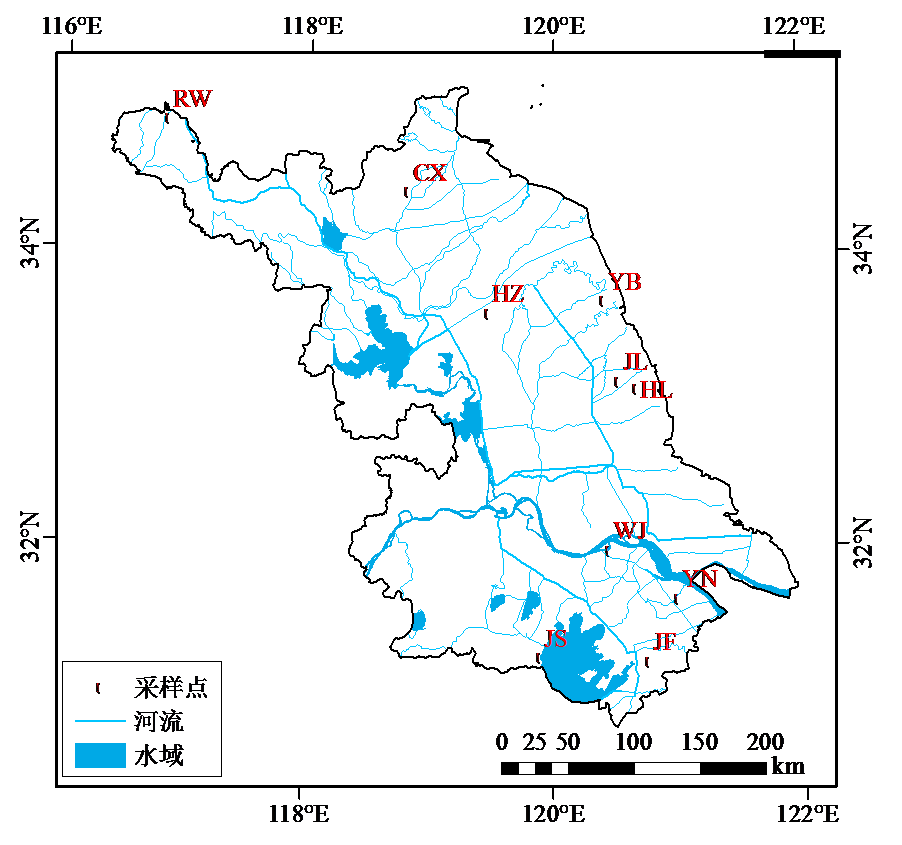
图1 采样点示意图
Figure 1 Schematic diagram of sampling sites
| 序号 | 采样点 | 主养品种 | 渔药使用情况 | 饲料使用情况 | 水产养殖调水产品使用情况 | 养殖面积/ hm2 | 所在 地区 | 经纬度 |
|---|---|---|---|---|---|---|---|---|
| 1 | YN | 青鱼、草鱼、鲢鱼、鳙鱼 | 温度较高时(超过30 ℃)、上市前每7天随饲料拌喂渔药(以恩诺沙星、氟苯尼考为主)1次,病害发生时,加频加量喂药 | 养殖全程使用海大四大家鱼商品饲料,越冬期投喂量减少并搭配多维、中草药等保健料 | 养殖周期开始时,彻底调水改底,养殖过程中根据需要进行调水改底 | 30 | 常州市 武进区 | 120°59′35″E, 31°38′15″N |
| 2 | HZ | 正常情况下每10天随饲料拌喂渔药(以恩诺沙星、氟苯尼考为主)1次,病害发生时,加频加量喂药 | 养殖前期使用通威四大家鱼商品饲料、后期使用天参四大家鱼商品饲料,越冬期投喂量减少并搭配多维、中草药等保健料 | 根据需要进行调水改底 | 60 | 淮安市 洪泽区 | 118°88′21″E,33°34′63″N | |
| 3 | CX | 鲫鱼 | 每年3-8月,每10天随饲料拌喂渔药(以恩诺沙星、氟苯尼考为主)1次,病害发生时,加频加量喂药 | 养殖全程使用通威鲫鱼商品饲料,越冬期投喂量减少并搭配多维、中草药等保健料 | 正常情况下每11-12天调水改底,遇特殊情况,及时调水改底 | 20 | 宿迁市 宿城区 | 118°48′22″E,33°84′31″N |
| 4 | YB | 病害发生时,随饲料拌喂渔药(以恩诺沙星、氟苯尼考为主),病害严重时,存在过量投喂 | 养殖全程使用通威鲫鱼商品饲料,成鱼上市前半年自行配制饲料(使用量与商品料1꞉1),自配料中添加恩诺沙星;每天固定1次喂料时搭配多维、中草药等保健料 | 定期检测水质情况,根据结果调水改底 | 80 | 盐城市 射阳县 | 120°39′50″E,33°86′88″N | |
| 5 | JS | 鳊鱼 | 养殖全程随饲料拌喂渔药(以恩诺沙星、氟苯尼考为主),病害发生时加大投喂量 | 养殖全程使用正虹系列鳊鱼商品饲料,上市前一个月及越冬期投喂量减少并搭配多维、中草药等保健料 | 正常情况下每15天调水改底,遇特殊情况,及时调水改底 | 30 | 无锡市 宜兴市 | 119°53′36″E,31°14′02″N |
| 6 | WJ | 养殖全程随饲料拌喂渔药(以恩诺沙星、氟苯尼考为主),病害发生时加大投喂量 | 养殖全程使用澳华系列鳊鱼商品饲料,越冬期投喂量减少并搭配多维、中草药等保健料 | 正常情况下每7天调水改底,遇特殊情况,及时调水改底 | 20 | 常州市 武进区 | 119°86′43″E,31°58′09″N | |
| 7 | HL | 斑点叉尾鮰 | 正常情况下,每7天随饲料拌喂渔药(以恩诺沙星、氟苯尼考为主)1次,病害发生时,加频加量喂药 | 养殖全程使用通威系列斑点叉尾鮰商品饲料,越冬期投喂量减少并搭配多维、中草药等保健料 | 正常情况下每3天调水改底,遇特殊情况,及时调水改底 | 20 | 南通市 海安市 | 120°39′88″E,32°63′74″N |
| 8 | JL | 病害发生时,随饲料拌喂渔药(以恩诺沙星为主),病害严重时,加大投喂量 | 养殖全程使用通威系列斑点叉尾鮰商品饲料及宝辉生物发酵饲料(1꞉1),越冬期3天投喂一次宝辉生物发酵饲料,遇极端天气情况停止投喂 | 根据需要进行调水改底,一般每30天一次 | 100 | 盐城市 大丰区 | 120°50′49″E,33°22′04″N | |
| 9 | JF | 大口黑鲈 | 正常情况下,每10天随饲料拌喂渔药(以恩诺沙星、氟苯尼考为主)1次,病害发生时,加频加量喂药 | 养殖全程使用澳华系列鲈鱼商品饲料,越冬期投喂量减少并搭配多维、中草药等保健料 | 根据需要进行调水改底,一般每15天一次 | 10 | 苏州市 吴江区 | 120°45′30″E,31°12′30″N |
| 10 | RW | 正常情况下,每7天随饲料拌喂渔药(以恩诺沙星、氟苯尼考为主)1次,病害发生时,加频加量喂药 | 养殖全程使用通威系列鲈鱼商品饲料,越冬期投喂量减少并搭配多维、中草药等保健料 | 根据需要进行调水改底,一般每20天一次 | 20 | 徐州市 沛县 | 116°80′20″E,34°90′26″N |
表2 采样点信息
Table 2 The sampling sites
| 序号 | 采样点 | 主养品种 | 渔药使用情况 | 饲料使用情况 | 水产养殖调水产品使用情况 | 养殖面积/ hm2 | 所在 地区 | 经纬度 |
|---|---|---|---|---|---|---|---|---|
| 1 | YN | 青鱼、草鱼、鲢鱼、鳙鱼 | 温度较高时(超过30 ℃)、上市前每7天随饲料拌喂渔药(以恩诺沙星、氟苯尼考为主)1次,病害发生时,加频加量喂药 | 养殖全程使用海大四大家鱼商品饲料,越冬期投喂量减少并搭配多维、中草药等保健料 | 养殖周期开始时,彻底调水改底,养殖过程中根据需要进行调水改底 | 30 | 常州市 武进区 | 120°59′35″E, 31°38′15″N |
| 2 | HZ | 正常情况下每10天随饲料拌喂渔药(以恩诺沙星、氟苯尼考为主)1次,病害发生时,加频加量喂药 | 养殖前期使用通威四大家鱼商品饲料、后期使用天参四大家鱼商品饲料,越冬期投喂量减少并搭配多维、中草药等保健料 | 根据需要进行调水改底 | 60 | 淮安市 洪泽区 | 118°88′21″E,33°34′63″N | |
| 3 | CX | 鲫鱼 | 每年3-8月,每10天随饲料拌喂渔药(以恩诺沙星、氟苯尼考为主)1次,病害发生时,加频加量喂药 | 养殖全程使用通威鲫鱼商品饲料,越冬期投喂量减少并搭配多维、中草药等保健料 | 正常情况下每11-12天调水改底,遇特殊情况,及时调水改底 | 20 | 宿迁市 宿城区 | 118°48′22″E,33°84′31″N |
| 4 | YB | 病害发生时,随饲料拌喂渔药(以恩诺沙星、氟苯尼考为主),病害严重时,存在过量投喂 | 养殖全程使用通威鲫鱼商品饲料,成鱼上市前半年自行配制饲料(使用量与商品料1꞉1),自配料中添加恩诺沙星;每天固定1次喂料时搭配多维、中草药等保健料 | 定期检测水质情况,根据结果调水改底 | 80 | 盐城市 射阳县 | 120°39′50″E,33°86′88″N | |
| 5 | JS | 鳊鱼 | 养殖全程随饲料拌喂渔药(以恩诺沙星、氟苯尼考为主),病害发生时加大投喂量 | 养殖全程使用正虹系列鳊鱼商品饲料,上市前一个月及越冬期投喂量减少并搭配多维、中草药等保健料 | 正常情况下每15天调水改底,遇特殊情况,及时调水改底 | 30 | 无锡市 宜兴市 | 119°53′36″E,31°14′02″N |
| 6 | WJ | 养殖全程随饲料拌喂渔药(以恩诺沙星、氟苯尼考为主),病害发生时加大投喂量 | 养殖全程使用澳华系列鳊鱼商品饲料,越冬期投喂量减少并搭配多维、中草药等保健料 | 正常情况下每7天调水改底,遇特殊情况,及时调水改底 | 20 | 常州市 武进区 | 119°86′43″E,31°58′09″N | |
| 7 | HL | 斑点叉尾鮰 | 正常情况下,每7天随饲料拌喂渔药(以恩诺沙星、氟苯尼考为主)1次,病害发生时,加频加量喂药 | 养殖全程使用通威系列斑点叉尾鮰商品饲料,越冬期投喂量减少并搭配多维、中草药等保健料 | 正常情况下每3天调水改底,遇特殊情况,及时调水改底 | 20 | 南通市 海安市 | 120°39′88″E,32°63′74″N |
| 8 | JL | 病害发生时,随饲料拌喂渔药(以恩诺沙星为主),病害严重时,加大投喂量 | 养殖全程使用通威系列斑点叉尾鮰商品饲料及宝辉生物发酵饲料(1꞉1),越冬期3天投喂一次宝辉生物发酵饲料,遇极端天气情况停止投喂 | 根据需要进行调水改底,一般每30天一次 | 100 | 盐城市 大丰区 | 120°50′49″E,33°22′04″N | |
| 9 | JF | 大口黑鲈 | 正常情况下,每10天随饲料拌喂渔药(以恩诺沙星、氟苯尼考为主)1次,病害发生时,加频加量喂药 | 养殖全程使用澳华系列鲈鱼商品饲料,越冬期投喂量减少并搭配多维、中草药等保健料 | 根据需要进行调水改底,一般每15天一次 | 10 | 苏州市 吴江区 | 120°45′30″E,31°12′30″N |
| 10 | RW | 正常情况下,每7天随饲料拌喂渔药(以恩诺沙星、氟苯尼考为主)1次,病害发生时,加频加量喂药 | 养殖全程使用通威系列鲈鱼商品饲料,越冬期投喂量减少并搭配多维、中草药等保健料 | 根据需要进行调水改底,一般每20天一次 | 20 | 徐州市 沛县 | 116°80′20″E,34°90′26″N |
| 采样点 | 总溶解固体 质量浓度/(mg∙L−1) | 氧化还原电位/ mV | 电导率/ (μS∙cm−1) | 水温/ ℃ |
|---|---|---|---|---|
| YN | 575.09±63.87c | 419.32±39.56 | 429.35±47.52 | 19.8±0.3a |
| HZ | 586.32±39.85c | 402.12±37.91 | 431.85±36.47 | 18.5±0.1b |
| CX | 611.09±46.01c | 399.55±29.02 | 412.06±49.52 | 19.2±0.2c |
| YB | 546.32±57.94c | 413.52±45.17 | 406.99±55.01 | 17.1±0.2c |
| JS | 705.36±44.85b | 402.35±33.67 | 398.25±64.28 | 18.9±0.1b |
| WJ | 853.39±36.98a | 419.38±55.98 | 412.36±28.46 | 19.6±0.1a |
| HL | 715.32±34.52b | 422.56±46.99 | 406.58±19.55 | 18.2±0.2b |
| JL | 603.35±75.12c | 399.58±32.88 | 428.65±37.89 | 17.6±0.2c |
| JF | 599.37±66.39c | 414.58±39.64 | 426.74±24.59 | 19.2±0.1c |
| RW | 613.32±56.35c | 435.62±22.35 | 433.02±33.56 | 16.5±0.1c |
表3 养殖尾水物理性水质参数
Table 3 Physical parameters of wastewater
| 采样点 | 总溶解固体 质量浓度/(mg∙L−1) | 氧化还原电位/ mV | 电导率/ (μS∙cm−1) | 水温/ ℃ |
|---|---|---|---|---|
| YN | 575.09±63.87c | 419.32±39.56 | 429.35±47.52 | 19.8±0.3a |
| HZ | 586.32±39.85c | 402.12±37.91 | 431.85±36.47 | 18.5±0.1b |
| CX | 611.09±46.01c | 399.55±29.02 | 412.06±49.52 | 19.2±0.2c |
| YB | 546.32±57.94c | 413.52±45.17 | 406.99±55.01 | 17.1±0.2c |
| JS | 705.36±44.85b | 402.35±33.67 | 398.25±64.28 | 18.9±0.1b |
| WJ | 853.39±36.98a | 419.38±55.98 | 412.36±28.46 | 19.6±0.1a |
| HL | 715.32±34.52b | 422.56±46.99 | 406.58±19.55 | 18.2±0.2b |
| JL | 603.35±75.12c | 399.58±32.88 | 428.65±37.89 | 17.6±0.2c |
| JF | 599.37±66.39c | 414.58±39.64 | 426.74±24.59 | 19.2±0.1c |
| RW | 613.32±56.35c | 435.62±22.35 | 433.02±33.56 | 16.5±0.1c |
| 采样点 | pH值 | 溶解氧质量浓度/ (mg∙L−1) | 总磷质量 浓度/ (mg∙L−1) | 总氮质量 浓度/ (mg∙L−1) | 氨氮质量 浓度/ (mg∙L−1) | 硝态氮质量浓度/ (mg∙L−1) | 亚硝态氮质量浓度/ (mg∙L−1) | 总有机碳质量浓度/ (mg∙L−1) | 生化需 氧量/ (mg∙L−1) | 高锰酸盐指数/ (mg∙L−1) |
|---|---|---|---|---|---|---|---|---|---|---|
| YN | 8.14± 0.08 | 9.05± 0.09a | 0.46± 0.06b | 3.59± 0.49bc | 0.75± 0.11b | 0.21± 0.05a | 0.15± 0.02ab | 1.05± 0.30bc | 0.33± 0.04d | 7.15± 1.05b |
| HZ | 8.02± 0.14 | 9.11± 0.22a | 0.51± 0.03b | 3.11± 0.37c | 0.77± 0.09b | 0.16± 0.07ab | 0.17± 0.03a | 0.95± 0.22c | 0.29± 0.06d | 7.36± 0.99b |
| CX | 7.91± 0.11 | 8.87± 0.18a | 0.39± 0.02c | 3.21± 0.64c | 0.46± 0.15c | 0.18± 0.08ab | 0.13± 0.01ab | 0.72± 0.19d | 0.15± 0.02e | 6.98± 1.35bc |
| YB | 8.15± 0.05 | 9.01± 0.16a | 0.41± 0.06bc | 3.07± 0.55c | 0.62± 0.20bc | 0.22± 0.12b | 0.11± 0.02b | 0.79± 0.21b | 0.19± 0.05e | 6.51± 1.02c |
| JS | 8.30± 0.07 | 7.12± 0.19b | 0.67± 0.17a | 4.11± 0.31b | 0.95± 0.08a | 0.25± 0.11a | 0.16± 0.04a | 1.46± 0.51ab | 0.62± 0.17b | 7.99± 1.35a |
| WJ | 8.24± 0.09 | 6.35± 0.23c | 0.75± 0.11a | 5.02± 0.28a | 1.21± 0.11a | 0.29± 0.05a | 0.19± 0.02a | 1.68± 0.45a | 0.85± 0.16a | 8.36± 2.01a |
| HL | 8.05± 0.12 | 8.81± 0.22a | 0.51± 0.08b | 3.45± 0.52bc | 0.74± 0.06b | 0.22± 0.04a | 0.11± 0.01b | 1.25± 0.32b | 0.54± 0.11bc | 8.01± 1.11a |
| JL | 7.95± 0.13 | 8.79± 0.14a | 0.44± 0.06b | 3.27± 0.36bc | 0.76± 0.18b | 0.14± 0.06b | 0.12± 0.02b | 0.70± 0.11d | 0.22± 0.04e | 7.22± 1.46b |
| JF | 8.61± 0.09 | 8.95± 0.16a | 0.46± 0.01b | 3.05± 0.49c | 0.59± 0.15bc | 0.13± 0.05b | 0.13± 0.03b | 0.71± 0.02d | 0.31± 0.06d | 6.35± 0.98c |
| RW | 8.67± 0.05 | 9.16± 0.23a | 0.52± 0.07b | 3.32± 0.37c | 0.63± 0.21bc | 0.09± 0.01c | 0.10± 0.01b | 0.63± 0.12d | 0.11± 0.01e | 6.49± 1.35c |
表4 养殖尾水化学性水质参数
Table 4 Chemical parameters of wastewater
| 采样点 | pH值 | 溶解氧质量浓度/ (mg∙L−1) | 总磷质量 浓度/ (mg∙L−1) | 总氮质量 浓度/ (mg∙L−1) | 氨氮质量 浓度/ (mg∙L−1) | 硝态氮质量浓度/ (mg∙L−1) | 亚硝态氮质量浓度/ (mg∙L−1) | 总有机碳质量浓度/ (mg∙L−1) | 生化需 氧量/ (mg∙L−1) | 高锰酸盐指数/ (mg∙L−1) |
|---|---|---|---|---|---|---|---|---|---|---|
| YN | 8.14± 0.08 | 9.05± 0.09a | 0.46± 0.06b | 3.59± 0.49bc | 0.75± 0.11b | 0.21± 0.05a | 0.15± 0.02ab | 1.05± 0.30bc | 0.33± 0.04d | 7.15± 1.05b |
| HZ | 8.02± 0.14 | 9.11± 0.22a | 0.51± 0.03b | 3.11± 0.37c | 0.77± 0.09b | 0.16± 0.07ab | 0.17± 0.03a | 0.95± 0.22c | 0.29± 0.06d | 7.36± 0.99b |
| CX | 7.91± 0.11 | 8.87± 0.18a | 0.39± 0.02c | 3.21± 0.64c | 0.46± 0.15c | 0.18± 0.08ab | 0.13± 0.01ab | 0.72± 0.19d | 0.15± 0.02e | 6.98± 1.35bc |
| YB | 8.15± 0.05 | 9.01± 0.16a | 0.41± 0.06bc | 3.07± 0.55c | 0.62± 0.20bc | 0.22± 0.12b | 0.11± 0.02b | 0.79± 0.21b | 0.19± 0.05e | 6.51± 1.02c |
| JS | 8.30± 0.07 | 7.12± 0.19b | 0.67± 0.17a | 4.11± 0.31b | 0.95± 0.08a | 0.25± 0.11a | 0.16± 0.04a | 1.46± 0.51ab | 0.62± 0.17b | 7.99± 1.35a |
| WJ | 8.24± 0.09 | 6.35± 0.23c | 0.75± 0.11a | 5.02± 0.28a | 1.21± 0.11a | 0.29± 0.05a | 0.19± 0.02a | 1.68± 0.45a | 0.85± 0.16a | 8.36± 2.01a |
| HL | 8.05± 0.12 | 8.81± 0.22a | 0.51± 0.08b | 3.45± 0.52bc | 0.74± 0.06b | 0.22± 0.04a | 0.11± 0.01b | 1.25± 0.32b | 0.54± 0.11bc | 8.01± 1.11a |
| JL | 7.95± 0.13 | 8.79± 0.14a | 0.44± 0.06b | 3.27± 0.36bc | 0.76± 0.18b | 0.14± 0.06b | 0.12± 0.02b | 0.70± 0.11d | 0.22± 0.04e | 7.22± 1.46b |
| JF | 8.61± 0.09 | 8.95± 0.16a | 0.46± 0.01b | 3.05± 0.49c | 0.59± 0.15bc | 0.13± 0.05b | 0.13± 0.03b | 0.71± 0.02d | 0.31± 0.06d | 6.35± 0.98c |
| RW | 8.67± 0.05 | 9.16± 0.23a | 0.52± 0.07b | 3.32± 0.37c | 0.63± 0.21bc | 0.09± 0.01c | 0.10± 0.01b | 0.63± 0.12d | 0.11± 0.01e | 6.49± 1.35c |
| 抗生素 | 检出率% | 范围/(ng·L−1) | 均值/(ng·L−1) | 中值/(ng·L−1) |
|---|---|---|---|---|
| AZM | 0 | ND | ND | ND |
| CTM | 80 | ND-22.50 | 8.92 | 4.43 |
| ERY | 100 | 0.36-13.16 | 4.16 | 3.76 |
| LCC | 100 | 0.24-46.89 | 6.81 | 0.93 |
| ROX | 100 | 0.02-1.26 | 0.41 | 0.36 |
| CLR | 100 | 5.00-15.21 | 11.60 | 12.77 |
| ODM | 0 | ND | ND | ND |
| TYL | 60 | 1.87-5.14 | 2.92 | 2.06 |
| IVE | 60 | ND-6.19 | 2.49 | 0.17 |
| EPR | 0 | ND | ND | ND |
| ABA | 80 | ND-14.51 | 5.09 | 2.52 |
| SDZ | 80 | ND-5.82 | 2.75 | 2.12 |
| STZ | 100 | 0.39-6.48 | 2.77 | 2.31 |
| SMR | 90 | ND-2.46 | 2.23 | 1.28 |
| SMM | 60 | ND-7.20 | 2.78 | 0.20 |
| SMT | 100 | 0.15-4.14 | 1.58 | 1.24 |
| SFM | 100 | 0.27-1.07 | 0.61 | 0.60 |
| SMZ | 70 | ND-14.31 | 7.57 | 5.02 |
| SDM | 0 | ND | ND | ND |
| SEZ | 100 | 0.25-17.53 | 4.95 | 1.70 |
| SCP | 90 | ND-13.02 | ND | 2.48 |
| SDT | 0 | ND | ND | ND |
| SQX | 0 | ND | ND | ND |
| ENR | 100 | 11.47-35.80 | 20.36 | 19.3 |
| CIP | 100 | 0.27-9.52 | 3.76 | 2.82 |
| NOR | 100 | 3.56-18.25 | 10.69 | 11.12 |
| OFL | 100 | 4.02-21.15 | 9.11 | 6.67 |
| PEF | 0 | ND | ND | ND |
| LOM | 0 | ND | ND | ND |
| FLE | 0 | ND | ND | ND |
| AMOZ | 0 | ND | ND | ND |
| AHD | 0 | ND | ND | ND |
| SEM | 0 | ND | ND | ND |
| AOZ | 0 | ND | ND | ND |
| OTC | 80 | ND-3.86 | 2.34 | 1.96 |
| TC | 80 | ND-10.49 | 4.87 | 3.47 |
| CTC | 100 | 0.19-0.52 | 0.32 | 0.28 |
| DOC | 100 | ND-1.19 | 0.61 | 0.54 |
| CAP | 0 | ND | ND | ND |
| TAP | 0 | ND | ND | ND |
| FF | 100 | 6.69-41.10 | 19.41 | 16.02 |
| FFA | 100 | 0.75-1.74 | 1.15 | 1.16 |
表5 目标抗生素的统计形分布
Table 5 Distribution of target antibiotics
| 抗生素 | 检出率% | 范围/(ng·L−1) | 均值/(ng·L−1) | 中值/(ng·L−1) |
|---|---|---|---|---|
| AZM | 0 | ND | ND | ND |
| CTM | 80 | ND-22.50 | 8.92 | 4.43 |
| ERY | 100 | 0.36-13.16 | 4.16 | 3.76 |
| LCC | 100 | 0.24-46.89 | 6.81 | 0.93 |
| ROX | 100 | 0.02-1.26 | 0.41 | 0.36 |
| CLR | 100 | 5.00-15.21 | 11.60 | 12.77 |
| ODM | 0 | ND | ND | ND |
| TYL | 60 | 1.87-5.14 | 2.92 | 2.06 |
| IVE | 60 | ND-6.19 | 2.49 | 0.17 |
| EPR | 0 | ND | ND | ND |
| ABA | 80 | ND-14.51 | 5.09 | 2.52 |
| SDZ | 80 | ND-5.82 | 2.75 | 2.12 |
| STZ | 100 | 0.39-6.48 | 2.77 | 2.31 |
| SMR | 90 | ND-2.46 | 2.23 | 1.28 |
| SMM | 60 | ND-7.20 | 2.78 | 0.20 |
| SMT | 100 | 0.15-4.14 | 1.58 | 1.24 |
| SFM | 100 | 0.27-1.07 | 0.61 | 0.60 |
| SMZ | 70 | ND-14.31 | 7.57 | 5.02 |
| SDM | 0 | ND | ND | ND |
| SEZ | 100 | 0.25-17.53 | 4.95 | 1.70 |
| SCP | 90 | ND-13.02 | ND | 2.48 |
| SDT | 0 | ND | ND | ND |
| SQX | 0 | ND | ND | ND |
| ENR | 100 | 11.47-35.80 | 20.36 | 19.3 |
| CIP | 100 | 0.27-9.52 | 3.76 | 2.82 |
| NOR | 100 | 3.56-18.25 | 10.69 | 11.12 |
| OFL | 100 | 4.02-21.15 | 9.11 | 6.67 |
| PEF | 0 | ND | ND | ND |
| LOM | 0 | ND | ND | ND |
| FLE | 0 | ND | ND | ND |
| AMOZ | 0 | ND | ND | ND |
| AHD | 0 | ND | ND | ND |
| SEM | 0 | ND | ND | ND |
| AOZ | 0 | ND | ND | ND |
| OTC | 80 | ND-3.86 | 2.34 | 1.96 |
| TC | 80 | ND-10.49 | 4.87 | 3.47 |
| CTC | 100 | 0.19-0.52 | 0.32 | 0.28 |
| DOC | 100 | ND-1.19 | 0.61 | 0.54 |
| CAP | 0 | ND | ND | ND |
| TAP | 0 | ND | ND | ND |
| FF | 100 | 6.69-41.10 | 19.41 | 16.02 |
| FFA | 100 | 0.75-1.74 | 1.15 | 1.16 |
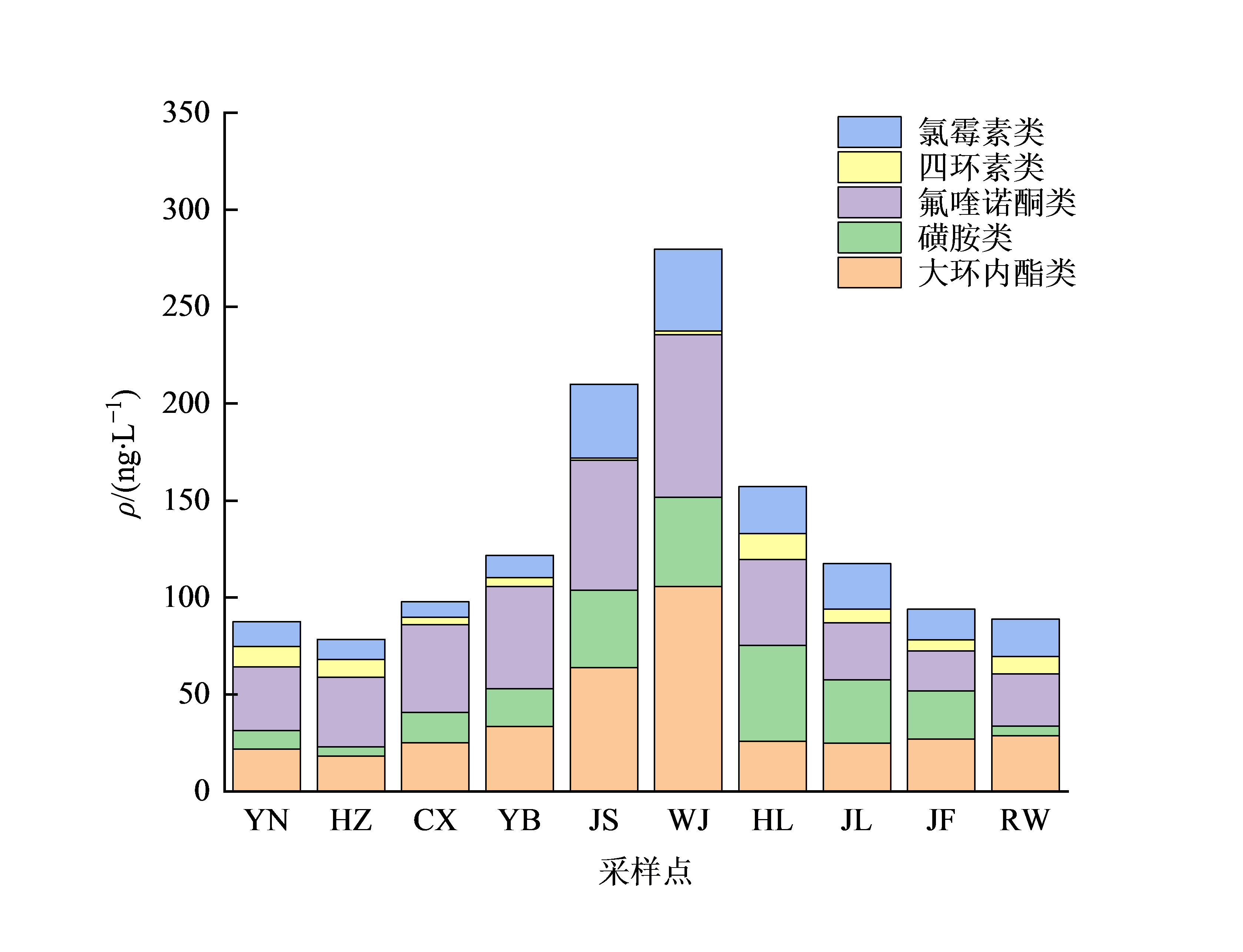
图2 抗生素的时空分布图
Figure 2 The temporal and spatial distribution of antibiotics
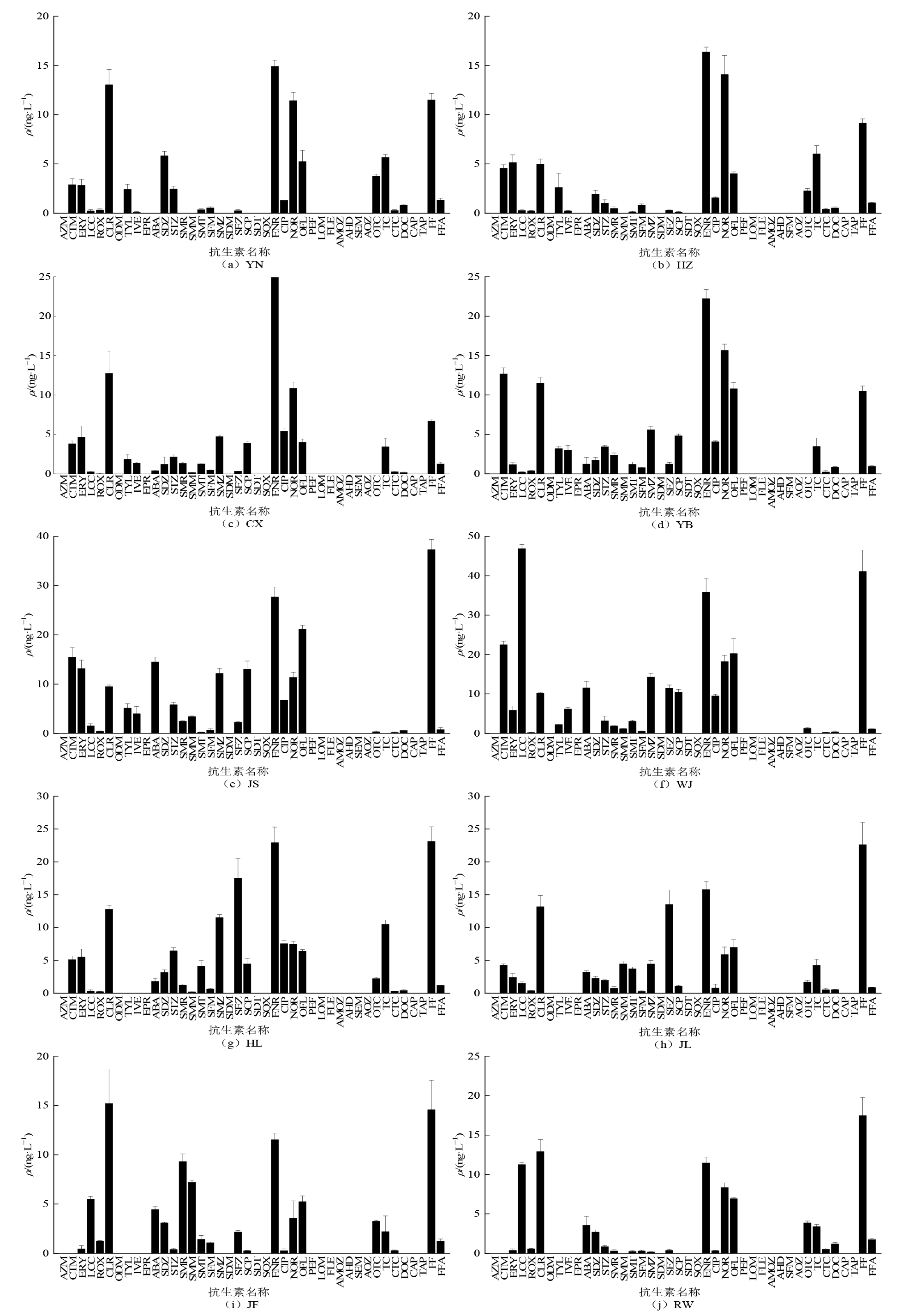
图3 各采样点抗生素种类及浓度
Figure 3 Types and Concentrations of antibiotics in each sampling site
| 抗生素 | Cp/(ng∙L−1) | 抗生素 | Cp/(ng∙L−1) | 抗生素 | Cp/(ng∙L−1) |
|---|---|---|---|---|---|
| CTM | 2 | STZ | 16330 | CIP | 17 |
| ERY | 20 | SMR | 1740 | NOR | 103.8 |
| LCC | 680 | SMM | 10000 | OFL | 11.3 |
| ROX | 47 | SMT | - | OTC | 170 |
| CLR | 24940 | SFM | 1277 | TC | 90 |
| TYL | 3.4 | SMZ | 460 | CTC | 5 |
| IVE | 0.48 | SEZ | - | DOC | 300 |
| ABA | 1.43 | SCP | 26400 | FF | 1900 |
| SDZ | 1226 | ENR | 28.8 | FFA | - |
表6 目标抗生素的预测无效应浓度值(Cp)
Table 6 Predicted no effect concentrations of target antibiotics
| 抗生素 | Cp/(ng∙L−1) | 抗生素 | Cp/(ng∙L−1) | 抗生素 | Cp/(ng∙L−1) |
|---|---|---|---|---|---|
| CTM | 2 | STZ | 16330 | CIP | 17 |
| ERY | 20 | SMR | 1740 | NOR | 103.8 |
| LCC | 680 | SMM | 10000 | OFL | 11.3 |
| ROX | 47 | SMT | - | OTC | 170 |
| CLR | 24940 | SFM | 1277 | TC | 90 |
| TYL | 3.4 | SMZ | 460 | CTC | 5 |
| IVE | 0.48 | SEZ | - | DOC | 300 |
| ABA | 1.43 | SCP | 26400 | FF | 1900 |
| SDZ | 1226 | ENR | 28.8 | FFA | - |
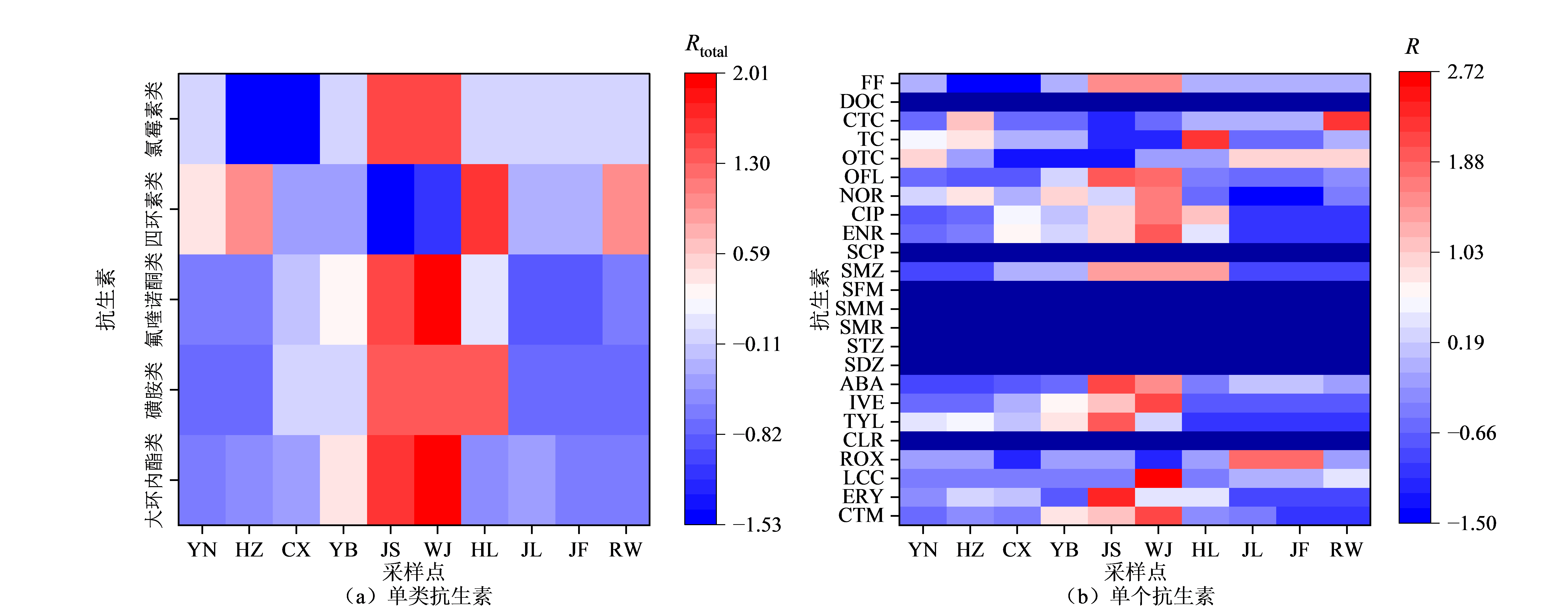
图4 抗生素生态风险评价
Figure 4 Ecological risk assessment of antibiotics

图5 抗生素污染与环境因子的Pearson相关性分析
Figure 5 Pearson correlation analysis between antibiotics and environmental factors
| [1] |
AHMAD A, KURNIAWAN S B, ABDULLAH S R S, et al., 2022. Contaminants of emerging concern (CECs) in aquaculture effluent: Insight into breeding and rearing activities, alarming impacts, regulations, performance of wastewater treatment unit and future approaches[J]. Chemosphere, 290: 133319.
DOI URL |
| [2] |
BBOSA G S, MWEBAZA N, ODDA J, et al., 2014. Antibiotics/antibacterial drug use, their marketing and promotion during the post-antibiotic golden age and their role in emergence of bacterial resistance[J]. Health, 6(5): 410-425.
DOI URL |
| [3] |
CHEN J F, CHEN X L, ZHU Y, et al., 2024. New insights into bioaugmented removal of sulfamethoxazole in sediment microcosms: degradation efficiency, ecological risk and microbial mechanisms[J]. Microbiome, 12(43): 1-16.
DOI |
| [4] |
CHEN J M, SUN R X, PAN C G, et al., 2020. Antibiotics and food safety in aquaculture[J]. Journal of Agricultural and Food Chemistry, 68(43): 11908-11919.
DOI URL |
| [5] | CHENG J X, JIANG L, SUN T Q, et al., 2019. Occurrence, seasonal variation and risk assessment of antibiotics in the surface water of north China[J]. Archives of Eniviromental Contamination and Toxicology, 77(1): 88-97. |
| [6] |
DELGADO N, OROZCO J, ZAMBRONA S, et al., 2023. Veterinary pharmaceutical as emerging contaminants in wastewater and surface water: An overview[J]. Journal of Hazard Mater, 460: 132431.
DOI URL |
| [7] |
GUO X Y, CHEN H B, TONG Y Q, et al., 2024. A review on the antibiotic florfenicol: Occurrence, environmental fate, effects, and health risks[J]. Environmental Research, 244: 117934.
DOI URL |
| [8] |
GUO Z F, BOEING W J, XU Y Y, et al., 2023. A systematic workflow of data mining confirms widespread occurrence of antibiotic contamination in freshwater reservoirs[J]. Exposure and Health, 15: 889-901.
DOI |
| [9] |
HUANG D, LIU J Y, ZHANG J H, et al., 2024. Enhanced removal of florfenicol by distributing nanoscale zerovalent iron onto activated carbon: Mechanism and toxicity evaluation[J]. Chemical Engineering Journal, 479: 147938.
DOI URL |
| [10] |
HUANG L L, MO Y M, WU Z Q, et al., 2020. Occurrence, distribution, and health risk assessment of quinolone antibiotics in water, sediment, and fish species of Qingshitan reservoir, South China[J]. Scientific Reports, 10: 15777.
DOI PMID |
| [11] |
KOVALAKOVA P, CIZMAS L, MCDONALD T J, et al., 2020. Occurrence and toxicity of antibiotics in the aquatic environment: A review[J]. Chemosphere, 251: 126351.
DOI URL |
| [12] |
LEI K, ZHU Y, CHEN W, et al., 2019. Spatial and seasonal variations of antibiotics in river waters in the Haihe River catchment in China and ecotoxicological risk assessment[J]. Environment International, 130: 104919.
DOI URL |
| [13] |
LEI L S, YU J, LIU L Q, et al., 2025. Unveiling soil-borne antibiotic resistome and their associated risks: A comparative study of antibiotic and non-antibiotic pharmaceutical factories[J]. Journal of Hazardous Materials, 486: 137127.
DOI URL |
| [14] |
LI Z, LI M, ZHANG Z Y, et al., 2020. Antibiotics in aquatic environments of China: A review and meta-analysis[J]. Ecotoxicology and Environmental Safety, 199: 110668.
DOI URL |
| [15] |
LIU L, WANG L F, PANG K, et al., 2025. Source orientation, environmental fate, and risks of antibiotics in the surface water of the largest sediment-laden river[J]. Environmental Pollution, 375: 126363.
DOI URL |
| [16] |
LIU X, STEELE J C, MENG X Z, 2017. Usage, residue, and human health risk of antibiotics in Chinese aquaculture: A review[J]. Environment Pollution, 223: 161-169.
DOI URL |
| [17] |
LIU Y, ZHANG M, WU Y, et al., 2024. Profiles, drivers, and prioritization of antibiotics in China’s major rivers[J]. Journal of Hazardous Materials, 477: 135399.
DOI URL |
| [18] |
LU S, LIN C Y, LEI K, et al., 2020. Occurrence, spatiotemporal variation, and ecological risk of antibiotics in the water of the semi-enclosed urbanized Jiaozhou Bay in eastern China[J]. Water Research, 184: 116187.
DOI URL |
| [19] |
MU Y, TANG B B, CHENG X, et al., 2024. Source apportionment and predictable driving factors contribute to antibiotics profiles in Changshou Lake of the Three Gorges Reservoir area, China[J]. Journal of Hazardous Materials, 466: 133522.
DOI URL |
| [20] |
O’MALLEY K, MCNAMARA P, MARSHALL C, et al., 2024. Environmental drivers impact the accumulation and diversity of antibiotic resistance in green stormwater infrastructure[J]. Journal of Hazardous Materials, 469: 133923.
DOI URL |
| [21] |
SCHAR D, ZHAO C, WANG Y, et al., 2021. Twenty-year trends in antimicrobial resistance from aquaculture and fisheries in Asia[J]. Nature Communication, 12: 5384.
DOI |
| [22] |
SHAO G J, PAN X D, HAN J L, et al., 2024. Antibiotic residues in commercial freshwater fish from southeast China: Distribution and human health risk assessment[J]. Environmental Science and Pollution Research, 31: 23780-23789.
DOI |
| [23] |
TONG L, QIN L T, GUAN C, et al., 2020. Antibiotic resistance gene profiling in response to antibiotic usage and environmental factors in the surface water and groundwater of Honghu Lake, China[J]. Environmental Science and Pollution Research, 27(25): 31995-32005.
DOI |
| [24] |
WANG C, LIU X H, YANG Y Y, et al., 2021. Antibiotic and antibiotic resistance genes in freshwater aquaculture ponds in China: A meta-analysis and assessment[J]. Journal of Cleaner Production, 329: 129719.
DOI URL |
| [25] | WANG C, ZHAO Y P, LIU S, et al., 2021. Contamination, distribution, and risk assessment of antibiotics in the urban surface water of the Pearl River in Guangzhou, South China[J]. Environmental Monitoring and Assessment, 193(2): 113365. |
| [26] |
WANG X H, HU M H, GU H X, et al., 2020. Short-term exposure to norfloxacin induces oxidative stress, neurotoxicity and microbiota alteration in juvenile large yellow croaker Pseudosciaena crocea[J]. Environmental Pollution, 267: 115397.
DOI URL |
| [27] |
YANG Q L, GAO Y, KE J, et al., 2021. Antibiotics: An overview on the environmental occurrence, toxicity, degradation, and removal methods[J]. Bioengineered, 12(1): 7376-7416.
DOI PMID |
| [28] |
YI K X, WANG D B, YANG Q, et al., 2017. Effect of ciprofloxacin on biological nitrogen and phosphorus removal from wastewater[J]. Science of the Total Environment, 605-606: 368-375.
DOI URL |
| [29] |
ZHANG G D, LU S Y, WANG Y Q, et al., 2020. Occurrence of antibiotics and antibiotic resistance genes and their correlations in lower Yangtze River, China[J]. Environmental Pollution, 257: 113365.
DOI URL |
| [30] |
ZHANG J C, ZHANG X R, ZHOU Y, et al., 2023a. Occurrence, distribution and risk assessment of antibiotics at various aquaculture stages in typical aquaculture areas surrounding the Yellow Sea[J]. Journal of Environmental Sciences, 126(4): 621-632.
DOI URL |
| [31] |
ZHANG R J, ZHANG G, ZHENG Q, et al., 2012. Occurrence and risks of antibiotics in the Laizhou Bay, China: Impacts of river discharge[J]. Ecotoxicology and Environmental Safety, 80: 208-215.
DOI PMID |
| [32] |
ZHANG Y R, LIU L, LIU Y L, et al., 2024. Deciphering the natural and anthropogenic drivers on the fate and risk of antibiotics and antibiotic resistance genes (ARGs) in a typical river-estuary system, China[J]. Journal of Hazardous Materials, 480: 136006.
DOI URL |
| [33] |
ZHANG Y X, CHEN H Y, JING L J, et al., 2023b. Ecotoxicological risk assessment and source apportionment of antibiotics in the waters and sediments of a peri-urban river[J]. Science of the Total Environment, 731: 139128.
DOI URL |
| [34] |
ZHAO J, HAN Y Z, LIU J Z, et al., 2024. Occurrence, distribution and potential environmental risks of pollutants in aquaculture ponds during pond cleaning in Taihu Lake Basin, China[J]. Science of the Total Environment, 939: 173610.
DOI URL |
| [35] |
ZHENG D S, YIN G Y, LIU M, et al., 2021. A systematic review of antibiotics and antibiotic resistance genes in estuarine and coastal environments[J]. Science of The Total Environment, 777: 146009.
DOI URL |
| [36] |
ZHOU L J, LI J, ZHANG Y D, et al., 2019. Trends in the occurrence and risk assessment of antibiotics in shallow lakes in the lower-middle reaches of the Yangtze River basin, China[J]. Ecotoxicology and Environmental Safety, 183: 109511.
DOI URL |
| [37] |
ZHOU L J, WANG W X, LÜ Y J, et al., 2020. Tissue concentrations, trophic transfer and human risks of antibiotics in freshwater food web in Lake Taihu, China[J]. Ecotoxicology and Environmental Safety, 197: 110626.
DOI URL |
| [38] |
ZHOU L J, YING G G, LIU S, et al., 2013. Occurrence and fate of eleven classes of antibiotics in two typical sewage treatment plants in South China[J]. Science of The Total Environment, 452-453: 365-376.
DOI URL |
| [39] |
ZHU T T, SU Z X, LAI W X, et al., 2021. Insights into the fate and removal of antibiotics and antibiotic resistance genes using biological wastewater treatment technology[J]. Science of The Total Environment, 776: 145906.
DOI URL |
| [40] |
ZOU S C, XU W H, ZHANG R J, et al., 2011. Occurrence and distribution of antibiotics in coastal water of the Bohai Bay, China: Impacts of river discharge and aquaculture activities[J]. Environmental Pollution, 159(10): 2913-2920.
DOI PMID |
| [41] | 董晓, 2017. 渔业养殖环境中抗生素残留检测及消除技术[D]. 上海: 上海海洋大学: 24-28. |
| DONG X, 2017. Residual of antibiotics in aquaculture environment and its elimination technology[D]. Shanghai: Shanghai Ocean University: 24-28. | |
| [42] | 方昊, 余军楠, 王智峰, 等, 2019. 江苏典型中华绒螯蟹养殖区抗生素污染特征与生态风险评估[J]. 生态与农村环境学报, 35(11): 1436-1444. |
| FANG H, YU J N, WANG Z F, et al., 2019. Contamination characteristics and ecological risk assessment of antibiotics in typical Eriocheir sinensis aquaculture environments of Jiangsu Province[J]. Journal of Ecology and Rural Environment, 35(11): 1436-1444. | |
| [43] | 户江涛, 宗虎民, 王菊英, 等, 2007. 环境因子对氟苯尼考在海洋沉积物中降解的影响[J]. 中国环境科学, 27(6): 748-751. |
| HU J T, ZONG H M, WANG J Y, et al., 2007. The effect of environmental factors on the degradation of florfenicol in marine sediment[J]. China Environmental Science, 27(6): 748-751. | |
| [44] | 江苏省市场监督管理局, 2024. 水产养殖场投入品管理规范:DB32/T4813—2024[S]. 北京: 中国标准出版社: 2. |
| Jiangsu Administration for Market Regulation, 2024. Managementspecificationformaterialsinaquaculturefarms:DB32/T4813—2024[S]. Beijing: Standards Press of China: 2. | |
| [45] | 江苏省生态环境厅, 江苏省市场监督管理局, 2021. 池塘养殖尾水排放标准:DB32/4034—2021[S]. 北京: 中国标准出版社: 2-3. |
| Department of Ecology and Environment of Jiangsu Province, Jiangsu Administration for Market Regulation, 2021. Discharge standard of water from aquaculture ponds: DB 32/4034—2021[S]. Beijing: Standards Press of China: 2-3. | |
| [46] | 李佳乐, 王瑶, 董一慧, 等, 2022. 鄱阳湖流域袁河水体典型抗生素分布特征及生态风险评价[J]. 生态毒理学报, 17(4): 563-574. |
| LI J L, WANG Y, DONG Y H, et al., 2022. Distribution characteristics and ecological risk assessment of typical antibiotics in Yuanhe River of Poyang Lake Basin[J]. Asian Journal of Ecotoxicology, 17(4): 563-574. | |
| [47] | 李清雪, 董天羽, 孙王茹, 等, 2022. 典型北方城市河流中抗生素污染特征及风险评价[J]. 生态毒理学报, 17(4): 213-229. |
| LI Q X, DONG T Y, SUN W R, et al., 2022. Pollution characteristics and risk assessment of antibiotics in typical northern urban rivers[J]. Asian Journal of Ecotoxicology, 17(4): 213-229. | |
| [48] | 李贞金, 2020. 水产养殖典型抗生素的残留水平与分布特征研究[D]. 上海: 华东理工大学: 15-18. |
| LI Z J, 2020. Residual levels and distribution characteristics of typical antibiotics in aquaculture[D]. Shanghai: East China University of Science and Technology: 15-18. | |
| [49] | 李贞金, 张洪昌, 沈根祥, 等, 2020. 水产养殖水、沉积物中抗生素检测方法优化及残留特征研究[J]. 生态毒理学报, 15(1): 209-219. |
| LI Z J, ZHANG H C, SHEN G X, et al., 2020. Optimization of antibiotic detection methods and residual characteristics in aquaculture water and sediment[J]. Asian Journal of Ecotoxicology, 15(1): 209-219. | |
| [50] | 林靖钧, 李瑞雪, 林华, 等, 2022. 我国水产养殖水体中抗生素的污染特征[J]. 净水技术, 41(3): 12-19. |
| LIN J J, LI R X, LIN H, et al., 2022. Pollution characteristics of antibiotics in aquaculture water at home[J]. Water Purification Technology, 41(3): 12-19. | |
| [51] | 刘崇万, 朱晓华, 徐志华, 等, 2022. 江苏典型稻虾及稻蟹共作系统中除草剂残留非靶向动态筛查及污染特征[J]. 生态与农村环境学报, 38(7): 933-943. |
| LIU C W, ZHU X H, XU Z H, et al., 2022. Dynamic non-target analysis and occurrence of herbicides residues in rice-crab co-culture systems in Jiangsu province[J]. Journal of Ecology and Rural Environment, 38(7): 933-943. | |
| [52] | 刘元望, 李兆君, 冯瑶, 等, 2016. 微生物降解抗生素的研究进展[J]. 农业环境科学学报, 35(2): 212-224. |
| LIU Y W, LI Z J, FENG Y, et al., 2016. Research progress in microbial degradation of antibiotics[J]. Journal of Agro-Environment Science, 35(2): 212-224. | |
| [53] | 罗红, 陈倩, 刘乐丹, 等, 2023. 江苏省淡水鱼养殖规模大户2022年养殖、经营现状调研[J]. 科学养鱼, 39(2): 7-10. |
| LUO H, CHEN Q, LIU L D, et al., 2023. Research on the current situation of large-scale freshwater fish farming and operation in Jiangsu Province in 2022[J]. Scientific Fish Farming, 39(2): 7-10. | |
| [54] | 马小莹, 郑浩, 汪庆庆, 等, 2020. 江苏省不同水源抗生素污染及生态风险评估[J]. 环境卫生学杂志, 10(2): 131-137. |
| MA X Y, ZHENG H, WANG Q Q, et al., 2020. Current status of antibiotic contamination and its ecological risk evaluation in different water bodies of Jiangsu province[J]. Journal of Environmental Hygiene, 10(2): 131-137. | |
| [55] |
孟勇, 王静, 朱晓华, 等, 2020. 基于三重四极杆复合线性离子阱质谱法筛查和确证水产品中多种抗生素残留[J]. 食品科学, 41(4): 313-318.
DOI |
|
MENG Y, WANG J, ZHU X H, et al., 2020. Screening and confirmation of multiple antibiotic residues in aquatic products by triple quadrupole-linear ion trap mass spectrometry[J]. Food Science, 41(4): 313-318.
DOI |
|
| [56] | 农业农村部渔业渔政管理局, 全国水产技术推广总站, 中国水产学会, 2024. 中国渔业统计年鉴[M]. 北京: 中国农业出版社: 30-33, 56. |
| Ministry of Agriculture and Rural Affairs of the People’s Republic of China, National Fisheries Technology Extension Center, China Society of Fisheries, 2024. China Fishery Statistical Yearbook[M]. Beijing: China Agriculture Press: 30-33, 56. | |
| [57] | 王龙飞, 程逸群, 胡晓东, 等, 2021. 江苏省代表性水源地抗生素及抗性基因赋存现状[J]. 环境科学, 42(2): 749-760. |
| WANG L F, CHENG Y Q, HU X D, et al., 2021. Occurrence of antibiotics and antibiotic resistance genes in representative drinking water in Jiangsu Province[J]. Environmental Science, 42(2): 749-760. | |
| [58] | 徐秋鸿, 刘曙光, 娄厦, 等, 2023. 长江口近岸地区抗生素抗性基因与微生物群落分布特征[J]. 环境科学, 44(1): 158-168. |
| XU Q H, LIU S G, LOU X, et al., 2023. Distributions of antibiotic resistance genes and microbial communities in the nearshore area of the Yangtze River estuary[J]. Environmental Science, 44(1): 158-168. | |
| [59] | 徐志华, 孟勇, 杨洪生, 等, 2021. 江苏典型养殖区斑点叉尾鮰中多种药物的残留与膳食暴露评估[J]. 中国渔业质量与标准, 11(5): 1-8. |
| XU Z H, MENG Y, YANG H S, et al., 2021. Residues and dietary exposure assessment of multiple drugs in Ictalurus punctatus in typical aquaculture areas of Jiangsu[J]. Chinese Fishery Quality and Standards, 11(5): 1-8. | |
| [60] | 徐志华, 朱晓华, 葛筱琴, 等, 2019. 高邮养殖区罗氏沼虾中多环芳烃的残留现状与健康风险评价[J]. 食品安全质量检测学报, 10(19): 6718-6723. |
| XU Z H, ZHU X H, GE X Q, et al., 2019. Determination and health risk assessment of polycyclic aromatic hydrocarbons residues in Macrobrachium rosenbergii in major aquaculture areas of Gaoyou city[J]. Journal of Food Safety & Quality, 10(19): 6718-6723. | |
| [61] | 闫如玉, 2019. 上海市养殖场抗生素及其他药物的赋存特征与风险评估[D]. 上海: 华东师范大学. |
| YAN R Y, 2019. Occurrence characteristics and risk assessment of antibiotics and other drugs in Shanghai livestock farms[D]. Shanghai: East China Normal University. | |
| [62] |
杨俊, 王汉欣, 吴韵斐, 等, 2019. 苏州市水环境中典型抗生素污染特征及生态风险评估[J]. 生态环境学报, 28(2): 359-368.
DOI |
| YANG J, WANG H X, WU Y F, et al., 2019. Occurrence, distribution and risk assessment of typical antibiotics in the aquatic environment of Suzhou city[J]. Ecology and Environmental Sciences, 28(2): 359-368. | |
| [63] | 杨妍, 王子宇, 葛林科, 等, 2024. 我国水体中大环内酯类抗生素的分布特征及环境光化学行为[J]. 环境化学, 43(3): 734-750. |
| YANG Y, WANG Z Y, GE L K, et al., 2024. Occurrence and photochemical behavior of macrolide antibiotics in the aquatic environment of China[J]. Environmental Chemistry, 43(3): 734-750. | |
| [64] | 余军楠, 方昊, 胡建林, 等, 2020. 江苏四个典型克氏原螯虾养殖区抗生素污染特征与生态风险评估[J]. 农业环境科学学报, 39(2): 386-393. |
| YU J N, FANG H, HU J L, et al., 2020. Contamination characteristics and ecological risk assessment of antibiotics in four typical Procambarus clarkii aquaculture environments in Jiangsu Province, China[J]. Journal of Agro-Environment Science, 39(2): 386-393. | |
| [65] | 岳琛, 欧欢, 张雪婷, 等, 2023. 垂直潜流人工湿地对水产养殖尾水中抗生素和氮磷的去除及其影响因素[J]. 环境工程学报, 17(4): 1243-1251. |
| YUE C, OU H, ZHANG X T, et al., 2023. Analysis of influence factors on antibiotics and nutrients removal from aquaculture Wastewater by vertical flow constructed wetlands[J]. Chinese Journal of Environmental Engineering, 17(4): 1243-1251. | |
| [66] | 赵思雅, 申珊齐, 李爱民, 2024. 太湖抗生素、抗性基因的时空分布特征及生态风险评估[J]. 生态毒理学报, 19(3): 192-207. |
| ZHAO S Y, SHEN S Q, LI A M, 2024. Characteristics of spatial and temporal distribution of antibiotics and resistance genes and ecological risk assessment in Lake Taihu[J]. Asian Journal of Ecotoxicology, 19(3): 192-207. | |
| [67] | 卓丽, 王美欢, 石运刚, 等, 2019. 南方典型水源地及水产养殖区抗生素的复合污染特征及生态风险[J]. 生态毒理学报, 14(2): 164-175. |
| ZHUO L, WANG M H, SHI Y G, et al., 2019. Occurrence, distribution, and ecological risk of antibiotics in surface water of typical drinking water sources and aquaculture in South China[J]. Asian Journal of Ecotoxicology, 14(2): 164-175. | |
| [68] | 中华人民共和国国家质量监督检验检疫总局, 中国国家标准化管理委员会, 2013. 良好农业规范第13部分:水产养殖基础控制点与符合性规范:GB/T20014.13—2013[S]. 北京: 中国农业科学技术出版社: 2-18. |
| General Administration of Quality Supervision, Inspection and Quarantine of the People’s Republic of China, National Standardization Administration, 2013. Goodagriculturalpractice—part13:Aquaculturebasecontrolpointsandcompliancecriteria:GB/T20014.13—2013[S]. Beijing: China Agricultural Science and Technology Press: 2-18. | |
| [69] | 中华人民共和国环境保护部, 2013. 水质磷酸盐和总磷的测定连续流动-钼酸铵分光光度法:HJ670—2013[S]. 北京: 中国环境出版社: 1-8. |
| Ministry of Environmental Protection Standards of the People’s Republic of China, 2013. Water quality—determination of orthophosphate and total phosphorus—continuous flow analysis (CFA) and Ammonium molybdate spectrophotometry: HJ 670—2013[S]. Beijing: China Environmental Press: 1-8. | |
| [70] | 中华人民共和国环境保护部, 2012. 水质总氮的测定碱性过硫酸钾消解紫外分光光度法:HJ636—2012[S]. 北京: 中国环境出版社: 1-8. |
| Ministry of Environmental Protection Standards of the People’s Republic of China, 2012. Water quality—determination of total nitrogen—alkaline potassium persulfate digestion UV spectrophotometric method: HJ 636—2012[S]. Beijing: China Environmental Press: 1-8. | |
| [71] | 中华人民共和国环境保护部, 2010. 水质氨氮的测定纳氏试剂分光光度法:HJ535—2009[S]. 北京: 中国环境出版社: 1-6. |
| Ministry of Environmental Protection Standards of the People’s Republic of China, 2010. Water quality—determination of ammonia nitrogen—Nessler’s reagent spectrophotometry: HJ 535—2009[S]. Beijing: China Environmental Press: 1-6. | |
| [72] | 中华人民共和国环境保护部, 2009. 水质总有机碳的测定燃烧氧化-非分散红外吸收法:HJ501—2009[S]. 北京: 中国环境出版社: 1-5. |
| Ministry of Environmental Protection Standards of the People’s Republic of China, 2009. Water quality—determination of total organic carbon—combustion oxidation nondispersive infrared absorption method: HJ 501—2009[S]. Beijing: China Environmental Press: 1-5. | |
| [73] | 中华人民共和国环境保护部, 2009. 水质五日生化需氧量(BOD5)的测定稀释与接种法:HJ505—2009[S]. 北京: 中国环境出版社: 1-9. |
| Ministry of Environmental Protection Standards of the People’s Republic of China, 2009. Water quality—determination of biochemical oxygen demand after 5 days (BOD5) for dilution and seeding method: HJ 505—2009[S]. Beijing: China Environmental Press: 1-9. | |
| [74] | 中华人民共和国环境保护部, 1989. 水质高锰酸盐指数的测定:GB/T11892—1989[S]. 北京: 中国标准出版社: 1-4. |
| Ministry of Environmental Protection Standards of the People’s Republic of China, 1989. Water quality—determination of permanganate index: GB/T 11892—1989[S]. Beijing: Standards Press of China: 1-4. | |
| [75] | 中华人民共和国生态环境部, 2024. 水质硝酸盐氮的测定气相分子吸收光谱法:HJ198—2024[S]. 北京: 中国环境出版社: 1-8. |
| Ministry of Ecology and Environment of the People’s Republic of China, 2024. Water quality—determination of nitrate nitrogen—gas- phase molecular absorption spectrometry: HJ 198—2024[S]. Beijing: China Environmental Press: 1-8. | |
| [76] | 中华人民共和国生态环境部, 2024. 水质亚硝酸盐氮的测定气相分子吸收光谱法:HJ197—2024[S]. 北京: 中国环境出版社: 1-6. |
| Ministry of Ecology and Environment of the People’s Republic of China, 2024. Water quality—determination of nitrite nitrogen—gas-phase molecular absorption spectrometry: HJ 197—2024[S]. Beijing: China Environmental Press: 1-6. |
| [1] | 周浩然, 何涛, 彭恋, 钟志明, 钱宝. 长江流域重要水源地微塑料赋存特征及生态风险评估[J]. 生态环境学报, 2026, 35(3): 345-351. |
| [2] | 李家蔚, 黄凯, 李盛泽, 董路, 于相毅, 毛岩, 孟耀斌. SWAT-KM环境暴露模拟支持下的滇池流域邻苯二甲酸二辛酯生态风险研判[J]. 生态环境学报, 2026, 35(3): 362-377. |
| [3] | 杜方旎, 冯青靓, 原寒, 曹少飞. 模式鱼类生物标志物在放射生态学研究中的应用及前景[J]. 生态环境学报, 2025, 34(8): 1182-1191. |
| [4] | 周依湘, 唐斌, 付成忠, 许榕钦, 周东静, 王俊丽, 郑晶. 北江中下游水源地双酚类化合物和溴代阻燃剂的污染特征及风险评估[J]. 生态环境学报, 2025, 34(7): 1007-1019. |
| [5] | 田蜜, 廖日权, 张健, 董凤凤, 唐建辉. 钦州湾全氟/多氟烷基化合物的污染特征及生态风险评估[J]. 生态环境学报, 2025, 34(7): 1020-1028. |
| [6] | 肖咏茵, 王帆, 李灿桦, 汪超, 王万军. 淡水中可生物降解微塑料生物膜上耐药基因的富集特征及其健康风险[J]. 生态环境学报, 2025, 34(7): 1029-1041. |
| [7] | 蔡敏, 周丽, 张旭, 崔娜欣, 庞思, 邹国燕, 袁泉, 黄伟伟, 赵志勇. 植物提取液对养殖水体浮游植物群落结构和功能的影响[J]. 生态环境学报, 2025, 34(7): 1090-1099. |
| [8] | 郭欣达, 付奔, 余思洁, 侯鹰, 陈卫平. 城市内涝和夏季高温风险评价与优先管控区识别方法研究[J]. 生态环境学报, 2025, 34(5): 731-742. |
| [9] | 陈思宇, 孙丽娟, 苏枞枞, 于兴娜. 太原市春夏季VOCs组成特征及其对二次有机气溶胶和臭氧的贡献[J]. 生态环境学报, 2025, 34(4): 548-555. |
| [10] | 张亚平, 莫璀玲, 李迎鹏, 徐棵. 左氧氟沙星暴露对斑马鱼肠道微生物的影响[J]. 生态环境学报, 2025, 34(4): 593-607. |
| [11] | 梅耀萍, 吴本丽, 黄龙, 吴仓仓, 陈静, 陈夏君, 何吉祥. 不同水生植物对水产养殖尾水氮磷去除效果研究[J]. 生态环境学报, 2025, 34(3): 442-450. |
| [12] | 张艳, 张少娟, 吕韬, 贺慧汀. 黄河流域(内蒙古段)景观生态风险与生境质量的耦合协同关系研究[J]. 生态环境学报, 2025, 34(12): 1841-1852. |
| [13] | 赵彧, 方王凯, 张紫薇, 张焕军, 李轶. 太湖水体中非甾体消炎药的赋存特征及其对细菌群落和抗生素抗性基因的影响[J]. 生态环境学报, 2025, 34(10): 1495-1506. |
| [14] | 李彦林, 陈杨洋, 杨霜溶, 刘菊梅. 植物根系分泌的有机酸对土壤碳氮矿化的影响[J]. 生态环境学报, 2024, 33(9): 1362-1371. |
| [15] | 丛鑫, 张怀迪, 张荣, 赵琛, 陈坤, 刘寒冰. 基于Meta分析的近10年中国农田土壤重金属污染特征与风险解析[J]. 生态环境学报, 2024, 33(9): 1451-1459. |
| 阅读次数 | ||||||
|
全文 |
|
|||||
|
摘要 |
|
|||||
