
生态环境学报 ›› 2026, Vol. 35 ›› Issue (5): 738-747.DOI: 10.16258/j.cnki.1674-5906.2026.05.007
秦敬恒1,2( ), 陈兵3, 雷育锟4, 杨阳2, 陈国俊2, 刘同旭2, 胡世文2,*(), 王培1,*()
收稿日期:2025-09-28
修回日期:2026-01-19
接受日期:2026-01-20
出版日期:2026-05-18
发布日期:2026-05-08
通讯作者:
*E-mail: 作者简介:秦敬恒(1995年生),男,硕士研究生,研究方向为土壤铁矿物和有机碳耦合作用。E-mail: a18838981682@163.com
基金资助:
QIN Jingheng1,2(), CHEN Bing3, LEI Yukun4, YANG Yang2, CHEN Guojun2, LIU Tongxu2, HU Shiwen2,*(), WANG Pei1,*()
Received:2025-09-28
Revised:2026-01-19
Accepted:2026-01-20
Online:2026-05-18
Published:2026-05-08
摘要:
含磷铁矿物与铁还原菌之间的相互作用是影响稻田土壤铁和磷迁移性和生物有效性的关键过程,然而,关于含磷铁矿物与铁还原菌互作对稻田土壤中铁和磷的迁移转运机制尚不清楚。选取典型水稻土开展盆栽试验,设置磷酸铁和异化铁还原菌(Shewanella oneidensis MR-1)的添加实验:对照组(CK)、低水平磷酸铁添加(FeP1)、高水平磷酸铁添加(FeP2)、低水平磷酸铁+MR-1添加(FeP1+MR-1)和高水平磷酸铁+MR-1(FeP2+MR-1)添加。在水稻生育期内,测定土壤孔隙水和植株中铁磷质量分数及植株和籽粒单株生物量变化,以此探究添加磷酸铁与异化铁还原菌对土壤-水稻体系中铁和磷迁移与转运的影响。结果表明,在淹水末期,与CK相比,FeP1、FeP1+MR-1和FeP2+MR-1处理的盐酸提取态Fe(II)质量分数分别高25.0 %、45.7 %、23.6 %;在磷酸铁+MR-1添加组中,孔隙水Fe(II)与盐酸提取态Fe(II)质量分数高于CK以及只添加磷酸铁的处理,说明异化铁还原菌促进了磷酸铁的还原和铁的释放。成熟期时,根表铁膜中的Fe质量分数,FeP1、FeP2、FeP1+MR-1、FeP2+MR-1处理组分别比CK(69.3 g·kg−1)高出24.4%、17.8%、20.1%、28.9%;对于根表铁膜中的P质量分数,FeP1、FeP2、FeP1+MR-1、FeP2+MR-1处理分别比CK(3.95 g·kg−1)高出24.5%、31.2%、24.7%、36.4%。在磷酸铁+MR-1添加组中,根际磷的生物有效性和植株磷的积累显著提高,表现为根表铁膜、茎、叶和稻壳的磷质量分数增加。FeP1、FeP2、FeP1+MR-1和FeP2+MR-1 4个处理组的糙米单株生物量分别为20.2、21.1、21.6和22.4 g·plant−1,均显著高于CK(18.6 g·plant−1)。淹水-排水稻田中磷酸铁与铁还原菌在根际环境中的协同作用,可有效促进铁和磷在土壤-孔隙水-植株系统中的迁移和转运。
中图分类号:
秦敬恒, 陈兵, 雷育锟, 杨阳, 陈国俊, 刘同旭, 胡世文, 王培. 含磷铁矿物与铁还原菌互作对土壤-水稻体系铁和磷迁移与转运的影响机制[J]. 生态环境学报, 2026, 35(5): 738-747.
QIN Jingheng, CHEN Bing, LEI Yukun, YANG Yang, CHEN Guojun, LIU Tongxu, HU Shiwen, WANG Pei. Effects of the Interplay between Phosphorus-bearing Iron Minerals and Iron-Reducing Bacteria on Iron and Phosphorus Migration and Transportation in Soil-rice Systems[J]. Ecology and Environmental Sciences, 2026, 35(5): 738-747.
| 指标 | 测定值 |
|---|---|
| 土壤pH | 5.21 |
| 比表面积/(m2·g−1) | 9.33 |
| 阳离子交换量/(cmol·kg−1) | 12.5 |
| 有机碳质量分数/(g·kg−1) | 38.7 |
| 全铁质量分数/(g·kg−1) | 16.9 |
| 全锰质量分数/(g·kg−1) | 0.25 |
| 全磷质量分数/(g·kg−1) | 0.86 |
| 有效磷质量分数/(mg·kg−1) | 59.5 |
| 全钙质量分数/(g·kg−1) | 1.49 |
| 全镁质量分数/(g·kg−1) | 1.64 |
| 全氮质量分数/(g·kg−1) | 2.17 |
表1 供试土壤理化性质
Table 1 Physicochemical properties of the experimental soil
| 指标 | 测定值 |
|---|---|
| 土壤pH | 5.21 |
| 比表面积/(m2·g−1) | 9.33 |
| 阳离子交换量/(cmol·kg−1) | 12.5 |
| 有机碳质量分数/(g·kg−1) | 38.7 |
| 全铁质量分数/(g·kg−1) | 16.9 |
| 全锰质量分数/(g·kg−1) | 0.25 |
| 全磷质量分数/(g·kg−1) | 0.86 |
| 有效磷质量分数/(mg·kg−1) | 59.5 |
| 全钙质量分数/(g·kg−1) | 1.49 |
| 全镁质量分数/(g·kg−1) | 1.64 |
| 全氮质量分数/(g·kg−1) | 2.17 |
| 处理组名称 | 磷酸铁添加量 | S. oneidensis MR-1添加量 | 重复 |
|---|---|---|---|
| CK | 0 | 0 | 3 |
| FeP1 | 0.068 g·kg−1 | 0 | |
| FeP2 | 0.17 g·kg−1 | 0 | |
| FeP1+MR-1 | 0.068 g·kg−1 | 1×10⁷ cells·mL−1 | |
| FeP2+MR-1 | 0.17 g·kg−1 | 1×10⁷ cells·mL−1 |
表2 不同处理组设置
Table 2 Experimental treatments
| 处理组名称 | 磷酸铁添加量 | S. oneidensis MR-1添加量 | 重复 |
|---|---|---|---|
| CK | 0 | 0 | 3 |
| FeP1 | 0.068 g·kg−1 | 0 | |
| FeP2 | 0.17 g·kg−1 | 0 | |
| FeP1+MR-1 | 0.068 g·kg−1 | 1×10⁷ cells·mL−1 | |
| FeP2+MR-1 | 0.17 g·kg−1 | 1×10⁷ cells·mL−1 |
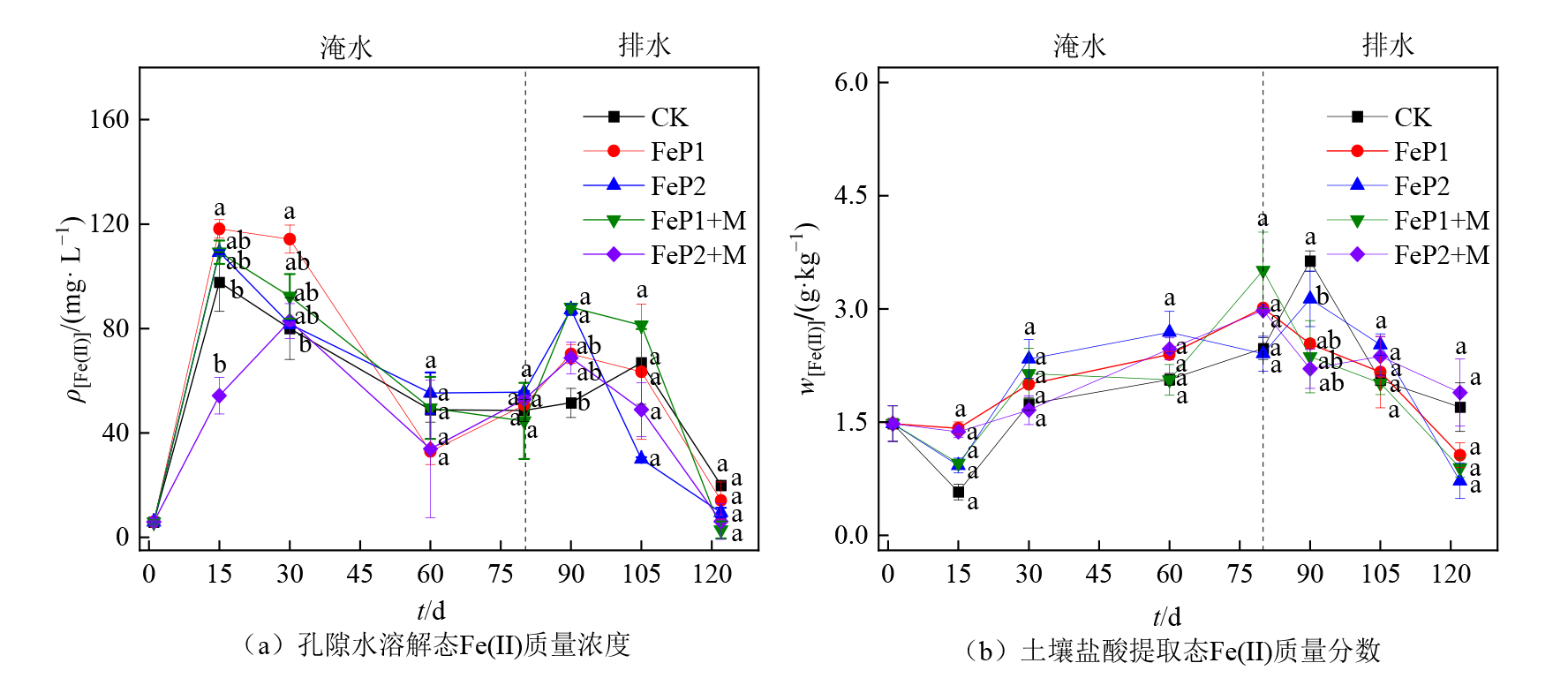
图1 水稻孔隙水Fe(II)质量浓度和盐酸提取态Fe(II)质量分数变化 样品量n=3;图内曲线上的不同小写字母表示各处理之间的显著差异性(p<0.05)。下同
Figure 1 Changes in concentration of Fe(II) in rice pore water and mass fraction of HCl-extractable Fe(II)
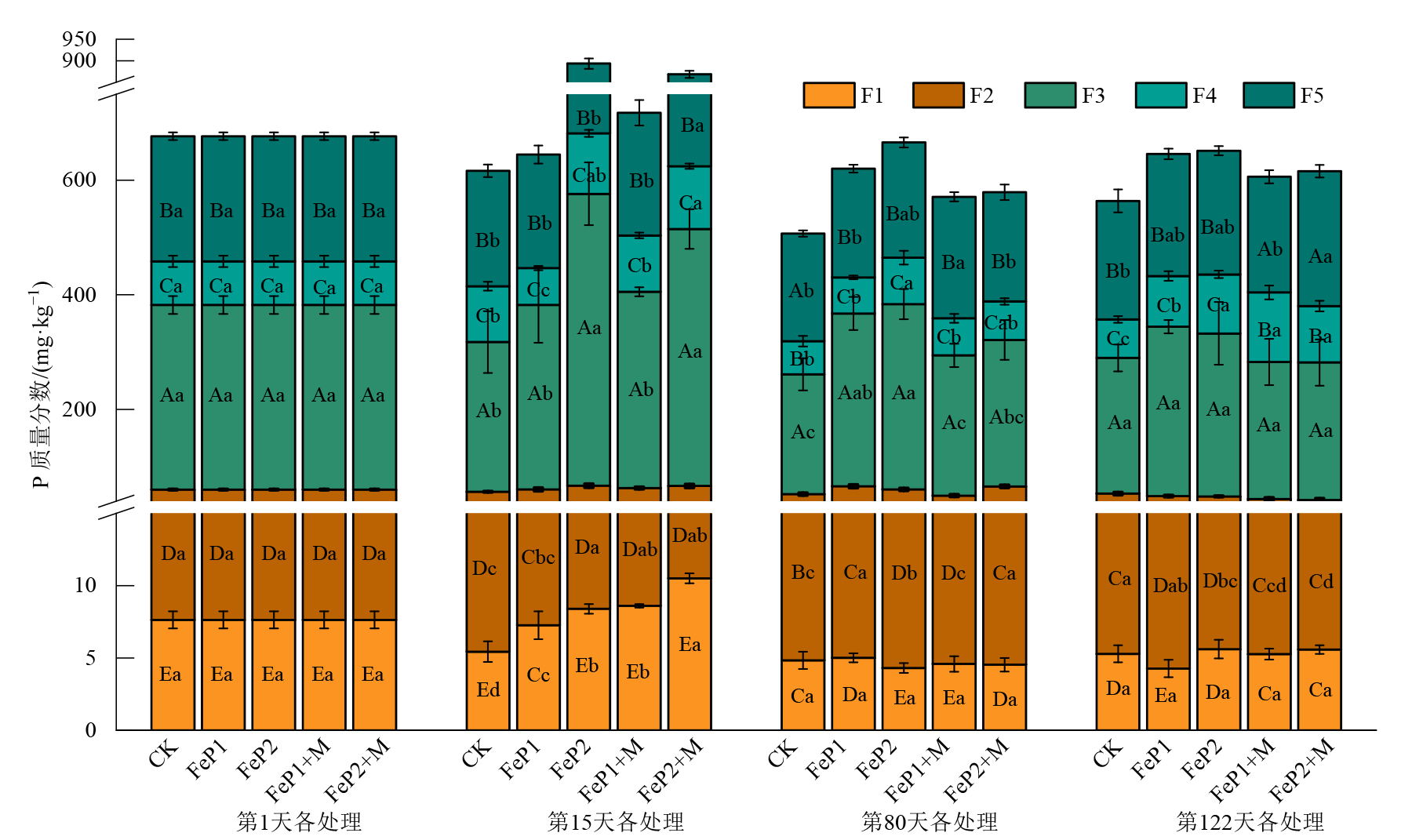
图2 水稻土壤第1、15、80和122天不同处理下P形态分级 样品量n=3;不同大写字母表示同一处理不同分级处理(p<0.05),不同小写字母表示相同分级处理不同处理(p<0.05)
Figure 2 Phosphorus fractions in paddy soil under different treatments at 1, 15, 80, and 122 d
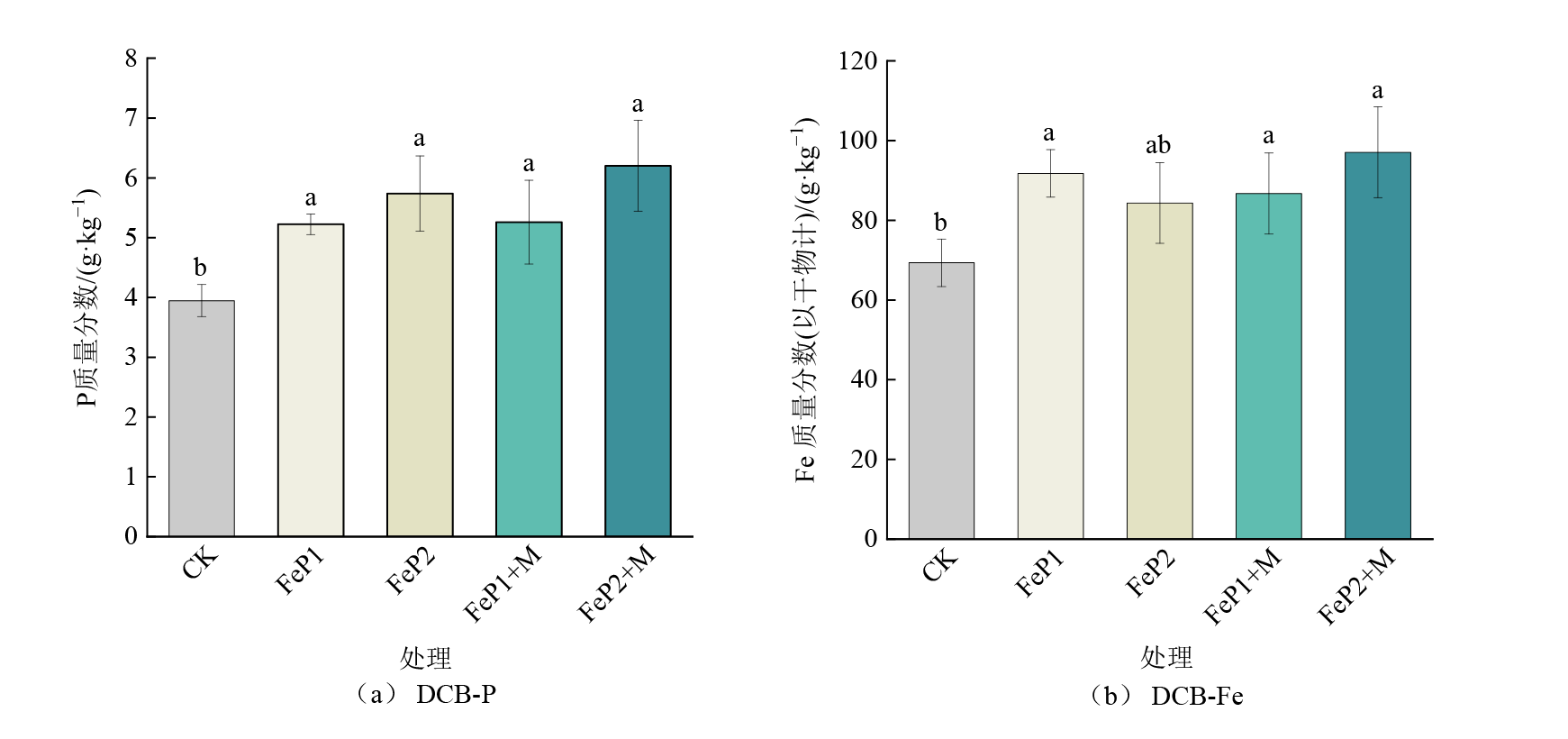
图3 水稻根表铁膜中DCB-P和DCB-Fe质量分数
Figure 3 Mass fractions of DCB-extractable phosphorus (DCB-P) and iron (DCB-Fe) in iron plaque on rice root surfaces
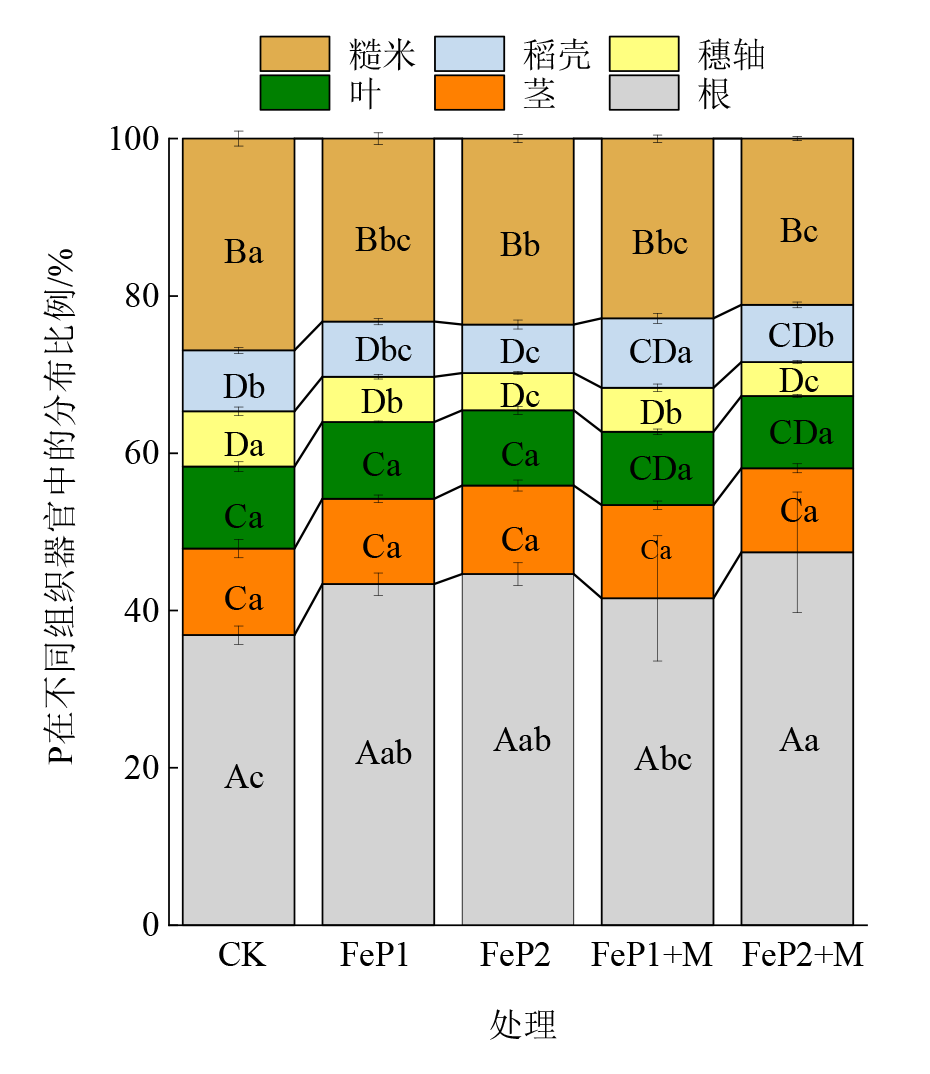
图4 水稻成熟期不同处理中各组织器官P分布比例 重复样品数n=3,不同大写字母表示同一处理不同组织部位(p<0.05),不同小写字母表示相同组织器官不同处理(p<0.05)
Figure 4 Distribution proportions of phosphorus among different rice organs at maturity under different treatments
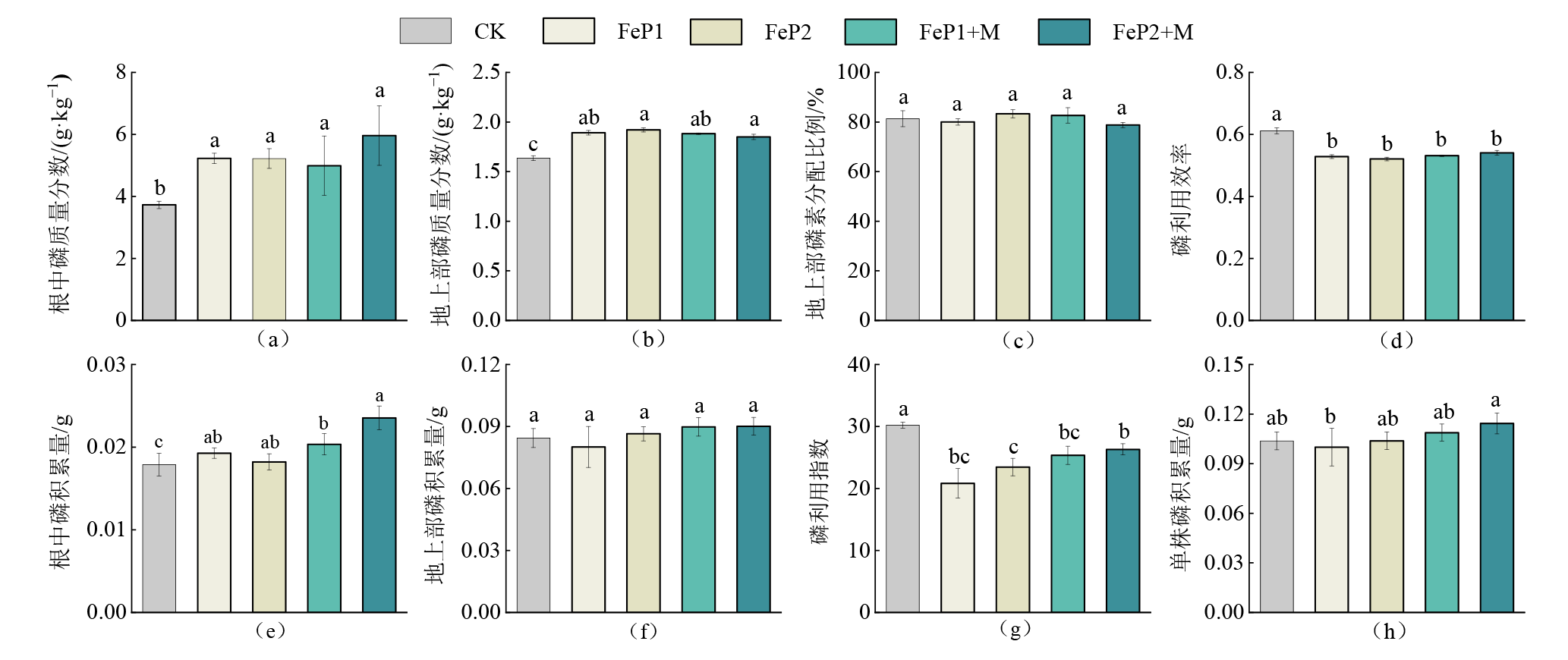
图5 水稻成熟期不同处理中根系与地上部的磷质量分数和磷吸收利用
Figure 5 Phosphorus content and uptake efficiency of rice roots and shoots at maturity in the different treatments
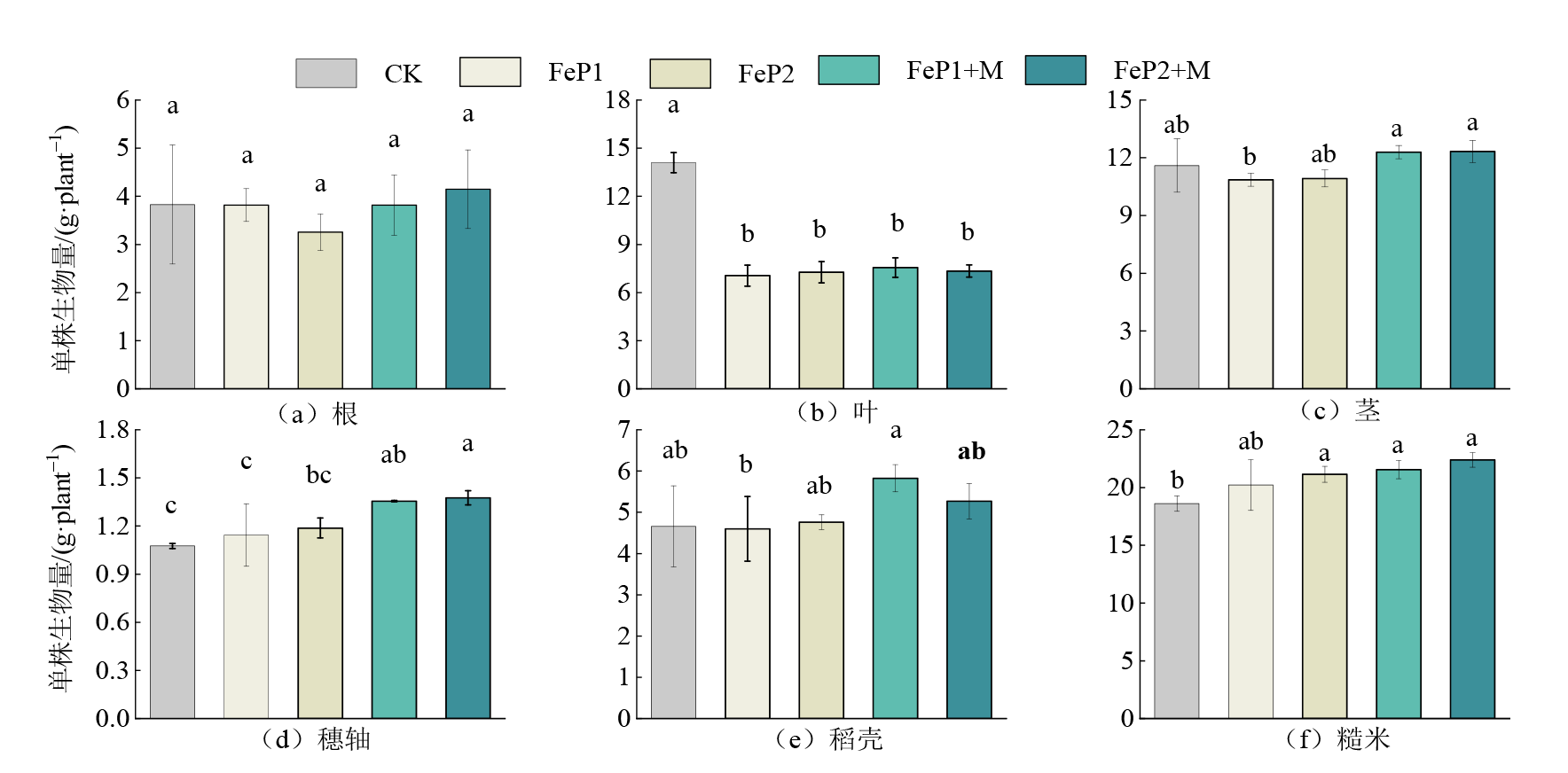
图6 水稻成熟期各组织器官单株生物量
Figure 6 Biomass of different rice organs at the maturity stage in the different treatments
| [1] |
CHEN Y T, LI X M, LIU T X, et al., 2022. Metagenomic analysis of Fe(II)-oxidizing bacteria for Fe(III) mineral formation and carbon assimilation under microoxic conditions in paddy soil[J]. Science of the Total Environment, 851(Part 1): 158068.
DOI URL |
| [2] |
DAKORA F D, PHILLIPS D A, 2002. Root exudates as mediators of mineral acquisition in low-nutrient environments[J]. Plant and Soil, 245(1): 35-47.
DOI |
| [3] |
DUBOC O, HERNANDEZ-MORA A, WENZEL W W, et al., 2022. Improving the prediction of fertilizer phosphorus availability to plants with simple, but non-standardized extraction techniques[J]. Science of the Total Environment, 806: 150486.
DOI URL |
| [4] |
GAO Z C, LIN Y L, XU B, et al., 2017. Degradation of acrylamide by the UV/chlorine advanced oxidation process[J]. Chemosphere, 187: 268-276.
DOI URL |
| [5] |
HEDLEY M J, STEWART J W B, CHAUHAN B S, 1982. Changes in inorganic and organic soil phosphorus fractions induced by cultivation practices and by laboratory incubations[J]. Soil Science Society of America Journal, 46(5): 970-976.
DOI URL |
| [6] |
HERON G, CROUZET C, BOURG A C M, et al., 1994. Speciation of Fe(II) and Fe(III) in contaminated aquifer sediments using chemical extraction techniques[J]. Environmental Science & Technology, 28(9): 1698-1705.
DOI URL |
| [7] |
JIANG F Y, CHEN X, LAO A C, 2009. Ion plaque formation on wetland plants and its influence on phosphorus, calcium and metal uptake[J]. Aquatic Ecology, 43(4): 879-890.
DOI URL |
| [8] |
KUPPE C W, KIRK G J D, WISSUWA M, et al., 2022. Rice increases phosphorus uptake in strongly sorbing soils by intra-root facilitation[J]. Plant, Cell & Environment, 45(3): 884-899.
DOI URL |
| [9] | LAN Z M, LIN X J, WANG F, et al., 2012. Phosphorus availability and rice grain yield in a paddy soil in response to long-term fertilization[J]. Plant and Soil, 355(1-2): 319-331. |
| [10] |
LIMMER M A, THOMAS J, SEYFFERTH A L, 2022. The effect of silicon on the kinetics of rice root iron plaque formation[J]. Plant and Soil, 477: 171-181.
DOI |
| [11] | LINAM F A, LIMMER M A, SEYFFERTH A L, 2024. Contrasting roles of rice root iron plaque in retention and plant uptake of silicon, phosphorus, arsenic, and selenium in diverse paddy soils[J]. Plant and Soil, 502: 397-415. |
| [12] |
LISA H, VILS T P, S H J, et al., 2010. A comparative study of phosphate sorption in lowland soils under oxic and anoxic conditions[J]. Journal of Environmental Quality, 39(2): 734-43.
DOI PMID |
| [13] |
LIST C, HOSSEINI Z, LEDERBALLE MEIBOM K, et al., 2019. Impact of iron reduction on the metabolism of Clostridium acetobutylicum[J]. Environmental Microbiology, 21(10): 3548-3563.
DOI URL |
| [14] |
LOVLEY D R, 1991. Dissimilatory Fe(III) and Mn(IV) reduction[J]. Microbiological Reviews, 55(2): 259-287.
DOI PMID |
| [15] | LU Y S, FENG W, LIU H, et al., 2022. Efficient phosphate recovery as vivianite: Synergistic effect of iron minerals and microorganisms[J]. Environmental Science: Water Research & Technology, 8(2): 270-279. |
| [16] | MA B, ZHANG Y, FAN Y F, et al., 2024. Genetic improvement of phosphate-limited photosynthesis for high yield in rice[J]. Proceedings of the National Academy of Sciences, 121(34): e1890768175. |
| [17] |
MARTINENGO S, SANTORO V, SCHIAVON M, et al., 2024. The influence of phosphorus availability on rice root traits driving iron plaque formation and dissolution, and implications for phosphorus uptake[J]. Plant and Soil, 494: 603-616.
DOI |
| [18] |
MYERS C R, MYERS J M, 1997. Cloning and sequence of cymA, a gene encoding a tetraheme cytochrome c required for reduction of iron(III), fumarate, and nitrate by Shewanella putrefaciens MR-1[J]. Journal of Bacteriology, 179(4): 1143-1152.
DOI URL |
| [19] |
NIU K Y, LI M Y, LENZEN M, et al., 2024. Impacts of global trade on cropland soil-phosphorus depletion and food security[J]. Nature Sustainability, 7(9): 1128-1140.
DOI |
| [20] |
O’LOUGHLIN E J, BOYANOV M I, GORSKI C A, et al., 2021. Effects of Fe(III) oxide mineralogy and phosphate on Fe(II) secondary mineral formation during microbial iron reduction[J]. Minerals, 11(2): 149.
DOI URL |
| [21] |
OSHIKI M, ISHII S, YOSHIDA K, et al., 2013. Nitrate-dependent ferrous iron oxidation by anaerobic ammonium oxidation (Anammox) bacteria[J]. Applied and Environmental Microbiology, 79(13): 4087-4093.
DOI PMID |
| [22] |
PANG F, LI Q, SOLANKI M K, et al., 2024. Soil phosphorus transformation and plant uptake driven by phosphate-solubilizing microorganisms[J]. Frontiers in Microbiology, 15: 1383813.
DOI URL |
| [23] |
PERETYAZHKO T, SPOSITO G, 2005. Iron(III) reduction and phosphorous solubilization in humid tropical forest soils[J]. Geochimica et Cosmochimica Acta, 69(14): 3643-3652.
DOI URL |
| [24] |
QUEVEDO C P, JIMÉNEZ-MILLÁN J, CIFUENTES G R, et al., 2021. The potential role of S- and Fe-cycling bacteria on the formation of Fe-bearing mineral (pyrite and vivianite) in alluvial sediments from the upper Chicamocha River basin, Colombia[J]. Minerals, 11(10): 1148.
DOI URL |
| [25] |
RICHARDSON A E, HOCKING P J, SIMPSON R J, et al., 2009. Plant mechanisms to optimise access to soil phosphorus[J]. Crop and Pasture Science, 60(2): 124-143.
DOI URL |
| [26] |
RICHARDSON A E, LYNCH J P, RYAN P R, et al., 2022. Plant and microbial strategies to improve the phosphorus efficiency of agriculture[J]. Plant and Soil, 349(1-2): 121-156.
DOI URL |
| [27] |
RUBAN V, LÓPEZ-SÁEZ J F, et al., 1999. Selection and evaluation of sequential extraction procedures for the determination of phosphorus forms in lake sediment[J]. Journal of Environmental Monitoring, 1(1): 51-56.
PMID |
| [28] |
SARACANLAO R J, SAELENS T, VOEGELIN A, et al., 2024. Recycled iron phosphates: A new phosphorus fertilizer for paddy rice[J]. Environmental Science & Technology, 58(21): 9250-9260.
DOI URL |
| [29] |
SHEN J, YUAN L, ZHANG J, et al., 2011. Phosphorus dynamics: From soil to plant[J]. Plant Physiology, 156(3): 997-1005.
DOI PMID |
| [30] | TIESSEN H, MOIR J O, 2007. Characterization of available P by sequential extraction[M]// GREGORICH E G, CARTER M R. Soil Sampling and Methods of Analysis. Boca Raton, FL: CRC Press: 293-306. |
| [31] |
WEBER K A, ACHENBACH L A, COATES J D, 2006. Microorganisms pumping iron: Anaerobic microbial iron oxidation and reduction[J]. Nature Reviews Microbiology, 4(10): 752-764.
PMID |
| [32] |
WITHERS P J A, VAN DIJK K C, NESET T S S, et al., 2015. Stewardship to tackle global phosphorus inefficiency: The case of Europe[J]. Ambio, 44(2): 193-206.
DOI URL |
| [33] |
WU Y C, ZOU Z W, HUANG C X, et al., 2023. Effect of biochar addition on phosphorus adsorption characteristics of red soil[J]. Frontiers in Environmental Science, 10: 893212.
DOI URL |
| [34] | 陈益芳, 王毅, 武维华, 2025. 植物钾、磷养分吸收利用机制的研究进展[J]. 科学通报, 70(25): 4259-4271. |
| CHEN Y F, WANG Y, WU W H, 2025. Research progress on mechanisms of potassium and phosphorus uptake and utilization in plants[J]. Science Bulletin, 70(25): 4259-4271. | |
| [35] | 邓九胜, 张炜, 朱荣松, 等, 2011. 基于土壤有效磷水稻磷肥施用推荐体系的探讨[J]. 西北农业学报, 20(2): 81-84. |
| DENG J S, ZHANG W, ZHU R S, et al., 2011. Discussion on the recommended phosphorus fertilizer application system for rice based on soil available phosphorus[J]. Journal of Northwest Agriculture, 20(2): 81-84. | |
| [36] | 高明霞, 胡正义, 王国栋, 2007. 水稻根表胶膜的浸提及其元素测定方法[J]. 环境化学, 26(3): 331-334. |
| GAO M X, HU Z Y, WANG G D, 2007. The extraction and elemental analysis of iron plaque from the surface of rice roots[J]. Environmental Chemistry, 26(3): 331-334. | |
| [37] | 梁玉刚, 李静怡, 周晶, 等, 2022. 中国水稻栽培技术的演变与展望[J]. 作物研究, 36(2): 180-188. |
| LIANG Y G, LI J Y, ZHOU J, et al., 2022. Evolution and prospect of rice cultivation technology in China[J]. Crop Research, 36(2): 180-188. | |
| [38] |
李林峰, 徐梓盛, 陈勇, 等, 2024. 施硅水平对水稻根表铁膜和体内Cd累积分布的影响[J]. 生态环境学报, 33(5): 781-790.
DOI |
| LI L F, XU Z S, CHEN Y, et al., 2024. The impact of silicon application levels on the iron plaque of rice roots and the accumulation and distribution of cadmium within the plant[J]. Journal of Ecology and Environment, 33(5): 781-790. | |
| [39] |
邱园园, 刘昆, 卓鑫鑫, 等, 2022. 铁的生理功能及其对水稻产量和品质影响的研究综述[J]. 中国稻米, 28(1): 43-47.
DOI |
| QIU Y Y, LIU K, ZHUO X X, et al., 2022. Research review on the physiological function of iron and its effects on rice yield and quality[J]. China Rice, 28(1): 43-47. | |
| [40] | 孙永健, 孙园园, 徐徽, 等, 2014. 水氮管理模式对不同氮效率水稻氮素利用特性及产量的影响[J]. 作物学报, 40(9): 1639-1649. |
|
SUN Y J, SUN Y Y, XU H, et al., 2014. Effects of water-nitrogen management patterns on nitrogen utilization characteristics and yield in rice cultivars with different nitrogen use efficiencies[J]. Acta Agronomica Sinica, 40(9): 1639-1649.
DOI URL |
|
| [41] | 唐先干, 秦文婧, 谢金水, 等, 2018. 不同比例猪粪有机肥配施对稻穗不同部位氮含量分布的影响[J]. 南方农业学报, 49(10): 1940-1945. |
| TANG X G, QIN W J, XIE J S, et al., 2018. Effects of different ratios of pig manure organic fertilizer on nitrogen distribution in different parts of rice panicle[J]. Journal of Southern Agriculture, 49(10): 1940-1945. | |
| [42] |
王超, 杨倩楠, 张池, 等, 2023. 丹霞山不同土地利用方式土壤磷组分特征及其有效性[J]. 生态环境学报, 32(5): 889-897.
DOI |
| WANG C, YANG Q N, ZHANG C, et al., 2023. The characteristics of soil phosphorus fractions and their availability under different land use types in Danxia Mountain[J]. Ecology and Environmental Sciences, 32(5): 889-897. | |
| [43] | 王亚洁, 朱永官, 孙国新, 等, 2015. 铁还原菌Shewanella oneidensis MR-1 对根表铁膜中砷运移的影响[J]. 环境科学学报, 35(7): 2240-2246. |
| WANG Y J, ZHU Y G, SUN G X, et al., 2015. Effects of iron-reducing bacteria on arsenic releasing from iron plaque on rice root surface[J]. Acta Scientiae Circumstantiae, 35(7): 2240-2246. | |
| [44] | 肖春旺, 刘玉成, 1998. 磷资源有效性对四川大头茶幼苗构件生长的影响[J]. 贵州师范大学学报(自然科学版), 16(1): 10-15. |
| XIAO C W, LIU Y C, 1998. Influence of resource availability of phosphorus on the growth of module of Gordinia acuminata seedlings[J]. Journal of Guizhou Normal University (Natural Sciences), 16(1): 10-15. | |
| [45] |
严如玉, 甘国渝, 赵希梅, 等, 2023. 我国水稻优势产区生产格局及施肥现状研究[J]. 中国稻米, 29(3): 1-8.
DOI |
|
YAN R Y, GAN G Y, ZHAO X M, et al., 2023. Study on the production pattern and fertilization status of rice dominant production areas in China[J]. China Rice, 29(3): 1-8.
DOI |
| [1] | 朱茂红, 李仁英, 翟伊然, 徐昊, 杜鸿萱, 王孙雨. 高温缓解剂和砷阻控剂配施对高温胁迫下分蘖期水稻生理及砷吸收的影响[J]. 生态环境学报, 2026, 35(4): 610-618. |
| [2] | 林嘉茵, 侯玉婷, 曾海岑, 李伟志, 李冬琴, 叶挺进, 陈火君. 硅钙基材料的制备及其对镉污染土壤钝化效果研究[J]. 生态环境学报, 2025, 34(8): 1282-1292. |
| [3] | 李雪, 王震, 毛雪飞. 聚乙烯与聚丙烯微塑料对镉胁迫下水稻幼苗生长及抗氧化作用的影响[J]. 生态环境学报, 2025, 34(7): 1053-1063. |
| [4] | 黄邓铃尧, 唐炳然, 马媛媛, 何强, 李宏. 水稻土中砷对氮素转化的影响:以紫色土为例[J]. 生态环境学报, 2025, 34(5): 784-795. |
| [5] | 杜明慧, 李伯欣, 余英德, 陶琳, 范世献, 余敏男, 于晓雯, 邹淑君, 黄德银. 保护性耕作对南方双季稻田土壤性质及产量的影响[J]. 生态环境学报, 2025, 34(4): 521-533. |
| [6] | 吴小令, 周琪川, 梁小佳, 周燕敏, 钟松雄. 稻田土壤中砷的生物地球化学行为研究进展及污染防控策略[J]. 生态环境学报, 2025, 34(11): 1802-1811. |
| [7] | 李林峰, 徐梓盛, 陈勇, 李奇, 林晓扬, 李义纯. 施硅水平对水稻根表铁膜和体内Cd累积分布的影响[J]. 生态环境学报, 2024, 33(5): 781-790. |
| [8] | 刘苏杰, 刘传平, 方利平, 陈冠虹, 李芳柏. 水稻土丁酸互营产甲烷菌群的砷甲基化特征及机制解析[J]. 生态环境学报, 2024, 33(10): 1580-1589. |
| [9] | 王金明, 秦晓波, 万运帆, 周盛, 张志伟. 中国水稻食物系统碳足迹结构组成和地区差异[J]. 生态环境学报, 2023, 32(8): 1405-1418. |
| [10] | 宫亮, 金丹丹, 牛世伟, 王娜, 邹晓锦, 张鑫, 隋世江, 解占军, 韩瑛祚. 辽宁省水稻田固碳减排潜力分析[J]. 生态环境学报, 2023, 32(7): 1226-1236. |
| [11] | 黄英梅, 钟松雄, 朱忆雯, 王向琴, 李芳柏. 单质硫抑制水稻植株甲基汞累积的效应与机制[J]. 生态环境学报, 2023, 32(6): 1115-1122. |
| [12] | 杨凯, 杨靖睿, 曹培培, 吕春华, 孙文娟, 于凌飞, 邓希. CO2浓度升高下水稻株高、茎蘖与SPAD动态响应及其模拟[J]. 生态环境学报, 2023, 32(5): 933-942. |
| [13] | 徐敏, 许超, 余光辉, 尹力初, 张泉, 朱捍华, 朱奇宏, 张杨珠, 黄道友. 地下水位和长期秸秆还田对土壤镉有效性及稻米镉含量的影响[J]. 生态环境学报, 2023, 32(1): 150-157. |
| [14] | 邓天乐, 谢立勇, 张凤哲, 赵洪亮, 蒋语童. CO2浓度升高条件下稗草与水稻生长空间竞争关系研究[J]. 生态环境学报, 2022, 31(8): 1566-1572. |
| [15] | 李莹, 张洲, 杨高明, 祖艳群, 李博, 陈建军. 湿地植物根系泌氧能力和根表铁膜与根系吸收重金属的关系[J]. 生态环境学报, 2022, 31(8): 1657-1666. |
| 阅读次数 | ||||||
|
全文 |
|
|||||
|
摘要 |
|
|||||
