
生态环境学报 ›› 2026, Vol. 35 ›› Issue (2): 311-322.DOI: 10.16258/j.cnki.1674-5906.2026.02.014
马栋栋( ), 李雪婷, 李云龙, 李想, 何昊宣
收稿日期:2025-07-17
修回日期:2025-11-25
接受日期:2025-12-23
出版日期:2026-02-18
发布日期:2026-02-09
通讯作者:
马栋栋
作者简介:马栋栋(1987年生),男,副教授,博士,研究方向为数字经济与环境治理。E-mial: dongdongma2010@163.com
基金资助:
MA Dongdong(), LI Xueting, LI Yunlong, LI Xiang, HE Haoxuan
Received:2025-07-17
Revised:2025-11-25
Accepted:2025-12-23
Online:2026-02-18
Published:2026-02-09
摘要:
数字技术是否有助于黄河流域生态保护和高质量发展协同推进是关系到黄河流域绿色转型的核心问题之一。基于2011-2022年黄河流域67个地级城市的面板数据,选取经修正的耦合协调度模型,测度了黄河流域生态保护与高质量发展的耦合协调度,并采用固定效应模型、机制分析模型和空间杜宾模型考察了数字技术对该耦合协调度的影响机制和溢出效应。研究表明,1)黄河流域生态保护和高质量发展耦合协调度呈现U型增长的趋势,总体呈现中、下游地区高于上游地区的格局。2)黄河流域生态保护和高质量发展耦合协调度与数字技术之间呈现出先降低后升高的U型关系;运用多种稳健性检验方法得出该结果仍然成立。3)绿色技术创新(绿色发明和绿色实用新型专利)、人力资本积累、节能效应是数字技术提升耦合协调度的重要渠道,中介效应占比分别为25.2%、17.4%、14.3%和23.7%。4)数字技术对不同城市群、资源禀赋型城市的耦合协调度影响效果差异性较大。5)数字技术对耦合协调度的影响效果初期呈现虹吸效应,在成熟期则出现溢出效应。该研究可为数字技术发展及黄河流域全面绿色转型提供决策参考。
中图分类号:
马栋栋, 李雪婷, 李云龙, 李想, 何昊宣. 数字技术对黄河流域生态保护和高质量发展协同推进的影响研究[J]. 生态环境学报, 2026, 35(2): 311-322.
MA Dongdong, LI Xueting, LI Yunlong, LI Xiang, HE Haoxuan. Research on the Impact of Digital Technology on the Coordinated Advancement of Ecological Protection and High-Quality Development in the Yellow River Basin[J]. Ecology and Environmental Sciences, 2026, 35(2): 311-322.
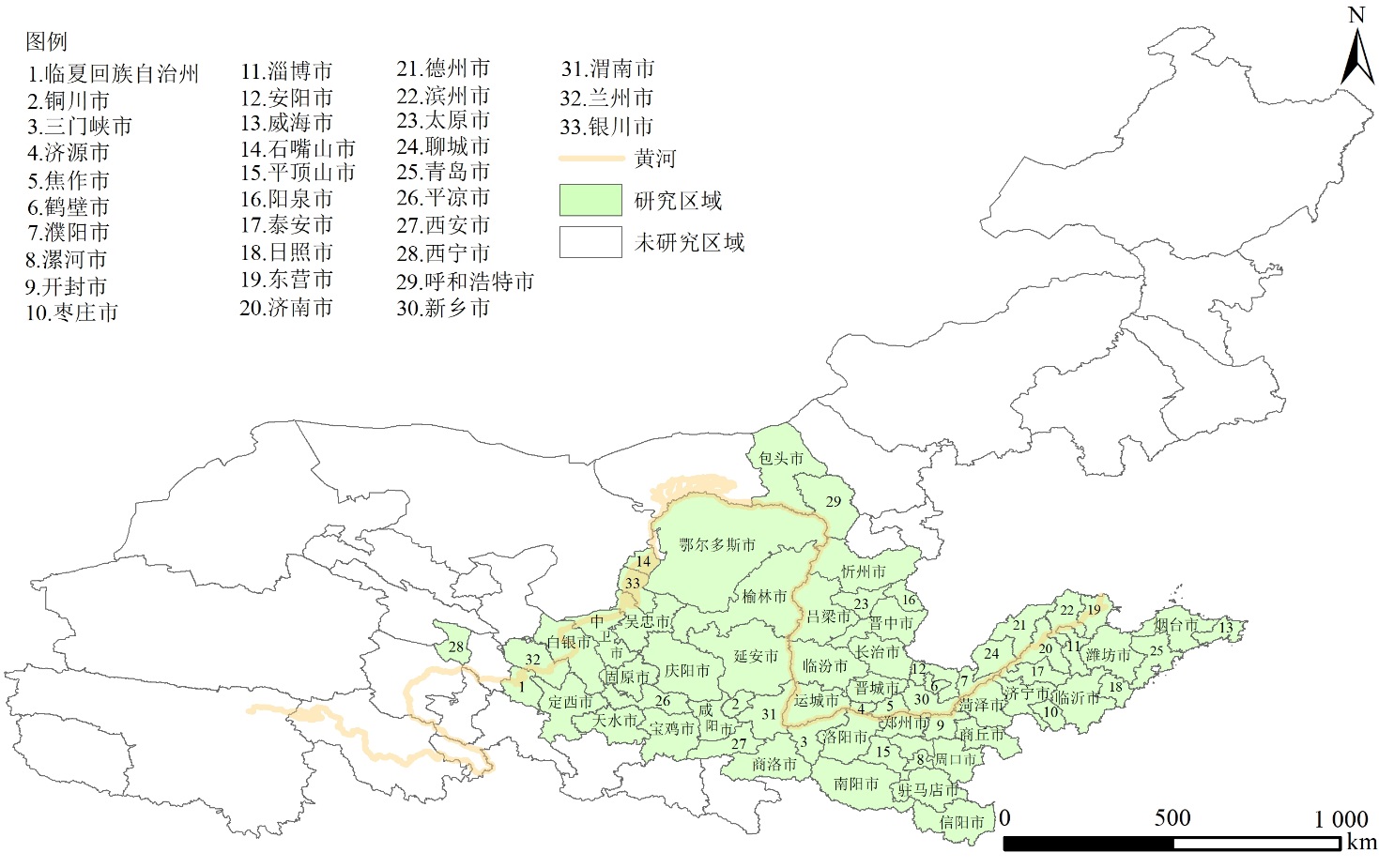
图1 黄河流域地理位置 本文所有地图基于国家测绘地理信息局标准地图服务系统GS(2023)2767号标准地图制作;底图边界无修改
Figure 1 The geographical location of the Yellow River Basin
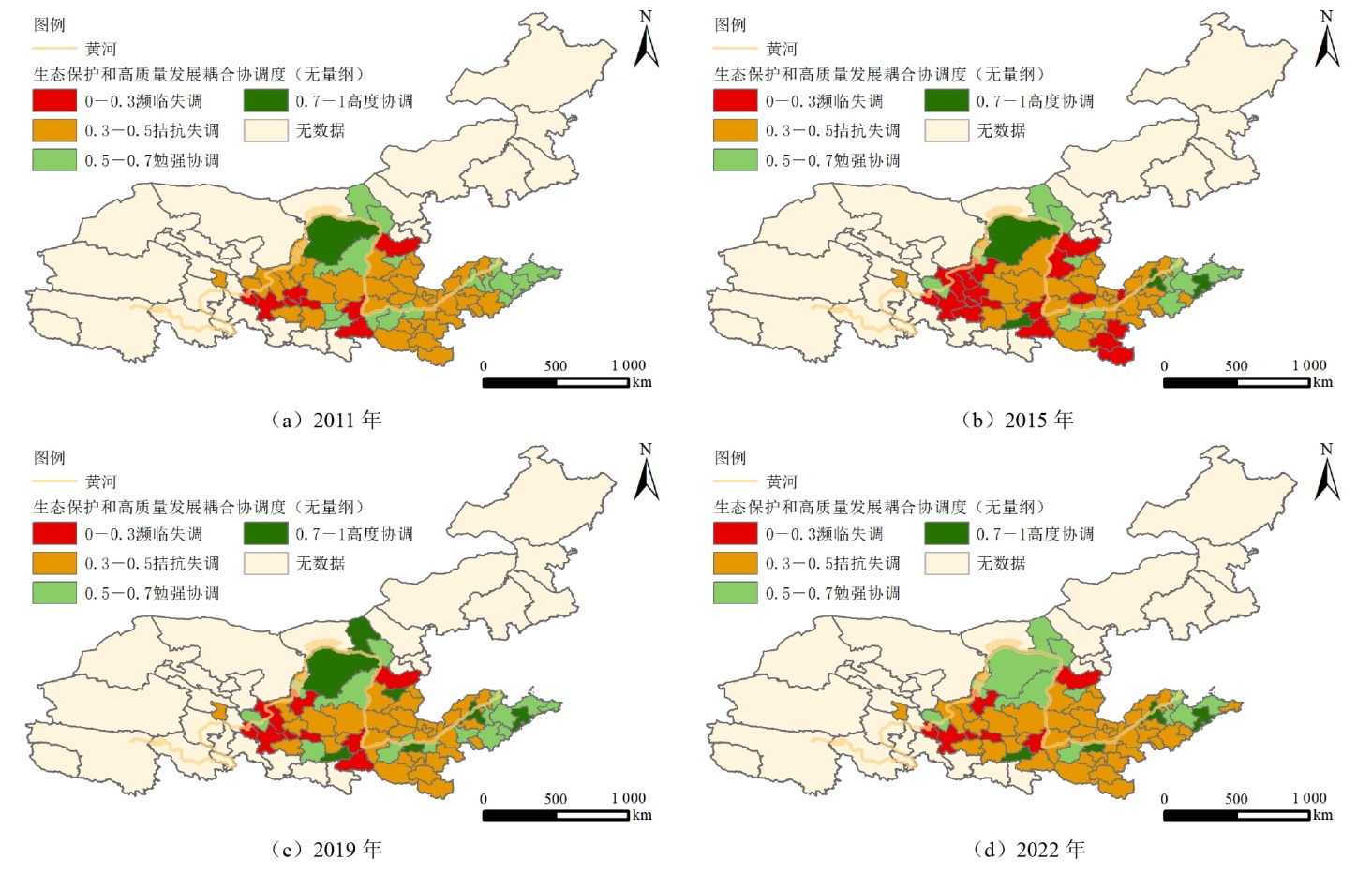
图2 不同时期黄河流域生态保护与高质量发展耦合协调度空间分布
Figure 2 Spatial distribution of the coupling coordination degree of ecological protection and high quality development in the Yellow River Basin across different periods
| 变量 | 耦合协调度 | 生态保护 | 高质量发展 |
|---|---|---|---|
| 数字技术 | −6.25×10⁻³*** 1) (−4.74) 4) | 1.73*** (3.77) | 87.96*** (5.22) |
| 数字技术平方项 | 4.34×10⁻⁵** 2) (2.31) | ||
| 社会储蓄 | 1.08×10⁻⁹*** (2.74) | 8.17×10⁻⁷ (1.40) | −3.05×10⁻⁵ (−1.42) |
| 劳动力供给 | −2.34×10⁻⁷*** (−6.46) | 1.409×10⁻⁴*** (2.63) | 5.79×10⁻⁴ (0.29) |
| 财政分权度 | 1.40×10⁻³ (0.03) | 23.52 (0.38) | 4.375×103* 3) (1.76) |
| 城市化水平 | 1.19×10⁻⁵*** (5.71) | 9.5×10⁻³*** (3.11) | −2.88×10⁻² (−0.25) |
| 市场化程度 | 1.51×10⁻²*** (7.55) | 0.346 (0.12) | 7.23×10²*** (6.67) |
| 拟合优度 | 0.152 | 0.391 | 0.216 |
| 样本量 | 804 | 804 | 804 |
表1 基准回归结果
Table 1 Benchmark regression results
| 变量 | 耦合协调度 | 生态保护 | 高质量发展 |
|---|---|---|---|
| 数字技术 | −6.25×10⁻³*** 1) (−4.74) 4) | 1.73*** (3.77) | 87.96*** (5.22) |
| 数字技术平方项 | 4.34×10⁻⁵** 2) (2.31) | ||
| 社会储蓄 | 1.08×10⁻⁹*** (2.74) | 8.17×10⁻⁷ (1.40) | −3.05×10⁻⁵ (−1.42) |
| 劳动力供给 | −2.34×10⁻⁷*** (−6.46) | 1.409×10⁻⁴*** (2.63) | 5.79×10⁻⁴ (0.29) |
| 财政分权度 | 1.40×10⁻³ (0.03) | 23.52 (0.38) | 4.375×103* 3) (1.76) |
| 城市化水平 | 1.19×10⁻⁵*** (5.71) | 9.5×10⁻³*** (3.11) | −2.88×10⁻² (−0.25) |
| 市场化程度 | 1.51×10⁻²*** (7.55) | 0.346 (0.12) | 7.23×10²*** (6.67) |
| 拟合优度 | 0.152 | 0.391 | 0.216 |
| 样本量 | 804 | 804 | 804 |
| 变量 | 缩减年份 | 缩尾处理 |
|---|---|---|
| 数字技术 | −5.7×10⁻³*** (−4.18) | −5.9×10⁻³*** (−4.21) |
| 数字技术平方项 | 3×10−4* (1.82) | 4×10−4* (1.95) |
| 控制变量 | 是 | 是 |
| 拟合优度 | 0.906 | 0.862 |
| 样本量 | 603 | 804 |
表2 稳健性检验结果
Table 2 Robustness test results
| 变量 | 缩减年份 | 缩尾处理 |
|---|---|---|
| 数字技术 | −5.7×10⁻³*** (−4.18) | −5.9×10⁻³*** (−4.21) |
| 数字技术平方项 | 3×10−4* (1.82) | 4×10−4* (1.95) |
| 控制变量 | 是 | 是 |
| 拟合优度 | 0.906 | 0.862 |
| 样本量 | 603 | 804 |
| 变量 | 绿色发明数量 | 绿色实用新型专利数量 | 人力资本积累 | 节能效应 |
|---|---|---|---|---|
| 索贝尔(Sobel)检验 | 4.7×10⁻⁴*** (3.997) 1) | 3.2×10⁻⁴*** (2.689) | 3.1×10⁻⁴*** (3.281) | 2.7×10⁻⁴*** (3.091) |
| 古德曼(Goodman)检验1 | 4.7×10⁻⁴*** (3.974) | 3.2×10⁻⁴*** (2.674) | 3.1×10⁻⁴*** (3.244) | 2.7×10⁻⁴*** (3.052) |
| 古德曼(Goodman)检验2 | 4.7×10⁻⁴*** (4.021) | 3.2×10⁻⁴*** (2.704) | 3.1×10⁻⁴*** (3.320) | 2.7×10⁻⁴*** (3.131) |
| 间接效应系数 | 4.7×10⁻⁴*** (3.997) | 3.2×10⁻⁴*** (2.689) | 3.1×10⁻⁴*** (3.281) | 2.7×10⁻⁴*** (3.090) |
| 直接效应系数 | 1.4×10⁻³*** (3.806) | 1.5×10⁻³*** (4.288) | 1.9×10⁻³*** (4.502) | 8.7×10⁻⁴** (2.182) |
| 总效应系数 | 1.9×10⁻³*** (4.968) | 1.9×10⁻³*** (4.968) | 2.2×10⁻³*** (5.254) | 1.1×10⁻³*** (2.871) |
| 中介效应比例 | 0.252 | 0.174 | 0.143 | 0.237 |
表3 机制分析结果
Table 3 Analysis results of the mechanism
| 变量 | 绿色发明数量 | 绿色实用新型专利数量 | 人力资本积累 | 节能效应 |
|---|---|---|---|---|
| 索贝尔(Sobel)检验 | 4.7×10⁻⁴*** (3.997) 1) | 3.2×10⁻⁴*** (2.689) | 3.1×10⁻⁴*** (3.281) | 2.7×10⁻⁴*** (3.091) |
| 古德曼(Goodman)检验1 | 4.7×10⁻⁴*** (3.974) | 3.2×10⁻⁴*** (2.674) | 3.1×10⁻⁴*** (3.244) | 2.7×10⁻⁴*** (3.052) |
| 古德曼(Goodman)检验2 | 4.7×10⁻⁴*** (4.021) | 3.2×10⁻⁴*** (2.704) | 3.1×10⁻⁴*** (3.320) | 2.7×10⁻⁴*** (3.131) |
| 间接效应系数 | 4.7×10⁻⁴*** (3.997) | 3.2×10⁻⁴*** (2.689) | 3.1×10⁻⁴*** (3.281) | 2.7×10⁻⁴*** (3.090) |
| 直接效应系数 | 1.4×10⁻³*** (3.806) | 1.5×10⁻³*** (4.288) | 1.9×10⁻³*** (4.502) | 8.7×10⁻⁴** (2.182) |
| 总效应系数 | 1.9×10⁻³*** (4.968) | 1.9×10⁻³*** (4.968) | 2.2×10⁻³*** (5.254) | 1.1×10⁻³*** (2.871) |
| 中介效应比例 | 0.252 | 0.174 | 0.143 | 0.237 |
| 变量 | 呼包鄂榆 | 宁夏沿黄 | 兰西 | 关中平原 | 山西中部 | 中原 | 山东半岛 |
|---|---|---|---|---|---|---|---|
| 数字技术 | −2.1×10⁻³ (−0.41) | 9.49×10⁻⁴ (0.17) | 4.7×10⁻³ (1.28) | −1.11×10⁻²*** (−4.31) | −2.03×10⁻³ (−0.28) | −5.57×10⁻³*** (−3.05) | −4.8×10⁻³** (−1.94) |
| 数字技术平方项 | −1.29×10⁻⁵ (−0.20) | −4.84×10⁻⁵ (−0.69) | −1.06×10⁻⁴* (−1.90) | 1×10⁻⁴*** (3.03) | −7.36×10⁻⁵ (−0.58) | 1.82×10⁻⁵ (0.59) | 1.58×10⁻⁵ (0.50) |
| 控制变量 | 是 | 是 | 是 | 是 | 是 | 是 | 是 |
| 拟合优度 | 3.3×10⁻² | 0.124 | 0.128 | 0.112 | 0.373 | 9.4×10⁻³ | 0.236 |
| 样本量 | 48 | 60 | 60 | 132 | 60 | 264 | 192 |
表4 城市群异质性分析结果1)
Table 4 Analysis results of urban agglomeration heterogeneity
| 变量 | 呼包鄂榆 | 宁夏沿黄 | 兰西 | 关中平原 | 山西中部 | 中原 | 山东半岛 |
|---|---|---|---|---|---|---|---|
| 数字技术 | −2.1×10⁻³ (−0.41) | 9.49×10⁻⁴ (0.17) | 4.7×10⁻³ (1.28) | −1.11×10⁻²*** (−4.31) | −2.03×10⁻³ (−0.28) | −5.57×10⁻³*** (−3.05) | −4.8×10⁻³** (−1.94) |
| 数字技术平方项 | −1.29×10⁻⁵ (−0.20) | −4.84×10⁻⁵ (−0.69) | −1.06×10⁻⁴* (−1.90) | 1×10⁻⁴*** (3.03) | −7.36×10⁻⁵ (−0.58) | 1.82×10⁻⁵ (0.59) | 1.58×10⁻⁵ (0.50) |
| 控制变量 | 是 | 是 | 是 | 是 | 是 | 是 | 是 |
| 拟合优度 | 3.3×10⁻² | 0.124 | 0.128 | 0.112 | 0.373 | 9.4×10⁻³ | 0.236 |
| 样本量 | 48 | 60 | 60 | 132 | 60 | 264 | 192 |
| 变量 | (1)资源型 | (2)非资源型 |
|---|---|---|
| 数字技术 | −2.81×10⁻³* (−1.67) | −7.15×10⁻³*** (−5.33) |
| 数字技术平方项 | 2.56×10⁻⁷ (0.01) | 5.31×10⁻⁵*** (2.95) |
| 控制变量 | 是 | 是 |
| 拟合优度 | 0.348 | 1.82×10⁻² |
| 样本量 | 420 | 384 |
表5 资源禀赋异质性分析结果
Table 5 Test results of resource endowment heterogeneity
| 变量 | (1)资源型 | (2)非资源型 |
|---|---|---|
| 数字技术 | −2.81×10⁻³* (−1.67) | −7.15×10⁻³*** (−5.33) |
| 数字技术平方项 | 2.56×10⁻⁷ (0.01) | 5.31×10⁻⁵*** (2.95) |
| 控制变量 | 是 | 是 |
| 拟合优度 | 0.348 | 1.82×10⁻² |
| 样本量 | 420 | 384 |
| 变量 | 回归结果 | 直接效应 | 间接效应 | 总效应 |
|---|---|---|---|---|
| 数字技术 | −2.31×10⁻³** (−2.60) 1) | −4.3×10⁻³* (−1.89) | −7.4×10⁻²** (−2.14) | −7.83×10⁻²** (−2.23) |
| 数字技术 平方项 | 2.64×10⁻⁵** (2.63) | 5.2×10⁻⁴ (1.43) | 1.42×10⁻³** (2.42) | 1.48×10⁻²** (2.47) |
| 数字技术 滞后项 | −3.55×10⁻³ (−0.98) | |||
| 数字技术平方滞后项 | 5.61×10⁻⁵ (1.06) | |||
| 控制变量 | 是 | 是 | 是 | 是 |
| 样本量 | 804 | 804 | 804 | 804 |
| 拟合优度 | 1.08×10⁻² | 4.6×10⁻² | 4.6×10⁻² | 4.6×10⁻² |
表6 空间杜宾模型回归结果
Table 6 Regression results of spatial Durbin model
| 变量 | 回归结果 | 直接效应 | 间接效应 | 总效应 |
|---|---|---|---|---|
| 数字技术 | −2.31×10⁻³** (−2.60) 1) | −4.3×10⁻³* (−1.89) | −7.4×10⁻²** (−2.14) | −7.83×10⁻²** (−2.23) |
| 数字技术 平方项 | 2.64×10⁻⁵** (2.63) | 5.2×10⁻⁴ (1.43) | 1.42×10⁻³** (2.42) | 1.48×10⁻²** (2.47) |
| 数字技术 滞后项 | −3.55×10⁻³ (−0.98) | |||
| 数字技术平方滞后项 | 5.61×10⁻⁵ (1.06) | |||
| 控制变量 | 是 | 是 | 是 | 是 |
| 样本量 | 804 | 804 | 804 | 804 |
| 拟合优度 | 1.08×10⁻² | 4.6×10⁻² | 4.6×10⁻² | 4.6×10⁻² |
| [1] |
LYU Y, WANG W Q, WU Y, et al., 2023. How does digital economy affect green total factor productivity? Evidence from China[J]. Science of the Total Environment, 857(Part 2): 159428.
DOI URL |
| [2] |
PRAPTI D R, SHARIFF A R M, MAN H C, et al., 2021. Internet of things (IoT) - based aquaculture: An overview of IoT application on water quality monitoring[J]. Reviews in Aquaculture, 14(2): 979-992.
DOI URL |
| [3] |
YANG Q H, MA H Z, WANG Y Y, et al., 2022. Research on the influence mechanism of the digital economy on regional sustainable development[J]. Procedia Computer Science, 202: 178-183.
DOI URL |
| [4] | 艾阳, 宋培, 李琳, 等, 2024. 数字经济发展、产业结构转型与劳动收入份额提升——基于人力资本的调节视角[J]. 经济评论 (3): 3-22. |
| AI Y, SONG P, LI L, et al., 2024. Digital economy development, industrial structure transformation and labor income share improvement: Based on the regulatory perspective of human capital[J]. Economic Review (3): 3-22. | |
| [5] | 安树伟, 李瑞鹏, 2020. 黄河流域高质量发展的内涵与推进方略[J]. 改革 (1): 76-86. |
| AN S W, LI R P, 2020. Connotation and promotion strategy of high-quality development in the Yellow River Basin[J]. Reform (1): 76-86. | |
| [6] | 方慧, 姜春宇, 李小玉, 2025. 数字技术创新与产业链韧性提升: 基于节点企业视角的考察[J]. 经济学动态 (2): 127-144. |
| FANG H, JIANG C Y, LI X Y, 2025. Digital technology innovation and improvement of industrial chain resilience: An investigation from the perspective of node enterprises[J]. Economic Perspectives (2): 127-144. | |
| [7] |
韩冬日, 吕晓丽, 董会忠, 等, 2023. 数字技术对降碳减污协同增效的门槛效应[J]. 资源科学, 45(11): 2130-2143.
DOI |
| HAN D R, LÜ X L, DONG H Z, et al., 2023. Threshold effect of digital technology on synergistic efficiency of carbon reduction and pollution reduction[J]. Resources Science, 45(11): 2130-2143. | |
| [8] | 江小涓, 靳景, 2022. 数字技术提升经济效率:服务分工、产业协同和数实孪生[J]. 管理世界, 38(12): 9-26. |
| JIANG X J, JIN J, 2022. Digital technology improving economic efficiency: Service division, industrial collaboration and digital-real twin[J]. Management World, 38(12): 9-26. | |
| [9] | 孔繁彬, 2022. 数字技术与环境治理现代化——基于环境成本公平性视角[J]. 财经问题研究 (8): 65-72. |
| KONG F B, 2022. Digital technology and modernization of environmental governance: From the perspective of environmental cost equity[J]. Research on Financial and Economic Issues (8): 65-72. | |
| [10] | 李达, 林龙圳, 林震, 等, 2021. 黄河流域生态保护和高质量发展的EKC检验[J]. 生态学报, 41(10): 3965-3974. |
| LI D, LIN L Z, LIN Z, et al., 2021. EKC test on ecological protection and high-quality development in the Yellow River Basin[J]. Acta Ecologica Sinica, 41(10): 3965-3974. | |
| [11] |
李衡, 韩燕, 2022. 黄河流域PM2.5时空演变特征及其影响因素分析[J]. 世界地理研究, 31(1): 130-141.
DOI |
| LI H, HAN Y, 2022. Analysis on spatial-temporal evolution characteristics of PM2.5 and its influencing factors in the Yellow River Basin[J]. World Regional Studies, 31(1): 130-141. | |
| [12] | 李三希, 黄卓, 2022. 数字经济与高质量发展:机制与证据[J]. 经济学 (季刊), 22(5): 1699-1716. |
| LI S X, HUANG Z, 2022. Digital economy and high-quality development: Mechanisms and evidence[J]. China Economic Quarterly, 22(5): 1699-1716. | |
| [13] | 李帅娜, 2021. 数字技术赋能服务业生产率:理论机制与经验证据[J]. 经济与管理研究, 42(10): 51-67. |
| LI S N, 2021. Digital technology empowering service industry productivity: Theoretical mechanism and empirical evidence[J]. Research on Economics and Management, 42(10): 51-67. | |
| [14] |
刘华军, 乔列成, 孙淑惠, 2020. 黄河流域用水效率的空间格局及动态演进[J]. 资源科学, 42(1): 57-68.
DOI |
| LIU H J, QIAO L C, SUN S H, 2020. Spatial pattern and dynamic evolution of water use efficiency in the Yellow River Basin[J]. Resources Science, 42(1): 57-68. | |
| [15] |
苗长虹, 夏成, 金凤君, 等, 2025. 黄河流域生态保护和高质量发展战略实施成效与推进策略[J]. 自然资源学报, 40(3): 569-583.
DOI |
|
MIAO C H, XIA C, JIN F J, et al., 2025. Implementation effect and promotion strategy of ecological protection and high-quality development strategy in the Yellow River Basin[J]. Journal of Natural Resources, 40(3): 569-583.
DOI URL |
|
| [16] |
苗长虹, 张佰发, 2021. 黄河流域高质量发展分区分级分类调控策略研究[J]. 经济地理, 41(10): 143-153.
DOI |
| MIAO C H, ZHANG B F, 2021. Research on zoning, grading and classification regulation strategies for high-quality development of the Yellow River Basin[J]. Economic Geography, 41(10): 143-153. | |
| [17] | 戚聿东, 刘欢欢, 2020. 数字经济下数据的生产要素属性及其市场化配置机制研究[J]. 经济纵横 (11): 63-76, 2. |
| QI Y D, LIU H H, 2020. Research on the attribute of data as a production factor and its market-oriented allocation mechanism in the digital economy[J]. Economic Review (11): 63-76, 2. | |
| [18] | 任保平, 巩羽浩, 2023. 数字经济发展促进区域协调发展:理论机理与实现路径[J]. 改革与战略, 39(4): 89-98. |
| REN B P, GONG Y H, 2023. Digital economy development promoting regional coordinated development: Theoretical mechanism and realization path[J]. Reform and Strategy, 39(4): 89-98. | |
| [19] | 任保平, 何厚聪, 2022. 中国式现代化新征程中我国数字经济创新体系的构建[J]. 上海经济研究 (12): 17-26. |
| REN B P, HE H C, 2022. Construction of China's digital economy innovation system in the new journey of Chinese modernization[J]. Shanghai Journal of Economics (12): 17-26. | |
| [20] | 任希丽, 张海伟, 2023. 数字技术与中国省区产业增长——基于双重差分非线性计量模型的实证分析[J]. 商业研究 (1): 11-19 |
| REN X L, ZHANG H W, 2023. Digital technology and industrial growth in Chinese provinces: Empirical analysis based on double difference nonlinear econometric model[J]. Commercial Research (1): 11-19. | |
| [21] | 史歌, 任保平, 2023. 黄河流域生态保护与高质量发展耦合协调综合评价[J]. 人民黄河, 45(11): 16-21, 28. |
| SHI G, REN B P, 2023. Comprehensive evaluation of coupling coordination between ecological protection and high-quality development in the Yellow River Basin[J]. Yellow River, 45(11): 16-21, 28. | |
| [22] | 宋德勇, 李超, 李项佑, 2021. 新型基础设施建设是否促进了绿色技术创新的 “量质齐升”——来自国家智慧城市试点的证据[J]. 中国人口·资源与环境, 31(11): 155-164. |
| SONG D Y, LI C, LI X Y, 2021. Does new infrastructure construction promote “quantity and quality improvement” of green technology innovation: Evidence from national smart city pilots[J]. China Population, Resources and Environment, 31(11): 155-164. | |
| [23] | 孙继琼, 2021. 黄河流域生态保护与高质量发展的耦合协调: 评价与趋势[J]. 财经科学 (3): 106-118. |
| SUN J Q, 2021. Coupling coordination between ecological protection and high-quality development in the Yellow River Basin: Evaluation and trend[J]. Finance and Economics (3): 106-118. | |
| [24] | 汤姿, 石长波, 张娜, 2018. 黑龙江省旅游经济与生态环境时空耦合研究——基于 “坚持人与自然和谐共生” 的视角[J]. 商业研究 (1): 1-9. |
| TANG Z, SHI C B, ZHANG N, 2018. Study on spatial-temporal coupling between tourism economy and ecological environment in Heilongjiang Province: From the perspective of “adhering to harmonious coexistence between human and nature”[J]. Commercial Research (1): 1-9. | |
| [25] |
王淑佳, 孔伟, 任亮, 等, 2021. 国内耦合协调度模型的误区及修正[J]. 自然资源学报, 36(3): 793-810.
DOI |
|
WANG S J, KONG W, REN L, et al., 2021. Misunderstandings and corrections of domestic coupling coordination degree models[J]. Journal of Natural Resources, 36(3): 793-810.
DOI URL |
|
| [26] |
王雪梅, 杨雪峰, 赵枫, 等, 2023. 基于机器学习算法的干旱区绿洲地上生物量估算[J]. 生态环境学报, 32(6): 1007-1015.
DOI |
| WANG X M, YANG X F, ZHAO F, et al., 2023. Estimation of aboveground biomass in the arid oasis based on the machine learning algorithm[J]. Ecology and Environmental Sciences, 32(6): 1007-1015. | |
| [27] | 杨慧梅, 江璐, 2021. 数字经济、空间效应与全要素生产率[J]. 统计研究, 38(4): 3-15. |
| YANG H M, JIANG L, 2021. Digital economy, spatial effect and total factor productivity[J]. Statistical Research, 38(4): 3-15. | |
| [28] | 杨开忠, 董亚宁, 2020. 黄河流域生态保护和高质量发展制约因素与对策——基于 “要素-空间-时间” 三维分析框架[J]. 水利学报, 51(9): 1038-1047. |
| YANG K Z, DONG Y N, 2020. Restrictive factors and countermeasures for ecological protection and high-quality development of the Yellow River Basin: Based on the “factor-space-time” three-dimensional analysis framework[J]. Journal of Hydraulic Engineering, 51(9): 1038-1047. | |
| [29] | 杨怡康, 蒋毓琪, 田文博, 2025. 黄河流域资源型城市碳生态安全与高质量发展耦合协调研究[J]. 人民黄河, 47(5): 8-14. |
| YANG Y K, JIANG Y Q, TIAN W B, 2025. Research on coupling coordination between carbon ecological security and high-quality development of resource-based cities in the Yellow River Basin[J]. Yellow River, 47(5): 8-14. | |
| [30] | 张军扩, 侯永志, 刘培林, 等, 2019. 高质量发展的目标要求和战略路径[J]. 管理世界, 35(7): 1-7. |
| ZHANG J K, HOU Y Z, LIU P L, et al., 2019. Target requirements and strategic paths for high-quality development[J]. Management World, 35(7): 1-7. | |
| [31] |
张可云, 张颖, 2020. 不同空间尺度下黄河流域区域经济差异的演变[J]. 经济地理, 40(7): 1-11.
DOI |
|
ZHANG K Y, ZHANG Y, 2020. Evolution of regional economic differences in the Yellow River Basin under different spatial scales[J]. Economic Geography, 40(7): 1-11.
DOI |
|
| [32] |
张宁宁, 粟晓玲, 周云哲, 等, 2019. 黄河流域水资源承载力评价[J]. 自然资源学报, 34(8): 1759-1770.
DOI |
|
ZHANG N N, SU X L, ZHOU Y Z, et al., 2019. Evaluation of water resources carrying capacity in the Yellow River Basin[J]. Journal of Natural Resources, 34(8): 1759-1770.
DOI URL |
|
| [33] | 赵景峰, 李妍, 2022. 数字经济对黄河流域科技创新产出的影响及空间溢出效应研究[J]. 科技管理研究, 42(9): 56-63. |
| ZHAO J F, LI Y, 2022. Research on the impact of digital economy on scientific and technological innovation output in the Yellow River Basin and its spatial spillover effect[J]. Science and Technology Management Research, 42(9): 56-63. | |
| [34] | 赵涛, 张智, 梁上坤, 2020. 数字经济、创业活跃度与高质量发展——来自中国城市的经验证据[J]. 管理世界, 36(10): 65-76. |
| ZHAO T, ZHANG Z, LIANG S K, 2020. Digital economy, entrepreneurial activity and high-quality development: Empirical evidence from Chinese cities[J]. Management World, 36(10): 65-76. | |
| [35] | 赵星, 2022. 新型数字基础设施的技术创新效应研究[J]. 统计研究, 39(4): 80-92. |
| ZHAO X, 2022. Research on the technological innovation effect of new digital infrastructure[J]. Statistical Research, 39(4): 80-92. |
| [1] | 陈洁茹, 叶长盛, 魏嶶, 蔡鑫, 汪礼丽. 环鄱阳湖城市群县域“三生空间”耦合协调性及影响因素分析[J]. 生态环境学报, 2025, 34(5): 807-818. |
| [2] | 李曼, 吴东丽, 何昊, 余慧婕, 赵琳, 刘聪, 胡正华, 李琪. 1990-2020年黄河流域碳储量时空演变及驱动因素研究[J]. 生态环境学报, 2025, 34(3): 333-344. |
| [3] | 张继, 杨世琦, 赵磊, 冯介玲, 陈艳英. 基于InVEST模型的重庆市“一带三屏”生境质量时空演变特征分析[J]. 生态环境学报, 2025, 34(2): 167-180. |
| [4] | 张艳, 张少娟, 吕韬, 贺慧汀. 黄河流域(内蒙古段)景观生态风险与生境质量的耦合协同关系研究[J]. 生态环境学报, 2025, 34(12): 1841-1852. |
| [5] | 张雯, 郑天, 刘永超, 钟捷, 苏杰, 李加林. 基于电路理论的浙江省生态保护修复关键区域识别[J]. 生态环境学报, 2024, 33(9): 1482-1494. |
| [6] | 向男, 王明旭, 张宏锋, 廖宝淦. 生态保护重要性分区及其长时间序列生境状况时空分异研究——以广东省为例[J]. 生态环境学报, 2024, 33(6): 958-968. |
| [7] | 王鹭莹, 李小马, 甘德欣, 刘鹏翱, 郭胜, 李毅. 长株潭城市群生态系统服务权衡与协同关系的空间异质性及其驱动因素[J]. 生态环境学报, 2024, 33(6): 969-979. |
| [8] | 田嘉莉, 毛靖宇, 彭甲超, 姚婷婷, 付书科. 重污染企业减污降碳协同效应时空分异特征及其驱动因素分析——来自A股100家企业的证据[J]. 生态环境学报, 2024, 33(11): 1661-1671. |
| [9] | 许静, 王德仁. 基于VORS模型的黄河流域生态系统健康评估与预测[J]. 生态环境学报, 2024, 33(10): 1612-1623. |
| [10] | 秦艳培, 徐少君, 田耀武. 黄河流域河南段植被和土壤及其碳密度空间分异研究[J]. 生态环境学报, 2022, 31(9): 1745-1753. |
| [11] | 曹云, 孙应龙, 姜月清, 万君. 黄河流域净生态系统生产力的时空分异特征及其驱动因子分析[J]. 生态环境学报, 2022, 31(11): 2101-2110. |
| [12] | 付乐, 迟妍妍, 于洋, 张丽苹, 刘斯洋, 王夏晖, 许开鹏, 王晶晶, 张信. 2000—2020年黄河流域土地利用变化特征及影响因素分析[J]. 生态环境学报, 2022, 31(10): 1927-1938. |
| [13] | 齐静, 邓伟, 周渝, 刘婷, 罗旭. 重庆市生态保护红线成效评估方法与应用[J]. 生态环境学报, 2021, 30(7): 1532-1540. |
| [14] | 袁洁, 赵晏强. 基于Web of Science数据库的湿地修复研究发展态势分析[J]. 生态环境学报, 2021, 30(7): 1541-1548. |
| [15] | 陈志端, 陈鸿, 郭晶鹏, 吴若昊. 国土空间规划体系下生态空间规划思想内核与技术框架初探[J]. 生态环境学报, 2021, 30(5): 1094-1102. |
| 阅读次数 | ||||||
|
全文 |
|
|||||
|
摘要 |
|
|||||
