
生态环境学报 ›› 2026, Vol. 35 ›› Issue (10): 1545-1554.DOI: 10.16258/j.cnki.1674-5906.2026.10.005
何爱琳1( ), 常顺利1, 李吉玫2,3,*(), 万燕4, 吴东升4, 吐尔洪·努尔东4
收稿日期:2026-01-05
修回日期:2026-07-04
接受日期:2026-08-24
出版日期:2026-10-18
发布日期:2026-10-21
通讯作者:
E-mail: 作者简介:何爱琳(2001年生),女,硕士研究生,主要从事森林群落生态学研究。E-mail: 3404660288@qq.com
基金资助:
He Ailin1(), Chang Shunli1, Li Jimei2,3,*(), Wan Yan4, Wu Dongsheng4, Tuerhong Nuerdong4
Received:2026-01-05
Revised:2026-07-04
Accepted:2026-08-24
Online:2026-10-18
Published:2026-10-21
摘要:
【目的】探讨单个固定样地尺度下不同生长型植物多样性特征及其对局域环境因子的响应。【方法】以新疆托木尔峰国家级自然保护区雪岭云杉林2 hm2固定监测样地为研究对象,基于2024年首轮调查数据,分析了木本与草本植物群落的物种组成、α多样性与β多样性格局,并比较了其对地形因子、林分结构及空间变量的响应差异。【结果】样地内群落物种组成较为简单,木本植物以雪岭云杉为绝对优势种(重要值74.8%),草本层物种丰富度较高,但优势种较为集中;草本植物的α多样性显著高于木本植物(p<0.001)。木本植物α多样性与平均胸径、平均树高、胸高断面积呈显著负相关(p<0.01),草本植物α多样性与坡度、林分密度、郁闭度呈显著负相关(p<0.05);不同生长型植物β多样性的主导组分存在明显的分异。木本植物β多样性以嵌套组分为主(贡献率72%),草本植物β多样性以物种周转组分为主(贡献率83%)。Mantel检验与方差分解结果表明,空间变量对木本植物β多样性及其嵌套组分的解释率相对较高,而地形因子与林分结构因子对草本植物β多样性及其周转组分的解释率相对较高。【结论】在单个固定样地尺度下,不同生长型植物在α与β多样性格局及其组分贡献上存在明显的分异。研究结果可为雪岭云杉林植物多样性格局的长期动态监测与群落变化研究提供本底数据支撑。
中图分类号:
何爱琳, 常顺利, 李吉玫, 万燕, 吴东升, 吐尔洪·努尔东. 新疆托木尔峰雪岭云杉林固定样地不同生长型植物α与β多样性特征及影响因素[J]. 生态环境学报, 2026, 35(10): 1545-1554.
He Ailin, Chang Shunli, Li Jimei, Wan Yan, Wu Dongsheng, Tuerhong Nuerdong. Patterns and Drivers of Alpha and Beta Diversity Across Plant Growth Forms in a Permanent Plot of Picea schrenkiana Forest in Tomur Peak, Xinjiang[J]. Ecology and Environmental Sciences, 2026, 35(10): 1545-1554.

图1 新疆托木尔峰国家级自然保护区雪岭云杉森林2 hm2固定监测样地位置图
Figure 1 Location map of the 2 hm2 forest dynamics plot in the Picea schrenkiana forest, Tomur National Nature Reserve, Xinjiang
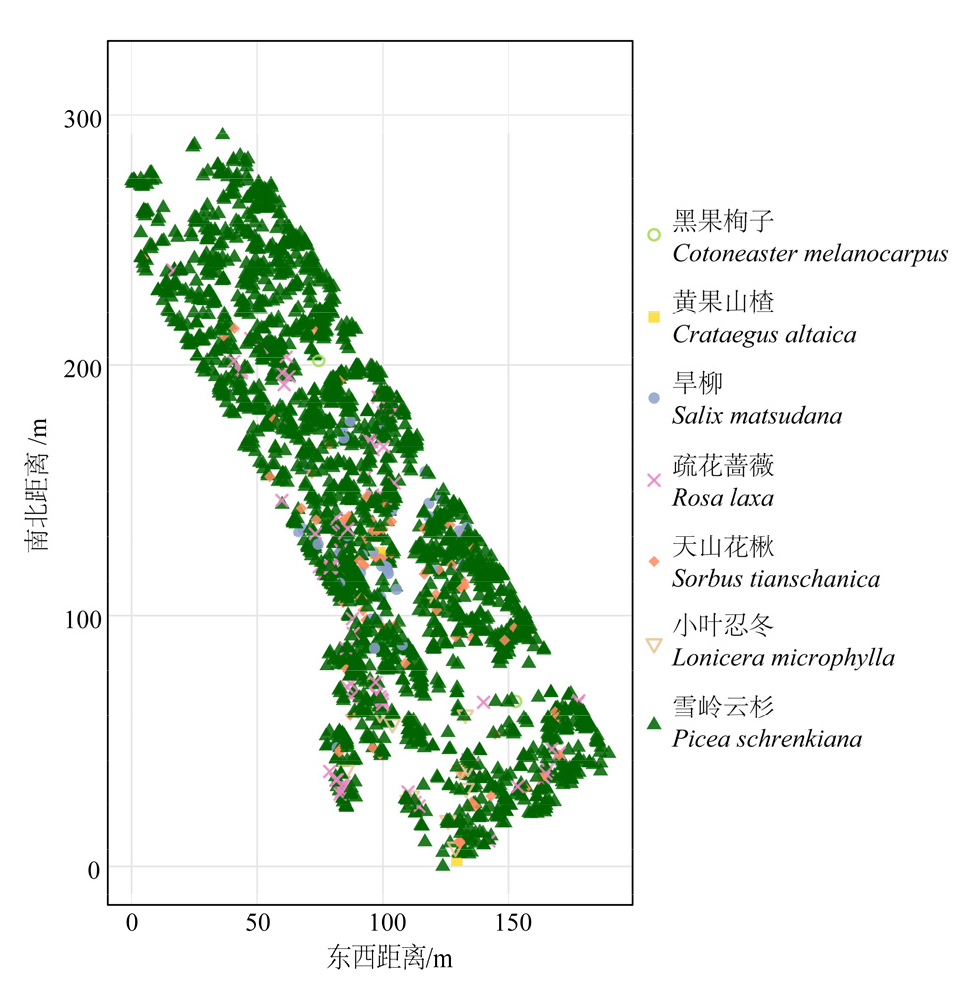
图2 新疆托木尔峰国家级自然保护区雪岭云杉森林 2 hm2 动态监测样地图
Figure 2 Map of the 2 hm2 forest dynamics plot in the Picea schrenkiana forest, Tomur National Nature Reserve, Xinjiang
| 物种 | 所属科 | 相对多度/ % | 相对 频度/% | 相对 优势度/% | 重要值/ % |
|---|---|---|---|---|---|
| 雪岭云杉 Picea schrenkiana | 松科 | 90.0 | 38.8 | 95.7 | 74.8 |
| 天山花楸 Sorbus tianschanica | 蔷薇科 | 4.00 | 24.0 | 1.88 | 9.97 |
| 疏花蔷薇Rosa laxa | 蔷薇科 | 3.27 | 17.8 | 0.17 | 7.09 |
| 旱柳Salix matsudana | 杨柳科 | 2.06 | 10.9 | 1.91 | 4.94 |
| 小叶忍冬 Lonicera microphylla | 忍冬科 | 0.52 | 5.43 | 0.04 | 2.00 |
| 黄果山楂 Crataegus altaica | 蔷薇科 | 0.12 | 1.55 | 0.01 | 0.56 |
| 黑果栒子 Cotoneaster melanocarpus | 蔷薇科 | 0.08 | 1.55 | 0.01 | 0.55 |
表1 样地木本植物物种组成及重要值
Table 1 Species composition and importance values of woody plants in the plot
| 物种 | 所属科 | 相对多度/ % | 相对 频度/% | 相对 优势度/% | 重要值/ % |
|---|---|---|---|---|---|
| 雪岭云杉 Picea schrenkiana | 松科 | 90.0 | 38.8 | 95.7 | 74.8 |
| 天山花楸 Sorbus tianschanica | 蔷薇科 | 4.00 | 24.0 | 1.88 | 9.97 |
| 疏花蔷薇Rosa laxa | 蔷薇科 | 3.27 | 17.8 | 0.17 | 7.09 |
| 旱柳Salix matsudana | 杨柳科 | 2.06 | 10.9 | 1.91 | 4.94 |
| 小叶忍冬 Lonicera microphylla | 忍冬科 | 0.52 | 5.43 | 0.04 | 2.00 |
| 黄果山楂 Crataegus altaica | 蔷薇科 | 0.12 | 1.55 | 0.01 | 0.56 |
| 黑果栒子 Cotoneaster melanocarpus | 蔷薇科 | 0.08 | 1.55 | 0.01 | 0.55 |
| 物种 | 所属科 | 相对 多度/% | 相对 高度/% | 相对 盖度/% | 重要值/ % |
|---|---|---|---|---|---|
| 三穗薹草 Carex tristachya | 莎草科 | 34.3 | 8.22 | 15.2 | 19.2 |
| 紫苞鸢尾Iris ruthenica | 鸢尾科 | 13.8 | 11.0 | 15.0 | 13.3 |
| 稗草 Echinochloa crus-galli | 禾本科 | 10.5 | 5.58 | 8.38 | 8.15 |
| 羊角芹 Aegopodium alpestre | 伞形科 | 6.74 | 5.63 | 5.34 | 5.90 |
| 山地糙苏 Phlomoides oreophila | 唇形科 | 1.60 | 6.04 | 9.95 | 5.86 |
| 老鹳草 Geranium wilfordii | 牻牛儿苗科 | 2.16 | 8.31 | 4.68 | 5.05 |
| 葛缕子Carum carvi | 伞形科 | 3.90 | 3.90 | 3.36 | 4.42 |
| 铁线莲Clematis | 毛茛科 | 6.13 | 6.13 | 4.51 | 4.23 |
| 高山黄芪 Astragalus alpinus | 豆科 | 5.02 | 5.02 | 4.58 | 4.22 |
| 岩参Cicerbita azurea | 菊科 | 3.16 | 4.39 | 4.41 | 3.99 |
表2 样地草本植物物种组成及重要值排序(前10位)
Table 2 Species composition and ranked importance values (top 10) of herbaceous plants in the plot
| 物种 | 所属科 | 相对 多度/% | 相对 高度/% | 相对 盖度/% | 重要值/ % |
|---|---|---|---|---|---|
| 三穗薹草 Carex tristachya | 莎草科 | 34.3 | 8.22 | 15.2 | 19.2 |
| 紫苞鸢尾Iris ruthenica | 鸢尾科 | 13.8 | 11.0 | 15.0 | 13.3 |
| 稗草 Echinochloa crus-galli | 禾本科 | 10.5 | 5.58 | 8.38 | 8.15 |
| 羊角芹 Aegopodium alpestre | 伞形科 | 6.74 | 5.63 | 5.34 | 5.90 |
| 山地糙苏 Phlomoides oreophila | 唇形科 | 1.60 | 6.04 | 9.95 | 5.86 |
| 老鹳草 Geranium wilfordii | 牻牛儿苗科 | 2.16 | 8.31 | 4.68 | 5.05 |
| 葛缕子Carum carvi | 伞形科 | 3.90 | 3.90 | 3.36 | 4.42 |
| 铁线莲Clematis | 毛茛科 | 6.13 | 6.13 | 4.51 | 4.23 |
| 高山黄芪 Astragalus alpinus | 豆科 | 5.02 | 5.02 | 4.58 | 4.22 |
| 岩参Cicerbita azurea | 菊科 | 3.16 | 4.39 | 4.41 | 3.99 |
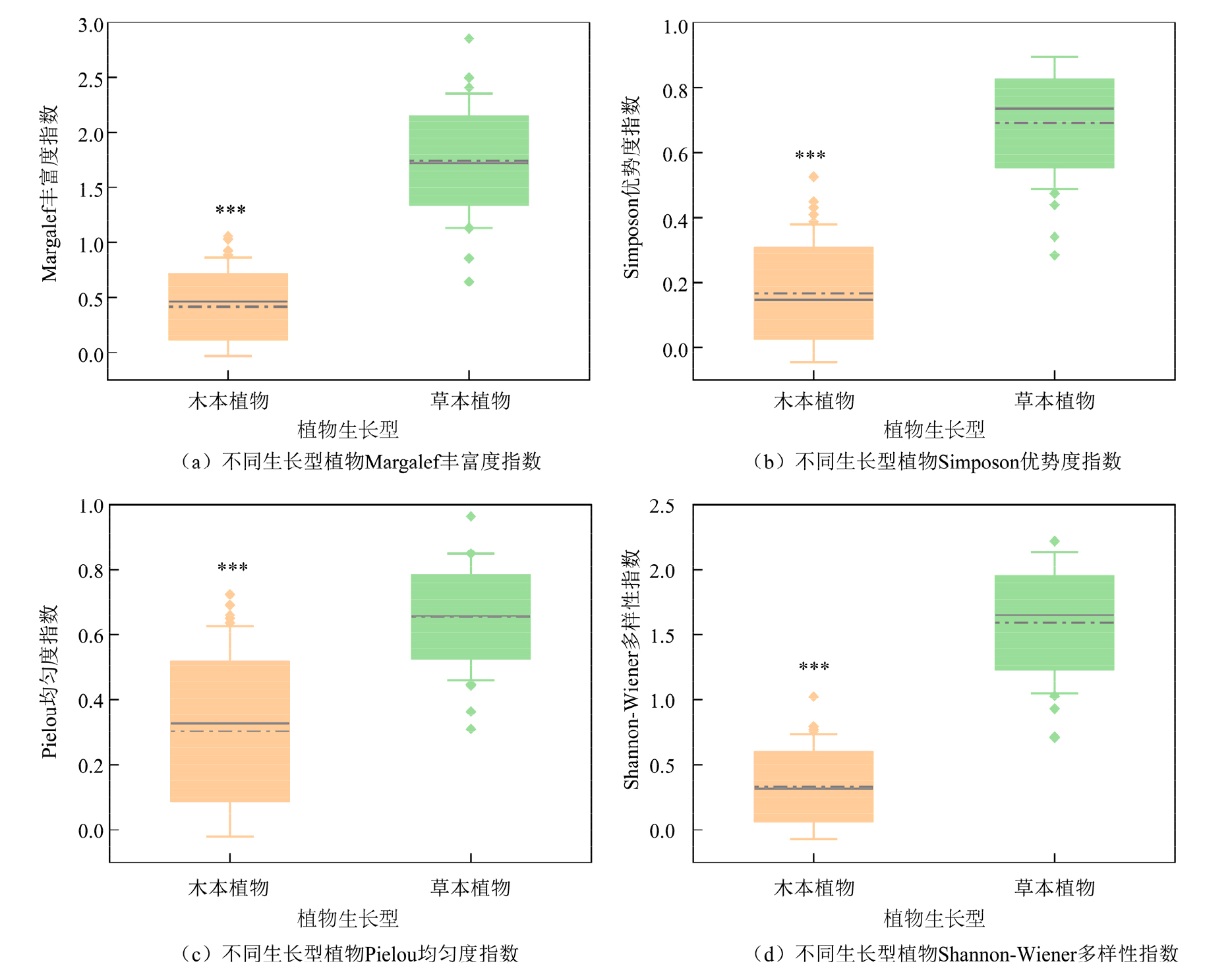
图3 不同生长型植物α多样性指数比较
Figure 3 Comparison of α-diversity indices between contrasting growth forms
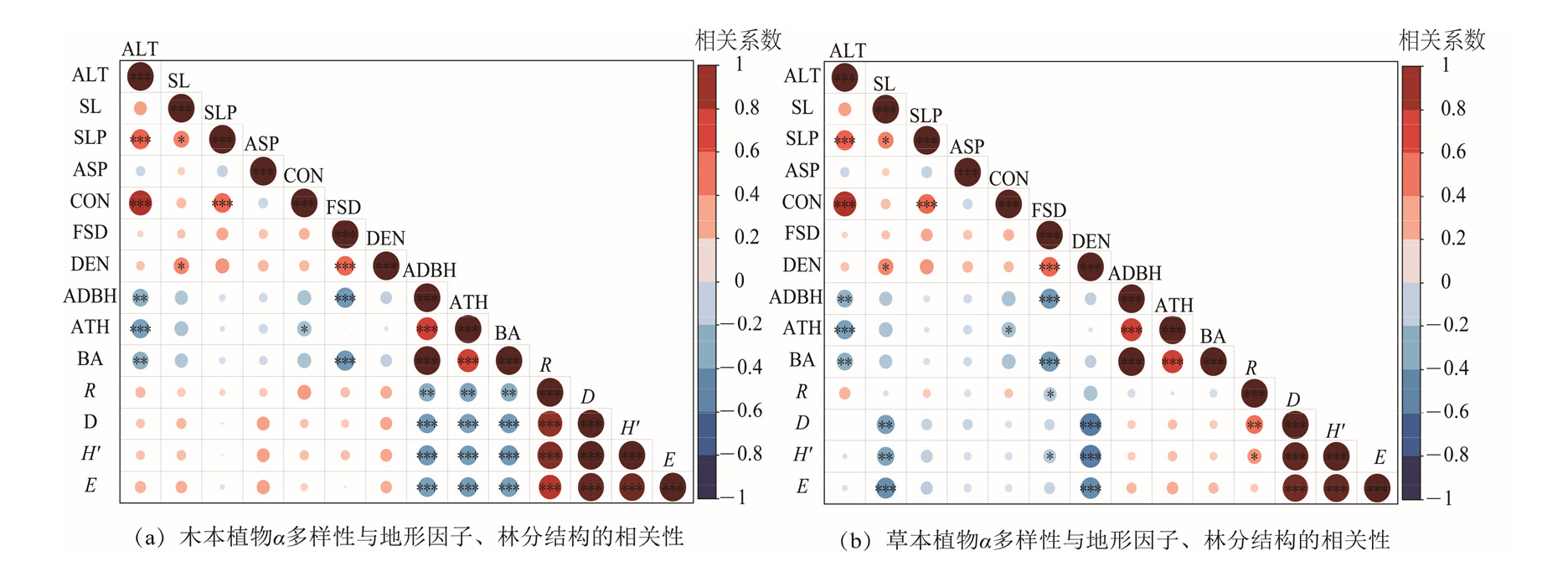
图4 不同生长型植物α多样性与地形因子、林分结构之间的相关性分析 ALT:海拔;SL:坡度;SLP:坡位;ASP:坡向;CON:凹凸度;FSD:林分密度;DEN:郁闭度;ADBH:平均胸径;ATH: 平均树高;BA:胸高断面积;R:Margalef丰富度指数;D:Simpson优势度指数;H′:Shannon-Wiener多样性指数E:Pielou均 匀度指数。***,**,*分别表示在0.001、0.01和0.05的水平上具有显著性
Figure 4 Correlation analysis of α-diversity of different plant growth forms with topographic variables and stand structural attributes
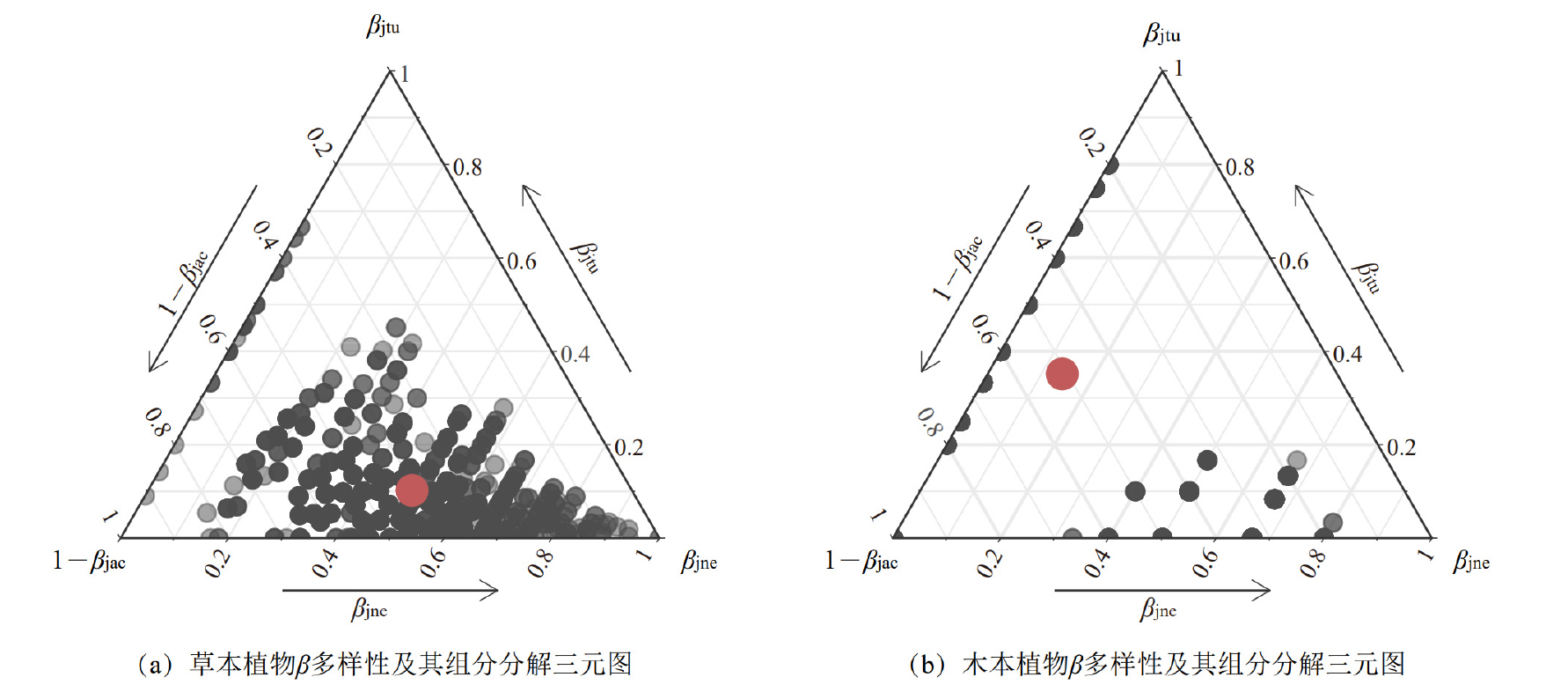
图5 不同生长型植物β多样性及其组分分解三元图 三元图表示样地内50个20 m×20 m 样方之间木本与草本植物群落 β 多样性(βjac)及其周转组分(βjtu)和嵌套组分 (βjne)的分解结果。图中灰色散点代表样方间两两比较的结果,红色圆点表示所有样方对比较结果的平均值
Figure 5 Ternary plots of β-diversity partitioning (turnover and nestedness components) across plant growth forms
| 环境因子 | 木本植物 | 草本植物 | |||||
|---|---|---|---|---|---|---|---|
| βjac | βjtu | βjne | βjac | βjtu | βjne | ||
| 海拔ALT | 0.13** | −0.12 | 0.22*** | 0.16** | 0.09* | 0.05 | |
| 坡度SL | 0.03 | 0.05 | −0.01 | 0.12* | 0.13** | −0.05 | |
| 坡向ASP | −0.02 | 0.01 | −0.02 | 0.01 | 0.002 | 0.03 | |
| 坡位SLP | 0.07* | −0.05 | 0.09* | 0.18*** | 0.20*** | −0.08 | |
| 凹凸度CON | 0.11** | −0.01 | 0.10* | 0.10* | 0.09* | −0.02 | |
| 林分密度FSD | 0.07 | 0.02 | 0.04 | 0.30*** | 0.17** | 0.10* | |
| 郁闭度DEN | 0.14** | 0.10 | 0.02 | 0.42*** | 0.31*** | 0.03 | |
| 平均胸径ADBH | 0.09* | −0.06 | 0.12* | 0.16* | 0.14** | −0.04 | |
| 平均树高ATH | 0.18*** | 0.14* | 0.02 | 0.08 | 0.13* | −0.13 | |
| 胸高断面积BA | 0.08* | −0.11 | 0.15** | 0.15* | 0.13* | −0.04 | |
表3 β多样性(βjac)及其周转组分(βjtu)和嵌套组分(βjne)与环境因子spearman相关性与Mantel检验
Table 3 Spearman correlations and Mantel tests between β-diversity (βjac), its turnover (βjtu) and nestedness (βjne) components, and environmental variables
| 环境因子 | 木本植物 | 草本植物 | |||||
|---|---|---|---|---|---|---|---|
| βjac | βjtu | βjne | βjac | βjtu | βjne | ||
| 海拔ALT | 0.13** | −0.12 | 0.22*** | 0.16** | 0.09* | 0.05 | |
| 坡度SL | 0.03 | 0.05 | −0.01 | 0.12* | 0.13** | −0.05 | |
| 坡向ASP | −0.02 | 0.01 | −0.02 | 0.01 | 0.002 | 0.03 | |
| 坡位SLP | 0.07* | −0.05 | 0.09* | 0.18*** | 0.20*** | −0.08 | |
| 凹凸度CON | 0.11** | −0.01 | 0.10* | 0.10* | 0.09* | −0.02 | |
| 林分密度FSD | 0.07 | 0.02 | 0.04 | 0.30*** | 0.17** | 0.10* | |
| 郁闭度DEN | 0.14** | 0.10 | 0.02 | 0.42*** | 0.31*** | 0.03 | |
| 平均胸径ADBH | 0.09* | −0.06 | 0.12* | 0.16* | 0.14** | −0.04 | |
| 平均树高ATH | 0.18*** | 0.14* | 0.02 | 0.08 | 0.13* | −0.13 | |
| 胸高断面积BA | 0.08* | −0.11 | 0.15** | 0.15* | 0.13* | −0.04 | |

图6 β多样性及其两个组分的方差分解结果 基于Jaccard 指数的β多样性及其分解组分(βjac、βjtu、βjne)的方差分解结果,图中的数值为百分数,用于估计 地形因子(用绿色表示)、林分结构(用粉色表示)和空间变量(用蓝色表示)对β多样性及其分解组分的解释量。 Residual 表示未被解释的变异比例。图中数值为-的部分表示解释变量解释量过小或者方差分解过程未找到显著的 解释变量导致未能执行方差分解过程
Figure 6 Variance partitioning of β-diversity based on the Jaccard index and its decomposed components
| [1] |
Anderson M J, Crist T O, Chase J M, et al., 2011. Navigating the multiple meanings of β diversity: A roadmap for the practicing ecologist[J]. Ecology Letters, 14(1): 19-28.
DOI PMID |
| [2] |
Arnell M, Eriksson O, 2022. Landscape-scale range filling and dispersal limitation of woody plants[J]. Journal of Biogeography, 49: 2028-2036.
DOI URL |
| [3] |
Baselga A, 2010. Partitioning the turnover and nestedness components of beta diversity[J]. Global Ecology and Biogeography, 19(1): 134-143.
DOI URL |
| [4] |
Compagnoni A, Levin S, Childs D Z, et al., 2021. Herbaceous perennial plants with short generation time have stronger responses to climate anomalies than those with longer generation time[J]. Nature Communications, 12(1): 1824.
DOI PMID |
| [5] |
Deng T T, Du Q Q, Zhu Y, et al., 2025. Environmental drivers of herbaceous plant diversity in the understory community of a warm-temperate forest[J]. Plant Diversity, 47(2): 282-290.
DOI URL |
| [6] |
Farzam M, Ejtehadi H, 2017. Effects of drought and slope aspect on canopy facilitation in a mountainous rangeland[J]. Journal of Plant Ecology, 10(4): 626-633.
DOI |
| [7] |
Geng Q W, Muhammad A, Yuan Z X, et al., 2022. Plant species composition and diversity along successional gradients in arid and semi-arid regions of China[J]. Forest Ecology and Management, 524: 120542.
DOI URL |
| [8] |
Gou X X, Zhang T W, Yu S L, et al., 2023. Climate response of Picea schrenkiana based on tree-ring width and maximum density[J]. Dendrochronologia, 78: 126067.
DOI URL |
| [9] |
Haq S M, Rashid I, Waheed M, et al., 2023. From forest floor to tree top: Partitioning of biomass and carbon stock in multiple strata of forest vegetation in Western Himalaya[J]. Environmental Monitoring and Assessment, 195(7): 812.
DOI |
| [10] |
He R, Hu M, Shi H, et al., 2022. Patterns of species diversity and its determinants in a temperate deciduous broad-leaved forest[J]. Forest Ecosystems, 9(1): 100062.
DOI URL |
| [11] |
Legendre P, 2014. Interpreting the replacement and richness difference components of beta diversity[J]. Global Ecology and Biogeography, 23(11): 1324-1334.
DOI URL |
| [12] |
Li L P, Wang X P, Zerbe S, et al., 2011. Altitudinal patterns of stand structure and herb layer diversity of Picea schrenkiana forests in the central Tianshan Mountains, Northwest China[J]. Journal of Arid Land, 3(4): 254-260.
DOI URL |
| [13] |
Liu Y Y, Qian H, Zhou Y D, 2025. Inconsistent geographical patterns of phylogenetic relatedness among different plant growth forms: A case study in woody and herbaceous angiosperms of China[J]. Journal of Systematics and Evolution, 63(3): 767-777.
DOI URL |
| [14] | Nettesheim F C, Garbin M L, Rajao P H, et al., 2018. Environment is more relevant than spatial structure as a driver of regional variation in tropical tree community richness and composition[J]. Plant Ecology & Diversity, 11(1): 27-40. |
| [15] |
Poppenwimer T, Mayrose I, Demalach N, 2023. Revising the global biogeography of annual and perennial plants[J]. Nature, 624(7990): 109-114.
DOI |
| [16] |
Rosauer D, Laffan S W, Crisp M D, et al., 2009. Phylogenetic endemism: A new approach for identifying geographical concentrations of evolutionary history[J]. Molecular ecology, 18(19): 4061-4072.
DOI PMID |
| [17] |
Šímová I, Violle C, Svenning J C, et al., 2018. Spatial patterns and climate relationships of major plant traits in the New World differ between woody and herbaceous species[J]. Journal of Biogeography, 45(4): 895-916.
DOI URL |
| [18] |
Wang W D, Zhao J J, Zhang B J, et al., 2024. Patterns and drivers of tree species diversity in a coniferous forest of northwest China[J]. Frontiers in Forests and Global Change, 7: 1333232.
DOI URL |
| [19] |
Xu J S, Chai Y F, Wang M, et al., 2018. Shifts in plant community assembly processes across growth forms along a habitat severity gradient: A test of the plant functional trait approach[J]. Frontiers in Plant Science, 9: 180.
DOI PMID |
| [20] |
Yang Q L, Sun G L, Wang G Y, et al., 2025. Drought intensity affects radial growth and recovery of P. schrenkiana at varying elevations in the Western Tianshan Mountains, China[J]. Forest Ecosystems, 14: 100370.
DOI URL |
| [21] | 阿地来·赛提尼亚孜, 常顺利, 张毓涛, 等, 2021. 天山雪岭云杉林群落组成与结构10年动态变化[J]. 生态学杂志, 40(10): 3033-3040. |
| Adilai Saitiniyazi, Chang S L, Zhang Y T, et al., 2021. Decadal dynamics of community composition and structure in Picea schrenkiana forest in the Tianshan Mountains[J]. Chinese Journal of Ecology, 40(10): 3033-3040. | |
| [22] | 邓逸飞, 王郅臻, 段文标, 等, 2025. 小兴安岭地区不同演替阶段林下植物多样性及其优势种生态位特征[J]. 生态学报, 45(12): 6000-6011. |
| Deng Y F, Wang Z Z, Duan W B, et al., 2025. Understory plant diversity and niche characteristics of dominant species across successional stages in the Xiaoxing’an Mountains[J]. Acta Ecologica Sinica, 45(12): 6000-6011. | |
| [23] |
樊凡, 赵联军, 马添翼, 等, 2022. 川西王朗亚高山暗针叶林25.2 hm2动态监测样地物种组成与群落结构特征[J]. 植物生态学报, 46(9): 1005-1017.
DOI |
|
Fan F, Zhao L J, Ma T Y, et al., 2022. Species composition and community structure in a 25.2 hm2 permanent plot of subalpine dark coniferous forest in Wanglang, western Sichuan[J]. Chinese Journal of Plant Ecology, 46(9): 1005-1017.
DOI |
|
| [24] | 黄继红, 依里帆·艾克拜尔江, 程瑞明, 等, 2025. 新疆西天山雪岭云杉群落动态变化及其影响因素[J]. 生物多样性, 33(11): 147-158. |
| Huang J H, Akberjan E, Cheng R M, et al., 2025. Dynamics of the Picea schrenkiana community in the west Tianshan Mountains of Xinjiang and their influencing factors[J]. Biodiversity Science, 33(11): 147-158. | |
| [25] | 兰洁, 雷相东, 张毓涛, 2019. 天山中部雪岭云杉林多功能权衡与协同关系[J]. 林业科学, 55(11): 9-18. |
| Lan J, Lei X D, Zhang Y T, 2019. Trade-offs and synergies of multiple ecosystem functions in Picea schrenkiana forests in the central Tianshan Mountains[J]. Scientia Silvae Sinicae, 55(11): 9-18. | |
| [26] | 强亚琪, 范春雨, 张春雨, 2023. 长白山暗针叶林群落物种多样性维持机制[J]. 生态学报, 43(5): 1884-1891. |
| Qiang Y Q, Fan C Y, Zhang C Y, 2023. Maintenance mechanisms of species diversity in the dark coniferous forest community of Changbai Mountain[J]. Acta Ecologica Sinica, 43(5): 1884-1891. | |
| [27] |
斯幸峰, 赵郁豪, 陈传武, 等, 2017. Beta多样性分解: 方法、应用与展望[J]. 生物多样性, 25(5): 464-480.
DOI |
|
Si X F, Zhao Y H, Chen C W, et al., 2017. Beta-diversity partitioning: methods, applications and perspectives[J]. Biodiversity Science, 25(5): 464-480.
DOI |
|
| [28] | 王艳红, 李帅锋, 郎学东, 等, 2020. 地形异质性对云南普洱季风常绿阔叶林物种多样性的影响[J]. 植物生态学报, 44(10): 1015-1027. |
|
Wang Y H, Li S F, Lang X D, et al., 2020. Effects of topographic heterogeneity on species diversity in a monsoon evergreen broad-leaved forest in Pu’er, Yunnan[J]. Chinese Journal of Plant Ecology, 44(10): 1015-1027.
DOI URL |
|
| [29] |
许金石, 柴永福, 刘晓, 等, 2019. 华北区域环境梯度上阔叶林构建模式及分布成因[J]. 植物生态学报, 43(9): 732-741.
DOI |
|
Xu J S, Chai Y F, Liu X, et al., 2019. Community assembly patterns and distribution drivers of broad-leaved forests along environmental gradients in North China[J]. Chinese Journal of Plant Ecology, 43(9): 732-741.
DOI URL |
|
| [30] | 钟萍, 王光军, 刘绍华, 等, 2024. 桂北典型岩溶区植物alpha和beta多样性特征及影响因素[J]. 生态学报, 44(7): 3016-3026. |
| Zhong P, Wang G J, Liu S H, et al., 2024. Characteristics and driving factors of plant alpha and beta diversity in a typical karst area of northern Guangxi[J]. Acta Ecologica Sinica, 44(7): 3016-3026. | |
| [31] | 邹星晨, 王欣苗, 左亚凡, 等, 2023. 青海云杉不同演替阶段林下草本多样性特征及其环境解释[J]. 生态学报, 43(24): 10285-10294. |
| Zou X C, Wang X M, Zuo Y F, et al., 2023. Understory herbaceous diversity and its environmental interpretation across successional stages of Picea crassifolia forests in Qinghai[J]. Acta Ecologica Sinica, 43(24): 10285-10294. |
| [1] | 王宇星, 王文颖, 熊友才, 杨方堃, 马燕梅. 高寒草地土壤总有机碳与活性碳组分对退化和地形的响应[J]. 生态环境学报, 2026, 35(6): 831-842. |
| [2] | 李林, 张朝阳, 储小雪, 周景钢, 王雪, 魏识广. 鼎湖山不同类型森林物种多样性和功能多样性研究[J]. 生态环境学报, 2025, 34(8): 1219-1227. |
| [3] | 邓鹏飞, 肖永有, 曾常金, 高雨, 张秀兰, 陈兴彬, 肖复明, 徐小牛. 长期弃管杉木人工林群落结构及其物种多样性特点[J]. 生态环境学报, 2025, 34(4): 511-520. |
| [4] | 林馨, 徐伟铭, 廖云婷, 邵尔辉. 福建省耕地占补时空分异及其对生态系统服务价值的影响研究[J]. 生态环境学报, 2024, 33(12): 1837-1848. |
| [5] | 潘昱伶, 璩向宁, 李琴, 王磊, 王筱平, 谭鹏, 崔庚, 安雨, 佟守正. 黄河宁夏段典型滩涂湿地土壤理化因子空间分布特征及其对微地形的响应[J]. 生态环境学报, 2023, 32(4): 668-677. |
| [6] | 李晖, 李必龙, 葛黎黎, 韩琛惠, 杨倩, 张岳军. 2000-2021年汾河流域植被时空演变特征及地形效应[J]. 生态环境学报, 2023, 32(3): 439-449. |
| [7] | 刘祥宏, 尹勤瑞, 辛建宝, 刘伟, 许秀泉, 黄占斌, 安如意. 生态植被自然修复及其人工促进技术研究进展与展望[J]. 生态环境学报, 2022, 31(7): 1476-1488. |
| [8] | 张苗苗, 陈书涛, 丁司丞, 王瑾, 章堃. 增温及秸秆施用对大豆-冬小麦轮作农田土壤真菌群落组成及多样性的影响[J]. 生态环境学报, 2022, 31(4): 759-770. |
| [9] | 李巧玉, 张小晶, 陈娟, 刘媛, 刘锦春, 陶建平. 川西亚高山彩叶林景观分布格局及其地形影响研究[J]. 生态环境学报, 2021, 30(8): 1581-1588. |
| [10] | 王瑞璠, 魏倪彬, 张仓皓, 鲍甜甜, 刘健, 余坤勇, 王帆. 南方丘陵区林下植被覆盖度无人机多角度遥感测量[J]. 生态环境学报, 2021, 30(12): 2294-2302. |
| [11] | 张洋洋, 周清慧, 许骄阳, 魏鸣, 陈继豪, 何伟, 王鹏程, 晏召贵. 林龄对马尾松人工林林下植物与土壤种子库多样性的影响[J]. 生态环境学报, 2021, 30(11): 2121-2129. |
| 阅读次数 | ||||||
|
全文 |
|
|||||
|
摘要 |
|
|||||
