
生态环境学报 ›› 2026, Vol. 35 ›› Issue (5): 679-690.DOI: 10.16258/j.cnki.1674-5906.2026.05.002
陈煖杏1,2,3( ), 向云燕1,2,4, 廖敬1,2,3, 杨元征1,2, 俎佳星1,2,*()
收稿日期:2025-09-06
修回日期:2026-02-14
接受日期:2026-03-15
出版日期:2026-05-18
发布日期:2026-05-08
通讯作者:
*E-mail: 作者简介:陈煖杏(2001年生),女,硕士研究生,主要研究方向为遥感植被物候。E-mail: cxxfc123@163.com
基金资助:
CHEN Xuanxing1,2,3(), XIANG Yunyan1,2,4, LIAO Jing1,2,3, YANG Yuanzheng1,2, ZU Jiaxing1,2,*()
Received:2025-09-06
Revised:2026-02-14
Accepted:2026-03-15
Online:2026-05-18
Published:2026-05-08
摘要:
草地生态系统是中国陆地生态系统中至关重要的组成部分,在维持生态系统平衡和功能方面发挥着不可替代的作用。该研究以中国草地生态系统为研究对象,基于2000-2022年GOSIF GPP数据集,系统分析了中国草地植被生长季峰值物候(Peak of Growing Season,POS)和总初级生产力最大值(GPPmax)的时空演变规律,并深入探讨了其对春季物候(Start of Growing Season,SOS)及气候因子(温度和降水)的响应机制。研究结果表明:在研究时段内,整个研究区域的POS呈现不显著的提前趋势,变化速率为0.03 d−1∙a−1;而GPPmax则表现出显著的增加趋势,斜率为0.029 g∙m−2∙d−1∙a−1(以C计)。从空间上看,研究区约有55.84%的像元表现为POS提前的趋势(显著占比为22.40%),约有78.85%的区域表现出GPPmax增加的趋势(显著占比为33.31%)。就驱动因素而言,SOS在POS的变化趋势中起主导作用,其影响显著超过气候因素,这一发现凸显了植被自身节律的联动效应对植被后期生长的关键作用。GPPmax的主控因子呈现显著的区域分异特征:在西部干旱半干旱区主要受SOS调控,青藏高原则以温度为主导因子,而东部干旱区的GPPmax主要受降水控制。未来在研究全球碳循环与植被物候变化中,必须同时重视气候因素和生物节律的双重影响。
中图分类号:
陈煖杏, 向云燕, 廖敬, 杨元征, 俎佳星. 中国草地峰值物候特征时空变化及其影响因素分析[J]. 生态环境学报, 2026, 35(5): 679-690.
CHEN Xuanxing, XIANG Yunyan, LIAO Jing, YANG Yuanzheng, ZU Jiaxing. Spatiotemporal Variation of Peak Phenology Metrics in China’s Grasslands and Analysis of Influencing Factors[J]. Ecology and Environmental Sciences, 2026, 35(5): 679-690.
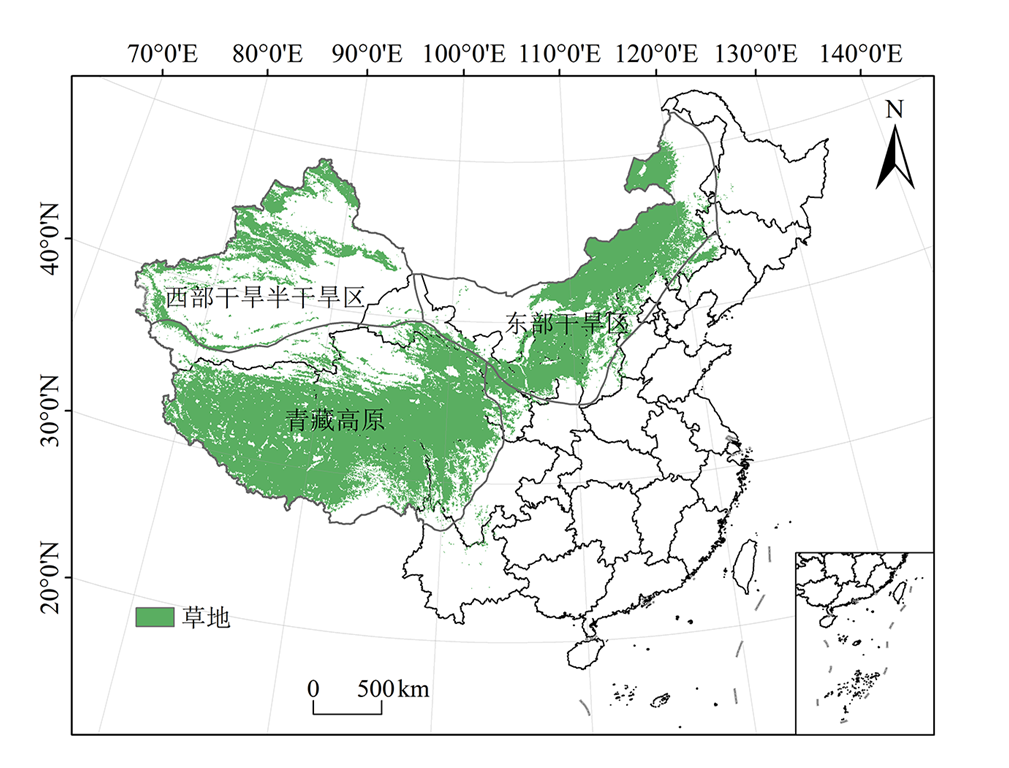
图1 中国草地分布图 根据Wang et al.(2020)的研究将研究区分为西部干旱半干旱区、青藏高原、东部干旱区。本图基于国家地理信息公共服务平台下载,审图号为GS(2024)0650号;底图边界无修改。下同
Figure 1 Distribution of grasslands in China
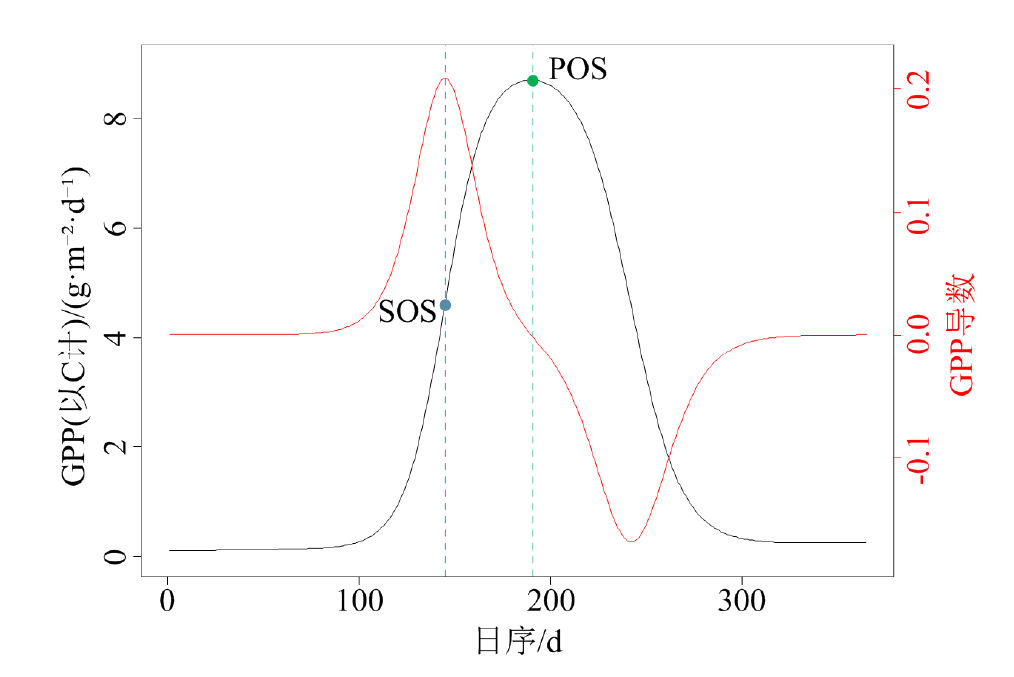
图2 基于GOSIF GPP时序物候提取示意图 黑线表示基于logistic函数拟合后的GPP时序曲线,红线表示logistic函数拟合的GPP曲线导数;SOS表示春季物候,POS表示生长季峰值物候,GPP表示总初级生产力,POS对应的GPP为GPPmax。下同
Figure 2 Schematic diagram for phenological extraction of GOSIF GPP time series
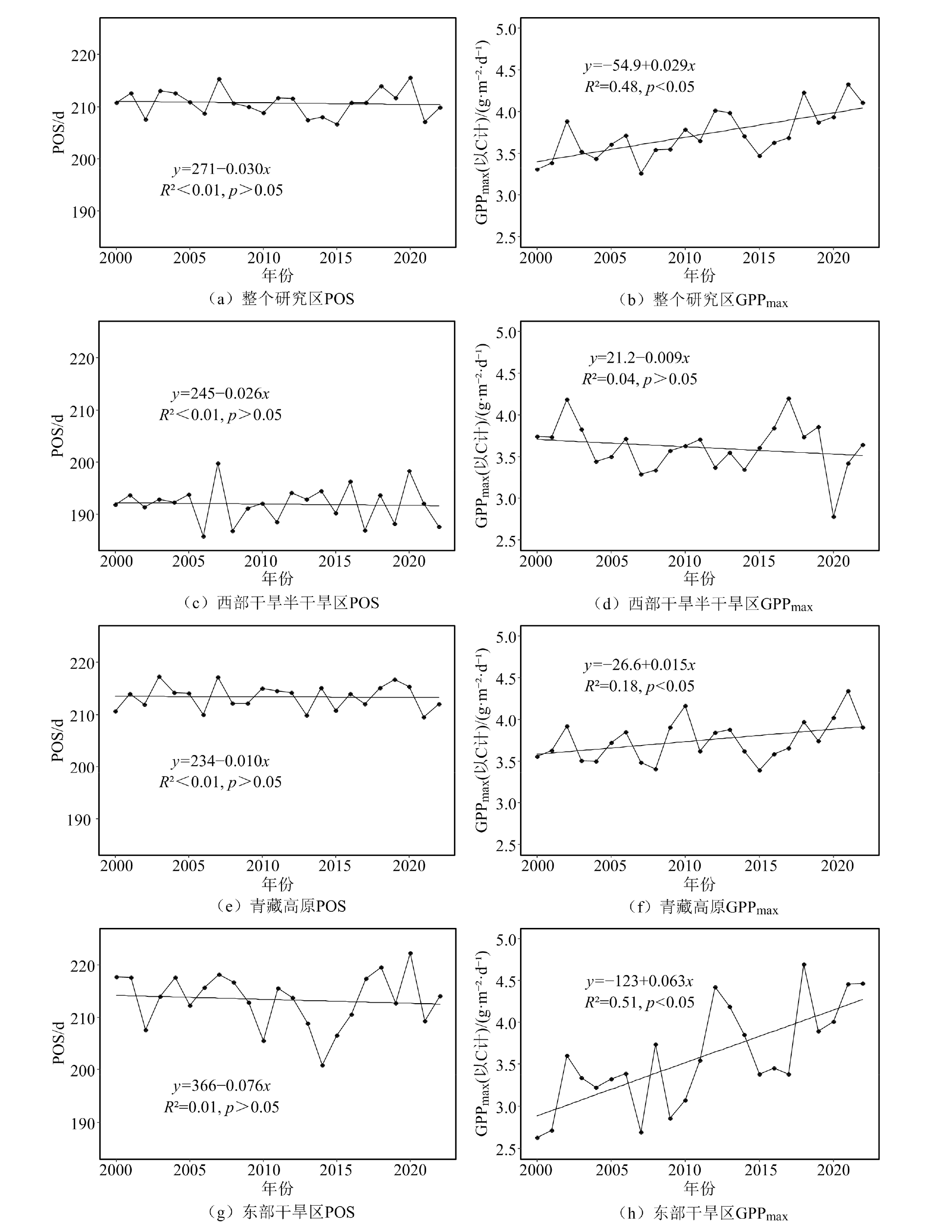
图3 2000-2022年中国草地POS、GPPmax年际变化趋势
Figure 3 Interannual trends of POS and GPPmax in Chinese grasslands from 2000 to 2022
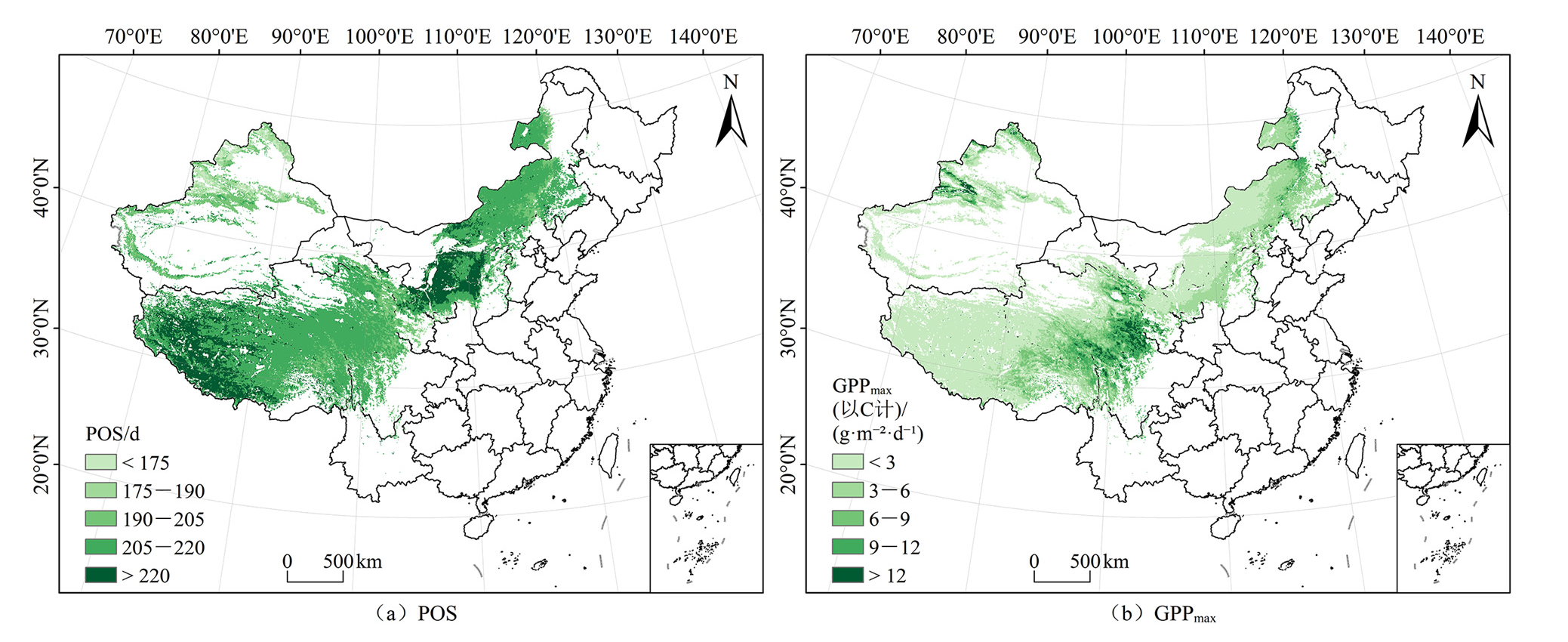
图4 2000-2022年中国草地POS、GPPmax均值空间分布
Figure 4 Spatial distribution of mean POS and GPPmax in Chinese grasslands from 2000 to 2022
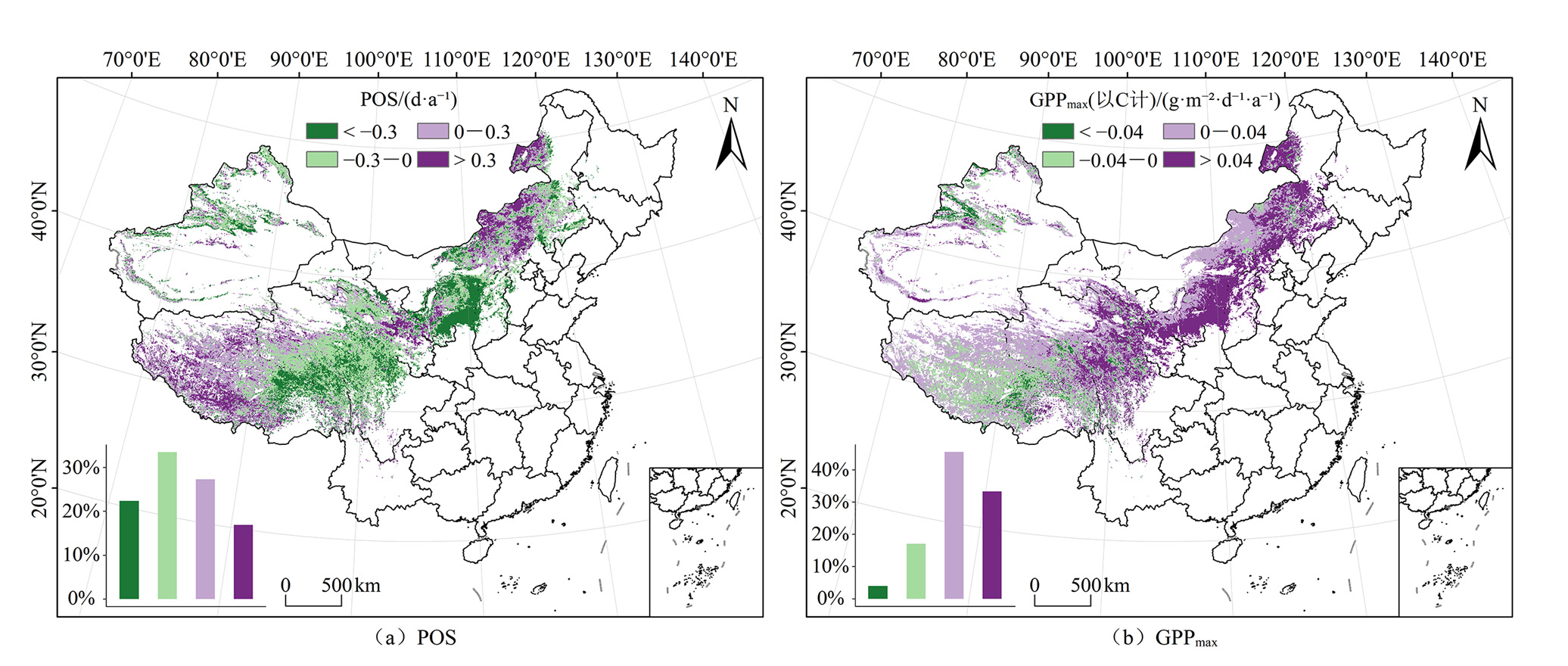
图5 2000-2022年中国草地POS、GPPmax变化趋势 图中百分数表示像元占比,下同
Figure 5 Trends in POS and GPPmax in Chinese grasslands from 2000 to 2022

图6 POS、GPPmax分别与影响因子(SOS、温度、降水)变化趋势的异同 PRE代表降水,TEM为温度;“+”表示正趋势,“?”表示负趋势
Figure 6 Similarities and differences in the trends of POS and GPPmax with influencing factors (SOS, temperature, precipitation)

图7 POS、GPPmax分别与影响因子(SOS、温度、降水)的偏相关空间格局
Figure 7 Partial Correlation Spatial Patterns of POS and GPPmax with influencing factors (SOS, temperature, precipitation)
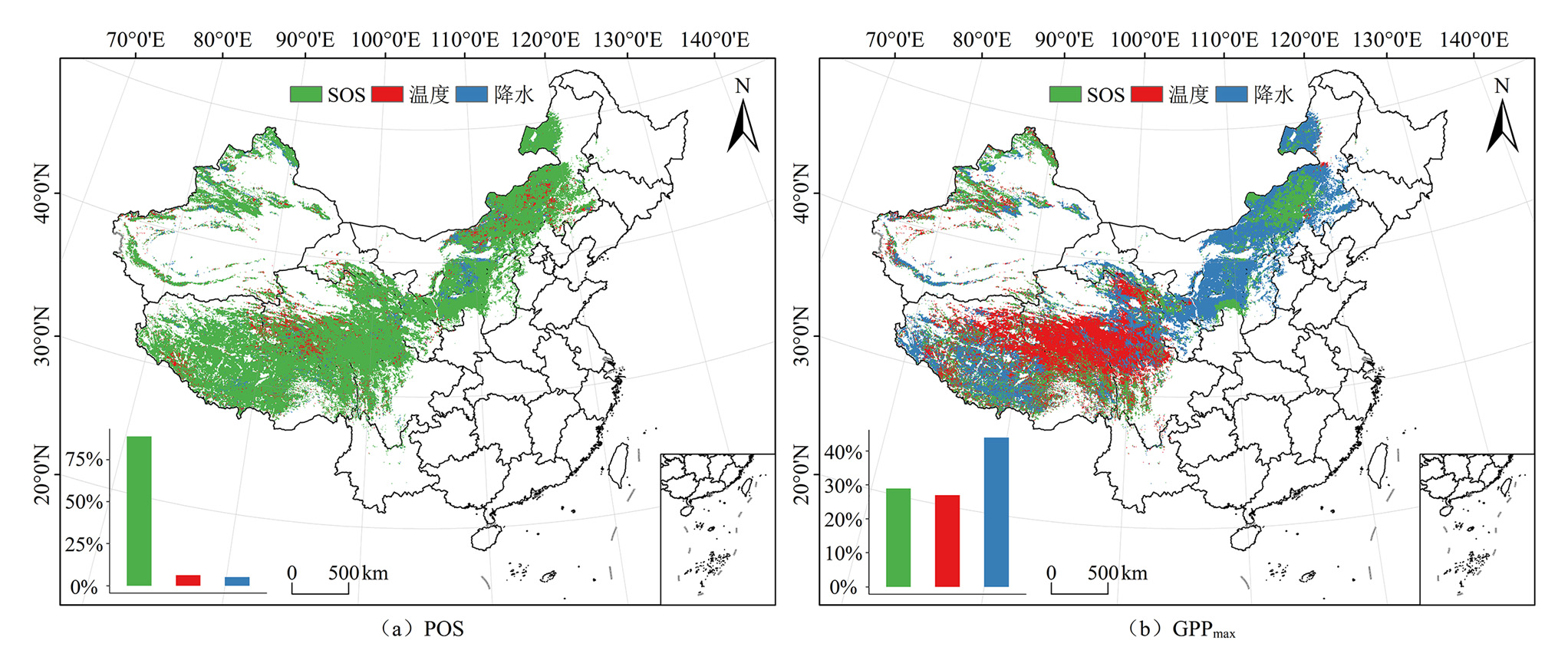
图8 基于偏相关显著性水平识别出的POS与GPPmax的主控因子
Figure 8 The most significant factor controlling POS and GPPmax, according to the significance level of the partial correlation
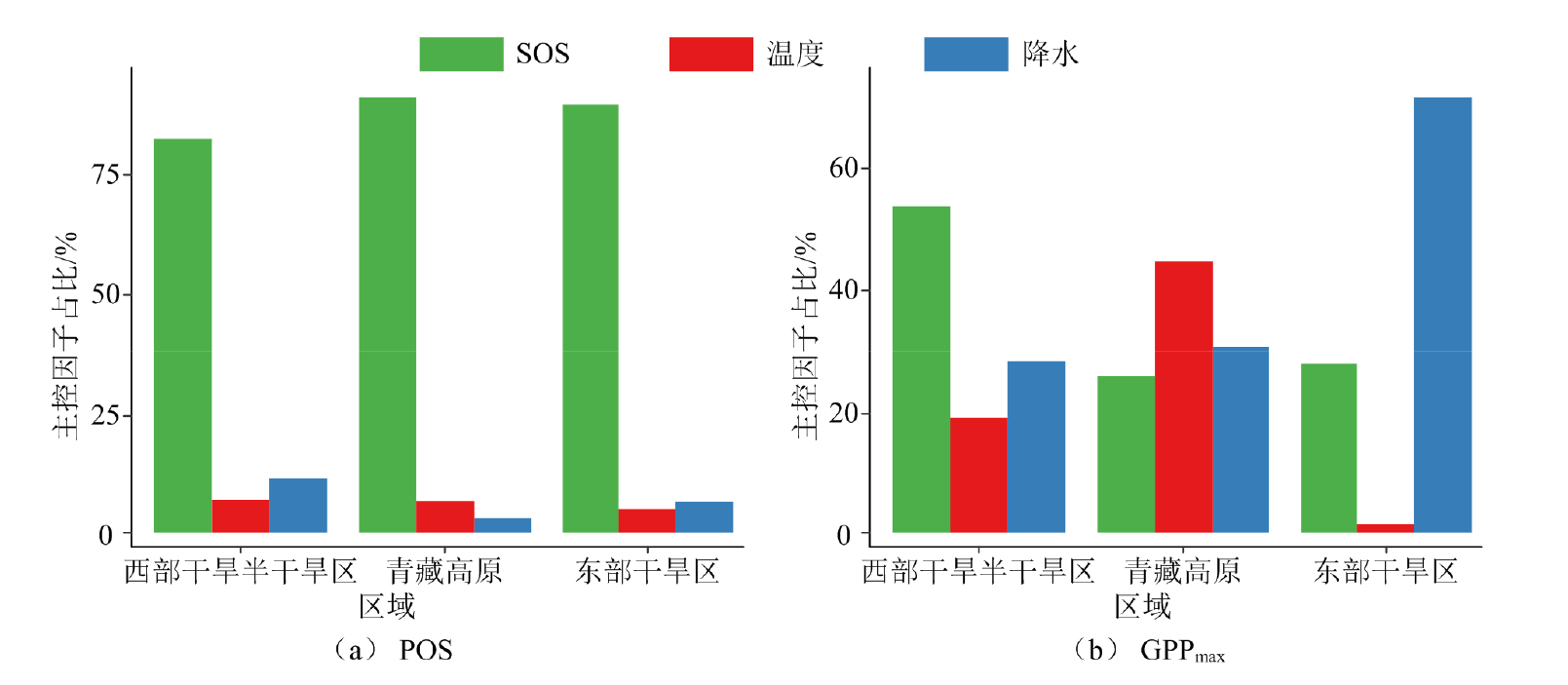
图9 3个分区的主控因子
Figure 9 Dominant controlling factors in the three subregions
| [1] |
CHEN J, JÖNSSON P, TAMURA M, et al., 2004. A simple method for reconstructing a high-quality NDVI time-series data set based on the Savitzky-Golay filter[J]. Remote Sensing of Environment, 91(3-4): 332-344.
DOI URL |
| [2] |
DING M J, ZHANG Y L, SUN X M, et al., 2013. Spatiotemporal variation in alpine grassland phenology in the Qinghai-Tibetan Plateau from 1999 to 2009[J]. Chinese Science Bulletin, 58(3): 396-405.
DOI URL |
| [3] |
DONG T, LIU J, SHI M J, et al., 2024. Seasonal scale climatic factors on grassland phenology in arid and semi-arid zones[J]. Land, 13(5): 653.
DOI URL |
| [4] |
ELMORE A J, GUINN S M, MINSLEY B J, et al., 2012. Landscape controls on the timing of spring, autumn, and growing season length in mid-Atlantic forests[J]. Global Change Biology, 18(2): 656-674.
DOI URL |
| [5] |
FANG J, LI X, XIAO J F, et al., 2023. Vegetation photosynthetic phenology metrics in northern terrestrial ecosystems[J]. Scientific Data, 10(1): 300.
DOI |
| [6] |
FU Y S, LI X X, CHEN S Z, et al., 2022. Soil moisture regulates warming responses of autumn photosynthetic transition dates in subtropical forests[J]. Global Chang Biology, 28(16): 4935-4946.
DOI URL |
| [7] |
GONSAMO A, CHEN J M, OOI Y W, 2018. Peak season plant activity shift towards spring is reflected by increasing carbon uptake by extratropical ecosystems[J]. Global Chang Biology, 24(5): 2117-2128.
DOI URL |
| [8] |
GUO Q, LI S G, HU Z M, et al., 2016. Responses of gross primary productivity to different sizes of precipitation events in a temperate grassland ecosystem in Inner Mongolia, China[J]. Journal of Arid Land, 8(1): 36-46.
DOI |
| [9] |
HE P X, MA X L, MENG X Y, et al., 2022. Spatiotemporal evolutionary and mechanism analysis of grassland GPP in China[J]. Ecological Indicators, 143: 109323.
DOI URL |
| [10] | HUANG K, XIA J Y, WANG Y P, et al., 2018. Enhanced peak growth of global vegetation and its key mechanisms[J]. Nature Ecology & Evolution, 2(12): 1897-1905. |
| [11] |
HUANG Z, ZHOU L, CHI Y G, 2023. Spring phenology rather than climate dominates the trends in peak of growing season in the Northern Hemisphere[J]. Global Chang Biology, 29(16): 4543-4555.
DOI URL |
| [12] |
LI X, XIAO J F, 2019. Mapping photosynthesis solely from solar-induced chlorophyll fluorescence: A global, fine-resolution dataset of gross primary production derived from OCO-2[J]. Remote Sensing, 11(21): 2563.
DOI URL |
| [13] |
LI Z Z, WANG R H, LIU B, et al., 2022. Responses of vegetation autumn phenology to climatic factors in northern China[J]. Sustainability, 14(14): 8590.
DOI URL |
| [14] |
LI J H, HUANG L, CAO W, et al., 2023a. Benefits, potential and risks of China’s grassland ecosystem conservation and restoration[J]. Science of The Total Environment, 905: 167413.
DOI URL |
| [15] |
LI Z N, QU H C, LI L, et al., 2023b. Effects of climate change on vegetation dynamics of the Qinghai-Tibet Plateau, a causality analysis using empirical dynamic modeling[J]. Heliyon, 9(5): e16001.
DOI URL |
| [16] |
LIU E H, ZHOU G S, HE Q J, et al., 2022. Climatic mechanism of delaying the start and advancing the end of the growing season of Stipa krylovii in a semi-arid region from 1985-2018[J]. Agronomy, 12(8): 1906.
DOI URL |
| [17] |
MA R, SHEN X J, ZHANG J Q, et al., 2022. Variation of vegetation autumn phenology and its climatic drivers in temperate grasslands of China[J]. International Journal of Applied Earth Observation and Geoinformation, 114: 103064.
DOI URL |
| [18] |
PIAO S L, LIU Q, CHEN A P, et al., 2019. Plant phenology and global climate change: Current progresses and challenges[J]. Global Chang Biology, 25(6): 1922-1940.
DOI URL |
| [19] |
SHEN X J, LIU B H, HENDERSON M, et al., 2018. Asymmetric effects of daytime and nighttime warming on spring phenology in the temperate grasslands of China[J]. Agricultural and Forest Meteorology, 259: 240-249.
DOI URL |
| [20] |
TANG J, WANG H M, CONG N, et al., 2024. Analysis of changes in forest fegetation peak growth metrics and driving factors in a typical climatic transition zone: A case study of the Funiu Mountain, China[J]. Remote Sensing, 16(16): 2921.
DOI URL |
| [21] |
TANG Y, XU X J, ZHOU Z S, et al., 2021. Estimating global maximum gross primary productivity of vegetation based on the combination of MODIS greenness and temperature data[J]. Ecological Informatics, 63: 101307.
DOI URL |
| [22] |
WANG G, ZHANG Q, YU H Q, et al., 2020. Double increase in precipitation extremes across China in a 1.5 ℃/2.0 ℃ warmer climate[J]. Science of The Total Environment, 746: 140807.
DOI URL |
| [23] |
WANG X Y, WU C Y, 2019. Estimating the peak of growing season (POS) of China’s terrestrial ecosystems[J]. Agricultural and Forest Meteorology, 278: 107639.
DOI URL |
| [24] |
WOLF S, KEENAN T F, FISHER J B, et al., 2016. Warm spring reduced carbon cycle impact of the 2012 US summer drought[J]. Proceedings of the National Academy of Sciences of the United States of America, 113(21): 5880-5885.
DOI PMID |
| [25] |
XU X J, DU H Q, FAN W L, et al., 2019. Long-term trend in vegetation gross primary production, phenology and their relationships inferred from the FLUXNET data[J]. Journal of Environmental Management, 246: 605-616.
DOI PMID |
| [26] |
XU L, PIAO S L, LI L Z X, et al., 2020. Summer soil drying exacerbated by earlier spring greening of northern vegetation[J]. Science Advances, 6(1): eaax0255.
DOI URL |
| [27] |
YANG Q, LIU G Y, GIANNETTI B F, et al., 2020. Emergy-based ecosystem services valuation and classification management applied to China’s grasslands[J]. Ecosystem Services, 42: 101073.
DOI URL |
| [28] |
YANG J, HUANG X, 2023. The 30 m annual land cover datasets and its dynamics in China from 1985 to 2022[J]. Earth System Science Data, 13(8): 3907-3925.
DOI URL |
| [29] |
YU J C, LI X J, DU H Q, et al., 2024. Solar-induced fluorescence-based phenology of subtropical forests in China and its response to climate factors[J]. Agricultural and Forest Meteorology, 356: 110182.
DOI URL |
| [30] |
ZENG L L, Wardlow B D, XIANG D X, et al., 2020. A review of vegetation phenological metrics extraction using time-series, multispectral satellite data[J]. Remote Sensing of Environment, 237: 111511.
DOI URL |
| [31] |
ZHANG G L, ZHANG Y J, DONG J W, et al., 2013. Green-up dates in the Tibetan Plateau have continuously advanced from 1982 to 2011[J]. Proceedings of the National Academy of Sciences, 110(11): 4309-4314.
DOI URL |
| [32] |
ZHANG C B, ZHANG Y, WANG Z Q, et al., 2019. Monitoring Phenology in the Temperate Grasslands of China from 1982 to 2015 and Its Relation to Net Primary Productivity[J]. Sustainability, 12(1): 12.
DOI URL |
| [33] |
ZHANG J R, GONSAMO A, TONG X J, et al., 2023. Solar-induced chlorophyll fluorescence captures photosynthetic phenology better than traditional vegetation indices[J]. ISPRS Journal of Photogrammetry and Remote Sensing 203: 183-198.
DOI URL |
| [34] |
ZHENG K, WEI J Z, PEI J Y, et al., 2019. Impacts of climate change and human activities on grassland vegetation variation in the Chinese Loess Plateau[J]. Science of the Total Environment, 660: 236-244.
DOI URL |
| [35] | 白永飞, 赵玉金, 王扬, 等, 2020. 中国北方草地生态系统服务评估和功能区划助力生态安全屏障建设[J]. 中国科学院院刊, 35(6): 675-689. |
| BAI Y F, ZHAO Y J, WANG Y, et al., 2020. Assessment of ecosystem services and ecological regionalization of grasslands support establishment of ecological security barriers in northern China[J]. Bulletin of Chinese Academy of Sciences, 35(6): 675-689. | |
| [36] |
朝布嘎, 包刚, 元志辉, 等, 2023. 2001-2020年北半球中高纬度植被生长峰值期和峰值对气候的敏感性研究[J]. 地理科学进展, 42(9): 1809-1824.
DOI |
|
CHAO B G, BAO G, YUAN Z H, et al., 2023. Sensitivity of the peaking time of the growing season and peak EVI to climate at the middle and high latitudes of the Northern Hemisphere during 2001-2020[J]. Progress in Geography, 42(9): 1809-1824.
DOI |
|
| [37] |
龚志远, 王春林, 董丹丹, 等, 2024. 安徽省气候变化和人类活动对草地物候的影响[J]. 应用生态学报, 35(4): 1092-1100.
DOI |
|
GONG Z Y, WANG C L, DONG D D, et al., 2024. Influence of climate change and human activities on grassland phenology in Anhui Province[J]. Chinese Journal of Applied Ecology, 35(4): 1092-1100.
DOI |
|
| [38] | 管琪卉, 丁明军, 张华敏, 2019. 青藏地区高寒草地春季物候时空变化及其对气候变化的响应[J]. 山地学报, 37(5): 639-648. |
| GUAN Q H, DING M J, ZHANG H M, 2019. Spatiotemporal variation of spring phenology in alpine grassland and response to climate changes on the Qinghai-Tibet, China[J]. Mountain Research, 37(5): 639-648. | |
| [39] | 李颖, 2023. 2000-2020年中国草地生态系统植被覆盖度时空变化及其与水热因子的关系[D]. 兰州: 甘肃农业大学: 41-43. |
| LI Y, 2023. Temporal and spatial variation of vegetation coverage in Chinese grassland ecosystems and the relationship among hydrothermal factors from 2000 to 2020[D]. Lanzhou: Gansu Agricultural University: 41-43. | |
| [40] | 梁顺林, 陈晓娜, 陈琰, 等, 2023. 陆表卫星遥感GLASS产品集的研发新进展[J]. 遥感学报, 27(4): 831-856. |
|
LIANG S L, CHEN X N, CHEN Y, et al., 2023. Updates on global land surface satellite (GLASS) products suite[J]. National Remote Sensing Bulletin, 27(4): 831-856.
DOI URL |
|
| [41] | 彭守璋, 2024a. 中国1 km分辨率逐月降水量数据集 (1901-2023)[DS/OL]. 国家青藏高原科学数据中心, [2024-9-15]. https://www.tpdc.ac.cn/zh-hans/data/faae7605-a0f2-4d18-b28f-5cee413766a2. |
| PENG S Z, 2024a. 1-km monthly precipitation dataset for China (1901-2023)[DS/OL]. National Tibetan Plateau Data Center, [2024-9-15]. https://www.tpdc.ac.cn/zh-hans/data/faae7605-a0f2-4d18-b28f-5cee413766a2. | |
| [42] | 彭守璋, 2024b. 中国1 km分辨率逐月平均气温数据集(1901-2023)[DS/OL]. 国家青藏高原科学数据中心, [2024-9-15]. https://www.tpdc.ac.cn/zh-hans/data/71ab4677-b66c-4fd1-a004-b2a541c4d5bf/. |
| PENG S Z, 2024b. 1-km monthly mean temperature dataset for china (1901-2023)[DS/OL]. National Tibetan Plateau Data Center, [2024-9-15]. https://www.tpdc.ac.cn/zh-hans/data/71ab4677-b66c-4fd1-a004-b2a541c4d5bf/. | |
| [43] | 任小玢, 张东海, 俞鸿千, 等, 2022. 气候变化和人为活动在宁夏草地变化中的相对作用[J]. 生态学报, 42(19): 7989-8001. |
| REN X B, ZHANG D H, YU H Q, et al., 2022. Assessment of relative effects of climate change and human activities on grassland dynamic in Ningxia[J]. Acta Ecologica Sinica, 42(19): 7989-8001. | |
| [44] | 宋文起, 王志恒, 2023. 近30年来中国气温、降水和水分盈亏的趋势及其变化[J]. 气候与环境研究, 28(1): 1-16. |
| SONG W Q, WANG Z H, 2023. Trends and changes in temperature, precipitation, and water surplus and deficit in China over the last 30 years[J]. Climatic and Environmental Research, 28(1): 1-16. | |
| [45] |
王华, 周玉科, 王笑影, 等, 2021. 东北植被生长峰值特征的变化及对气候和物候的响应[J]. 遥感技术与应用, 36(2): 441-452.
DOI |
| WANG H, ZHOU Y K, WANG X Y, et al., 2021. Spatiotemporal changes in vegetation growth peak and the response to climate and phenology over Northeast China[J]. Remote Sensing Technology and Application, 36(2): 441-452. | |
| [46] |
吴泽洪, 汪箫悦, 2025. 基于NDVI数据的中国典型草地物候及其对生产力的影响研究[J]. 遥感技术与应用, 40(1): 237-247.
DOI |
| WU Z H, WANG X Y, 2025. Changes in phenology of typical grassland in China based on NDVI data and its effect on productivity[J]. Remote Sensing Technology and Application, 40(1): 237-247. | |
| [47] |
杨涵, 孙慧兰, 叶茂, 等, 2024. 伊犁河谷植被物候变化特征及其对气候变化的响应[J]. 草地学报, 32(3): 859-868.
DOI |
|
YANG H, SUN H L, YE M, et al., 2024. Characteristics of vegetation phenology changes and its response to climate change in the Yili River Valley[J]. Acta Agrestia Sinica, 32(3): 859-868.
DOI |
|
| [48] | 晔薷罕, 希吉日塔娜, 常虹, 等, 2024. 草地生态系统土壤与植被对极端干旱的响应研究进展[J]. 畜牧与饲料科学, 45(2): 58-72. |
| YE R H, XIJIRI T N, CHANG H, et al., 2024. Research progress on the response of soil and vegetation to extreme drought in grassland ecosystems[J]. Animal Husbandry and Feed Science, 45(2): 58-72. | |
| [49] | 张心竹, 王鹤松, 延昊, 等, 2021. 2001-2018年中国总初级生产力时空变化的遥感研究[J]. 生态学报, 41(16): 6351-6362. |
| ZHANG X Z, WANG H S, YAN H, et al., 2021. Analysis of spatio-temporal changes of gross primary productivity in China from 2001 to 2018 based on Romote Sensing[J]. Acta Ecologica Sinica, 41(16): 6351-6362. | |
| [50] | 赵泽钰, 杨阳, 黄娅兰, 等, 2024. 草地植被生产力模拟及其影响因素[J]. 草业科学, 41(1): 163-177. |
| ZHAO Z Y, YANG Y, HUANG Y L, et al., 2024. Simulation of grassland vegetation productivity and its influencing factors[J]. Pratacultural Science, 41(1): 163-177. | |
| [51] | 俎佳星, 杨健, 2016. 东北地区植被物候时序变化[J]. 生态学报, 36(7): 2015-2023. |
| ZU J X, YANG J, 2016. Temporal variation of vegetation phenology in northeastern China[J]. Acta Ecologica Sinica, 36(7): 2015-2023. |
| [1] | 余燕鞠, 丁雪. 滇中城市群森林植被净初级生产力时空变化特征及其影响因素研究[J]. 生态环境学报, 2026, 35(2): 209-222. |
| [2] | 吴锡言, 李维军, 卡那特, 彭玉杰. 基于随机森林和OCO-2遥感数据分析2023年中国连续时空xCO2变化特征[J]. 生态环境学报, 2025, 34(9): 1341-1350. |
| [3] | 赵文琪, 张佳华, 张鹏, 白林燕, 姚凤梅. 植被物候监测技术与遥感反演方法研究进展[J]. 生态环境学报, 2025, 34(9): 1473-1482. |
| [4] | 张晟博, 吴作航, 党皓飞, 廖廓, 陆灯盛, 李登秋. 近20年武夷山地区不同遥感指标对极端气候事件的响应及差异[J]. 生态环境学报, 2025, 34(8): 1240-1254. |
| [5] | 丁馨, 刘健, 魏俐宏, 解德威, 郑昭佩. 基于GSMSR模型的山东省植被NEP时空格局及影响因素[J]. 生态环境学报, 2025, 34(7): 1079-1089. |
| [6] | 郭欣达, 付奔, 余思洁, 侯鹰, 陈卫平. 城市内涝和夏季高温风险评价与优先管控区识别方法研究[J]. 生态环境学报, 2025, 34(5): 731-742. |
| [7] | 陈鹏, 马育军, 张梦雅, 陈婉婷, 江晓鹏. 基于kNDVI的广东省植被动态变化分析[J]. 生态环境学报, 2025, 34(4): 499-510. |
| [8] | 郭铭彬, 龚建周, 王丽娟, 王时宽. 2019-2023年粤港澳大湾区NO2浓度变化的自然主控因子解析[J]. 生态环境学报, 2025, 34(4): 534-547. |
| [9] | 蒋存征, 陈安强, 胡万里, 付斌, 朱林立, 刘云娥, 黎明琦, 王炽, 张丹. 异龙湖区浅层地下水NO3−-N浓度时空变化及其来源解析[J]. 生态环境学报, 2025, 34(4): 570-580. |
| [10] | 郭昭, 师芸, 刘铁铭, 张雨欣, 闫永智. 2001-2020年秦岭北麓NPP时空格局及驱动因素分析[J]. 生态环境学报, 2025, 34(3): 401-410. |
| [11] | 赵乐鋆, 王诗瑶, 赵子渝, 洪星, 李夫星, 吴佳仪, 华婧妤. 2008-2022年华北平原七省市AOD时空变化特征及主要影响因素分析[J]. 生态环境学报, 2025, 34(2): 256-267. |
| [12] | 陈凡, 池善庆, 林财强, 俞伯林, 谢蓉蓉, 李家兵, 黄翔峰, 张海平, 刘佳, 吴乔枫. 城市河渠-人工湖连通系统表层溶存N2O浓度及排放通量研究[J]. 生态环境学报, 2025, 34(10): 1598-1608. |
| [13] | 王恭斌, 花利忠, 卢璇, 李琳, 章欣欣, 李兰晖. 基于遥感与机器学习的中国城市夏季热岛气候带分异特征(2003-2022年)及其驱动因子分析[J]. 生态环境学报, 2025, 34(10): 1609-1617. |
| [14] | 侯金龙, 马志强, 杨澄, 葛双双, 何迪, 董璠. 京津冀地区植被碳源/汇的时空变化特征及影响因素分析[J]. 生态环境学报, 2024, 33(9): 1329-1338. |
| [15] | 戴晓爱, 马佳欣, 唐艺菱, 李为乐. 甘肃省植被时空动态变化及其归因分析[J]. 生态环境学报, 2024, 33(8): 1163-1173. |
| 阅读次数 | ||||||
|
全文 |
|
|||||
|
摘要 |
|
|||||
