
Ecology and Environmental Sciences ›› 2026, Vol. 35 ›› Issue (3): 488-498.DOI: 10.16258/j.cnki.1674-5906.2026.03.015
• Research Article [Environmental Science] • Previous Articles
SI Qin1( ), WU Youde3, WANG Tao2,3,4,*(), CUI Hongcha5, PAN Ying3, LIU Yusi3
Received:2025-06-08
Revised:2025-11-19
Accepted:2025-12-26
Online:2026-03-18
Published:2026-03-13
斯琴1(), 武友德3, 王涛2,3,4,*(), 崔红茶5, 潘莹3, 刘宇斯3
通讯作者:
*E-mail: 作者简介:斯琴(1978年生),女,副教授,硕士,主要研究方向为生态系统服务。E-mail: 704195727@qq.com
基金资助:CLC Number:
SI Qin, WU Youde, WANG Tao, CUI Hongcha, PAN Ying, LIU Yusi. The Allometric Relationship between Urbanization and Ecosystem Services in Yunnan Province and Its Interaction Mechanism[J]. Ecology and Environmental Sciences, 2026, 35(3): 488-498.
斯琴, 武友德, 王涛, 崔红茶, 潘莹, 刘宇斯. 云南省城镇化与生态系统服务异速关系及互动机制[J]. 生态环境学报, 2026, 35(3): 488-498.
Add to citation manager EndNote|Ris|BibTeX
URL: https://www.jeesci.com/EN/10.16258/j.cnki.1674-5906.2026.03.015

Figure 1 Location of the studied area
| 一级指标 | 二级指标(权重) | 三级指标 | 权重 |
|---|---|---|---|
| 综合城镇化 | 人口城镇化(0.25) | 城镇人口比例/% | 0.561 |
| 非农业人口比例/% | 0.439 | ||
| 经济城镇化(0.25) | 人均GDP/元 | 0.796 | |
| 二三产业产值占GDP比例/% | 0.204 | ||
| 社会城镇化(0.25) | 人均社会消费品零售总额/元 | 0.866 | |
| 城镇居民人均可支配收入/元 | 0.134 | ||
| 土地城镇化(0.25) | 人均道路铺设面积/m2 | 0.267 | |
| 建成区面积占城镇 土地总面积比例/% | 0.733 |
Table1 Urbanization level index system of Yunnan Province
| 一级指标 | 二级指标(权重) | 三级指标 | 权重 |
|---|---|---|---|
| 综合城镇化 | 人口城镇化(0.25) | 城镇人口比例/% | 0.561 |
| 非农业人口比例/% | 0.439 | ||
| 经济城镇化(0.25) | 人均GDP/元 | 0.796 | |
| 二三产业产值占GDP比例/% | 0.204 | ||
| 社会城镇化(0.25) | 人均社会消费品零售总额/元 | 0.866 | |
| 城镇居民人均可支配收入/元 | 0.134 | ||
| 土地城镇化(0.25) | 人均道路铺设面积/m2 | 0.267 | |
| 建成区面积占城镇 土地总面积比例/% | 0.733 |
| 异速增长类型 | 异速级别 | 划分标准 | 异速关系类型 | 异速关系特征 |
|---|---|---|---|---|
| 正异速增长 | 正异速三级 | 3≤b | 生态系统服务价值扩张强型 | 生态系统服务价值的增长速度明显快于城镇化增长速度 |
| 正异速二级 | 1≤b<3 | 生态系统服务价值扩张弱型 | 生态系统服务价值的增长速度快于城镇化相对增长速度 | |
| 正异速一级 | 0.85≤b<1 | 城镇化与生态系统服务价值基本协调型 | 生态系统服务价值的增长速度稍快于城镇化相对增长速度 | |
| 负异速增长 | 负异速一级 | 0.5≤b<0.85 | 城镇化扩张弱型 | 生态系统服务价值的增长速度稍慢于城镇化相对增长速度 |
| 负异速二级 | 0≤b<0.5 | 城镇化扩张强型 | 生态系统服务价值增长速度慢于城镇化相对增长速度 | |
| 负异速三级 | b<0 | 城镇化规模有所收缩型 | 生态系统服务价值和城镇化其中一个减少或同时减少 |
Table 2 Allometric relationship between urbanization and ecosystem services in Yunnan Province
| 异速增长类型 | 异速级别 | 划分标准 | 异速关系类型 | 异速关系特征 |
|---|---|---|---|---|
| 正异速增长 | 正异速三级 | 3≤b | 生态系统服务价值扩张强型 | 生态系统服务价值的增长速度明显快于城镇化增长速度 |
| 正异速二级 | 1≤b<3 | 生态系统服务价值扩张弱型 | 生态系统服务价值的增长速度快于城镇化相对增长速度 | |
| 正异速一级 | 0.85≤b<1 | 城镇化与生态系统服务价值基本协调型 | 生态系统服务价值的增长速度稍快于城镇化相对增长速度 | |
| 负异速增长 | 负异速一级 | 0.5≤b<0.85 | 城镇化扩张弱型 | 生态系统服务价值的增长速度稍慢于城镇化相对增长速度 |
| 负异速二级 | 0≤b<0.5 | 城镇化扩张强型 | 生态系统服务价值增长速度慢于城镇化相对增长速度 | |
| 负异速三级 | b<0 | 城镇化规模有所收缩型 | 生态系统服务价值和城镇化其中一个减少或同时减少 |
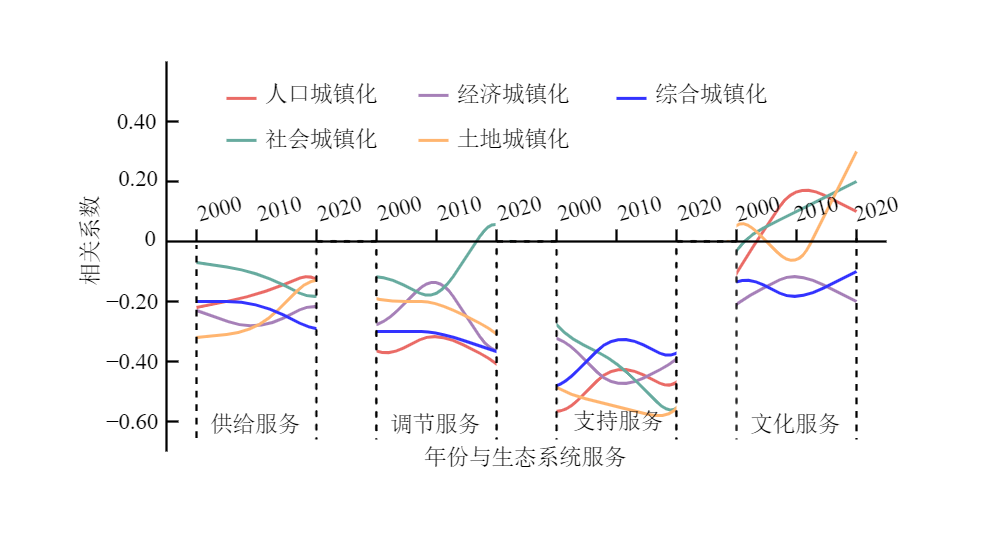
Figure 2 The Evolution of the Relationship between Urbanization and Ecosystem Services in Yunnan Province from 2000 to 2020

Figure 3 Spatiotemporal changes in the coupling and coordination of urbanization with supply services, regulation services, support services, and cultural services in Yunnan Province

Figure 4 Fitting model and allometric grade map of urbanization and ecosystem service allometric growth in Yunnan Province from 2000 to 2020

Figure 5 Allometric types and changes of urbanization and ecosystem services in Yunnan Province
| 变量 | 供给服务 | 调节服务 | 支持服务 | 文化服务 | |||||||||||
|---|---|---|---|---|---|---|---|---|---|---|---|---|---|---|---|
| 2000年 | 2010年 | 2020年 | 2000年 | 2010年 | 2020年 | 2000年 | 2010年 | 2020年 | 2000年 | 2010年 | 2020年 | ||||
| 城镇化水平 | −0.391*** (0.031) | −0.463*** (0.027) | −0.402*** (0.036) | −0.514*** (0.062) | −0.467*** (0.055) | −0.511*** (0.039) | −0.459*** (0.066) | −0.502*** (0.054) | −0.496*** (0.047) | −0.661*** (0.041) | −0.624*** (0.039) | −0.591*** (0.044) | |||
| 城镇化水平平方项 | 0.729*** (0.217) | 0.401*** (0.097) | 0.532*** (0.128) | 0.836*** (0.114) | 0.756*** (0.195) | 0.533*** (0.151) | 0.698*** (0.136) | 0.701*** (0.128) | 0.569*** (0.166) | 0.667*** (0.121) | 0.703*** (0.193) | 0.688*** (0.124) | |||
| 常数 | −0.013*** (0.008) | −0.006*** (0.003) | −0.019*** (0.010) | −0.125*** (0.011) | −0.088*** (0.008) | −0.009*** (0.001) | −0.015*** (0.005) | −0.005*** (0.002) | −0.066*** (0.012) | −0.006*** (0.002) | −0.003 (0.001) | −0.009 (0.004) | |||
| 空间滞后项 | −1.105*** (0.003) | −0.982*** (0.004) | −1.413*** (0.003) | −0.792*** (0.004) | −0.895*** (0.010) | −1.088*** (0.013) | −0.736*** (0.005) | −0.805*** (0.004) | −.933*** (0.002) | −0.623*** (0.011) | −0.771 (0.011) | −0.801 (0.009) | |||
| 空间误差项 | −0.517*** (0.022) | −0.436*** (0.006) | −0.472*** (0.011) | −0.635*** (0.21) | −0.368*** (0.17) | −0.559*** (0.13) | −0.552*** (0.021) | −0.495*** (0.014) | −0.609*** (0.018) | −0.774*** (0.011) | −0.713 (0.009) | −0.665 (0.016) | |||
| 拟合指标 | |||||||||||||||
| 对数似然值 | 13681.1 | 13625.1 | 13026.3 | 19645.3 | 18623.1 | 19010.2 | 14963.2 | 149083.6 | 15032.1 | 18631.7 | 18669.3 | 18902.5 | |||
| 赤池准则(AIC) | −26736.6 | −26456.3 | −26013.7 | −32561.3 | −32869.3 | −32001.6 | −29635.3 | −29550.2 | −29067.5 | −30256.3 | −31052.9 | −31126.7 | |||
| 贝叶斯信息准则(BIC) | −26776.2 | −26435.9 | −26000.2 | −32509.4 | −32074.6 | −31986.6 | −29053.2 | −29003.6 | −29157.8 | −29631.4 | −31265.7 | −30256.1 | |||
| 系数 | 0.801 | 0.737 | 0.781 | 0.772 | 0.694 | 0.803 | 0.698 | 0.803 | 0.761 | 0.802 | 0.769 | 0.771 | |||
| 样本量 | 15764 | 15764 | 15764 | 15764 | 15764 | 15764 | 15764 | 15764 | 15764 | 15764 | 15764 | 15764 | |||
Table 3 The SEMLD model returns results
| 变量 | 供给服务 | 调节服务 | 支持服务 | 文化服务 | |||||||||||
|---|---|---|---|---|---|---|---|---|---|---|---|---|---|---|---|
| 2000年 | 2010年 | 2020年 | 2000年 | 2010年 | 2020年 | 2000年 | 2010年 | 2020年 | 2000年 | 2010年 | 2020年 | ||||
| 城镇化水平 | −0.391*** (0.031) | −0.463*** (0.027) | −0.402*** (0.036) | −0.514*** (0.062) | −0.467*** (0.055) | −0.511*** (0.039) | −0.459*** (0.066) | −0.502*** (0.054) | −0.496*** (0.047) | −0.661*** (0.041) | −0.624*** (0.039) | −0.591*** (0.044) | |||
| 城镇化水平平方项 | 0.729*** (0.217) | 0.401*** (0.097) | 0.532*** (0.128) | 0.836*** (0.114) | 0.756*** (0.195) | 0.533*** (0.151) | 0.698*** (0.136) | 0.701*** (0.128) | 0.569*** (0.166) | 0.667*** (0.121) | 0.703*** (0.193) | 0.688*** (0.124) | |||
| 常数 | −0.013*** (0.008) | −0.006*** (0.003) | −0.019*** (0.010) | −0.125*** (0.011) | −0.088*** (0.008) | −0.009*** (0.001) | −0.015*** (0.005) | −0.005*** (0.002) | −0.066*** (0.012) | −0.006*** (0.002) | −0.003 (0.001) | −0.009 (0.004) | |||
| 空间滞后项 | −1.105*** (0.003) | −0.982*** (0.004) | −1.413*** (0.003) | −0.792*** (0.004) | −0.895*** (0.010) | −1.088*** (0.013) | −0.736*** (0.005) | −0.805*** (0.004) | −.933*** (0.002) | −0.623*** (0.011) | −0.771 (0.011) | −0.801 (0.009) | |||
| 空间误差项 | −0.517*** (0.022) | −0.436*** (0.006) | −0.472*** (0.011) | −0.635*** (0.21) | −0.368*** (0.17) | −0.559*** (0.13) | −0.552*** (0.021) | −0.495*** (0.014) | −0.609*** (0.018) | −0.774*** (0.011) | −0.713 (0.009) | −0.665 (0.016) | |||
| 拟合指标 | |||||||||||||||
| 对数似然值 | 13681.1 | 13625.1 | 13026.3 | 19645.3 | 18623.1 | 19010.2 | 14963.2 | 149083.6 | 15032.1 | 18631.7 | 18669.3 | 18902.5 | |||
| 赤池准则(AIC) | −26736.6 | −26456.3 | −26013.7 | −32561.3 | −32869.3 | −32001.6 | −29635.3 | −29550.2 | −29067.5 | −30256.3 | −31052.9 | −31126.7 | |||
| 贝叶斯信息准则(BIC) | −26776.2 | −26435.9 | −26000.2 | −32509.4 | −32074.6 | −31986.6 | −29053.2 | −29003.6 | −29157.8 | −29631.4 | −31265.7 | −30256.1 | |||
| 系数 | 0.801 | 0.737 | 0.781 | 0.772 | 0.694 | 0.803 | 0.698 | 0.803 | 0.761 | 0.802 | 0.769 | 0.771 | |||
| 样本量 | 15764 | 15764 | 15764 | 15764 | 15764 | 15764 | 15764 | 15764 | 15764 | 15764 | 15764 | 15764 | |||

Figure 6 Interaction mechanism of allometric relationship between urbanization and ecosystem services in Yunnan Province
| [1] |
CHI G Q, ZHU J, 2008. Spatial regression models for demographic analysis[J]. Population Research and Policy Review, 27(1): 17-42.
DOI URL |
| [2] |
COSTANZA R ARGE, GROOT R, et al., 1997. The value of the world’s ecosystem services and natural capital[J]. Nature, 387(6630): 253-260.
DOI |
| [3] |
COSTANZA R, DE GROOT R, SUTTON P, et al., 2014. Changes in the global value of ecosystem services[J]. Global Environmental Change, 26(5): 152-158.
DOI URL |
| [4] |
GUAN Q C, HAO J M, REN G P, et al., 2020. Ecological indexes for the analysis of the spatial-temporal characteristics of ecosystem service supply and demand: A case study of the major grain-producing regions in Quzhou, China[J]. Ecological Indicators, 108: 105748.
DOI URL |
| [5] |
HAN R, FENG C C, XU N Y, et al., 2003. Spatial heterogeneous relationship between ecosystem services and human disturbances: A case study in Chuandong[J]. Science of the Total Environment, 721(7): 137818.
DOI URL |
| [6] |
LIANG L W, WANG Z B, LI J X, 2019. The effect of urbanization on environmental pollution in rapidly developing urban agglomerations[J]. Journal of Cleaner Production, 237: 117649.
DOI URL |
| [7] |
LIU W, ZHAN J Y, ZHAO F, 2019. Impacts of urbanization-induced land-use changes on ecosystem services: A case study of the Pearl River Delta Metropolitan Region, China[J]. Ecological Indicators, 98: 228-238.
DOI URL |
| [8] |
WOLFF S, SCHULP C J E, KASTNER T, et al., 2017. Quantifying spatial variation in ecosystem services demand: A global mapping approach[J]. Ecological Economics, 136: 14-29.
DOI URL |
| [9] |
WU X, LIU S L, ZHAO S, et al., 2019. Quantification and driving force analysis of ecosystem services supply, demand and balance in China[J]. Science of the Total Environment, 652: 1375-1386.
DOI URL |
| [10] | WANG Y, FU Q, GUO J, et al., 2024. Unveiling the dynamics of urbanization and ecosystem services: Insights from the Su-Xi-Chang Region, China[J]. Urban Sustainability, 4(1): 36-36. |
| [11] | YUAN Y J, CHEN D X, WU S H, et al., 2019. Urban sprawl decreases the value of ecosystem services and intensifies the supply scarcity of ecosystem services in China[J]. Science of the Total Environment, 697: 134-170. |
| [12] |
ZHANG T, LIU S, WANG M, et al., 2024. Integrating dual evaluation and FLUS model for land use simulation and urban growth boundary delineation in production-living-ecology spaces: A case study of Central Harbin, China[J]. Geocarto International, 39(1): 2392881.
DOI URL |
| [13] |
ZHANG X X, BRANDT M, TONG X W, et al., 2022. A large but transient carbon sink from urbanization and rural depopulation in China[J]. Nature Sustainability, 5: 321-328.
DOI |
| [14] |
ZHANG Y, LI J, LIU X F, et al., 2023. Do carbon sequestration and food security in urban and rural landscapes differ in patterns, relationships, and responses?[J]. Applied Geography, 160: 103100.
DOI URL |
| [15] |
陈刚, 吴清, 杨俭波, 等, 2021. 中国国家森林乡村的空间分布特征与影响因素[J]. 经济地理, 41(6): 196-204.
DOI |
|
CHEN G, WU Q, YANG J B, et al., 2021. Spatial distribution characteristics and influencing factors of national forest villages in China[J]. Economic Geography, 41(6): 196-204.
DOI |
|
| [16] | 程琳, 李锋, 邓华锋, 2011. 中国超大城市土地利用状况及其生态系统服务动态演变[J]. 生态学报, 31(20): 6194-6203. |
| CHENG L, LI F, DENG H F, 2011. Land use status and dynamic evolution of ecosystem services in China's mega-cities[J]. Acta Ecologica Sinica, 31(20): 6194-6203. | |
| [17] | 陈相标, 丁文荣, 2025. 滇中地区生态系统服务供需匹配与生态管理分区[J]. 生态科学, 44(2): 186-196. |
| CHEN X B, DING W R, 2025. Ecosystem service supply and demand matching and ecological management zoning in central Yunnan[J]. Ecological Science, 44(2): 186-196. | |
| [18] | 陈彦光, 周一星, 2001. 基于RS数据的城市系统异速生长分析和城镇化水平预测模型: 基本理论与应用方法[J]. 北京大学学报(自然科学版), 37(6): 819-826. |
| CHEN Y G, ZHOU Y X, 2001. Allometric growth analysis and urbanization level prediction model of urban system based on RS data: basic theory and application method[J]. Journal of Peking University (Natural Science), 37(6): 819-826. | |
| [19] | 陈彦光, 2013. 城市异速标度研究的起源、困境和复兴[J]. 地理研究, 32(6): 1033-1045. |
| CHEN Y G, 2013. The origin, difficulties and revival of urban allometric scaling research[J]. Geographical Research, 32(6): 1033-1045. | |
| [20] |
丛晓男, 2019. 耦合度模型的形式、性质及在地理学中的若干误用[J]. 经济地理, 39(4): 18-25.
DOI |
| CONG X N, 2019. The form, nature and misuse of coupling degree model in geography[J]. Economic Geography, 39(4):18-25. | |
| [21] |
丁诗雨, 贾夏, 赵永华, 等, 2023. 秦巴山生态功能区生态系统服务供需关系时空演变研究[J]. 生态环境学报, 32(12): 2236-2248.
DOI |
| DING S Y, JIA X, ZHAO Y G, et al., 2023. Spatial-temporal patterns of supply and demand of ecosystem services in the ecological function area of Qin-Ba Mountains[J]. Journal of Ecology and Environment, 32(12): 2236-2248. | |
| [22] | 洪银兴, 陈雯, 2023. 由城镇化转向新型城市化: 中国式现代化征程中的探索[J]. 经济研究, 58(6): 4-18. |
| HONG Y X, CHEN W, 2023. From urbanization to new urbanization: exploration in the journey of Chinese-style modernization[J]. Economic Research, 58(6): 4-18. | |
| [23] | 雷绪斌, 朱玉林, 孙巧雨, 2025. 数字经济对新型城镇化发展的影响机制研究[J]. 经济纵横 (7): 104-113. |
| LEI X B, ZHU Y L, SUN Q Y, 2025. Research on the impact mechanism of digital economy on the development of new urbanization[J]. Economic Vertical and Horizontal (7): 104-113. | |
| [24] |
李汝资, 黄晓玲, 刘耀彬, 2023. 2010-2020年中国城镇化的时空分异及影响因素[J]. 地理学报, 78(4): 777-791.
DOI |
| LI R Z, HUANG X L, LIU Y B, 2023. Spatio-temporal differentiation and influencing factors of urbanization in China from 2010 to 2020[J]. Acta Geographica Sinica, 78(4): 777-791. | |
| [25] |
李宇珅, 冯志昕, 刘晔, 等, 2025. 中国城镇化及居住环境对老年人健康水平的影响研究[J]. 地理科学, 45(2): 290-302.
DOI |
| LI Y S, FENG Z X, LIU Y, et al., 2025. Research on the impact of urbanization and living environment on the health level of the elderly in China[J]. Geographical Science, 45(2): 290-302. | |
| [26] |
刘达, 李志刚, 2025. 人口回流视角下的县域城镇化模式类型及演进特征——以湖北天沔地区为例[J]. 地理学报, 80(10): 2708-2719.
DOI |
|
LIU D, LI Z G, 2025. Types and evolutionary characteristics of county-level urbanization models from the perspective of population return: a case study of Tianmen area in Hubei province[J]. Acta Geographica Sinica, 80(10): 2708-2719.
DOI |
|
| [27] | 罗赵慧, 王一超, 朱璐平, 等, 2025. 粤港澳大湾区景观格局演变及其对生态系统服务价值影响[J]. 生态科学, 44(3): 40-50. |
| LUO Z H, WANG Y C, ZHU L P, et al., 2025. Evolution of landscape pattern in the Guangdong-Hong Kong-Macao Greater Bay Area and its impact on ecosystem service value[J]. Ecological Science, 44(3): 40-50. | |
| [28] | 梅怡明, 江立芸, 孙浩翔, 等, 2024. 基于InVEST模型的梁子湖流域水生态系统服务价值评估[J]. 环境科学与技术, 47(11): 57-66. |
| MEI Y M, JIANG L Y, SUN H X, et al., 2024. Evaluation of water ecosystem service value in Liangzi lake basin based on InVEST model[J]. Environmental Science and Technology, 47(11): 57-66. | |
| [29] | 孟凡迪, 周智, 张贵军, 等, 2023. 基于生态系统服务供需与生态恢复力的国土空间生态修复分区——以京津冀为例[J]. 中国生态农业学报(中英文), 31(9): 1496-1510. |
| MENG F D, ZHOU Z, ZHANG G J, et al., 2023. Ecological restoration zoning of territorial space based on ecosystem service supply and demand and ecological resilience: A case study of Beijing-Tianjin-Hebei[J]. Chinese Journal of Ecological Agriculture (Chinese and English), 31(9): 1496-1510. | |
| [30] | 田慧霞, 覃阳毅, 李祖政, 等, 2025. 北京市生态系统服务演变及其对城市化的多尺度响应[J]. 生态学报, 45(5): 2209-2224. |
| TIAN H X, QIN Y Y, LI Z Z, et al., 2025. The evolution of ecosystem services in Beijing and its multi-scale response to urbanization[J]. Chinese Journal of Ecology, 45(5): 2209-2224. | |
| [31] |
童彦, 潘玉君, 张梅芬, 等, 2020. 云南人口城市化与土地城市化耦合协调发展研究[J]. 世界地理研究, 29(1): 120-129.
DOI |
| TONG Y, PAN Y J, ZHANG M F, et al., 2020. Study on the coupling and coordinated development of population urbanization and land urbanization in Yunnan[J]. World Geographical Research, 29(1): 120-129. | |
| [32] |
万世龙, 杨海楠, 马丽, 等, 2024. 黄河流域城市群水生态系统服务与城镇化权衡协同关系[J]. 资源科学, 46(3): 505-523.
DOI |
| WAN S L, YANG H N, MA L, et al., 2024. Synergistic relationship between water ecosystem services and urbanization in urban agglomerations in the Yellow River Basin[J]. Resources Science, 46(3): 505-523. | |
| [33] | 吴蒙, 周冯琦, 程进, 2021. 基于生态系统服务的快速城市化地区空间冲突测度及时空演变特征[J]. 中国人口·资源与环境, 31(5): 12-20. |
| WU M, ZHOU F Q, CHENG J, 2021. Spatial conflict measurement and spatio-temporal evolution characteristics of rapid urbanization areas based on ecosystem services[J]. Chinese Population Resources and Environment, 31(5): 12-20. | |
| [34] | 谢高地, 林智钦, 2024. 生态系统资产与服务评估核算研究[J]. 中国软科学 (S1): 388-393. |
| XIE G D, LIN Z Q, 2024. Research on the evaluation and accounting of ecosystem assets and services[J]. China Soft Science (S1): 388-393. | |
| [35] | 叶延琼, 李逸勉, 章家恩, 2011. 城市化过程中广州市农业生态系统服务价值的变化[J]. 应用生态学报, 22(6): 1523-1530. |
| YE Y Q, LI Y M, ZHANG J E, 2011. Changes in the value of agricultural ecosystem services in Guangzhou during urbanization[J]. Journal of Applied Ecology, 22(6): 1523-1530. | |
| [36] | 易成栋, 袁佳丽, 郑亮, 等, 2024. 基于夜间灯光数据的都市圈空间拓展特征及驱动因素分析[J]. 城市发展研究, 31(9): 109-117, 124. |
| YI C D, YUAN J L, ZHENG L, et al., 2024. Analysis of spatial expansion characteristics and driving factors of metropolitan area based on night lighting data[J]. Urban Development Research, 31(9): 109-117, 124. | |
| [37] |
尹上岗, 杨山, 2021. 长三角地区城市人口-绿地面积异速增长特征及驱动机制[J]. 地理研究, 40(10): 2780-2795.
DOI |
| YIN S G, YANG S, 2021. Characteristics and driving mechanism of allometric growth of urban population-green space area in Yangtze River Delta[J]. Geographical Research, 40(10): 2780-2795. | |
| [38] |
张晓平, 胡紫红, 张璐, 2023. 生态退化风险视角下的资源枯竭型城市国土空间生态保护修复——以大余县为例[J]. 测绘通报 (5): 148-152, 169.
DOI |
| ZHANG X P, HU Z H, ZHANG L, 2023. Ecological protection and restoration of land and space in resource-depleted cities from the perspective of ecological degradation risk: A case study of Dayu county[J]. Surveying and Mapping Bulletin (5): 148-152, 169. | |
| [39] |
张晓晴, 廖星月, 李果, 等, 2025. 基于DPSIR模型的湖北省长江干流城市群水生态安全评估及未来趋势预测[J]. 生态环境学报, 34(10): 1618-1632.
DOI |
| ZHANG X Q, LIAO X Y, LI G, et al., 2025. Assessment of water ecological security and future trend projection for urban agglomerations along the main stream of the Yangtze River in Hubei Province based on the DPSIR model[J]. Journal of Ecology and Environment, 34(10): 1618-1632. | |
| [40] |
张宇硕, 吴殿廷, 吕晓, 2020. 土地利用/覆盖变化对生态系统服务的影响: 空间尺度视角的研究综述[J]. 自然资源学报, 35(5): 1172-1189.
DOI |
|
ZHANG Y S, WU D T, LÜ X, 2020. The impact of land use/cover change on ecosystem services: A review from the perspective of spatial scale[J]. Journal of Natural Resources, 35(5): 1172-1189.
DOI URL |
|
| [41] |
赵雪雁, 马平易, 李文青, 等, 2021. 黄土高原生态系统服务供需关系的时空变化[J]. 地理学报, 76(11): 2780-2796.
DOI |
| ZHAO X Y, MA P Y, LI W Q, et al., 2021. Spatiotemporal variation of supply and demand of ecosystem services on the Loess Plateau[J]. Acta Geographica Sinica, 76(11): 2780-2796. |
| [1] | CUI Liyang, ZHANG Lei, JIA Xia, ZHAO Yonghua, MU Qi, SI Shaocheng. Soil Quality Assessment of Saline-alkali Land in Southern Xinjiang Combined with Ecosystem Services [J]. Ecology and Environmental Sciences, 2026, 35(2): 245-255. |
| [2] | HAN Nianlong, ZHANG Zhenlin, GAO Haojia, PENG Anqi, JI Jiahui. Identification of Ecosystem Service Bundles and Functional Zoning in the Dongjiang River Basin Based on Self-Organizing Map Neural Network [J]. Ecology and Environmental Sciences, 2026, 35(2): 289-297. |
| [3] | CHENG Hu, LI Yi, CHEN Zimo, HUANG Yanqiu, MIN Ju, SHI Weiming, ZHANG Longjiang, JI Rongting. Coordination Degree between New Urbanization and the Construction of “Beautiful China”: A Case Study of Jiangsu Province [J]. Ecology and Environmental Sciences, 2026, 35(1): 29-39. |
| [4] | HUANG Jixing, LIU Wanyi, YANG Shuqi, ZHU Weihan, ZANG Yuanrui, DAI Yongwu, LIN Jinhuang. Temporal and Spatial Trade-offs between the Production, Livelihood, and Ecological Functions of Cultivated Land from the Perspective of Ecosystem Services [J]. Ecology and Environmental Sciences, 2026, 35(1): 40-53. |
| [5] | LIN Wei, ZHOU Jinxing, HE Rongxiao, CHEN Zongzhu, CHEN Yiqing, WANG Yunlei, ZHONG Yunfang, LEI Jinrui. Temporal-Spatial Evolution of Ecosystem Service Value in the “Three-Space” System and Its Driving Factors in Northern Hainan [J]. Ecology and Environmental Sciences, 2025, 34(8): 1317-1328. |
| [6] | WANG Tianwen, LUO Mingliang, BAI Leichao. Dynamic Changes and Trade-off-Synergy Analysis of Ecosystem Services in the Jialing River Basin [J]. Ecology and Environmental Sciences, 2025, 34(6): 888-901. |
| [7] | YE Junhong, LIU Zhenhuan, LIU Ziyu. Scenarios Simulation of Territorial Space Ecological Restoration Zoning in the Pearl River Delta Urban Agglomeration Area [J]. Ecology and Environmental Sciences, 2025, 34(1): 4-12. |
| [8] | GAO Wenming, SONG Qian, ZHANG Haoxiang, WANG Shiru. Selection of Priority Conservation Areas Based on Ecosystem Service Functions and Wildlife Habitat Suitability Evaluation: A Case Study in the Sanjiang-yuan Region [J]. Ecology and Environmental Sciences, 2024, 33(8): 1318-1328. |
| [9] | WANG Wen, HOU Qingqing, PEI Tingting. Impact of the Slope on Ecosystem Services in Hedong District of Gansu Province, China [J]. Ecology and Environmental Sciences, 2024, 33(7): 1117-1129. |
| [10] | ZHANG Weichen, WANG Xingqi, WANG Bojie. Spatiotemporal Pattern and Influencing Factors of the Ecosystem Services in the Tabu River Basin [J]. Ecology and Environmental Sciences, 2024, 33(7): 1142-1152. |
| [11] | XIANG Nan, WANG Mingxu, ZHANG Hongfeng, LIAO Baogan. Research on Zoning of Ecological Conservation Importance and Its Spatio-temporal Differentiation of Habitat Status Over a Long Time Sequence: A Case Study in Guangdong Province [J]. Ecology and Environmental Sciences, 2024, 33(6): 958-968. |
| [12] | WANG Luying, LI Xiaoma, GAN Dexin, LIU Pengao, GUO Sheng, LI Yi. Spatial Heterogeneity and Driving Factors of Ecosystem Service Trade-offs and Synergies in the Changsha-Zhuzhou-Xiangtan Urban Agglomeration [J]. Ecology and Environmental Sciences, 2024, 33(6): 969-979. |
| [13] | QING Caixia, CHEN Shengbin, DENG Jiewen, DENG Xingwei, LI Zhe, QIU Lu. The Effects of Habitat Amount, Habitat Quality and Meteorological Factors on the Species Diversity of Dung Beetles in Chengdu [J]. Ecology and Environmental Sciences, 2024, 33(5): 708-719. |
| [14] | ZHU Jinwei, LIU Chengwu, KE Xinli, HUANG Limin, JIAO Wenxuan. Analysis on the Change Characteristics of Ecological Product Production Capacity in Urbanization Process: A Case Study of Hubei Yangtze River Economic Zone [J]. Ecology and Environmental Sciences, 2024, 33(3): 469-477. |
| [15] | GENG Yani, WU Tao, JIANG Peizhao, ZHANG Tengfei. Coupling Relationship between New Urbanization and Ecological Environment in Shaanxi Province and Scenario Prediction [J]. Ecology and Environmental Sciences, 2024, 33(12): 1874-1881. |
| Viewed | ||||||
|
Full text |
|
|||||
|
Abstract |
|
|||||
Copyright © 2021 Editorial Office of ACTA PETROLEI SINICA
Address:No. 6 Liupukang Street, Xicheng District, Beijing, P.R.China, 510650
Tel: 86-010-62067128, 86-010-62067137, 86-010-62067139
Fax: 86-10-62067130
Email: syxb@cnpc.com.cn
Support byBeijing Magtech Co.ltd, E-mail:support@magtech.com.cn
