
生态环境学报 ›› 2026, Vol. 35 ›› Issue (5): 819-830.DOI: 10.16258/j.cnki.1674-5906.2026.05.014
• 研究论文【环境科学】 •
上一篇
魏龙毅1( ), 林亲铁1,*(), 刘煜欣1, 万家豪1, 姚丽敏2, 钟松雄3
收稿日期:2025-10-08
修回日期:2025-12-21
接受日期:2026-01-21
出版日期:2026-05-18
发布日期:2026-05-08
通讯作者:
*E-mail: 作者简介:魏龙毅(2000年生),男,硕士研究生,从事土壤修复研究。E-mail: 2607818377@qq.com
基金资助:
WEI Longyi1(), LIN Qintie1,*(), LIU Yuxin1, WAN Jiahao1, YAO Limin2, ZHONG Songxiong3
Received:2025-10-08
Revised:2025-12-21
Accepted:2026-01-21
Online:2026-05-18
Published:2026-05-08
摘要:
砷(As)作为广泛分布于地质高背景区土壤中的潜在有毒元素,其高含量与特定赋存形态可能引发显著的生态与健康风险。为揭示典型地质高背景区土壤中砷的空间分布规律及其富集机制,以广州某高背景地块为研究对象,系统采集0-12 m深度范围内2336组土壤样品,利用分层统计方法分析砷含量的垂向变化特征,并结合区域地质调查资料将研究区划分为三类岩性单元;从高、中、低砷含量岩性中各选取3组代表性样品,开展连续提取实验以解析砷的赋存形态;进一步运用Spearman相关分析探讨砷与铁(Fe)之间的关系,并借助XRD、XPS和SEM-EDS等表征手段,揭示砷的矿物结合机制与赋存状态。结果表明,研究区土壤砷含量整体随深度增加而升高,深层土壤富集特征明显;砷形态以残渣态和铁氧化物结合态为主,活性形态占比较低,呈现出“总量高-活性低”的污染特征。砷与铁含量之间呈显著正相关(r=0.733,p<0.001)。微观表征结果进一步证实砷主要赋存于以铁、铝氧化物为主的矿物团聚体中。该研究阐明了地质高背景区土壤砷的分布规律与地球化学过程,为地质高背景土壤砷的环境风险评估与污染防控提供科学依据。
中图分类号:
魏龙毅, 林亲铁, 刘煜欣, 万家豪, 姚丽敏, 钟松雄. 广州某地质高背景地块土壤砷污染特征及成因分析[J]. 生态环境学报, 2026, 35(5): 819-830.
WEI Longyi, LIN Qintie, LIU Yuxin, WAN Jiahao, YAO Limin, ZHONG Songxiong. Arsenic Contamination Characteristics and Source Analysis in Soils of a Geogenic High-background Area in Guangzhou, China[J]. Ecology and Environmental Sciences, 2026, 35(5): 819-830.
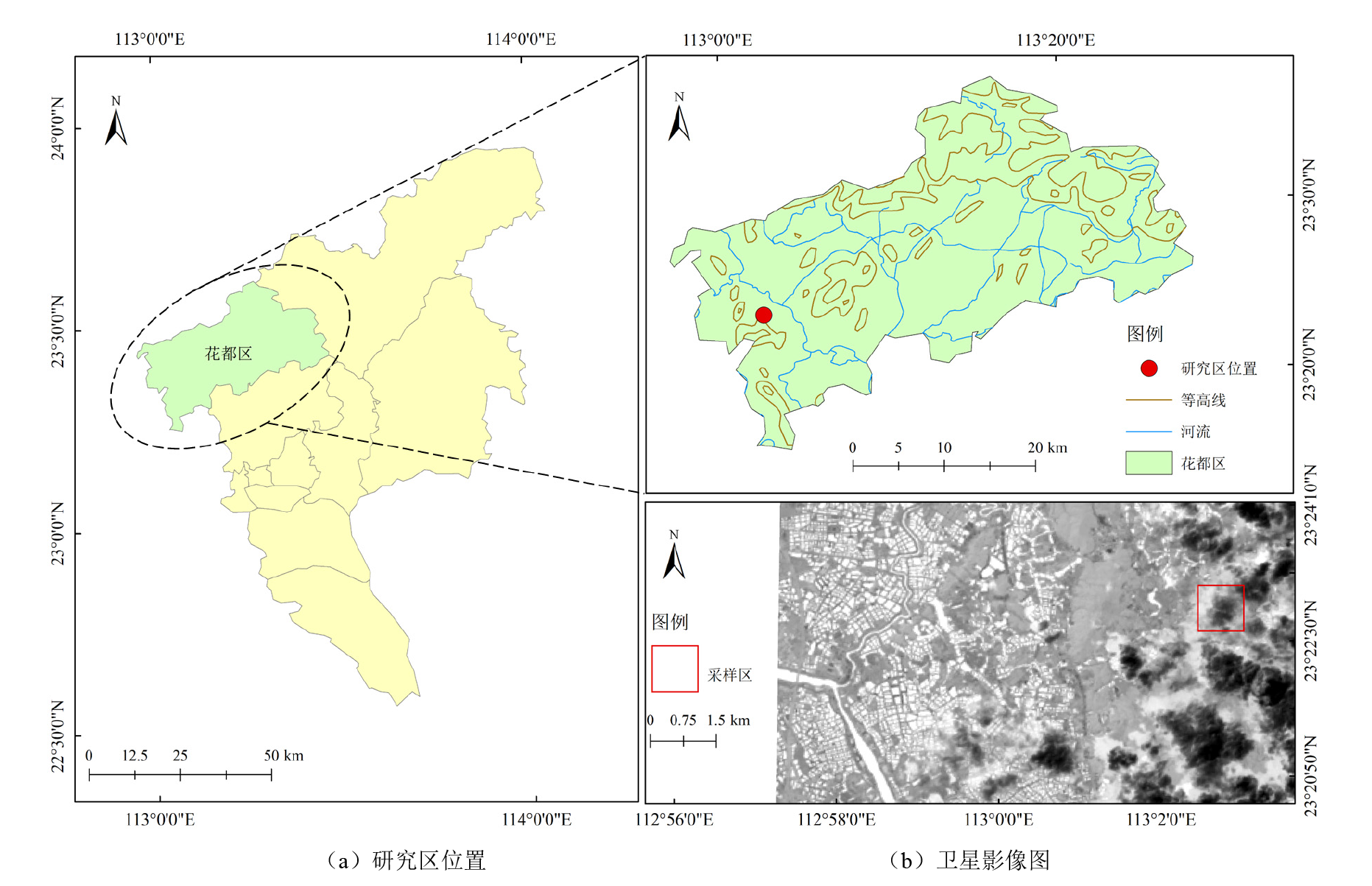
图1 研究区位置及卫星影像图 本图基于审图号为GS(2024)0650号的标准地图绘制;卫星影像图源于国家基础地理信息中心
Figure 1 Location map of the study area and satellite imagery
| 步骤 | 分级形态 | 提取剂 | 提取步骤 |
|---|---|---|---|
| 1 | 非特异性吸附态 | (NH4)2SO4 (0.05 M) | 室温振荡2 h, 提取两次 |
| 2 | 特异性吸附态 | (NH4)2H2PO4 (0.05 M) | 室温振荡12 h |
| 3 | 无定形铁氧 结合态 | (NH4)2C2O4 (0.2 M) pH=3.2 | 在室温避光下 摇晃4 h |
| 4 | 结晶型铁氧 结合态 | (NH4)2C2O4(0.2 M)+抗坏血酸 (0.1 M) pH=3.2 | 在 (96±3) ℃光照下水浴间断振荡30 min |
| 5 | 残渣态 | HNO3/HCl | 消解,参考土壤 重金属总量分析 |
表1 形态提取步骤
Table 1 Steps of speciation extraction
| 步骤 | 分级形态 | 提取剂 | 提取步骤 |
|---|---|---|---|
| 1 | 非特异性吸附态 | (NH4)2SO4 (0.05 M) | 室温振荡2 h, 提取两次 |
| 2 | 特异性吸附态 | (NH4)2H2PO4 (0.05 M) | 室温振荡12 h |
| 3 | 无定形铁氧 结合态 | (NH4)2C2O4 (0.2 M) pH=3.2 | 在室温避光下 摇晃4 h |
| 4 | 结晶型铁氧 结合态 | (NH4)2C2O4(0.2 M)+抗坏血酸 (0.1 M) pH=3.2 | 在 (96±3) ℃光照下水浴间断振荡30 min |
| 5 | 残渣态 | HNO3/HCl | 消解,参考土壤 重金属总量分析 |
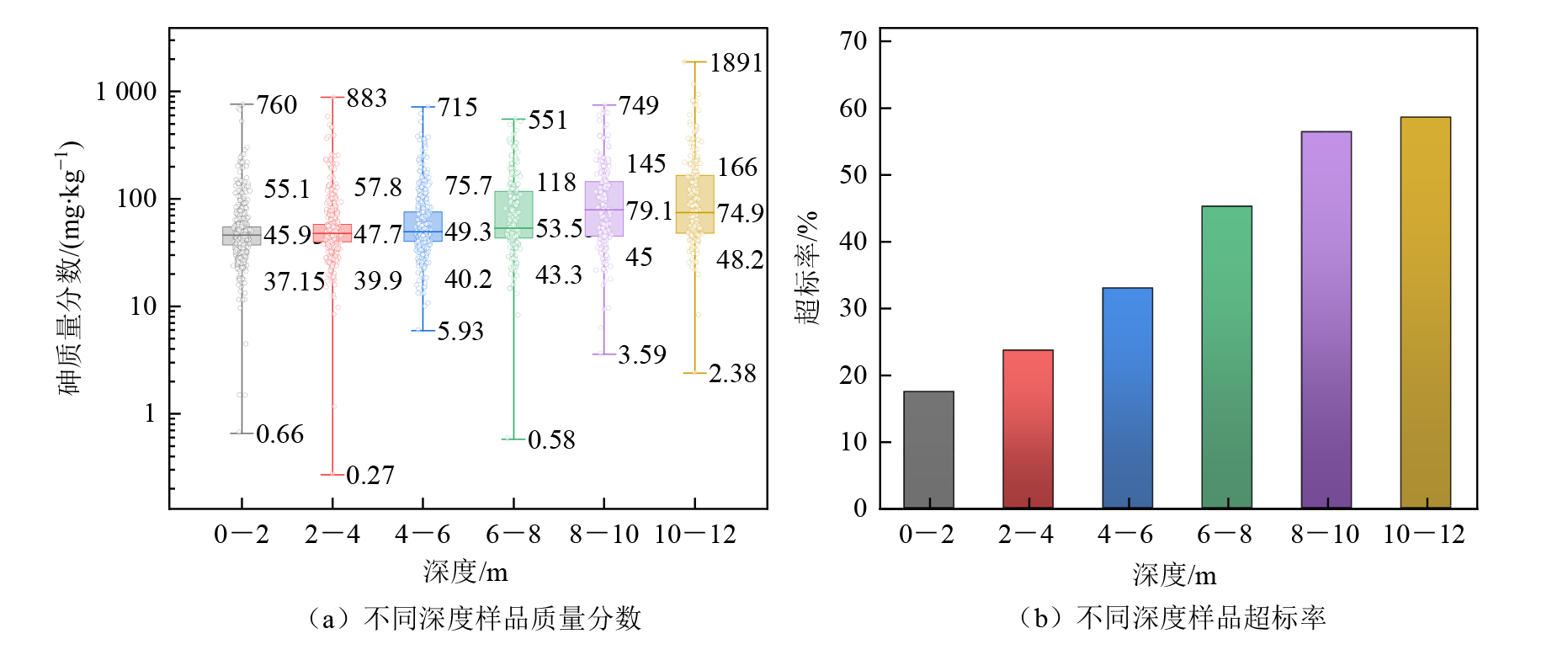
图2 砷空间分布图
Figure 2 Spatial distribution of Arsenic in the study area
| 土壤样品编号 | pH | w(SOM)/ % | CEC/ (cmol∙kg−1) | w(As)/ (mg∙kg−1) | ρ(As)/(μg∙L−1) | |
|---|---|---|---|---|---|---|
| 水平振荡法 | 硫酸硝酸法 | |||||
| PL | 7.61 | 4.97 | 5.61 | 52.87 | 1.01 | 1.48 |
| PM | 7.06 | 6.30 | 5.92 | 103.48 | 1.05 | 0.88 |
| PH | 7.98 | 4.22 | 3.68 | 389.92 | 6.75 | 11.47 |
| FL | 4.76 | 6.17 | 2.44 | 54.26 | 0.98 | 1.04 |
| FM | 5.16 | 6.71 | 2.83 | 150.34 | 0.90 | 0.84 |
| FH | 4.86 | 5.12 | 2.21 | 1193.77 | 0.94 | 0.92 |
| SL | 4.71 | 5.26 | 3.19 | 40.98 | 0.94 | 0.83 |
| SM | 4.67 | 6.01 | 2.58 | 71.81 | 0.96 | 1.03 |
| SH | 5.22 | 5.28 | 5.17 | 857.33 | 1.05 | 1.34 |
表2 土壤基本理化性质及砷含量
Table 2 Basic physicochemical properties and heavy metal contents of soil
| 土壤样品编号 | pH | w(SOM)/ % | CEC/ (cmol∙kg−1) | w(As)/ (mg∙kg−1) | ρ(As)/(μg∙L−1) | |
|---|---|---|---|---|---|---|
| 水平振荡法 | 硫酸硝酸法 | |||||
| PL | 7.61 | 4.97 | 5.61 | 52.87 | 1.01 | 1.48 |
| PM | 7.06 | 6.30 | 5.92 | 103.48 | 1.05 | 0.88 |
| PH | 7.98 | 4.22 | 3.68 | 389.92 | 6.75 | 11.47 |
| FL | 4.76 | 6.17 | 2.44 | 54.26 | 0.98 | 1.04 |
| FM | 5.16 | 6.71 | 2.83 | 150.34 | 0.90 | 0.84 |
| FH | 4.86 | 5.12 | 2.21 | 1193.77 | 0.94 | 0.92 |
| SL | 4.71 | 5.26 | 3.19 | 40.98 | 0.94 | 0.83 |
| SM | 4.67 | 6.01 | 2.58 | 71.81 | 0.96 | 1.03 |
| SH | 5.22 | 5.28 | 5.17 | 857.33 | 1.05 | 1.34 |
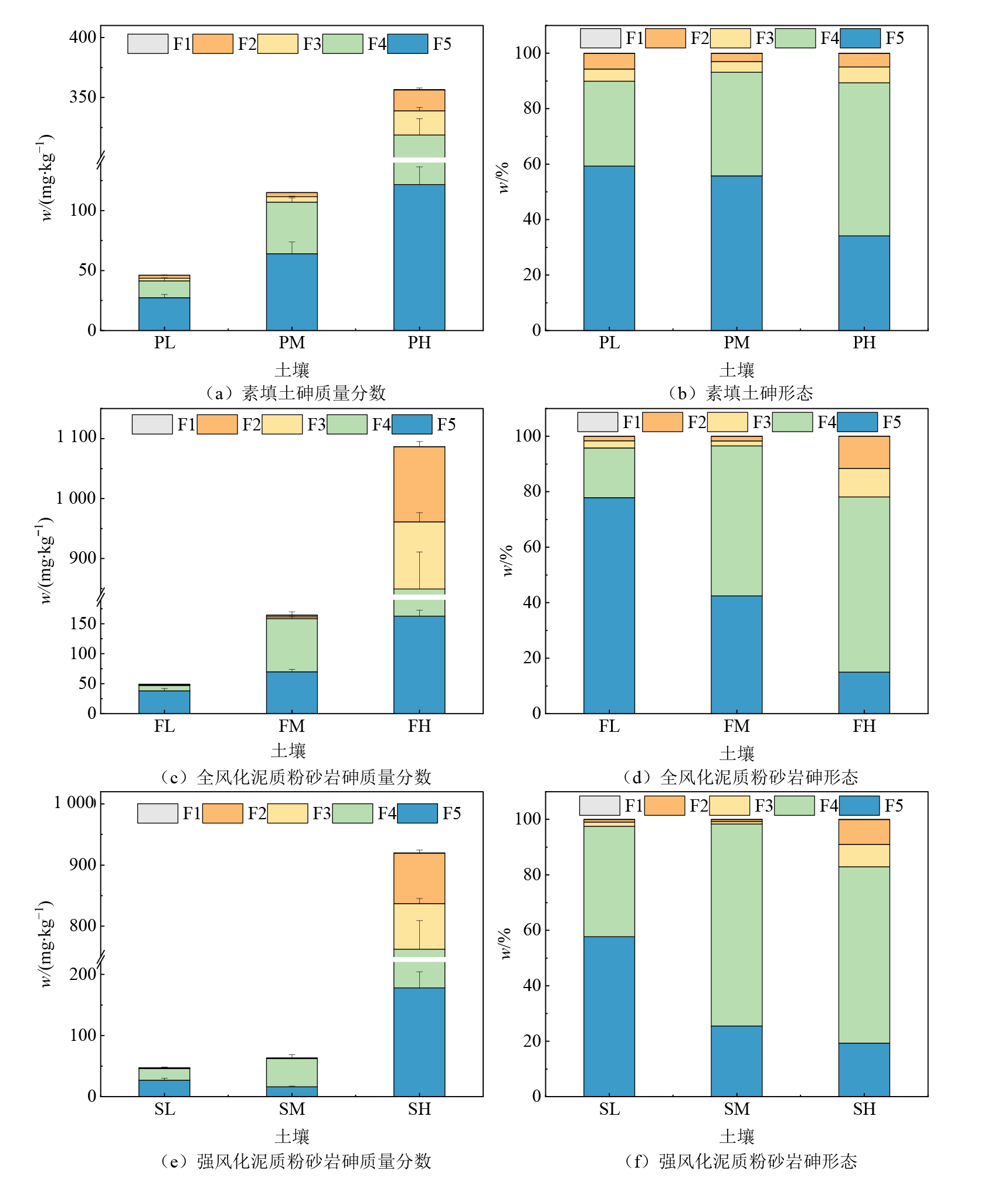
图3 不同岩性土壤砷形态分析图 F1为非特异性吸附态;F2为特异性吸附态;F3为无定形铁氧化物结合态;F4为结晶铁氧化物结合态;F5为残渣态
Figure 3 Arsenic speciation in soils of different lithologies
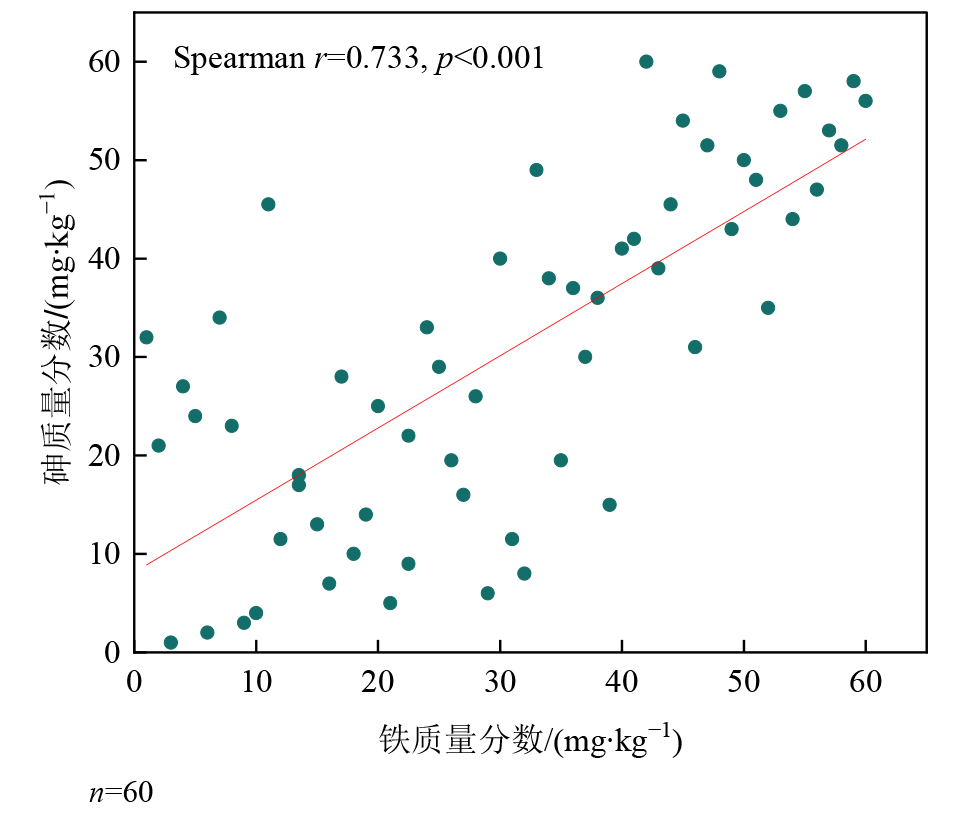
图4 土壤总砷与总铁质量分数Spearman相关性分析
Figure 4 Spearman correlation analysis between total soil arsenic and total iron content
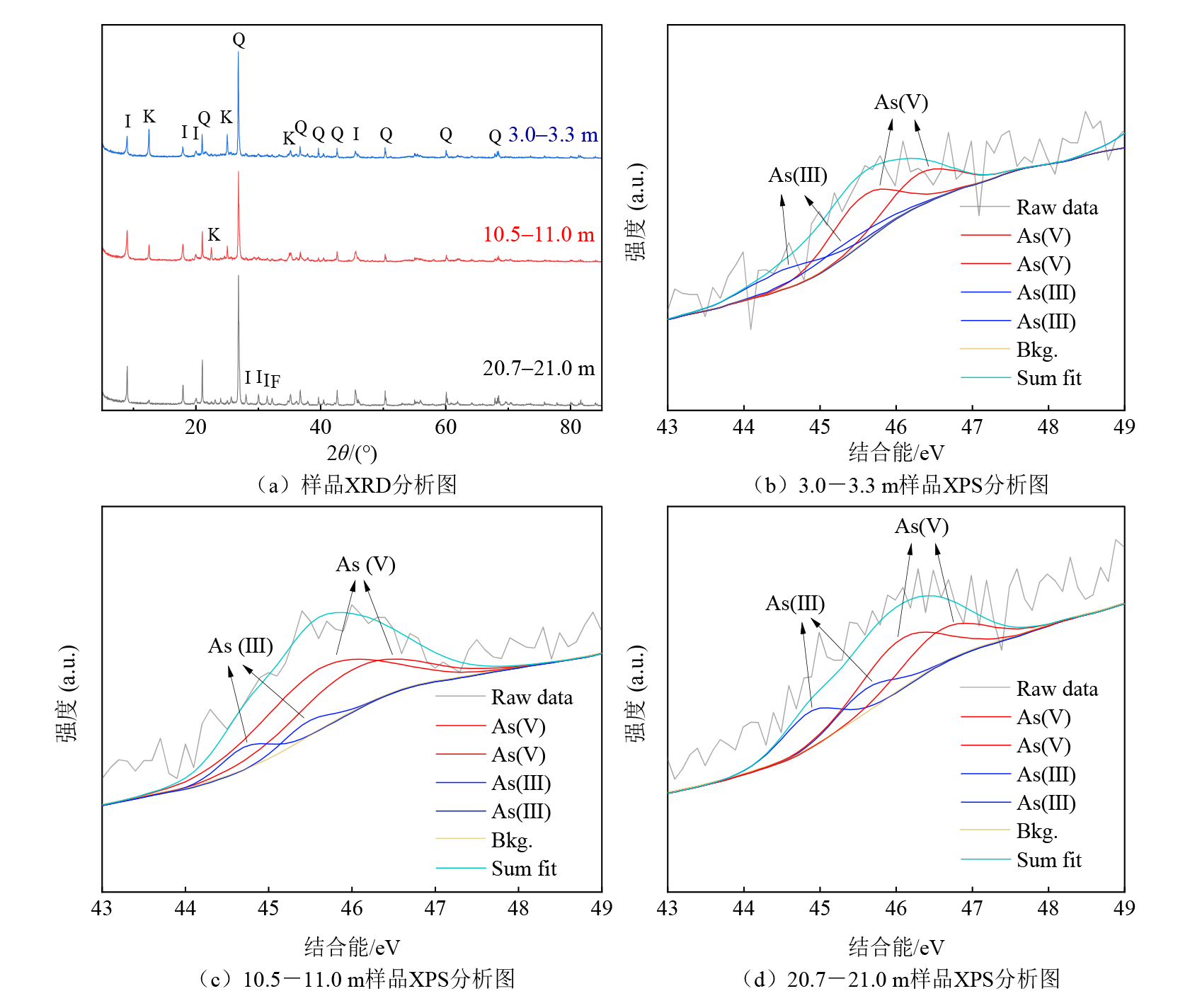
图5 样品表征分析图 Q:石英;I:伊利石;K:高岭石;F:镁橄榄石
Figure 5 Sample characterization analysis
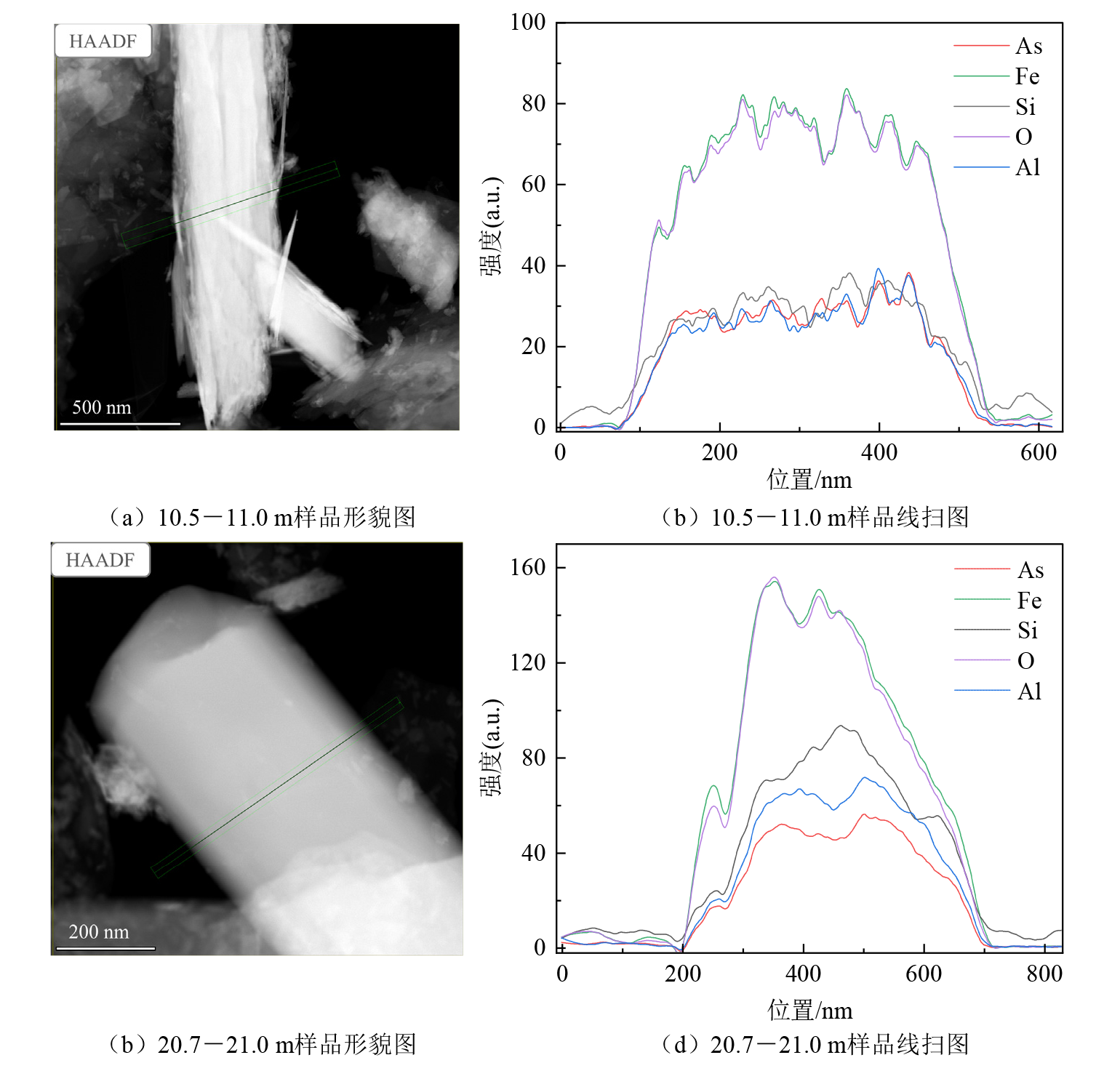
图6 土壤样品形貌及线扫描图
Figure 6 Morphology and line scan of soil samples
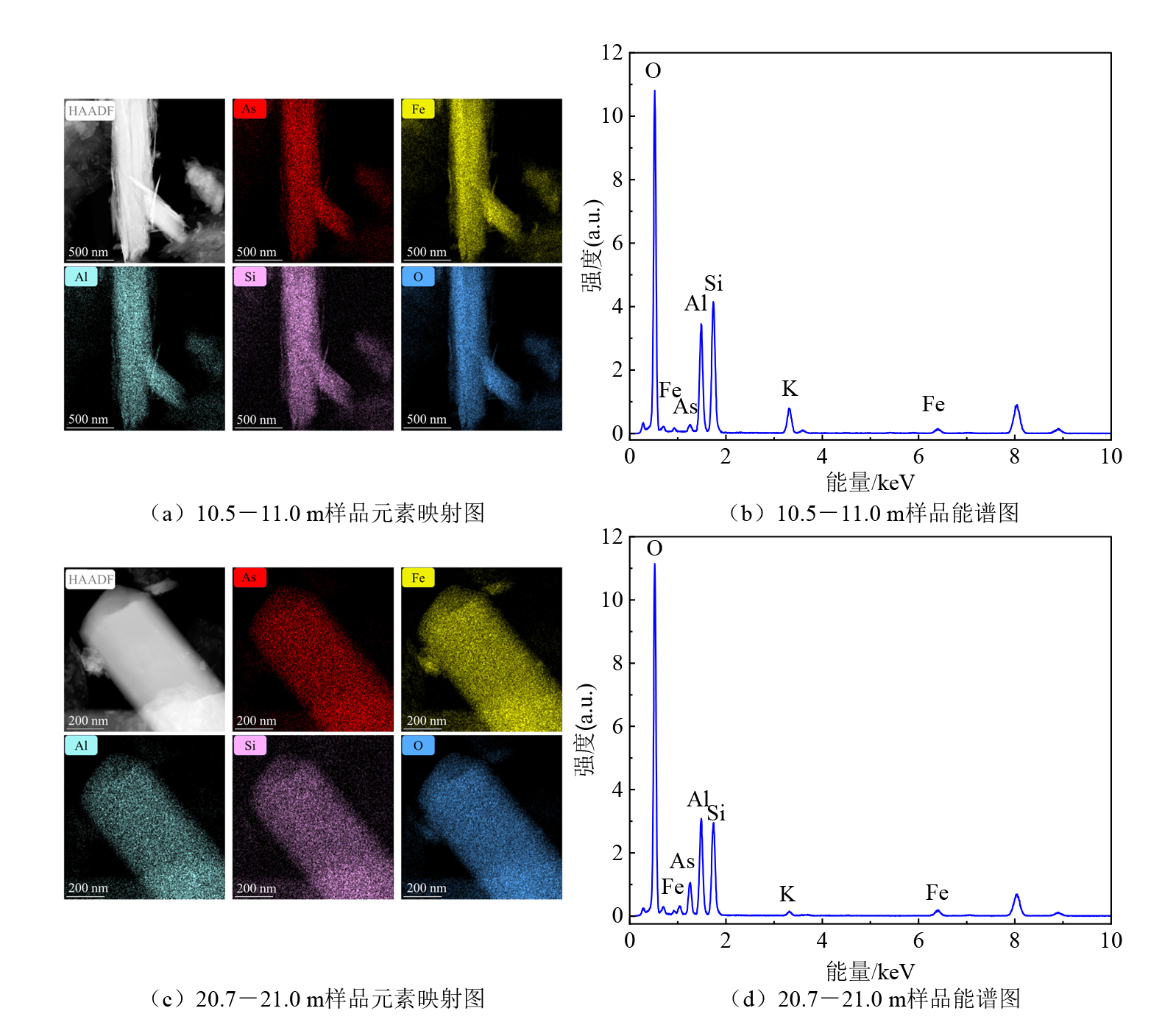
图7 土壤样品元素映射及能谱图
Figure 7 Elemental mapping and EDS spectra of soil samples
| [1] |
ALLEGRETTA I, PORFIDO C, MARTIN M, et al., 2018. Characterization of As-polluted soils by laboratory X-ray-based techniques coupled with sequential extractions and electron microscopy: The case of Crocette gold mine in the Monte Rosa mining district (Italy)[J]. Environmental Science and Pollution Research, 25(25): 25080-25090.
DOI |
| [2] |
ARMIENTO G, CREMISINI C, NARDI E, et al., 2011. High geochemical background of potentially harmful elements in soils and sediments: implications for the remediation of contaminated sites[J]. Chemistry and Ecology, 27(sup1): 131-141.
DOI URL |
| [3] |
BAO J S, CHANG Y H, CHENG N, et al., 2024. Vertical distribution and migration of heavy metals in soil of green stormwater infrastructure receiving roof runoff[J]. Science of The Total Environment, 954: 176511.
DOI URL |
| [4] |
BENNETT W W, TEASDALE P R, PANTHER J G, et al., 2012. Investigating arsenic speciation and mobilization in sediments with DGT and DET: A mesocosm evaluation of oxic-anoxic transitions[J]. Environmental Science & Technology, 46(7): 3981-3989.
DOI URL |
| [5] |
CAO J, XIE C Y, HOU Z R, 2022. Spatiotemporal distribution patterns and risk characteristics of heavy metal pollutants in the soil of lead-zinc mines[J]. Environmental Sciences Europe, 34(1): 27.
DOI |
| [6] |
CUI J L, ZHAO Y P, LI J S, et al., 2018. Speciation, mobilization, and bioaccessibility of arsenic in geogenic soil profile from Hong Kong[J]. Environmental Pollution, 232: 375-384.
DOI URL |
| [7] |
DIXIT S, HERING J G, 2003. Comparison of arsenic(V) and arsenic(III) sorption onto iron oxide minerals: Implications for arsenic mobility[J]. Environmental Science & Technology, 37(18): 4182-4189.
DOI URL |
| [8] |
GAO M, SU Y, GAO J, et al., 2022. Arsenic speciation transformation in soils with high geological background: New insights from the governing role of Fe[J]. Chemosphere, 302: 134860.
DOI URL |
| [9] |
GAUTHEIR T D, 2001. Detecting Trends using spearman’s rank correlation coefficient[J]. Environmental Forensics, 2(4): 359-362.
DOI URL |
| [10] |
GERDELIDANI A F, TOWFIGHI H, SHAHBAZI K, et al., 2021. Arsenic geochemistry and mineralogy as a function of particle-size in naturally arsenic-enriched soils[J]. Journal of Hazardous Materials, 403: 123931.
DOI URL |
| [11] |
GLOOSCHENKO W A, ARAFAT N, 1988. Atmospheric deposition of arsenic and selenium across canada using sphagnum moss as a biomonitor[J]. Science of The Total Environment, 73(3): 269-275.
PMID |
| [12] |
GOLDBERG S, JOHNSTON C T, 2001. Mechanisms of arsenic adsorption on amorphous oxides evaluated using macroscopic measurements, vibrational spectroscopy, and surface complexation modeling[J]. Journal of Colloid and Interface Science, 234(1): 204-216.
PMID |
| [13] |
HAN Y S, PARK J H, KIM S J, et al., 2019. Redox transformation of soil minerals and arsenic in arsenic-contaminated soil under cycling redox conditions[J]. Journal of Hazardous Materials, 378: 120745.
DOI URL |
| [14] |
HUANG H, ZHU Y G, CHEN Z, et al., 2012. Arsenic mobilization and speciation during iron plaque decomposition in a paddy soil[J]. Journal of Soils and Sediments, 12(3): 402-410.
DOI URL |
| [15] |
JI P L, TANG R, HE P, et al., 2017. Characterization of arsenic species in the anaerobic granular sludge treating roxarsone-contaminated wastewater[J]. Chemical Engineering Journal, 327: 162-168.
DOI URL |
| [16] | LI P, LIN C, CHENG H, et al., 2015. Contamination and health risks of soil heavy metals around a lead/zinc smelter in southwestern China[J]. Ecotoxicology and Environmental Safety, 113391-399. |
| [17] |
LI X Z, MA X D, HOU Q Y, et al., 2024. Arsenic in a karstic paddy soil with a high geochemical background in Guangxi, China: Its bioavailability and controlling factors[J]. Applied Sciences, 14(4): 1400.
DOI URL |
| [18] |
LI Z Q, GONG C, AI X J, et al., 2025. Distribution characteristics and pollution assessment of heavy metals in typical black soil profiles of Haicheng city, Liaoning province, China[J]. PLoS ONE, 20(1): e0314105.
DOI URL |
| [19] |
LIN S X, LIU X L, ZHANG Z L, et al., 2022. Speciation characteristics and ecological risk assessment of heavy metals in sediments from Caohai Lake, Guizhou Province[J]. Stochastic Environmental Research and Risk Assessment, 36(11): 3929-3944.
DOI |
| [20] |
LIU Y Z, CHEN Z J, XIAO T F, et al., 2022. Enrichment and environmental availability of cadmium in agricultural soils developed on Cd-rich black shale in southwestern China[J]. Environmental Science and Pollution Research, 29(24): 36243-36254.
DOI |
| [21] |
LU W H, LIU J, WANG Y F, et al., 2022. Cumulative risk assessment of soil-crop potentially toxic elements accumulation under two distinct pollution systems[J]. Minerals, 12(9): 1134.
DOI URL |
| [22] |
LU X W, ZHANG X L, 2005. Environmental geochemistry study of arsenic in Western Hunan mining area, P. R. China[J]. Environmental Geochemistry and Health, 27(4): 313-320.
DOI URL |
| [23] |
MIKKONEN H G, VAN DE GRAAFF R, COLLINS R N, et al., 2019. Immobilisation of geogenic arsenic and vanadium in iron-rich sediments and iron stone deposits[J]. Science of The Total Environment, 654: 1072-1081.
DOI URL |
| [24] |
NIAZI N K, SINGH B, SHAH P, 2011. Arsenic speciation and phytoavailability in contaminated soils using a sequential extraction procedure and XANES spectroscopy[J]. Environmental Science & Technology, 45(17): 7135-7142.
DOI URL |
| [25] |
PIKUŁA D, STĘPIEŃ W, 2021. Effect of the degree of soil contamination with heavy metals on their mobility in the soil profile in a microplot experiment[J]. Agronomy, 11(5): 878.
DOI URL |
| [26] |
PUTH M T, NEUHäUSER M, RUXTON G D, 2015. Effective use of Spearman’s and Kendall’s correlation coefficients for association between two measured traits[J]. Animal Behaviour, 102: 77-84.
DOI URL |
| [27] |
RAJMOHAN N, PRATHAPAR S A, JAYAPRAKASH M, et al., 2014. Vertical distribution of heavy metals in soil profile in a seasonally waterlogging agriculture field in Eastern Ganges Basin[J]. Environ Monit Assess, 186(9): 5411-5427.
DOI PMID |
| [28] |
REN D J, SHEN S L, CHENG W C, et al., 2016. Geological formation and geo-hazards during subway construction in Guangzhou[J]. Environmental Earth Sciences, 75(11): 934.
DOI URL |
| [29] |
SAMPAIO N, MAZZA F, SIQUEIRA S, et al., 2024. Applications of correlation analysis in environmental problems[J]. Revista de Gestão Social e Ambiental, 18(3): e04925.
DOI URL |
| [30] |
SMEDLEY P L, KINNIBURGH D G, 2002. A review of the source, behaviour and distribution of arsenic in natural waters[J]. Applied Geochemistry, 17(5): 517-568.
DOI URL |
| [31] |
SUN T, SUN Y B, PEI P G, et al., 2025. Dual roles of crayfish shell biochar on the fate of arsenic in acid and alkaline aerobic soils: insights from dissolved organic matter and metabolism genes[J]. Biochar, 7(1): 47.
DOI |
| [32] |
VANDEUREN A, PEREIRA B, KABA A J, et al., 2023. Environmental bioavailability of arsenic, nickel and chromium in soils impacted by high geogenic and anthropogenic background contents[J]. Science of The Total Environment, 902: 166073.
DOI URL |
| [33] |
VILTRES H, ODIO O F, LARTUNDO-ROJAS L, et al., 2020. Degradation study of arsenic oxides under XPS measurements[J]. Applied Surface Science, 511: 145606.
DOI URL |
| [34] |
WANG J, SHAHEEN S M, SWERTZ A C, et al., 2024. First insight into the mobilization and sequestration of arsenic in a karstic soil during redox changes[J]. Environmental Science & Technology, 58(40): 17850-17861.
DOI URL |
| [35] |
WENZEL W W, KIRCHBAUMER N, PROHASKA T, et al., 2001. Arsenic fractionation in soils using an improved sequential extraction procedure[J]. Analytica Chimica Acta, 436(2): 309-323.
DOI URL |
| [36] |
XIA X Q, JI J F, ZHANG C S, et al., 2024. The degree of soil arsenic background enrichment by carbonate weathering is mainly controlled by climate in large spatial scale[J]. Science of The Total Environment, 951: 175868.
DOI URL |
| [37] |
XU D M, FU R B, 2022. Mechanistic insight into the release behavior of arsenic (As) based on its geochemical fractions in the contaminated soils around lead/zinc (Pb/Zn) smelters[J]. Journal of Cleaner Production, 363: 132348.
DOI URL |
| [38] |
YANG P T, HASHIMOTO Y, WU W J, et al., 2020. Effects of long-term paddy rice cultivation on soil arsenic speciation[J]. Journal of Environmental Management, 254: 109768.
DOI URL |
| [39] |
ZHANG X R, SU Y F, WANG H Y, et al., 2025. Heavy metal enrichment in ferromanganese nodules and soil ecological risk assessment in the karst area with high geological background[J]. Toxics, 13(9): 746.
DOI URL |
| [40] |
ZHOU W X, HAN G L, LIU M, et al., 2020. Vertical distribution and controlling factors exploration of Sc, V, Co, Ni, Mo and Ba in six soil profiles of The Mun River Basin, Northeast Thailand[J]. International Journal of Environmental Research and Public Health, 17(5): 1745.
DOI URL |
| [41] | 安礼航, 刘敏超, 张建强, 等, 2020. 土壤中砷的来源及迁移释放影响因素研究进展[J]. 土壤, 52(2): 234-246. |
| AN L H, LIU M C, ZHANG J Q, et al., 2020. Sources of arsenic in soil and affecting factors of migration and release:a review[J]. Soils, 52(2): 234-246. | |
| [42] | 丁琛, 2019. 岩性特征与岩溶地面塌陷的关系——以广州市花都区岩溶地面塌陷为例[J]. 中国金属通报 (5): 224-226. |
| DING C, 2019. Relationship between lithologic characteristics and karst ground collapse: A case study of karst ground collapse in Huadu district of Guangzhou City[J]. China Metal Bulletin (5): 224-226. | |
| [43] | 丁琛, 2020. 广州市花都区花山镇、花东镇岩溶发育规律初探[J]. 中国地质灾害与防治学报, 31(6): 122-129. |
| DING C, 2020. Karst development law of Huashan town and Huadong town in Huadu district of Guangzhou city[J]. The Chinese Journal of Geological Hazard and Control, 31(6): 122-129. | |
| [44] | 国家环境保护总局, 2007. 固体废物浸出毒性浸出方法硫酸硝酸法: HJ/T 299—2007[S]. 北京: 中国环境出版社. |
| State Environmental Protection Administration, 2007. Solid waste-Extraction procedure for leaching toxicity-Sulphuric acid & nitric acid method: HJ/T 299—2007[S]. Beijing: China Environment Press. | |
| [45] | 国家环境保护总局, 2004. 土壤环境监测技术规范: HJ/T 166—2004[S]. 北京: 中国环境出版社. |
| State Environmental Protection Administration, 2004. The technical specification for soil environmental monitoring: HJ/T 166—2004[S]. Beijing: China Environment Press. | |
| [46] | 黑儿平, 何明江, 喻华, 等, 2025. 西北和西南某废弃锑冶炼厂污染场地剖面土壤锑砷迁移性及其影响因素[J]. 环境化学, 44(3): 975-990. |
| HEI E P, HE M H, YU H, et al., 2025. Soil antimony and arsenic migration characteristics and influencingfactors in the contaminated site profiles of an abandoned antimonysmelting plant in northwest and southwest[J]. Environmental Chemistry, 44(3): 975-990. | |
| [47] | 胡鹏杰, 詹娟, 刘娟, 等, 2023. 土壤重金属地质高背景成因、风险与管控研究进展[J]. 土壤学报, 60(5): 1363-1377. |
| HU P J, ZHAN J, LIU J, et al., 2023. Research progress on the causes, risks, and control of high geological background of heavy metals in soils[J]. Acta Pedologica Sinica, 60(5): 1363-1377. | |
| [48] | 雷金山, 阳军生, 肖武权, 等, 2009. 广州岩溶塌陷形成条件及主要影响因素[J]. 地质与勘探, 45(4): 488-492. |
| LEI J S, YANG J S, XIAO W Q, et al., 2009. Analysis of forming conditions and main influential factors of karst collapse in Guanzhou[J]. Geology and Exploration, 45(4): 488-492. | |
| [49] | 瞿思思, 周汉文, 钟增球, 等, 2010. 广西合浦新屋面高岭石矿物学特征及其形成途径[J]. 地质科技情报, 29(5): 9-14. |
| QU S S, ZHOU H W, ZHONG Z Q, et al., 2010. Mineral characteristics and formation of kaolinite in Xinwumian of Hepu, Guangxi[J]. Bulletin of Geological Science and Technology, 29(5): 9-14. | |
| [50] | 任杰, 曾杨, 张博伦, 等, 2024. 高地球化学背景地区重金属污染分布特征及源解析研究[J]. 环境科学研究, 37(12): 2745-2756. |
| REN J, ZENG Y, ZHANG B L, et al., 2024. Distribution characteristics and enrichment mechanisms of heavy metal pollution in high geochemical background areas[J]. Research of Environmental Sciences, 37(12): 2745-2756. | |
| [51] | 邵金秋, 温其谦, 阎秀兰, 等, 2019. 天然含铁矿物对砷的吸附效果及机制[J]. 环境科学, 40(9): 4072-4080. |
| SHAO J Q, WEN Q Q, YAN X L, et al., 2019. Adsorption and mechanism of arsenic by natural Iron-containing minerals[J]. Environmental Science, 40(9): 4072-4080. | |
| [52] | 唐瑞玲, 王惠艳, 吕许朋, 等, 2020. 西南重金属高背景区农田系统土壤重金属生态风险评价[J]. 现代地质, 34(5): 917-927. |
| TANG R L, WANG H Y, LÜ X P, et al., 2020. Ecological risk assessment of heavy metals in farmland system from an area with high background of heavy metals, southwestern China[J]. Geoscience, 34(5): 917-927. | |
| [53] | 王超, 王占恺, 李辉林, 等, 2024. 粤港澳大湾区土壤高砷环境背景成因分析及风险管控建议[J]. 地球环境学报, 15(5): 701-710. |
| WANG C, WANG Z K, LI H L, et al., 2024. Cause analysis and risk control suggestions of high soil environmental background of arsenic in the Guangdong-Hong Kong-Macao Greater Bay Area[J]. Journal of Earth Environment, 15(5): 701-710. | |
| [54] | 王秋艳, 文雪峰, 魏晓, 等, 2022. 碳酸盐岩风化和成土过程的重金属迁移富集机理初探及环境风险评价[J]. 地球与环境, 50(1): 119-130. |
| WANG Q Y, WEN X F, WEI X, et al., 2022. Heavy metal migration and enrichment mechanism and the environmental risks during the weathering and soil formation of carbonate rocks[J]. Earth and Environment, 50(1): 119-130. | |
| [55] | 王雪雯, 刘鸿雁, 顾小凤, 等, 2022. 地质高背景与污染叠加区不同土地利用方式下土壤重金属分布特征[J]. 环境科学, 43(4): 2094-2103. |
| WANG X W, LIU H Y, GU X F, et al., 2022. Distribution characteristics of heavy metals in soils affected by different land use types in a superimposed pollution area with high geological background[J]. Environmental Science, 43(4): 2094-2103. | |
| [56] | 文宇博, 2020. 广西岩溶地质高背景地区土壤重金属的富集机制和生物有效性研究[D]. 南京: 南京大学. |
| WEN Y B, 2020. Enrichment mechanism and bioavailability ofheavy metals in soils with high geochemical backgroundin the Karst region of Guangxi Province, China[D]. Nanjing: NanJing University. | |
| [57] | 肖高强, 陈杰, 白兵, 等, 2021. 云南典型地质高背景区土壤重金属含量特征及污染风险评价[J]. 地质与勘探, 57(5): 1077-1086. |
| XIAO G Q, CHEN J, BAI B, et al., 2021. Content characteristics and riskassessment of heavy metals in soil of typical high geological background areas, Yunnan Province[J]. Geology and Exploration, 57(5): 1077-1086. | |
| [58] | 张红娟, 吴兰, 孟祥敏, 等, 2022. 基于复合钝化剂施用植物轮作模式对农田土壤Cd和As污染的修复[J]. 水土保持学报, 36(5): 377-386. |
| ZHANG H J, WU L, MENG Y M, et al., 2022. Remediation of farmland soil contained Cd and As based on plant rotation pattern with compound passivator application[J]. Journal of Soil and Water Conservation, 36(5): 377-386. | |
| [59] | 中华人民共和国生态环境部, 2019. 建设用地土壤污染风险管控和修复监测技术导则: HJ 25.2—2019[S]. 北京: 中国环境出版集团. |
| Ministry of Ecology and Environment of the People’s Republic of China, 2019. Technical guidelines for monitoring during risk control and remediation of soil contamination of land for construction: HJ 25.2—2019[S]. Beijing: China Environment Publishing Group. | |
| [60] | 中华人民共和国生态环境部, 2018a. 土壤pH值的测定电位法: HJ 962—2018[S]. 北京: 中国环境出版社. |
| Ministry of Ecology and Environment of the People’s Republic of China, 2018a. Soil-determination of pH-potentionmetry: HJ 962—2018[S]. Beijing: China Environment Press. | |
| [61] | 中华人民共和国生态环境部, 2018b. 土壤环境质量建设用地土壤污染风险管控标准 (试行): GB 36600—2018[S]. 北京: 中国环境出版集团. |
| Ministry of Ecology and Environment of the People’s Republic of China, 2018b. Soil environmental quality-risk control standard for soil contamination of development land:GB 36600—2018[S]. Beijing: China Environment Publishing Group. | |
| [62] | 中华人民共和国生态环境部, 2018c. 土壤环境质量农用地土壤污染风险管控标准 (试行): GB 15618—2018[S]. 北京: 中国环境出版集团. |
| Ministry of Ecology and Environment of the People’s Republic of China, 2018c. Soil environmental quality-risk control standard for soil contamination of agricultural land: GB 15618—2018[S]. Beijing: China Environment Publishing Group. | |
| [63] | 钟松雄, 尹光彩, 陈志良, 等, 2017. Eh、pH和铁对水稻土砷释放的影响机制[J]. 环境科学, 38(6): 2530-2537. |
| ZHONG S X, YIN G C, CHEN Z L, et al., 2017. Influencing mechanism of Eh, pH and iron on the release of arsenic in paddy soil[J]. Environmental Science, 38(6): 2530-2537. | |
| [64] | 中华人民共和国环境保护部, 2017a. 土壤阳离子交换量的测定三氯化六氨合钴浸提-分光光度法: HJ 889—2017[S]. 北京: 中国环境出版社. |
| Ministry of Environmental Protection, 2017a. Soil quality-determination of cation exchange capacity(CEC)-hexamminecobalt trichloride solution-spectrophotometric method: HJ 889—2017[S]. Beijing: China Environment Press. | |
| [65] | 中华人民共和国环境保护部, 2017b. 土壤和沉积物金属元素总量的消解微波消解法: HJ 832—2017[S]. 北京: 中国环境出版社. |
| Ministry of Environmental Protection of the People’s Republic of China, 2017b. Soil and sediment-digestion of total elements-microwave assisted acid digestion method: HJ 832—2017[S]. Beijing: China Environment Press. | |
| [66] | 中华人民共和国环境保护部, 2011. 土壤有机碳的测定重铬酸钾氧化-分光光度法: HJ 615—2011[S]. 北京: 中国环境科学出版社: 1-4. |
| Ministry of Environmental Protection of the People’s Republic of China. 2011. Soil-determination of organic carbon-potassium dichromate oxidation spectrophotometric method: HJ 615—2011[S]. Beijing: China Environmental Science Press: 1-4. | |
| [67] | 中华人民共和国环境保护部, 2010. 固体废物浸出毒性浸出方法水平振荡法: HJ 557—2010[S]. 北京: 中国环境科学出版社: 1-3. |
| Ministry of Environmental Protection of the People’s Republic of China, 2010. Solid waste-extraction procedure for leaching toxicity-horizontal vibration method: HJ 557—2010[S]. Beijing: China Environmental Science Press: 1-3. |
| [1] | 朱茂红, 李仁英, 翟伊然, 徐昊, 杜鸿萱, 王孙雨. 高温缓解剂和砷阻控剂配施对高温胁迫下分蘖期水稻生理及砷吸收的影响[J]. 生态环境学报, 2026, 35(4): 610-618. |
| [2] | 张煜坤, 陈懂懂, 李奇, 贺福全, 张莉, 赵亮. 基于多元统计分析和PMF模型的土壤重金属源解析——以三江源为例[J]. 生态环境学报, 2026, 35(3): 458-468. |
| [3] | 韩存亮, 邓一荣, 常春英, 林龙勇, 程胜, 李俊春. 基于风险管控的土壤重金属高背景特征识别方法探讨[J]. 生态环境学报, 2026, 35(2): 278-288. |
| [4] | 史广宇, 沈新怡. 共热解技术对污泥中重金属的固定及资源化利用研究进展[J]. 生态环境学报, 2026, 35(2): 323-332. |
| [5] | 柳凤娟, 马超, 黄玲涵, 陈琪, 罗绪强. 生物炭添加对尾砂污染土壤中As和Sb植物有效性的影响[J]. 生态环境学报, 2025, 34(8): 1273-1281. |
| [6] | 孟畅, 红梅, 李斐. 高光谱敏感波段筛选与机器学习协同提升土壤重金属预测精度[J]. 生态环境学报, 2025, 34(6): 950-960. |
| [7] | 刘鸿林, 赵方凯, 杨磊, 沈琳钧, 杨恺丰, 李敏, 陈利顶. 城市公园土壤重金属污染及影响因素研究——以宁波市为例[J]. 生态环境学报, 2025, 34(5): 773-783. |
| [8] | 黄邓铃尧, 唐炳然, 马媛媛, 何强, 李宏. 水稻土中砷对氮素转化的影响:以紫色土为例[J]. 生态环境学报, 2025, 34(5): 784-795. |
| [9] | 崔雪丹, 段桂兰, 王向琴, 李志丰, 窦飞, 杜衍红, 袁雨珍, 刘传平, 李芳柏. 基于两地长期定位试验的铁改性木本泥炭修复中轻度镉砷污染稻田效果与土壤健康效应评价[J]. 生态环境学报, 2025, 34(4): 608-620. |
| [10] | 陈岩, 石成龙, 李璞君, 肖江, 陈光才. 含重金属林木生物质与骨粉共水热液相产物:解析及应用潜力初步评价[J]. 生态环境学报, 2025, 34(4): 642-652. |
| [11] | 陈琳, 兰冠宇, 徐妍, 李雪, 毛雪飞. 氢键有机框架材料在环境污染物吸附和检测中的研究进展[J]. 生态环境学报, 2025, 34(3): 474-483. |
| [12] | 王斌, 曾兆荷, 董璐, 岳林. 内梅罗指数法在地下水水质评价中的修正探讨与实践效果[J]. 生态环境学报, 2025, 34(2): 293-301. |
| [13] | 张传华, 刘力, 代杰, 李曼曼, 张凤太, 邓凌. 基于土壤重金属污染和累积性评价的耕地环境质量类别划分与风险管控[J]. 生态环境学报, 2025, 34(2): 311-320. |
| [14] | 吴小令, 杜衍红, 窦飞, 高双全, 王向琴. 生物炭和腐殖质治理重金属污染菜地的定位试验研究[J]. 生态环境学报, 2025, 34(12): 1952-1961. |
| [15] | 王永梅, 袁雨珍, 王梓成, 李志丰, 高双全, 刘传平, 杜衍红. 生物炭协同化肥减量对重金属污染土壤甜玉米安全生产的长期效应[J]. 生态环境学报, 2025, 34(12): 1962-1973. |
| 阅读次数 | ||||||
|
全文 |
|
|||||
|
摘要 |
|
|||||
