
Ecology and Environmental Sciences ›› 2026, Vol. 35 ›› Issue (3): 437-446.DOI: 10.16258/j.cnki.1674-5906.2026.03.010
• Research Article [Ecology] • Previous Articles Next Articles
ZHAO Shiyi1( ), LI Jun2, ZHAO Xu1, HUANG Minghao1, GOU Zhengyang1, ZHU Haibiao1, HUANG Hong1,*()
Received:2025-07-21
Revised:2026-01-13
Accepted:2026-01-24
Online:2026-03-18
Published:2026-03-13
赵师夷1(), 李珺2, 赵旭1, 黄明昊1, 缑正洋1, 祝海彪1, 黄宏1,*()
通讯作者:
*E-mail: 作者简介:赵师夷(2000年生),女,硕士研究生,主要研究方向为土壤有机碳。E-mail: 1144948924@qq.com
基金资助:CLC Number:
ZHAO Shiyi, LI Jun, ZHAO Xu, HUANG Minghao, GOU Zhengyang, ZHU Haibiao, HUANG Hong. Spatial Heterogeneity and Influencing Factors of Soil Organic Carbon Fractions in Chongming Dongtan Wetland[J]. Ecology and Environmental Sciences, 2026, 35(3): 437-446.
赵师夷, 李珺, 赵旭, 黄明昊, 缑正洋, 祝海彪, 黄宏. 崇明东滩湿地土壤有机碳组分空间异质性及影响因素[J]. 生态环境学报, 2026, 35(3): 437-446.
Add to citation manager EndNote|Ris|BibTeX
URL: https://www.jeesci.com/EN/10.16258/j.cnki.1674-5906.2026.03.010
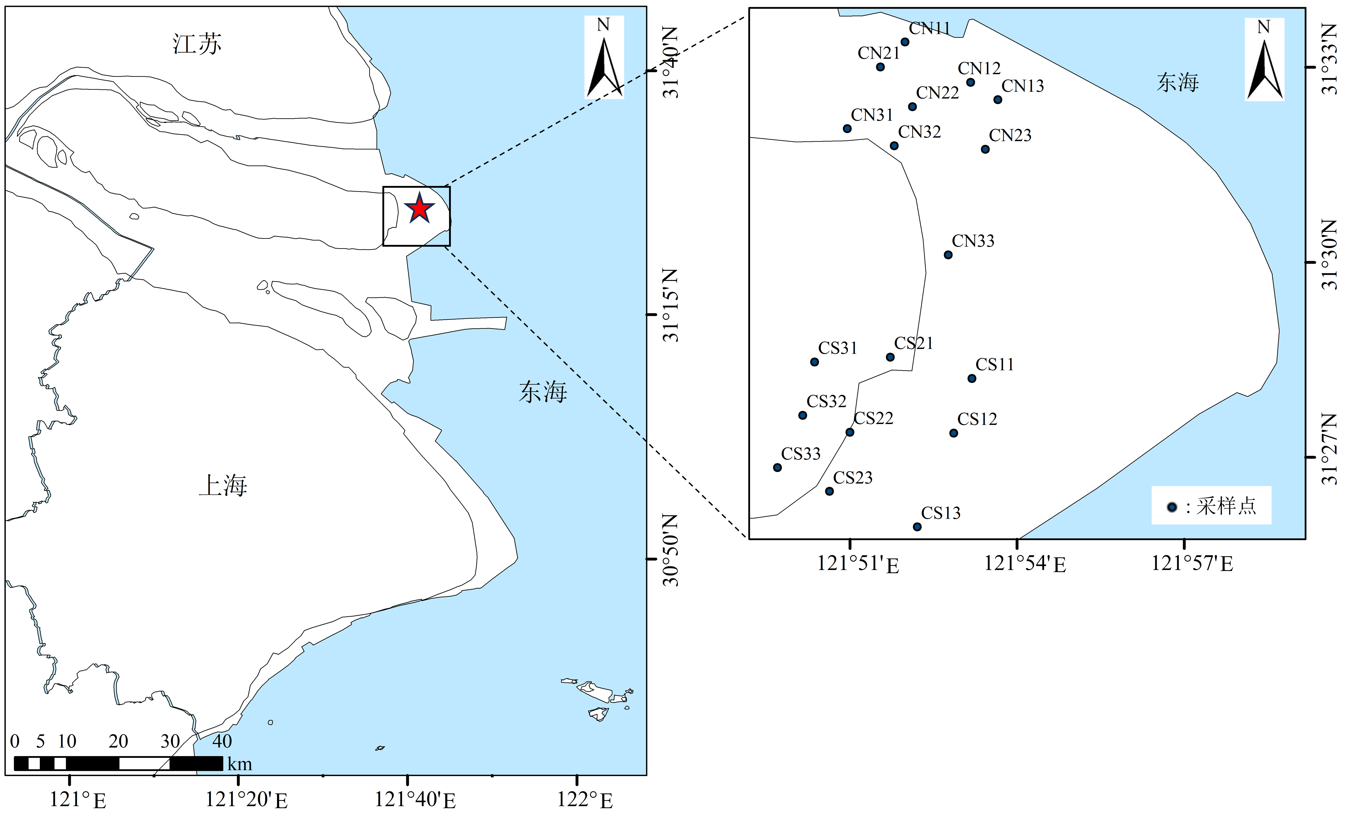
Figure 1 Distribution of sampling points in Dongtan of Chongming Island

Figure 2 Comparing of various organic carbon fractions in Chongming Dongtan wetland soil
| 湿地类型 | 点位 | 土壤盐度/ (g∙kg−1) | pH | 水分质量分数/% | 中值粒径/ µm |
|---|---|---|---|---|---|
| 光滩 | CN11-13 | 8.72±1.52 | 7.90±0.1 | 53.33±2.95 | 30.44±2.25 |
| CS11-13 | 4.21±1.83 | 7.92±0.07 | 62.12±3.15 | 33.42±1.86 | |
| 互花米草 覆盖区 | CN21-23 | 4.77±0.49 | 8.37±0.15 | 42.11±1.12 | 11.09±3.45 |
| CN31-33 | 5.35±0.17 | 7.85±0.25 | 43.26±1.34 | 11.75±2.22 | |
| 海三棱蔍草覆盖区 | CS21-23 | 2.34±1.22 | 7.92±0.06 | 46.35±1.82 | 19.92±1.32 |
| 芦苇覆盖区 | CS31-33 | 3.34±0.39 | 8.15±0.1 | 38.72±2.61 | 16.65±2.45 |
Table 1 Basic physical and chemical properties of soils of different vegetation types in Chongming Dongtan, China
| 湿地类型 | 点位 | 土壤盐度/ (g∙kg−1) | pH | 水分质量分数/% | 中值粒径/ µm |
|---|---|---|---|---|---|
| 光滩 | CN11-13 | 8.72±1.52 | 7.90±0.1 | 53.33±2.95 | 30.44±2.25 |
| CS11-13 | 4.21±1.83 | 7.92±0.07 | 62.12±3.15 | 33.42±1.86 | |
| 互花米草 覆盖区 | CN21-23 | 4.77±0.49 | 8.37±0.15 | 42.11±1.12 | 11.09±3.45 |
| CN31-33 | 5.35±0.17 | 7.85±0.25 | 43.26±1.34 | 11.75±2.22 | |
| 海三棱蔍草覆盖区 | CS21-23 | 2.34±1.22 | 7.92±0.06 | 46.35±1.82 | 19.92±1.32 |
| 芦苇覆盖区 | CS31-33 | 3.34±0.39 | 8.15±0.1 | 38.72±2.61 | 16.65±2.45 |

Figure 3 Correlation characteristics between soil physicochemical parameters and organic carbon components in Chongming Dongtan Wetland *:p<0.05;**:p<0.01
| 理化参数 | 莫兰指数 | Z值 | p值 |
|---|---|---|---|
| S | 0.52 | 3.98 | <0.001 |
| pH | 0.16 | 1.58 | 0.11 |
| w | 0.14 | 1.02 | 0.35 |
| D50 | 0.25 | 2.85 | <0.05 |
| LOC | 0.32 | 2.51 | <0.05 |
| ROC | 0.22 | 1.78 | 0.08 |
| TOC | 0.35 | 2.71 | <0.05 |
Table 2 Global spatial autocorrelation analysis results of physical and chemical parameters in wetland soils
| 理化参数 | 莫兰指数 | Z值 | p值 |
|---|---|---|---|
| S | 0.52 | 3.98 | <0.001 |
| pH | 0.16 | 1.58 | 0.11 |
| w | 0.14 | 1.02 | 0.35 |
| D50 | 0.25 | 2.85 | <0.05 |
| LOC | 0.32 | 2.51 | <0.05 |
| ROC | 0.22 | 1.78 | 0.08 |
| TOC | 0.35 | 2.71 | <0.05 |

Figure 4 Localized Moran’s I for each physicochemical parameter

Figure 5 Influence of soil physicochemical factors on TOC in Chongming Dongtan Wetland
| [1] |
ANNABI M, RACLOT D, BAHRI H, et al., 2017. Spatial variability of soil aggregate stability at the scale of an agricultural region in Tunisia[J]. Catena, 153: 157-167.
DOI URL |
| [2] |
ANSELIN L, 1995. Local indicators of spatial association — LISA[J]. Geographical Analysis, 27: 93-115.
DOI URL |
| [3] |
BRUNEL C, GROS R, LERCH T Z, et al., 2020. Changes in soil organic matter and microbial communities after fine and coarse residues inputs from Mediterranean tree species[J]. Applied Soil Ecology, 149: 103516.
DOI URL |
| [4] | CASTAÑO J, ZHANG J W, ZHOU M W, et al., 2021. A fungal secretome adapted for stress enabled a radical wood decay mechanism[J]. Mbio, 12(3): 11. |
| [5] |
CHANTIGNY M H, 2003. Dissolved and water-extractable organic matter in soils: A review on the influence of land use and management practices[J]. Geoderma, 113(3-4): 357-380.
DOI URL |
| [6] |
CHEN H H, MA K Y, HUANG Y, et al., 2022. Significant response of microbial community to increased salinity across wetland ecosystems[J]. Geoderma, 415: 115778.
DOI URL |
| [7] |
CHEN Q Q, GU H Q, ZHOU J Z, et al., 2007. Trends of soil organic matter turnover in the salt marsh of the Yangtze River estuary[J]. Journal of Geographical Sciences, 17(1): 101-113.
DOI |
| [8] |
CHENG L, LEAVITT S W, KIMBALL B A, et al., 2007. Dynamics of labile and recalcitrant soil carbon pools in a sorghum free-air CO2 enrichment (FACE) agroecosystem[J]. Soil Biology and Biochemistry, 39(9): 2250-2263.
DOI URL |
| [9] |
CHI W T, YANG Y, WANG P, et al., 2025. Seawater intrusion causes substantial release of dissolved organic carbon in coastal paddy soils[J]. Geochimica Et Cosmochimica Acta, 403: 112-129.
DOI URL |
| [10] |
CHOI Y, WANG Y, HSIEH Y P, et al., 2001. Vegetation succession and carbon sequestration in a coastal wetland in northwest Florida: Evidence from carbon isotopes[J]. Global Biogeochemical Cycles, 15(2): 311-319.
DOI URL |
| [11] |
DODLA S K, WANG J J, DELAUNE R D, 2012. Characterization of labile organic carbon in coastal wetland soils of the Mississippi River deltaic plain: relationships to carbon functionalities[J]. Science of The Total Environment, 435-436: 151-158.
DOI URL |
| [12] |
DUARTE C M, MIDDELBURG J J, CARACO N, 2005. Major role of marine vegetation on the oceanic carbon cycle[J]. Biogeosciences, 2(1): 1-8.
DOI URL |
| [13] |
FELLER C, BEARE M H, 1997. Physical control of soil organic matter dynamics in the tropics[J]. Geoderma, 79(1-4): 69-116.
DOI URL |
| [14] |
GAO J H, FENG Z X, CHEN L, et al., 2016. The effect of biomass variations of Spartina alterniflora on the organic carbon content and composition of a salt marsh in northern Jiangsu Province, China[J]. Ecological Engineering, 95: 160-170.
DOI URL |
| [15] |
GATTUSO J P, FRANKIGNOULLE M, WOLLAST R, 1998. Carbon and carbonate metabolism in coastal aquatic ecosystems[J]. Annual Review of Ecology and Systematics, 29: 405-434.
DOI URL |
| [16] | XU J X, WANG C, YAO D J, et al., 2020. Spectral characteristics of soil dissolved organic matters in Chongming Dongtan wetland[J]. Environmental Engineering, 38(6): 218-225. |
| [17] |
LI Y, QIU J H, LI Z, et al., 2018. Assessment of blue carbon storage loss in coastal wetlands under rapid reclamation[J]. Sustainability, 10(5): 13.
DOI URL |
| [18] |
MAIA C M B D F, NOVOTNY E H, RITTL T F, et al., 2013. Soil organic matter: Chemical and physical characteristics and analytical methods: A review[J]. Current Organic Chemistry, 17(24): 2985-2990.
DOI URL |
| [19] |
MI W H, SUN Y, ZHAO C, et al., 2019. Soil organic carbon and its labile fractions in paddy soil as influenced by water regimes and straw management[J]. Agricultural Water Management, 224: 105752.
DOI URL |
| [20] | NIE X D, LI Z W, HUANG J Q, et al., 2018. Thermal stability of organic carbon in soil aggregates as affected by soil erosion and deposition[J]. Soil & Tillage Research, 175: 82-90. |
| [21] |
OUESLATI I, ALLAMANO P, BONIFACIO E, et al., 2013. Vegetation and topographic control on spatial variability of soil organic carbon[J]. Pedosphere, 23(1): 48-58.
DOI URL |
| [22] |
PORET-PETERSON A T, JI B M, ENGELHAUPT E, et al., 2007. Soil microbial biomass along a hydrologic gradient in a subsiding coastal bottomland forest: Implications for future subsidence and sea-level rise[J]. Soil Biology & Biochemistry, 39(3): 641-645.
DOI URL |
| [23] |
ROVIRA P, VALLEJO V R, 2007. Labile, recalcitrant, and inert organic matter in Mediterranean forest soils[J]. Soil Biology & Biochemistry, 39(1): 202-215.
DOI URL |
| [24] |
SILVEIRA M L, COMERFORD N B, REDDY K R, et al., 2008. Characterization of soil organic carbon pools by acid hydrolysis[J]. Geoderma, 144(3-4): 405-414.
DOI URL |
| [25] |
SONG T J, AN Y, TONG S Z, et al., 2023. Soil water conditions together with plant nitrogen acquisition strategies control vegetation dynamics in semi-arid wetlands undergoing land management changes[J]. Catena, 227: 107115.
DOI URL |
| [26] | VANCE E D, 1986. Measurement and characteristics of microbial biomass in forest soils[J]. Soil Biology & Biochemistry, 18(1): 28. |
| [27] |
WALKLEY A, 1934. An examination of the Degtjareff method for determining soil organic matter, and a proposed modification of the chromic acid titration method[J]. Soil Science, 37(1): 29-38.
DOI URL |
| [28] |
WANG J J, DODLA S K, DELAUNE R D, et al., 2011. Soil carbon characteristics in two Mississippi River deltaic marshland profiles[J]. Wetlands, 31(1): 157-166.
DOI URL |
| [29] |
WANG Q D, SONG J M, CAO L, et al., 2017. Distribution and storage of soil organic carbon in a coastal wetland under the pressure of human activities[J]. Journal of Soils and Sediments, 17(1): 11-22.
DOI URL |
| [30] |
WIESKI K, GUO H Y, CRAFT C B, et al., 2010. Ecosystem functions of tidal fresh, brackish, and salt marshes on the Georgia coast[J]. Estuaries and Coasts, 33(1): 161-169.
DOI URL |
| [31] |
ZHAO G, YE S, LI G, et al., 2017. Soil organic carbon storage changes in coastal wetlands of the Liaohe Delta, China, based on landscape patterns[J]. Estuaries and Coasts, 40(4): 967-976.
DOI URL |
| [32] |
ZHAO P, GE S, HE D H, et al., 2022. Incorporating coastal blue carbon into subnational greenhouse gas inventories[J]. Frontiers in Marine Science, 9: 932984.
DOI URL |
| [33] | 陈燕萍, 杨世伦, 史本伟, 等, 2012. 潮滩上波高的时空变化及其影响因素——以长江三角洲海岸为例[J]. 海洋科学进展, 30(3): 317-327. |
| CHEN Y P, YANG S L, SHI B W, et al., 2012. Spatio-temporal variations of wave height and its influencing factors on tidal flat: A case study of the Yangtze River Delta coast[J]. Advances in Marine Science, 30(3): 317-327. | |
| [34] | 党二莎, 张立, 郭康丽, 等, 2022. 珠海近岸海域叶绿素a时空分布特征及其环境调控因素浅析[J]. 环境科学学报, 42(1): 240-247. |
| DANG E S, ZHANG L, GUO K L, et al., 2022. Spatio-temporal distribution characteristics of chlorophyll-a and analysis of its environmental regulatory factors in the coastal waters of Zhuhai[J]. Acta Scientiae Circumstantiae, 42(1): 240-247. | |
| [35] |
丁文慧, 姜俊彦, 李秀珍, 等, 2015. 崇明东滩南部盐沼植被空间分布及影响因素分析[J]. 植物生态学报, 39(7): 704-716.
DOI |
|
DING W H, JIANG J Y, LI X Z, et al., 2015. Spatial distribution of salt marsh vegetation in the south of Chongming Dongtan and its influencing factors[J]. Chinese Journal of Plant Ecology, 39(7): 704-716.
DOI URL |
|
| [36] | 顿佳耀, 王初, 姚东京, 等, 2019. 崇明东滩盐沼表层沉积物有机碳空间分布特征及其来源示踪研究[J]. 长江流域资源与环境, 28(1): 157-165. |
| DUN J Y, WANG C, YAO D J, et al., 2019. Spatial distribution characteristics and source tracing of organic carbon in surface sediments of salt marshes in Chongming Dongtan[J]. Resources and Environment in the Yangtze Basin, 28(1): 157-165. | |
| [37] | 国家海洋局, 2005. 滨海湿地生态监测技术规程:HY/T080—2005[S]. 北京: 中国标准出版社: 1-5. |
| State Oceanic Administration, 2005. Technical specification for coastal wetlands eco-monitoring: HY/T 080—2005[S]. Beijing: Standards Press of China: 1-5. | |
| [38] | 贾瑞霞, 仝川, 王维奇, 等, 2008. 闽江河口盐沼湿地沉积物有机碳含量及储量特征[J]. 湿地科学, 6(4): 492-499. |
| JIA R X, TONG C, WANG W Q, et al., 2008. Characteristics of sediment organic carbon content and storage in the salt marsh of the Minjiang River estuary[J]. Wetland Science, 6(4): 492-499. | |
| [39] | 姜俊彦, 黄星, 李秀珍, 等, 2015. 潮滩湿地土壤有机碳储量及其与土壤理化因子的关系——以崇明东滩为例[J]. 生态与农村环境学报, 31(4): 540-547. |
| JIANG J Y, HUANG X, LI X Z, et al., 2015. Soil organic carbon storage in tidal flat wetland and its relationship with soil physicochemical factors: A case study of Chongming Dongtan[J]. Journal of Ecology and Rural Environment, 31(4): 540-547. | |
| [40] | 焦立新, 孟伟, 郑丙辉, 等, 2010. 渤海湾潮滩不同粒径沉积物中多环芳烃的分布[J]. 中国环境科学, 30(9): 1241-1248. |
| JIAO L X, MENG W, ZHENG B H, et al., 2010. Distribution of polycyclic aromatic hydrocarbons in sediments of different particle sizes on tidal flats of Bohai Bay[J]. China Environmental Science, 30(9): 1241-1248. | |
| [41] | 雷金睿, 陈宗铸, 吴庭天, 等, 2019. 海南岛东北部土地利用与生态系统服务价值空间自相关格局分析[J]. 生态学报, 39(7): 2366-2377. |
| LEI J R, CHEN Z Z, WU T T, et al., 2019. Spatial autocorrelation pattern analysis of land use and ecosystem service value in northeastern Hainan Island[J]. Acta Ecologica Sinica, 39(7): 2366-2377. | |
| [42] | 李真, 2013. 海南岛红树林湿地土壤有机碳库分布特征研究[M]. 海口: 海南师范大学:78. |
| LI Z, 2013. Study on the distribution characteristics of soil organic carbon pool in mangrove wetlands of Hainan Island[M]. Haikou: Hainan Normal University: 78. | |
| [43] | 梁悦萍, 李科江, 张俊鹏, 等, 2018. 咸水灌溉棉田休耕期土壤胞外酶活性和微生物多样性研究[J]. 农业环境科学学报, 37(4): 732-740. |
| LIANG Y P, LI K J, ZHANG J P, et al., 2018. Soil extracellular enzyme activities and microbial diversity during the fallow period in cotton fields irrigated with saline water[J]. Journal of Agro-Environment Science, 37(4): 732-740. | |
| [44] | 廖抒蔚, 孔维凤, 梁嫦娥, 等, 2021. 湿地土壤水稳性团聚体结构和稳定性研究进展[J]. 湿地科学, 19(5): 623-628. |
| LIAO S W, KONG W F, LIANG C E, et al., 2021. Research progress on structure and stability of water-stable aggregates in wetland soils[J]. Wetland Science, 19(5): 623-628. | |
| [45] | 彭修强, 闫玉茹, 孙祝友, 等, 2023. 江苏盐城滨海盐沼湿地沉积物有机碳含量及碳储量研究[J]. 海洋通报, 42(4): 407-417. |
| PENG X Q, YAN Y R, SUN Z Y, et al., 2023. Organic carbon content and carbon storage in sediments of coastal salt marshes in Yancheng, Jiangsu Province[J]. Marine Science Bulletin, 42(4): 407-417. | |
| [46] | 尚欣怡, 巨天珍, 王继伟, 等, 2021. 内陆盐沼湿地典型植物群落土壤团聚体组成及有机碳粒径分布[J]. 湖北农业科学, 60(7): 47-52. |
| SHANG X Y, JU T Z, WANG J W, et al., 2021. Composition of soil aggregates and particle-size distribution of organic carbon in typical plant communities of inland salt marsh wetlands[J]. Hubei Agricultural Sciences, 60(7): 47-52. | |
| [47] | 孙小琳, 孔范龙, 李悦, 等, 2019. 胶州湾滨海湿地枯落物分解对土壤活性有机碳含量及其三维荧光特性的影响[J]. 应用生态学报, 30(2): 563-572. |
| SUN X L, KONG F L, LI Y, et al., 2019. Effects of litter decomposition on soil active organic carbon content and its three-dimensional fluorescence characteristics in coastal wetlands of Jiaozhou Bay[J]. Chinese Journal of Applied Ecology, 30(2): 563-572. | |
| [48] | 王刚, 杨文斌, 王国祥, 等, 2013. 互花米草海向入侵对土壤有机碳组分、来源和分布的影响[J]. 生态学报, 33(8): 2474-2483. |
|
WANG G, YANG W B, WANG G X, et al., 2013. Effects of seaward invasion of Spartina alterniflora on soil organic carbon composition, source and distribution[J]. Acta Ecologica Sinica, 33(8): 2474-2483.
DOI URL |
|
| [49] |
谢舒雅, 2024. 互花米草入侵对中国滨海湿地土壤碳收支的影响[J]. 生态环境学报, 33(10): 1516-1524.
DOI |
| XIE S Y, 2024. Effects of Spartina alterniflora Invasion on Soil Carbon Budget in Coastal Wetlands of China[J]. Ecology and Environmental Sciences, 33(10): 1516-1524. | |
| [50] | 于小彦, 张平究, 张经纬, 等, 2020. 城市河流沉积物微生物量分布和群落结构特征[J]. 环境科学学报, 40(2): 585-596. |
| YU X Y, ZHANG P J, ZHANG J W, et al., 2020. Distribution of microbial biomass and community structure in urban river sediments[J]. Acta Scientiae Circumstantiae, 40(2): 585-596. | |
| [51] | 张文敏, 吴明, 王蒙, 等, 2014. 杭州湾湿地不同植被类型下土壤有机碳及其组分分布特征[J]. 土壤学报, 51(6): 1351-1360. |
| ZHANG W M, WU M, WANG M, et al., 2014. Distribution of soil organic carbon and its fractions under different vegetation types in Hangzhou Bay wetlands[J]. Acta Pedologica Sinica, 51(6): 1351-1360. | |
| [52] | 张希彪, 2006. 人为干扰对黄土高原子午岭油松人工林土壤物理性质的影响[J]. 生态学报, 26(11): 3685-3695. |
| ZHANG X B, 2006. Effects of human disturbance on soil physical properties of Pinus tabuliformis plantations in Ziwuling on the Loess Plateau[J]. Acta Ecologica Sinica, 26(11): 3685-3695. | |
| [53] | 张艳, 刘彦伶, 李渝, 等, 2021. 喀斯特石漠化地区土地利用方式对土壤团聚体稳定性及其有机碳分布特征的影响[J]. 土壤通报, 52(6): 1308-1315. |
| ZHANG Y, LIU Y L, LI Y, et al., 2021. Effects of land use patterns on soil aggregate stability and organic carbon distribution characteristics in karst rocky desertification areas[J]. Chinese Journal of Soil Science, 52(6): 1308-1315. | |
| [54] | 曾贤刚, 阮芳芳, 彭彦彦, 2019. 基于空间网格尺度的中国PM2.5污染健康效应空间分布[J]. 中国环境科学, 39(6): 2624-2632. |
| ZENG X G, RUAN F F, PENG Y Y, 2019. Spatial distribution of health effects of PM2.5 pollution in China based on spatial grid scale[J]. China Environmental Science, 39(6): 2624-2632. |
| [1] | YANG Hong, LIU Yongchun, WANG Ru, LI Wei, LEI Jinrui. Analysis of the Spatial Distribution Pattern and Influencing Factors of Ancient Trees in the Volcanic Lava Area of Northern Qionghai based on GIS and GWR [J]. Ecology and Environmental Sciences, 2026, 35(3): 403-413. |
| [2] | HUANG Shaoqiang, JIANG Heng, YU Shiqin, JIANG Xinyu, CHENG Jiong, CHEN Sanxiong. Effects of Chlorella Vulgaris on Water Stability of Soil Aggregates and Extracellular Polymeric Substance Components in Red Soils of Guangdong [J]. Ecology and Environmental Sciences, 2026, 35(3): 425-436. |
| [3] | WU Yuqing, GUO Jie, WU Jiahui, LIU Xucheng, ZHAO Jiangang. Study on the Remediation Effect of the Combination of Soil Amendment and Plant on Pb Pollution in Ion-adsorption Rare Earth Mine [J]. Ecology and Environmental Sciences, 2026, 35(3): 469-477. |
| [4] | GUO Tian, YANG Yueqin, LI Weirui, XING Ying. Simulating the Impact of Biochar-Derived Organic Matter on the Migration and Transformation of Mercury in Soil [J]. Ecology and Environmental Sciences, 2026, 35(3): 478-487. |
| [5] | WANG Yue, YU Fudong, ZHANG Yue, XIANG Hengxing, YAN Hengqi, MAO Dehua. Multi-scenario Simulation of Landscape Pattern and Carbon Storage Changes in Northeast Black Soil Region Based on the PLUS-InVEST Model [J]. Ecology and Environmental Sciences, 2026, 35(2): 178-189. |
| [6] | LI Yanlin, XU Hongwei, XU Lin, LUO Ziteng, YUAN Yaling, TAN Bo. Effects of Strip Clearcutting on the Composition and Stability of Soil Water-stable Aggregates in Cryptomeria fortunei Plantations [J]. Ecology and Environmental Sciences, 2026, 35(2): 223-231. |
| [7] | CUI Liyang, ZHANG Lei, JIA Xia, ZHAO Yonghua, MU Qi, SI Shaocheng. Soil Quality Assessment of Saline-alkali Land in Southern Xinjiang Combined with Ecosystem Services [J]. Ecology and Environmental Sciences, 2026, 35(2): 245-255. |
| [8] | HAN Cunliang, DENG Yirong, CHANG Chunying, LIN Longyong, CHENG Sheng, LI Junchun. Methods of Identification of High Geological Background Areas of Potentially Toxic Metal(loid)s in Soils Based on Environmental Risk Management [J]. Ecology and Environmental Sciences, 2026, 35(2): 278-288. |
| [9] | SHI Hanzhi, CAO Yiran, LIU Fan, WU Zhichao, LI Furong, DENGTENG Haobo, XU Aiping, LI Dongqin, WEN Dian, WANG Xu. Study on the Regulation of Soil Lead Forms Transformation under the Combined Action of Straw and Bacteria [J]. Ecology and Environmental Sciences, 2026, 35(1): 155-166. |
| [10] | TANG Zhongao, CHUN Zhenjie, DUAN Xingwu, ZHANG Ruihuan, RONG Li, LIU Wenxu. Simulated Effects of Erosion on Soil Microorganisms and Soil Organic Carbon [J]. Ecology and Environmental Sciences, 2026, 35(1): 54-61. |
| [11] | WANG Guolin, LIU Kaiying, SONG Ningning, LIU Jun, WANG Fangli, WANG Xuexia, ZONG Haiying, LI Shaojing. Response Mechanism of Organic Nitrogen Components in Saline-alkali Soil to the Input of Straw and Straw Biochar [J]. Ecology and Environmental Sciences, 2026, 35(1): 62-74. |
| [12] | LIU Qing, GONG Yushun, WANG Wei, FANG Xiantao, WU Jinshui, SHEN Jianlin. Spatio-temporal Characteristics of Soil Organic Carbon and Its Components in Typical tea Gardens in Hunan Province, China [J]. Ecology and Environmental Sciences, 2025, 34(9): 1386-1397. |
| [13] | LI Donglin, ZHANG Jiaojiao, YANG Lei, WANG Peng, HE Dongmei. The Influence of Water System Connectivity and Reseeding of Suaeda glauca on Vegetation Restoration and Soil Physical and Chemical Properties in Degraded Coastal Wetlands [J]. Ecology and Environmental Sciences, 2025, 34(9): 1421-1431. |
| [14] | LI Shaoting, ZHANG Le, LU Yifu, XIAO Lixiang, GUO Can, ZHANG Zhaowei. Distribution and Health Risk Analysis of Radioactive Nuclides in Soil in Some Areas of Hubei Province [J]. Ecology and Environmental Sciences, 2025, 34(8): 1172-1181. |
| [15] | PENG Hao, SUN Hongtu, TENG Keyan, ZHANG Ailing, WU Di, ZHU Pei. Thoughts on Strengthening Soil Pollution Supervision and Prevention in the Decommissioning of Nuclear Facilities [J]. Ecology and Environmental Sciences, 2025, 34(8): 1203-1211. |
| Viewed | ||||||
|
Full text |
|
|||||
|
Abstract |
|
|||||
Copyright © 2021 Editorial Office of ACTA PETROLEI SINICA
Address:No. 6 Liupukang Street, Xicheng District, Beijing, P.R.China, 510650
Tel: 86-010-62067128, 86-010-62067137, 86-010-62067139
Fax: 86-10-62067130
Email: syxb@cnpc.com.cn
Support byBeijing Magtech Co.ltd, E-mail:support@magtech.com.cn
