Ecology and Environmental Sciences ›› 2026, Vol. 35 ›› Issue (2): 278-288.DOI: 10.16258/j.cnki.1674-5906.2026.02.011
• Environmental Science • Previous Articles Next Articles
HAN Cunliang( ), DENG Yirong, CHANG Chunying, LIN Longyong, CHENG Sheng, LI Junchun
Received:2025-05-06
Revised:2025-07-29
Accepted:2025-09-06
Online:2026-02-18
Published:2026-02-09
Contact:
DENG Yirong
韩存亮(), 邓一荣, 常春英, 林龙勇, 程胜, 李俊春
通讯作者:
邓一荣
作者简介:韩存亮(1983年生),男,高级工程师,博士,研究方向为土壤环境质量调查评价与重金属污染土壤修复。E-mail: 327461232@qq.com
基金资助:CLC Number:
HAN Cunliang, DENG Yirong, CHANG Chunying, LIN Longyong, CHENG Sheng, LI Junchun. Methods of Identification of High Geological Background Areas of Potentially Toxic Metal(loid)s in Soils Based on Environmental Risk Management[J]. Ecology and Environmental Sciences, 2026, 35(2): 278-288.
韩存亮, 邓一荣, 常春英, 林龙勇, 程胜, 李俊春. 基于风险管控的土壤重金属高背景特征识别方法探讨[J]. 生态环境学报, 2026, 35(2): 278-288.
Add to citation manager EndNote|Ris|BibTeX
URL: https://www.jeesci.com/EN/10.16258/j.cnki.1674-5906.2026.02.011
| 区域 | 所属地市 | 点位个数 | 区域代表性特征 |
|---|---|---|---|
| 粤北 | 韶关市 | 15 | 粤北地区有色金属矿区周边 |
| 珠三角 | 广州市 | 13 | 制造业集中分布的 三角洲沉积平原区 |
| 佛山市 | 22 | ||
| 江门市 | 24 | ||
| 粤西 | 湛江市 | 11 | 粤西雷州半岛玄武岩分布农业集中区 |
Table 1 Table of soil profile survey points in this study
| 区域 | 所属地市 | 点位个数 | 区域代表性特征 |
|---|---|---|---|
| 粤北 | 韶关市 | 15 | 粤北地区有色金属矿区周边 |
| 珠三角 | 广州市 | 13 | 制造业集中分布的 三角洲沉积平原区 |
| 佛山市 | 22 | ||
| 江门市 | 24 | ||
| 粤西 | 湛江市 | 11 | 粤西雷州半岛玄武岩分布农业集中区 |
| 土壤累积程度分级 | Ai值 |
|---|---|
| 无明显累积 | Ai ≤1.5 |
| 轻度累积 | 1.5<Ai ≤3 |
| 中度累积 | 3<Ai ≤6 |
| 重度累积 | Ai >6 |
Table 2 Grading of accumulation degree of single pollutant in soil
| 土壤累积程度分级 | Ai值 |
|---|---|
| 无明显累积 | Ai ≤1.5 |
| 轻度累积 | 1.5<Ai ≤3 |
| 中度累积 | 3<Ai ≤6 |
| 重度累积 | Ai >6 |
| 代号 | 成因类型 | 成因类型判别依据 |
|---|---|---|
| a | 污染源输入影响为主 | 表层土壤累积程度为中度或重度,且对应深层土壤重金属质量分数未超过筛选值 |
| b | 地质高背景影响为主 | 表层土壤无明显累积或轻度累积,且对应深层土壤重金属质量分数也超过筛选值 |
| c | 地质高背景与污染源叠加影响 | 表层土壤存在明显累积(累积程度为中度或重度),且对应深层土壤重金属质量分数也超过筛选值 |
| d | 无法判别 | 表层土壤累积程度不明显(无明显累积或轻度累积),且对应深层土壤重金属质量分数未超筛选值 |
Table 3 Types of causes and discrimination basis for soil heavy metal exceeding standards based on comparative analysis of surface and deep layer collaborative survey sites
| 代号 | 成因类型 | 成因类型判别依据 |
|---|---|---|
| a | 污染源输入影响为主 | 表层土壤累积程度为中度或重度,且对应深层土壤重金属质量分数未超过筛选值 |
| b | 地质高背景影响为主 | 表层土壤无明显累积或轻度累积,且对应深层土壤重金属质量分数也超过筛选值 |
| c | 地质高背景与污染源叠加影响 | 表层土壤存在明显累积(累积程度为中度或重度),且对应深层土壤重金属质量分数也超过筛选值 |
| d | 无法判别 | 表层土壤累积程度不明显(无明显累积或轻度累积),且对应深层土壤重金属质量分数未超筛选值 |
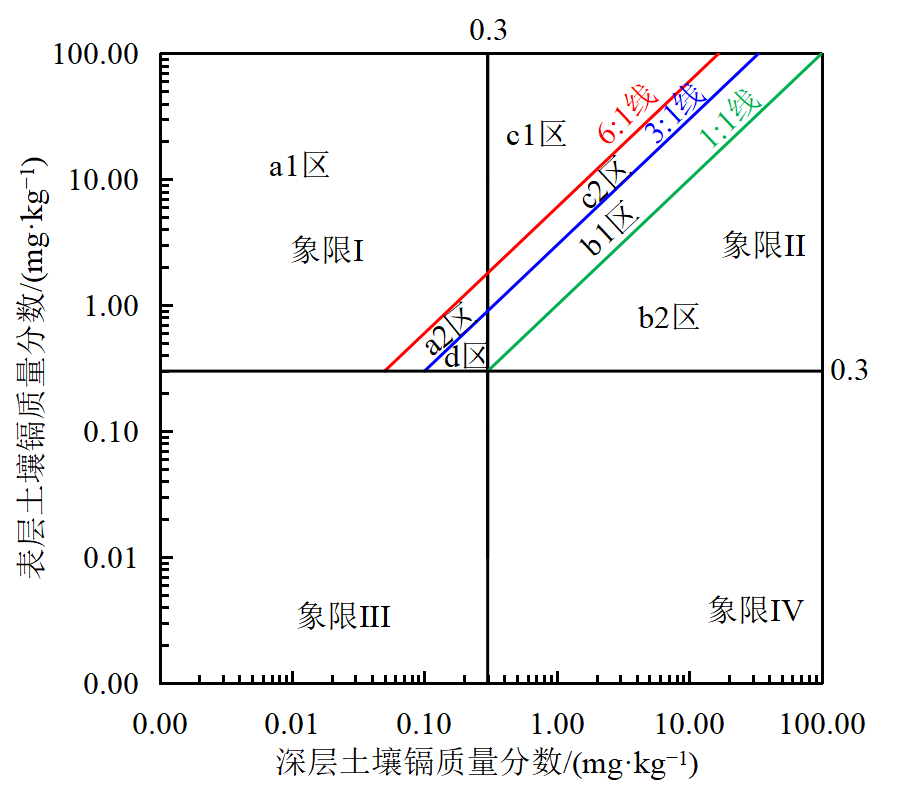
Figure 1 Schematic diagram of the zoning situation for identifying the causes of heavy metal exceedance in the “quadrant+zoning” based on the comparative analysis of element contents of deep and surface soils
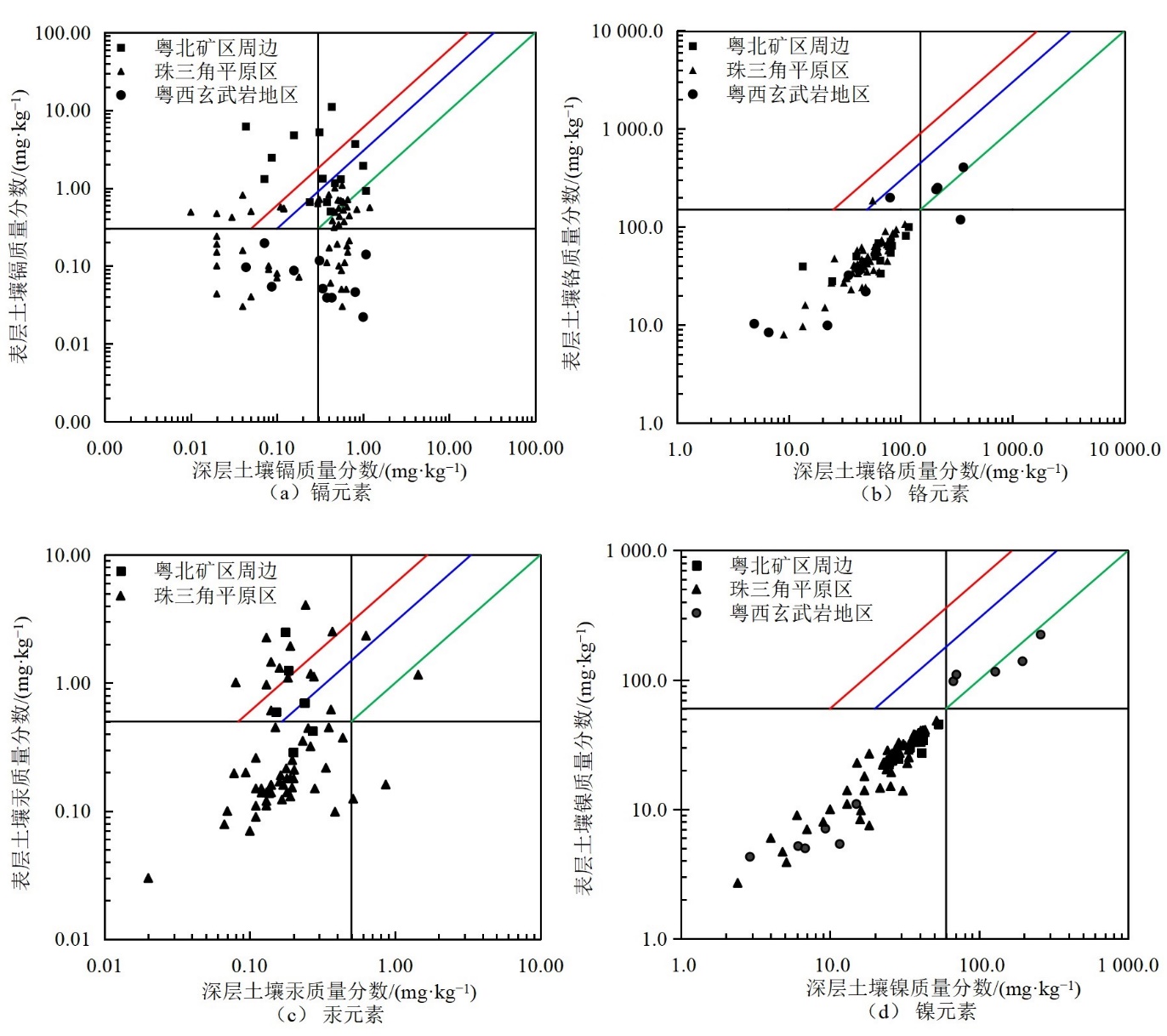
Figure 2 Zoning map for identifying the types of high geological background of heavy metals (Cd, Cr, Hg, and Ni) and pollution causes at the points of coordinated investigation of the surface and deep layers of farmland soils in typical regions

Figure 3 Zoning map for identifying the types of high geological background of heavy metals (Pb, As, Cu, and Zn) and pollution causes at the points of coordinated investigation of the surface and deep layers of farmland soils in typical regions of South China
| [1] |
BAI X X, TIAN H Z, ZHU C Y, et al., 2023. Present knowledge and future perspectives of atmospheric emission inventories of toxic trace elements: A critical review[J]. Environmental Science & Technology, 57(4): 1551-1567.
DOI URL |
| [2] |
CHOI J, 2006. Geochemical modeling of cadmium sorption to soil as a function of soil properties[J]. Chemosphere, 63(11): 1824-1834.
PMID |
| [3] |
HOU D Y, JIA X Y, WANG L W, et al., 2025. Global soil pollution by toxic metals threatens agriculture and human health[J]. Science, 388(6744): 316-321.
DOI PMID |
| [4] |
LIANG J, FENG C T, ZENG G M, et al., 2017. Spatial distribution and source identification of heavy metals in surface soils in a typical coal mine city, Lianyuan, China[J]. Environmental Pollution, 225: 681-690.
DOI PMID |
| [5] |
LIU C S, CHANG C Y, FEI Y H, et al., 2018. Cadmium accumulation in edible flowering cabbages in the Pearl River Delta, China: Critical soil factors and enrichment models[J]. Environmental Pollution, 233: 880-888.
DOI PMID |
| [6] | LI T T, JIA L L, ZHU X, et al., 2023. Distribution and risk assessment of heavy metals in surface sediments of coastal mudflats on Leizhou Peninsula, China[J]. Acta Oceanologica Sinica, 42(1): 25-35. |
| [7] |
LU Y, XIAO X, LIANG Y, et al., 2024. Distribution and transformation of potentially toxic elements in cracks under coal mining disturbance in farmland[J]. Environment Geochemistry and Health, 46: 312.
DOI |
| [8] |
SRINIVASARAO C, RAMA G S, and VENKATESWARLU B, 2014. Heavy metals concentration in soils under rainfed agro-ecosystems and their relationship with soil properties and management practices[J]. International Journal of Environmental Science and Technology, 11(7): 1959-1972.
DOI URL |
| [9] |
SHI T R, ZHANG J G, SHEN W J, et al., 2022. Machine learning can identify the sources of heavy metals in agricultural soil: A case study in northern Guangdong Province, China[J]. Ecotoxicology and Environmental Safety, 245: 114107.
DOI URL |
| [10] |
WEN Y B, LI W, YANG Z F, et al., 2020. Enrichment and source identification of Cd and other heavy metals in soils with high geochemical background in the karst region, Southwestern China[J]. Chemosphere, 245: 125620.
DOI URL |
| [11] |
WANG H X, LI X M, CHEN Y, et al., 2020. Geochemical behavior and potential health risk of heavy metals in basalt-derived agricultural soil and crops: A case study from Xuyi County, eastern China[J]. Science of The Total Environment, 729: 139058.
DOI URL |
| [12] |
WANG Q Y, WU M X, HU N W, et al., 2024. Tracing the vertical migration of exogenous cadmium in soil by seasonal freeze-thaw event using rare earth elements[J]. Science of The Total Environment, 946: 174147.
DOI URL |
| [13] |
WANG J, DENG Y R, HUANG Z Q, et al., 2025. Identification of driving factors for heavy metals and polycyclic aromatic hydrocarbons pollution in agricultural soils using interpretable machine learning[J]. Science of The Total Environment, 960: 178384.
DOI URL |
| [14] |
YE Z P, CHEN J Y, GAO L, et al., 2020. 210Pb dating to investigate the historical variations and identification of different sources of heavy metal pollution in sediments of the Pearl River Estuary, Southern China[J]. Marine Pollution Bulletin, 150: 110670.
DOI URL |
| [15] | 陈怀满, 2002. 土壤中化学物质的行为与环境质量[M]. 北京: 科学出版社: 379-380. |
| CHEN H M, 2002. The Behavior of Chemical Substances in Soil and Environmental Quality[M]. Beijing. Science Press: 379-380. | |
| [16] |
陈俊坚, 张会化, 刘鉴明, 等, 2011. 广东省区域地质背景下土壤表层重金属元素空间分布特征及其影响因子分析[J]. 生态环境学报, 20(4): 646-651.
DOI |
| CHEN J J, ZHANG H H, LIU J M, et al., 2011. Spatial distributions and controlled factors of heavy metals in surface soils in Guangdong based on the regional geology[J]. Ecology and Environmental Sciences, 20(4): 646-651. | |
| [17] | 陈雅丽, 翁莉萍, 马杰, 等, 2019. 近十年中国土壤重金属污染源解析研究进展[J]. 农业环境科学学报, 38(10): 2219-2238. |
| CHEN Y L, WENG L P, MA J, et al., 2019. Review on the last ten years of research on source identification of heavy metal pollution in soils[J]. Journal of Agro-Environment Science, 38(10): 2219-2238. | |
| [18] |
成杭新, 彭敏, 赵传冬, 等, 2019. 表生地球化学动力学与中国西南土壤中化学元素分布模式的驱动机制[J]. 地学前缘, 26(6): 159-191.
DOI |
|
CHENG H X, PENG M, ZHAO C D, et al., 2019. Epigenetic geochemical dynamics and driving mechanisms of distribution patterns of chemical elements in soil, Southwest China[J]. Earth Science Frontiers, 26(6): 159-191.
DOI |
|
| [19] |
陈碧珊, 郑康慧, 王璟, 等, 2022. 雷州半岛土壤-农作物汞元素含量特征与健康风险分析[J]. 生态环境学报, 31(3): 572-582.
DOI |
| CHEN B S, ZHENG K H, WANG J, et al., 2022. Content characteristics and health risk analysis of mercury in soil-crop system in Leizhou Peninsula[J]. Ecology and Environmental Sciences, 31(3): 572-582. | |
| [20] | 冯韶华, 俞一帆, 张旭峰, 等, 2023. 中国农田土壤重金属污染源解析研究进展[J]. 环境污染与防治, 45(9): 1300-1306. |
| FENG S H, YU Y F, ZHANG X F, et al., 2023. Source apportionment of heavy metals in agricultural soil in China: A review[J]. Environmental Pollution and Prevention and Control, 45(9): 1300-1306. | |
| [21] | 国家环境保护总局科技标准司, 2004. 土壤环境监测技术规范:HJ/T166—2004[S]. 北京: 中国环境科学出版社:3. |
| Department of Science and Technology Standards, State Environmental Protection Administration, 2004. Technicalspecificationsforsoilenvironmentalmonitoring:HJ/T166—2004[S]. Beijing: China Environmental Science Press: 3. | |
| [22] | 环境保护部, 国土资源部, 2014. 全国土壤污染状况调查公报[EB/OL]. [2017-6-8]. http://www.zhb.gov.cn/gkml/hbb/qt/201404/t20140417_270670.htm. |
| Ministry of Environmental Protection, Ministry of Land and Resources, 2014. National Soil Pollution Status Survey Bulletin[EB/OL]. [2017-6-8]. http://www.zhb.gov.cn/gkml/hbb/qt/201404/t20140417_270670.htm. | |
| [23] | 韩亚芬, 李琦, 黄淑玲, 2015. 宿州煤矿区大气降尘重金属的污染评价及来源解析[J]. 河北北方学院学报, 31(6): 33-37. |
| HAN Y F, LI Q, HUANG S L, 2015. Pollution assessment and source analysis of heavy metals in atmospheric deposition in Suzhou coal mine area[J]. Journal of Hebei North University (Natural Science Edition), 31(6): 33-37. | |
| [24] |
韩存亮, 黄泽宏, 肖荣波, 等, 2018. 粤北某矿区周边镉锌污染稻田土壤田间植物修复研究[J]. 生态环境学报, 27(1): 158-165.
DOI |
| HAN C L, HUANG Z H, XIAO R B, et al., 2018. Field phytoremediation of cadmium and zinc contaminated paddy soil around a mining area in Northern Guangdong Province[J]. Ecology and Environmental Sciences, 27(1): 158-165. | |
| [25] | 韩志轩, 王学求, 迟清华, 等, 2018. 珠江三角洲冲积平原土壤重金属元素含量和来源解析[J]. 中国环境科学, 38(9): 3455-3463. |
| HAN Z X, WANG X Q, CHI Q H, et al., 2018. Occurrence and source identification of heavy metals in the alluvial soils of Pearl River Delta region, south China[J]. China Environmental Science, 38(9): 3455-3463. | |
| [26] | 韩存亮, 罗炳圣, 常春英, 等, 2022. 基于多种方法的区域农业土壤重金属污染成因分析研究[J]. 生态与农村环境学报, 38(2): 176-183. |
| HAN C L, LUO B S, CHANG C Y, et al., 2022. Identifying the source of soil heavy metal pollution in regional agricultural area based on multiple methods[J]. Journal of Ecology and Rural Environment, 38(2): 176-183. | |
| [27] | 胡芬, 陈巧红, 姜烈, 等, 2025. 基于APCS-MLR和PMF模型的煤矿集中区农用地周边土壤重金属污染特征与来源解析[J/OL]. 环境科学, [2025-05-20]. https://link.cnki.net/urlid/11.1895.x.20250514.1135.012. |
| HU F, CHEN Q H, JIANG L, et al., 2025. Contamination characteristics and source apportionment of heavy metals in soil around the agricultural land in coal mining concentration areas based on APCS-MLR and PMF models[J/OL]. Environmental Science, [2025-05-20]. https://link.cnki.net/urlid/11.1895.x.20250514.1135.012. | |
| [28] | 廖强, 李金鑫, 李明珠, 等, 2018. 污灌条件下重金属在土壤中的累积效应及风险评价[J]. 农业环境科学学报, 37(11): 2560-2569. |
| LIAO Q, LI J X, LI M Z, et al., 2018. Cumulative distribution and risk assessment of heavy metals during sewage irrigation[J]. Journal of Agro-Environment Science, 37(11): 2560-2569. | |
| [29] | 刘进, 潘月鹏, 师华定, 2022. 华北地区农田土壤镉来源及大气沉降的贡献[J]. 农业环境科学学报, 41(8): 1698-1708. |
| LIU J, PAN Y P, SHI H D, 2022. Atmospheric deposition as a dominant source of cadmium in agricultural soils of north China[J]. Journal of Agro-Environment Science, 41(8): 1698-1708. | |
| [30] | 邱锦泉, 付善明, 肖方, 等, 2016. 粤北某矿区横石河流域耕作土壤剖面重金属空间分布及生态风险评价[J]. 生态科学, 35(3): 56-64. |
| QIU J Q, FU S M, XIAO F, et al., 2016. Spatial distribution and potential ecological risk assessment of heavy metals in cultivated soil profiles of Hengshi River Basin in the sulfide mine, northern Guangdong[J]. Ecological Science, 35(3): 56-64. | |
| [31] | 生态环境部土壤环境管理司, 生态环境部科技标准司, 2018. 土壤环境质量农用地土壤污染风险管控标准(试行):GB15618—2018[S]. 北京: 中国环境出版集团: 2. |
| Soil Environment Management Department of the Ministry of Ecology and Environment, Department of Science and Technology Standards,Ministry of Ecology and Environment, 2018. Soilenvironmentalquality—Riskcontrolstandardforsoilcontaminationofagriculturalland:GB15618—2018[S]. Beijing: China Environment Publishing Group: 2. | |
| [32] | 孙慧, 毕如田, 郭颖, 等, 2018. 广东省土壤重金属溯源及污染源解析[J]. 环境科学学报, 38(2): 704-714. |
| SUN H, BI R T, GUO Y, et al., 2018. Source apportionment analysis of trace metal contamination in soils of Guangdong province, China[J]. Acta Scientiae Circumstantiae, 38(2): 704-714. | |
| [33] | 孙斌, 魏志敏, 张力浩, 等, 2021. 地质高背景土壤重金属赋存特征及微生物群落结构差异[J]. 土壤学报, 58(5): 1246-1255. |
| SUN B, WEI Z M, ZHANG L H, et al., 2021. Distribution of heavy metals and microbial community structure in soils high in geological background value[J]. Acta Pedologica Sinica, 58(5): 1246-1255. | |
| [34] | 宋波, 肖乃川, 马丽钧, 等, 2022. 基于DGT技术的广西碳酸盐岩区稻米镉含量主控因素[J]. 环境科学, 43(1): 463-471. |
| SONG B, XIAO N C, MA L J, et al., 2022. Main control factors of cadmium content in rice in carbonate rock region of Guangxi based on the DGT technique[J]. Environmental Science, 43(1): 463-471. | |
| [35] | 王成, 赵艳萍, 谢鸣捷, 2021. 苏南典型工农业交错区土壤铅富集特征及源解析: 基于PCA-PMF方法[J]. 中国环境科学, 41(1): 279-287. |
| WANG C, ZHAO Y P, XIE M J, 2021. Characteristics of lead enrichment in the soil from a typical peri-urban agricultural area of the southern Jiangsu and source appointment based on the PCA-PMF method[J]. China Environmental Science, 41(1): 279-287. | |
| [36] | 王雪雯, 刘鸿雁, 顾小凤, 等, 2022. 地质高背景与污染叠加区不同土地利用方式下土壤重金属分布特征[J]. 环境科学, 43(4): 2094-2103. |
| WANG X W, LIU H Y, GU X F, et al., 2022. Distribution characteristics of heavy metals in soils affected by different land use types in a superimposed pollution area with high geological background[J]. Environmental Science, 43(4): 2094-2103. | |
| [37] | 王俊, 邓一荣, 李德安, 等, 2023. 人工智能数据挖掘在土壤环境科学中的应用——基于文献知识图谱的分析[J]. 土壤通报 (5): 1248-1260. |
| WANG J, DENG Y R, LI D A, et al., 2023. Application of intelligent data mining in soil environmental science: Analysis based on literature knowledge graph[J]. Chinese Journal of Soil Science (5): 1248-1260. | |
| [38] |
徐颖菲, 张耿苗, 张丽君, 等, 2019. 亚热带不同母岩成壤过程中金属元素的迁移和积累特点[J]. 浙江农业学报, 31(12): 2064-2072.
DOI |
|
XU Y F, ZHANG G M, ZHANG L J, et al., 2019. Migration and accumulation of metal elements during formation of soils derived from different parent rocks in subtropical zone[J]. Acta Agriculturae Zhejiangensis, 31(12): 2064-2072.
DOI |
|
| [39] | 肖高强, 陈杰, 白冰, 等, 2021. 云南典型地质高背景区土壤重金属含量特征及污染风险评价[J]. 地质与勘探, 57(5): 1077-1086. |
| XIAO G Q, CHEN J, BAI B, et al., 2021. Content characteristics and risk assessment of heavy metals in soil of typical high geological background areas, Yunnan Province[J]. Geology and Exploration, 57(5): 1077-1086. | |
| [40] |
徐磊, 黄加忠, 张亚, 等, 2022. 滇中高山丘陵区土壤重金属来源及影响因素——以武定县为例[J]. 中国农学通报, 38(1): 82-92.
DOI |
|
XU L, HUANG J Z, ZHANG Y, et al., 2022. Sources and influencing factors of soil heavy metals in the high mountain and hilly area of central Yunnan: Taking Wuding county as an example[J]. Chinese Agricultural Science Bulletin, 38(1): 82-92.
DOI |
|
| [41] | 许文, 周潇云, 张玥, 等, 2024. 土壤重金属污染源清单研究现状及进展[J]. 农业环境科学学报, 43(11): 2472-2486. |
| XU W, ZHOU X Y, ZHANG Y, 2024. Review on the status and progress of soil heavy metals emission inventory[J]. Journal of Agro-Environment Science, 43(11): 2472-2486. | |
| [42] | 于瑞莲, 胡恭任, 2008. 土壤中重金属污染源解析研究进展[J]. 有色金属, 60(4): 158-165. |
| [47] | ZHENG M J, ZHANG S, ZHANG M K, 2022. Distribution and heavy metal pollution characteristics of high background farmland in Zhejiang Province[J]. Zhejiang Agricultural Science, 63(1): 166-169. |
| [48] | 张连科, 李海鹏, 黄学敏, 等, 2016. 包头某铝厂周边土壤重金属的空间分布及来源解析[J]. 环境科学, 37(3): 1139-1146. |
| ZHANG L K, LI H P, HUANG X M, et al., 2016. Soil heavy metal spatial distribution and source analysis around an aluminum plant in Baotou[J]. Environmental Science. 37(3): 1139-1146. | |
| [49] | 赵万伏, 宋垠先, 管冬兴, 等, 2018. 典型黑色岩系分布区土壤重金属污染与生物有效性研究[J]. 农业环境科学学报, 37(7): 1332-1341. |
| ZHAO W F, SONG Y X, GUAN D X, et al., 2018. Pollution status and bioavailability of heavy metals in soils of a typical black shale area[J]. Journal of Agro-Environment Science, 37(7): 1332-1341. | |
| [50] | 曾宪平, 万继磊, 李密, 等, 2024. 黔中喀斯特高背景土壤-辣椒系统重金属含量特征及生态风险评价[J]. 环境化学, 43(6): 1871-1880. |
| ZENG X P, WAN J L, LI M, et al., 2024. Characteristics of heavy metals and assessments of ecological risks in cultivated soil-pepper system of Karst Areas[J]. Environmental Chemistry, 43(6): 1871-1880. | |
| [42] | YU R L, HU G R, 2008. Research progress in sources identification of soil heavy metal pollution[J]. Nonferrous Metals, 60(4): 158-165. |
| [43] | 中国环境监测总站, 1990. 中国土壤元素背景值[M]. 北京: 中国环境科学出版社: 98-100. |
| China National Environmental Monitoring Centre, 1990. Background Values of Soil Elements in China[M]. Beijing: China Environmental Science Press: 98-100. | |
| [44] | 朱永官, 陈保冬, 林爱军, 等, 2005. 珠江三角洲地区土壤重金属污染控制与修复研究的若干思考[J]. 环境科学学报, 25(12): 1575-1579. |
| ZHU Y G, CHEN B D, LIN A J, et al., 2005. Heavy metal contamination in Pearl River Delt—Status and research priorities[J]. Acta Scientiae Circumstantiae, 25(12): 1575-1579. | |
| [45] | 章明奎, 王浩, 张慧敏, 2008. 浙东海积平原农田土壤重金属来源辨识[J]. 环境科学学报, 28(10): 1946-1954. |
| ZHANG M K, WANG H M, ZHANG H M, 2008. Distinguishing different sources of heavy metals in soils on the coastal plain of Eastern Zhejiang Province[J]. Acta Scientiae Circumstantiae, 28(10): 1946-1954. | |
| [46] | 郑顺安, 2010. 我国典型农田土壤中重金属的转化与迁移特征研究[D]. 杭州: 浙江大学: 121-136. |
| ZHENG S A, 2010. Research on the transformation and migration characteristics of heavy metals in typical farmland soil in China[D]. Hangzhou: Zhejiang University: 121-136. | |
| [47] |
郑铭洁, 张爽, 章明奎, 2022. 浙江省地质高背景农田的分布与重金属污染特点[J]. 浙江农业科学, 63(1): 166-169.
DOI |
| [1] | LUO Shijie, WEN Qingqi, CHEN Chengyu. Research Progress on the Occurrence, Migration, Fate, and Environmental Risks of Nanoplastics in Oceans and Freshwaters [J]. Ecology and Environmental Sciences, 2025, 34(10): 1532-1546. |
| [2] | LI Haiyan, YANG Xiaoqin, JAN Meipeng, ZHANG Xiaoran. [J]. Ecology and Environmental Sciences, 2023, 32(2): 407-420. |
| [3] | WU Weilong, CHEN Yijie, WEI Ting, YANG Guiqiong, YANG Changhong, ZHEN Zhen, LIN Zhong. Mechanisms of Earthworm-driven Biodegradation of Polycyclic Aromatic Hydrocarbons in Coastal Saline Agricultural Soils [J]. Ecology and Environmental Sciences, 2023, 32(11): 1996-2006. |
| Viewed | ||||||
|
Full text |
|
|||||
|
Abstract |
|
|||||
Copyright © 2021 Editorial Office of ACTA PETROLEI SINICA
Address:No. 6 Liupukang Street, Xicheng District, Beijing, P.R.China, 510650
Tel: 86-010-62067128, 86-010-62067137, 86-010-62067139
Fax: 86-10-62067130
Email: syxb@cnpc.com.cn
Support byBeijing Magtech Co.ltd, E-mail:support@magtech.com.cn
