生态环境学报 ›› 2026, Vol. 35 ›› Issue (3): 333-344.DOI: 10.16258/j.cnki.1674-5906.2026.03.001
• “新污染物”研究专栏 •
下一篇
刘沙沙1( ), 张佳莹1, 肖舒淇1, 林静雯1, 吴文胜1,*(), 杨成方2,*()
收稿日期:2025-08-29
修回日期:2025-10-31
接受日期:2025-11-16
出版日期:2026-03-18
发布日期:2026-03-13
通讯作者:
*E-mail: 作者简介:刘沙沙(1986年生),女,副教授,博士,研究方向为新污染物的微生物修复。E-mail: 2657222877@qq.com
基金资助:
LIU Shasha1(), ZHANG Jiaying1, XIAO Shuqi1, LIN Jingwen1, WU Wensheng1,*(), YANG Chengfang2,*()
Received:2025-08-29
Revised:2025-10-31
Accepted:2025-11-16
Online:2026-03-18
Published:2026-03-13
摘要:
微塑料作为一种新型污染物在环境中普遍存在,微生物降解能够有效去除微塑料而受到广泛关注。为了减轻微塑料对环境的危害,从聚丙烯(PP)和聚氯乙烯(PVC)微塑料污染土壤中筛选能够降解PP/PVC的菌株并对其进行鉴定,通过考察PP/PVC的质量、表面微观形貌和官能团的变化,分析降解菌的生长情况及酶活性,确定筛选得到的菌株对PP/PVC的降解能力。结果表明,菌株PP1P和PP1Y能够以PP为唯一碳源生长、PVC1Y以PVC为唯一碳源生长,分别鉴定为粘液玫瑰单胞菌(Roseomonas mucosa)、类芽孢杆菌(Paenibacillus sp.)和巨大普里斯特氏菌(Priestia megaterium)。菌株PPVC1W能够以PP或PVC为碳源进行生长,鉴定为芽孢杆菌(Bacillus sp.)。培养50 d后,PP1P、PP1Y和PPVC1W对PP的失重率分别为8.12%±2.52%、8.06%±1.94%和6.03%±0.58%,PVC1Y和PPVC1W对PVC的失重率分别为5.15%±0.52%和4.79%±1.43%;PP和PVC表面呈现出明显的侵蚀、裂缝和凹陷;PP表面出现了新的吸收峰(−C=C),−OH、−C−H、−C=O和−C−C的峰强度增加,而PVC表面−OH的峰强度增加,−C−Cl的峰强度降低;降解菌的过氧化物酶和过氧化氢酶的活性显著升高。微塑料表面形貌和特征峰的变化、酶活性的增加量及生长的ΔOD600和活细胞增加量的大小顺序为PP1P-PP>PP1Y-PP >PPVC1W-PP,PVC1Y-PVC > PPVC1W-PVC,这与菌株对PP和PVC的失重率一致,说明本研究筛选得到的菌株对PP/PVC具有较好的降解能力,可为微塑料污染的微生物修复提供菌种资源和技术支撑。
中图分类号:
刘沙沙, 张佳莹, 肖舒淇, 林静雯, 吴文胜, 杨成方. 聚丙烯和聚氯乙烯微塑料降解菌的筛选及降解特性[J]. 生态环境学报, 2026, 35(3): 333-344.
LIU Shasha, ZHANG Jiaying, XIAO Shuqi, LIN Jingwen, WU Wensheng, YANG Chengfang. Screening and Degradation Characteristics of Polypropylene and Polyvinyl Chloride Microplastics Degrading Bacteria[J]. Ecology and Environmental Sciences, 2026, 35(3): 333-344.

图1 微塑料降解菌在NB培养基上的菌落形态
Figure 1 Colony morphology of microplastic degrading bacteria on NB medium

图2 PP和PVC微塑料降解菌株的系统发育进化树
Figure 2 Phylogenetic tree of PP and PVC microplastics degrading strains
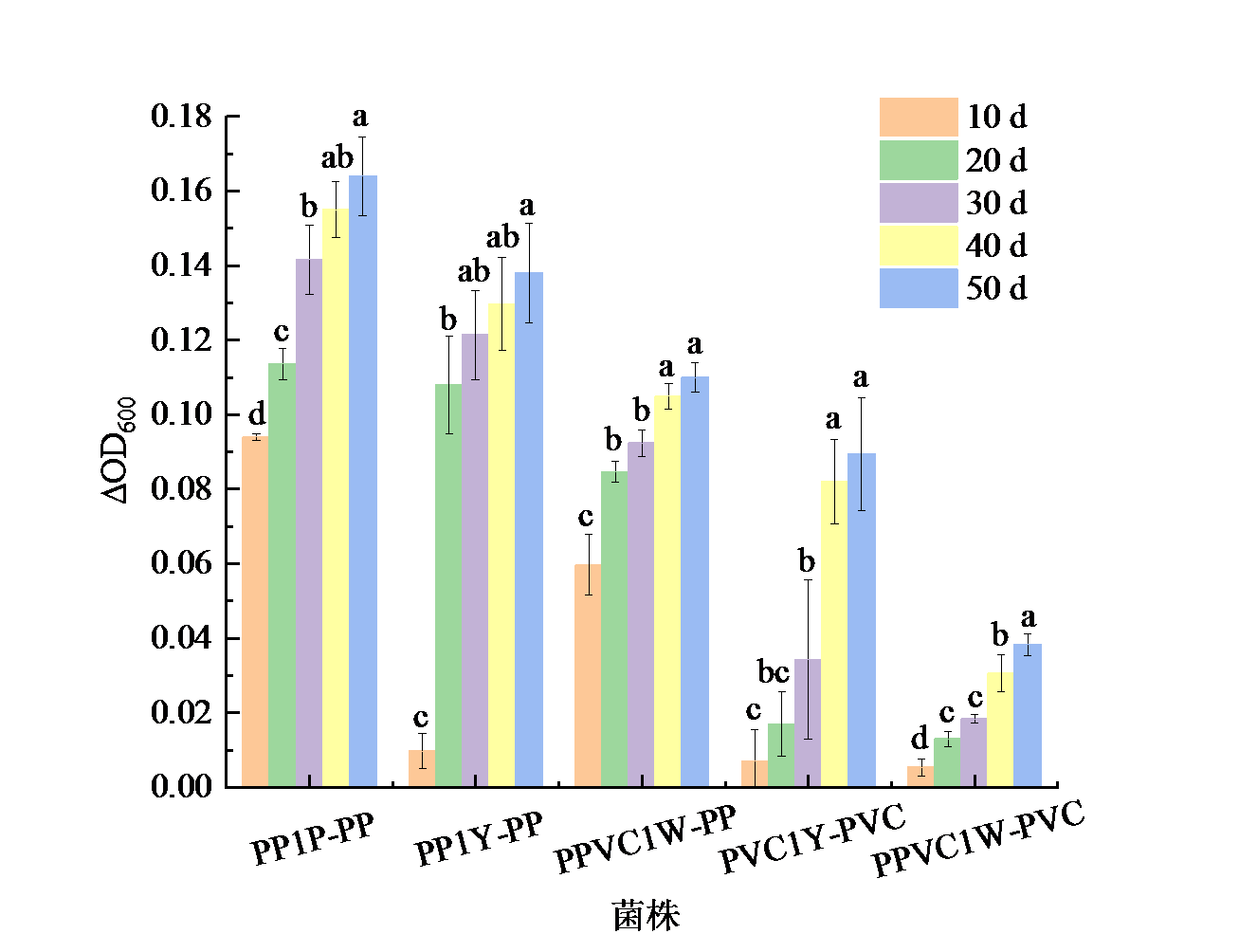
图3 菌株在降解PP/PVC微塑料前后OD600的变化 每组数据为n=3个重复的平均值±标准差;不同小写字母表示差异显著。下同
Figure 3 Changes of OD600 before and after degradation of bacterial strains when inoculate with PP/PVC microplastics
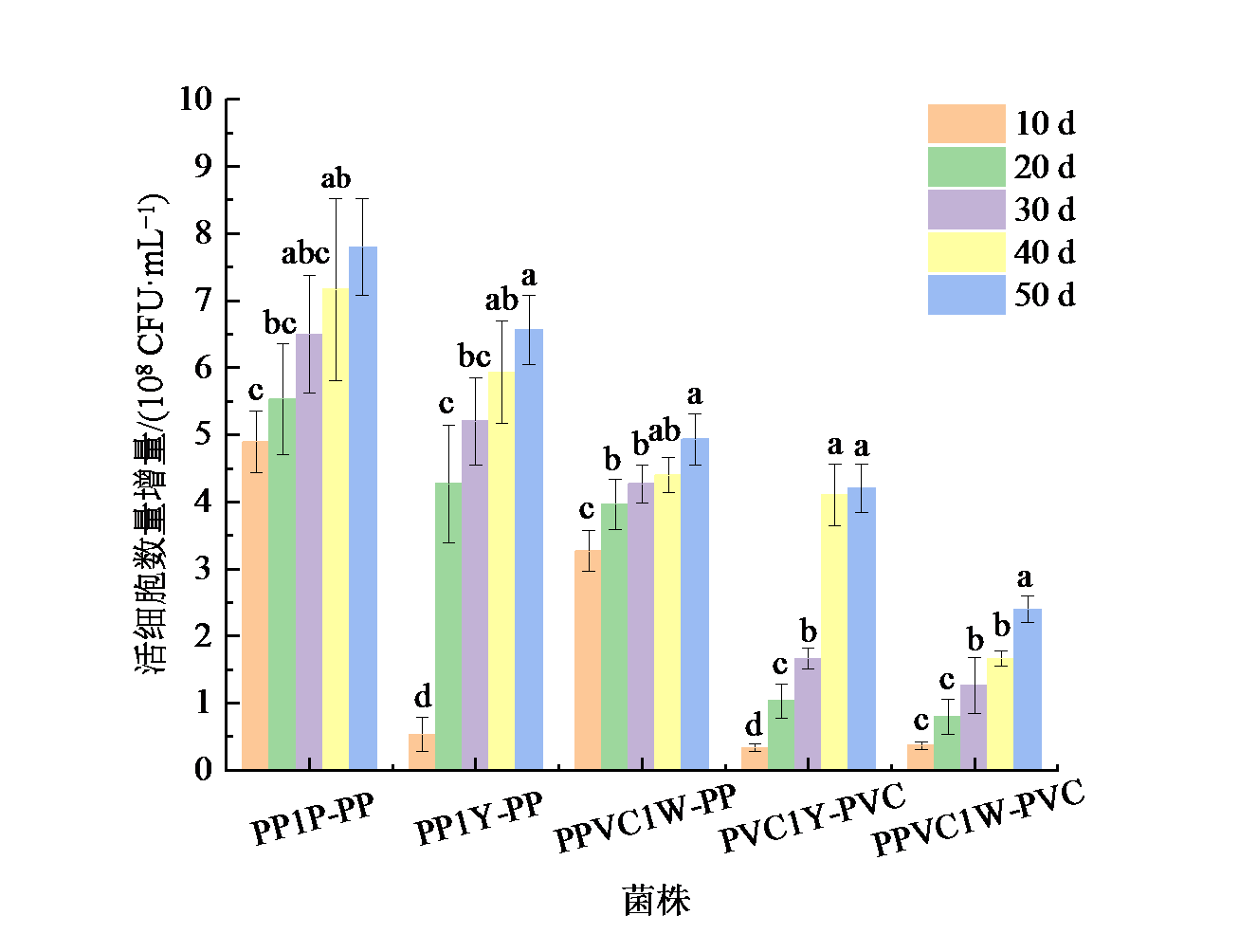
图4 菌株在降解PP/PVC微塑料后活细胞数量增量
Figure 4 Increment of viable cell count after degrading PP/PVC microplastics by bacterial strains
| 组别 | PP微塑料 | PVC微塑料 | ||||||
|---|---|---|---|---|---|---|---|---|
| CK | PP1P | PP1Y | PPVC1W | CK | PVC1Y | PPVC1W | ||
| 失重率/ % | 0.47± 0.10b | 8.12± 2.52a | 8.06± 1.94a | 6.03± 0.58a | 0.33± 0.06b | 5.15± 0.52a | 4.79± 1.43a | |
表1 菌株对PP/PVC微塑料的降解效果
Table 1 Degradation Effect of bacterial strains on PP/PVC microplastics
| 组别 | PP微塑料 | PVC微塑料 | ||||||
|---|---|---|---|---|---|---|---|---|
| CK | PP1P | PP1Y | PPVC1W | CK | PVC1Y | PPVC1W | ||
| 失重率/ % | 0.47± 0.10b | 8.12± 2.52a | 8.06± 1.94a | 6.03± 0.58a | 0.33± 0.06b | 5.15± 0.52a | 4.79± 1.43a | |

图5 PP微塑料的表面微观形貌
Figure 5 Surface micromorphology of PP microplastics

图6 PVC微塑料的表面微观形貌
Figure 6 Surface micromorphology of PVC microplastics
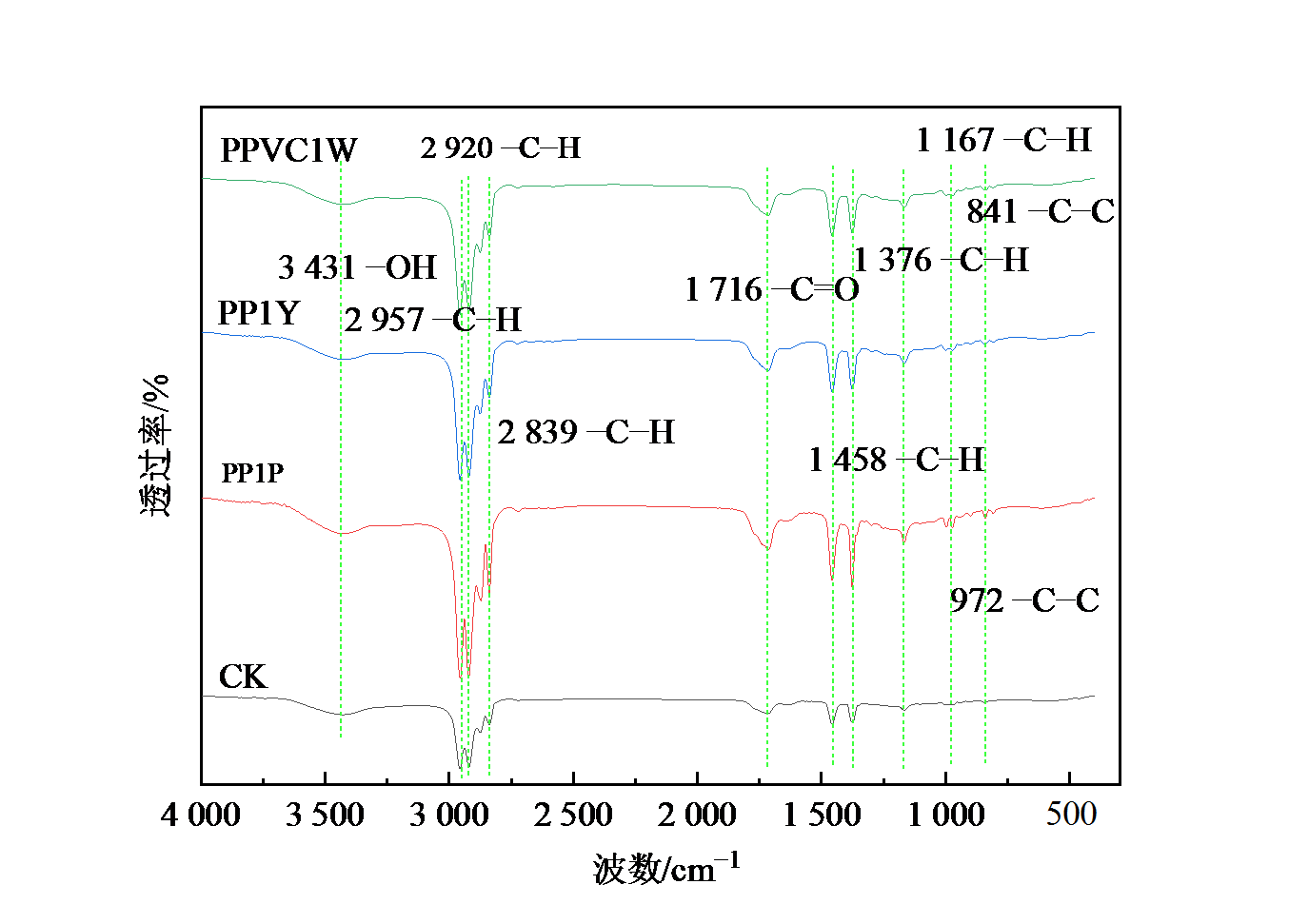
图7 PP微塑料的红外光谱分析
Figure 7 Fourier transform infrared spectroscopy analysis of PP microplastics
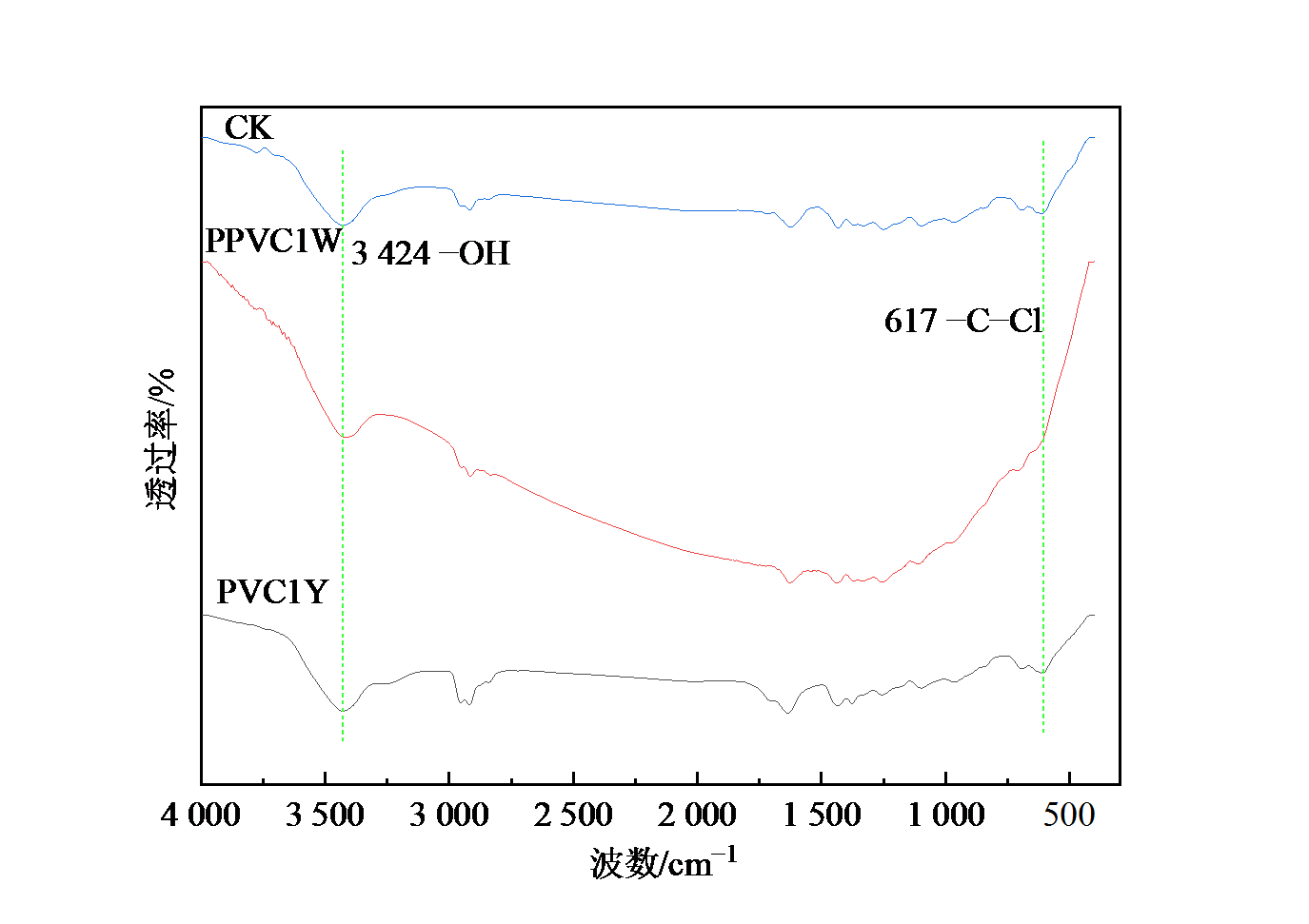
图8 PVC微塑料的红外光谱分析
Figure 8 Fourier transform infrared spectroscopy analysis of PVC microplastics
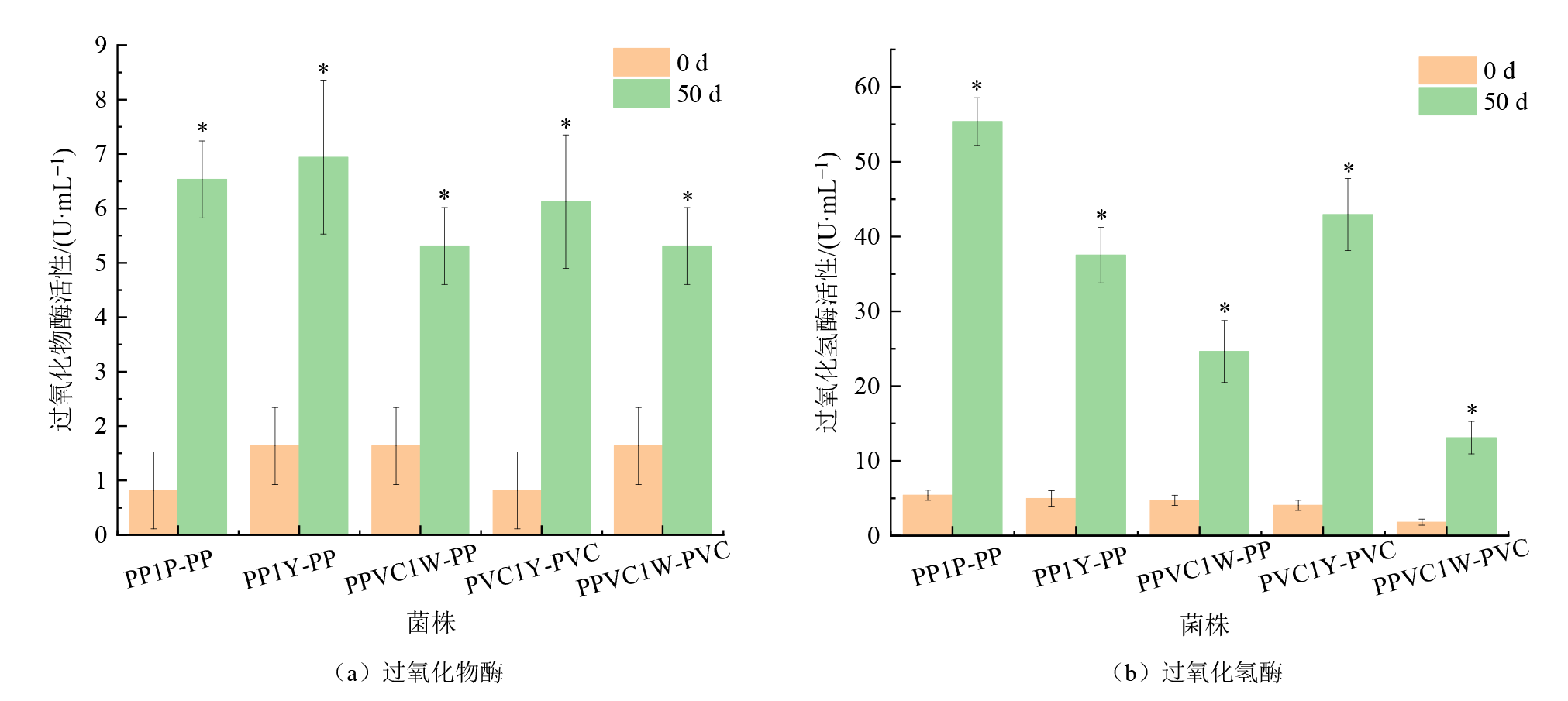
图9 降解菌的过氧化物酶和过氧化氢酶活性 每组数据为n=3个重复的平均值±标准差,*表示同一菌株的酶活性0 d与50 d相比存在显著差异(p<0.05)
Figure 9 Peroxidase and catalase activities of degrading bacteria
| [1] |
ANDLEEB S, MUNIR M, ALI I M, et al., 2025. Biodegradation of polyvinyl chloride using vermibacteria under variable physicochemical conditions[J]. Journal of Hazardous Materials Advances, 17: 100571.
DOI URL |
| [2] | ANGGIANI M, KRISTANTI R A, HADIBARATA T, et al., 2024. Degradation of polypropylene microplastics by a consortium of bacteria colonizing plastic surface waste from Jakarta Bay[J]. Water, Air, & Soil Pollution, 235: 308 |
| [3] |
ASEES W K, DIVYA B, 2024. A comprehensive approach to evaluate microplastic biodegradation potential of mangrove rhizobacteria[J]. Journal of Environmental Biology, 45(3): 317-329.
DOI URL |
| [4] |
ASIANDU A P, WAHYUDI A, SARI S W, 2021. A review: Plastics waste biodegradation using plastics-degrading bacteria[J]. Journal of Environmental Treatment Techniques, 9(1): 148-157.
DOI URL |
| [5] |
AUTA H S, EMENIKE C U, FAUZIAH S, 2017. Screening of Bacillus strains isolated from mangrove ecosystems in Peninsular Malaysia for microplastic degradation[J]. Environmental Pollution, 231(Part 2): 1552-1559.
DOI URL |
| [6] |
AUTA H S, EMENIKE C U, JAYANTHI B, et al., 2018. Growth kinetics and biodeterioration of polypropylene microplastics by Bacillus sp. and Rhodococcus sp. isolated from mangrove sediment[J]. Marine Pollution Bulletin, 127: 15-21.
DOI URL |
| [7] |
BIESTA-PETERS EG, REIJ MW, JOOSTEN H, et al., 2020. Comparison of two optical-density-based methods and a plate count method for estimation of growth parameters of Bacillus cereus[J]. Applied and Environmental Microbiology, 76(5): 1399-405.
DOI URL |
| [8] | BISMARCK A V L, CARLOS J J, PEDRO L, et al., 2019. Biodegradability study by FTIR and DSC of polymers films based on polypropylene and cassava starch[J]. Orbital: The Electronic Journal of Chemistry, 11(2): 71-82. |
| [9] |
BLÁQUEZ-BLÁQUEZ E, CERRADA M L, BENAVENTE R, et al., 2020. Identification of additives in polypropylene and their degradation under solar exposure studied by gas chromatography-mass spectrometry[J]. ACS Omega, 5(16): 9055-9063.
DOI URL |
| [10] |
CHAUDHARY D K, DAHAL R H, HONG Y, 2021. Noviherbaspirillum pedocola sp. nov., isolated from oil-contaminated experimental soil[J]. Archives of Microbiology, 203(6): 3071-3076.
DOI |
| [11] |
DEVI K N, RAJU P, SANTHANAM P, et al., 2021. Biodegradation of low-density polyethylene and polypropylene by microbes isolated from Vaigai River, Madurai, India[J]. Archives of microbiology, 203(10): 6253-6265.
DOI |
| [12] |
EL-DASH H A, YOUSEF N E, ABOELAZM A A, et al., 2023. Optimizing eco-friendly degradation of polyvinyl chloride (PVC) plastic using environmental strains of Malassezia species and Aspergillus fumigatus[J]. International Journal of Molecular Sciences, 24(20): 15452.
DOI URL |
| [13] |
GAO R R, SUN C M, 2021. A marine bacterial community capable of degrading poly(ethylene terephthalate) and polyethylene[J]. Journal of Hazardous Materials, 416: 125928.
DOI URL |
| [14] |
GIACOMUCCI L, RADDADI N, SOCCIO M, et al., 2020. Biodegradation of polyvinyl chloride plastic films by enriched anaerobic marine consortia[J]. Marine Environmental Research, 158: 104949.
DOI URL |
| [15] |
GIACOMUCCI L, RADDADI N, SOCCIO M, et al., 2019. Polyvinyl chloride biodegradation by Pseudomonas citronellolis and Bacillus flexus[J]. New Biotechnology, 52: 35-41.
DOI URL |
| [16] |
HABIB S, IRUTHAYAM A, ABD SHUKOR M Y, et al., 2020. Biodeterioration of untreated polypropylene microplastic particles by antarctic bacteria[J]. Polymers, 12(11): 2616.
DOI URL |
| [17] | JABLOUNE R, KHALIL M, MOUSSA I E B, et al., 2020. Enzymatic degradation of p-Nitrophenyl esters, polyethylene terephthalate, cutin, and suberin by Sub1, a suberinase encoded by the plant pathogen Streptomyces scabies[J]. Microbes and Environments, 35(1): 19086. |
| [18] |
JEON J M, PARK S J, CHOI T R, et al., 2021. Biodegradation of polyethylene and polypropylene by Lysinibacillus species JJY0216 isolated from soil grove[J]. Polymer Degradation and Stability, 191: 109662.
DOI URL |
| [19] |
KHATOON N, JAMAL A, ALI M I, 2019. Lignin peroxidase isoenzyme: A novel approach to biodegrade the toxic synthetic polymer waste[J]. Environmental Technology, 40(11): 1366-1375.
DOI URL |
| [20] |
KHOIRONI A, HADITYANTO H, ANGGORO S, et al., 2020. Evaluation of polypropylene plastic degradation and microplastic identification in sediments at Tambak Lorok coastal area, Semarang, Indonesia[J]. Marine Pollution Bulletin, 151: 110868.
DOI URL |
| [21] |
KUMARI A, CHAUDHARY D R, JHA B, 2019. Destabilization of polyethylene and polyvinylchloride structure by marine bacterial strain[J]. Environmental Science and Pollution Research International, 26(2): 1507-1516.
DOI PMID |
| [22] |
LIU G Z, ZHU Z L, YANG Y X, et al., 2019. Sorption behavior and mechanism of hydrophilic organic chemicals to virgin and aged microplastics in freshwater and seawater[J]. Environmental Pollution, 246: 26-33.
DOI PMID |
| [23] |
MALLA M A, DUBEY A, KUMAR A, et al., 2023. Unlocking the biotechnological and environmental perspectives of microplastic degradation in soil-ecosystems using metagenomics[J]. Process Safety and Environmental Protection, 170: 372-379.
DOI URL |
| [24] | MASOOD F, YASIN T, HAMEED A, 2014. Comparative oxo-biodegradation study of poly-3-hydroxybutyrate-co-3-hydroxyvalerate/polypropylene blend in controlled environments[J]. International Biodeterioration & Biodegradation, 87: 1-8. |
| [25] | MUKHERJEE S, KUNDU P P, 2014. Alkaline fungal degradation of oxidized polyethylene in black liquor: Studies on the effect of lignin peroxidases and manganese peroxidases[J]. Journal of Applied Polymer Science, 131(17): 40738. |
| [26] |
NASRABADI A E, RAMAVANDI B, BONYADI Z, 2023. Recent progress in biodegradation of microplastics by Aspergillus sp. in aquatic environments[J]. Colloid and Interface Science Communications, 57: 100754.
DOI URL |
| [27] |
NYAMJAV I, JANG Y, LEE Y E, et al., 2023. Biodegradation of polyvinyl chloride by Citrobacter koseri isolated from superworms (Zophobas atratus larvae)[J]. Frontiers in Microbiology, 14: 1175249.
DOI URL |
| [28] |
PARK S Y, KIM C G, 2019. Biodegradation of micro-polyethylene particles by bacterial colonization of a mixed microbial consortium isolated from a landfill site[J]. Chemosphere, 222: 527-533.
DOI PMID |
| [29] | PATIL R, BAGDE S U, 2016. Development of novel bacterial strains for enhanced biodegradation of plastic polymers by protoplast fusion[J]. Asian Journal of Microbiology, Biotechnology and Environmental Science, 18(2): 513-523. |
| [30] | PENG B Y, CHEN Z B, CHEN J B, et al., 2020. Biodegradation of polyvinyl chloride (PVC) in Tenebrio molitor (Coleoptera: Tenebrionidae) larvae[J]. Environment International, 45: 106106. |
| [31] |
PIRES P J, MIRANDA M G, SOUZA L G, et al., 2019. Investigation of degradation of polypropylene in soil using an enzymatic additive[J]. Iranian Polymer Journal, 28(12): 1045-1055.
DOI |
| [32] |
RAUSCHER A, MEYER N, JAKOBS A, et al., 2023. Biodegradable microplastic increases CO2 emission and alters microbial biomass and bacterial community composition in different soil types[J]. Applied Soil Ecology, 182: 104714.
DOI URL |
| [33] |
SHAH A A, HASAN F, HAMEED A, et al., 2008. Biological degradation of plastics: A comprehensive review[J]. Biotechnology Advances, 26(3): 246-265.
DOI PMID |
| [34] |
SUN X X, WANG S N, LIN Z Y, et al., 2025. Plastic biodegradation by sediment microbial populations under denitrifying conditions[J]. Environmental Science & Technology, 59: 11002-11015.
DOI URL |
| [35] |
VIVI V K, MARTINS-FRANCHETTI S M, ATTILI-ANGELIS D, 2019. Biodegradation of PCL and PVC: Chaetomium globosum (ATCC 16021) activity[J]. Folia Microbiologica, 64(1): 1-7.
DOI |
| [36] |
WRÓBEL M, DEJA-SIKORA E, HRYNKIEWICZ K, et al., 2024. Microbial allies in plastic degradation: Specific bacterial genera as universal plastic-degraders in various environments[J]. Chemosphere, 363: 142933.
DOI URL |
| [37] |
XU Y, XIAN Z N, YUE W L, et al., 2023. Degradation of polyvinyl chloride by a bacterial consortium enriched from the gut of Tenebrio molitor larvae[J]. Chemosphere, 318: 137944.
DOI URL |
| [38] |
YADAV M, MANDERIA S, SINGH S, et al., 2022. Isolation and characterization of polyvinyl chloride (PVC) degrading bacteria from polluted sites of Gwalior City, M.P., India[J]. Nature Environment and Pollution Technology, 21(1): 201-207.
DOI URL |
| [39] | YANG T, REN L, JIA Y, et al., 2018. Biodegradation of di-(2-ethylhexyl) phthalate by Rhodococcus ruber YC-YT1 in contaminated water and soil[J]. International Journal of Environmental Research & Public Health, 15(5): 964. |
| [40] |
ZHANG J Q, GAO D L, LI Q H, et al., 2020. Biodegradation of polyethylene microplastic particles by the fungus Aspergillus favus from the guts of wax moth Galleria mellonella[J]. Science of the Total Environment, 704: 135931.
DOI URL |
| [41] |
ZHANG Z, PENG H R, YANG D C, et al., 2022. Polyvinyl chloride degradation by a bacterium isolated from the gut of insect larvae[J]. Nature Communications, 13(1): 5360.
DOI PMID |
| [42] |
ZHAO J C, GUO Z A, MA X Y, et al., 2024. Novel surface modification of high-density polyethylene films by using enzymatic catalysis[J]. Journal of Applied Polymer Science, 91(6): 3673-3678.
DOI URL |
| [43] | 曹沁, 林毅博, 陈军, 等, 2020. 黄粉虫及其肠道微生物对聚氯乙烯的生物降解作用[J]. 微生物学通报, 47(2): 390-400. |
| CAO Q, LIN Y B, CHEN J, et al., 2020. Biodegradation of polyvinyl chloride by Tenebrio molitor and its intestinal microorganisms[J]. Microbiology China, 47(2): 390-400. | |
| [44] | 段亚良, 2023. 聚乙烯微塑料降解菌的筛选和降解机理研究[D]. 郑州: 河南工业大学: 12-29. |
| DUAN Y L, 2023. Screening and degradation mechanism of polyethylene microplastics degrading[D]. Zhengzhou: Henan University of Technology: 12-29. | |
| [45] |
李雪, 王震, 毛雪飞, 2025. 聚乙烯与聚丙烯微塑料对镉胁迫下水稻幼苗生长及抗氧化作用的影响[J]. 生态环境学报, 34(7): 1053-1063.
DOI |
| LI X, WANG Z, MAO X F, 2025. Effects of polyethylene and polypropylene microplastics on the growth and antioxidant mechanisms of rice seedlings under cadmium stress[J]. Ecology and Environmental Sciences, 34(7): 1053-1063. | |
| [46] |
柳春雨, 门丽娜, 连雅琴, 等, 2023. 大蜡螟幼虫肠道微生物聚乙烯降解酶基因的表达及性质分析[J]. 中国农业科技导报, 25(3): 132-139.
DOI |
| LIU C Y, MEN L N, LIAN Y Q, et al., 2023. Expression and characterization of enzymes for polyethylene degradation in the gut of Galleria mellonella L. larvae[J]. Journal of Agricultural Science and Technology, 25(3): 132-139. | |
| [47] | 时梦, 2024. 基于碳碳双键引入与氧化裂解的聚氯乙烯酶法降解研究[D]. 无锡: 江南大学: 28-35. |
| SHI M, 2024. Enzymic degradation of polyvinyl chloride based on the introduction and oxidative cleavage of carbon-carbon double bond[D]. Wuxi: Jiangnan University: 28-35. | |
| [48] | 侯丽君, 2020. 不同类型塑料降解菌的筛选及降解机理初探[D]. 杨凌: 西北农林科技大学: 30-32. |
| HOU L J, 2020. Screening of different types of plastics degradable microbes and its potential genetic mechanism[D]. Yangling: Northwest A & F University: 30-32. | |
| [49] |
汪彩琴, 杨潜英, 周名玉, 等, 2025. 微塑料对滨海湿地中污染物行为和元素循环的影响研究进展[J]. 生态环境学报, 34(10): 1519-1531.
DOI |
| WANG C Q, YANG Q Y, ZHOU M Y, et al., 2025. Research progress on the effects of microplastics on pollutant behavior and element cycling in coastal wetlands[J]. Ecology and Environmental Sciences, 34(10): 1519-1531. | |
| [50] | 王盼琳, 2022. 聚丙烯降解菌的筛选和降解特性研究[D]. 南京: 南京师范大学: 35-36. |
| WANG P L, 2022. Screening and degradation characteristics of polypropylene degrading bacteria[D]. Nanjing: Nanjing Normal University: 35-36. | |
| [51] | 王沛媛, 2022. 混合菌共培养对聚乙烯地膜降解性研究及降解菌株Rhodanobacter soli DCY45 全基因组序列分析[D]. 杨凌: 西北农林科技大学: 38-40. |
| WANG P Y, 2022. Degradability of polyethylene mulching film by bacterial co-culture and whole genome sequence analysis of the degradative strain Rhodanobacter soli DCY45[D]. Yangling: Northwest A & F University: 38-40. | |
| [52] |
肖咏茵, 王帆, 李灿桦, 等, 2025. 淡水中可生物降解微塑料生物膜上耐药基因的富集特征及其健康风险[J]. 生态环境学报, 34(7): 1029-1041.
DOI |
| XIAO Y Y, WANG F, LI C H, et al., 2025. Enrichment characteristics and health risks of antibiotic resistance genes in biofilms on biodegradable microplastics in freshwater[J]. Ecology and Environmental Sciences, 34(7): 1029-1041. |
| [1] | 周浩然, 何涛, 彭恋, 钟志明, 钱宝. 长江流域重要水源地微塑料赋存特征及生态风险评估[J]. 生态环境学报, 2026, 35(3): 345-351. |
| [2] | 肖咏茵, 王帆, 李灿桦, 汪超, 王万军. 淡水中可生物降解微塑料生物膜上耐药基因的富集特征及其健康风险[J]. 生态环境学报, 2025, 34(7): 1029-1041. |
| [3] | 李雪, 王震, 毛雪飞. 聚乙烯与聚丙烯微塑料对镉胁迫下水稻幼苗生长及抗氧化作用的影响[J]. 生态环境学报, 2025, 34(7): 1053-1063. |
| [4] | 梁亚迪, 姚雪雯, 李涵博, 陈志怀, 历红波, 欧阳铭韩, 罗小三. 典型轮胎磨损颗粒中重金属的含量特征及生态和健康风险评估[J]. 生态环境学报, 2025, 34(11): 1770-1777. |
| [5] | 汪彩琴, 杨潜英, 周名玉, 张道勇, 潘响亮. 微塑料对滨海湿地中污染物行为和元素循环的影响研究进展[J]. 生态环境学报, 2025, 34(10): 1519-1531. |
| [6] | 何艺, 秦欣欣, 张翔, 孙楠, 杨雅淋, 连军锋. 微塑料断面分布的不均一性——以赣江水域赣州段为例[J]. 生态环境学报, 2024, 33(4): 626-632. |
| [7] | 蒋皓, 吴启堂. 石油烃污染敏感场地健康风险筛选误差的概率方法分析[J]. 生态环境学报, 2024, 33(4): 645-654. |
| [8] | 袁梦瑶, 赖潘民旺, 胡渭平, 王姊煜, 贺峰, 张敏, 万学雅, 张晨昊, 张超, 郭军康. 秦岭典型钼矿区不同植物群落对矿区土壤碳汇效应研究[J]. 生态环境学报, 2024, 33(12): 1862-1873. |
| [9] | 林健晖, 李萍萍, 刘敏, 邓希, 康子歆, 杨涛, 展舒悦, 曾映旭. 不同生物膜附着微塑料对文蛤鳃的毒性效应[J]. 生态环境学报, 2024, 33(1): 111-118. |
| [10] | 陈鸿展, 区晖, 叶四化, 张倩华, 周树杰, 麦磊. 珠江广州段水体微塑料的时空分布特征及生态风险评估[J]. 生态环境学报, 2023, 32(9): 1663-1672. |
| [11] | 李海燕, 杨小琴, 简美鹏, 张晓然. 城市水体中微塑料的来源、赋存及其生态风险研究进展[J]. 生态环境学报, 2023, 32(2): 407-420. |
| [12] | 何文宣, 李垒, 孙思宇, 李昌, 李久义, 田秀君. 北运河水体、沉积物和鱼类中微塑料的分布特征研究[J]. 生态环境学报, 2023, 32(11): 1901-1912. |
| [13] | 李文菁, 黄月群, 黄亮亮, 李向通, 苏琼源, 孙扬言. 北部湾海洋鱼类微塑料污染特征及其风险评估[J]. 生态环境学报, 2023, 32(11): 1913-1921. |
| [14] | 李成涛, 吴婉晴, 陈晨, 张勇, 张凯. 可生物降解PBAT微塑料对土壤理化性质及上海青生理指标的影响[J]. 生态环境学报, 2023, 32(11): 1964-1977. |
| [15] | 李双双, 蔡铭灿, 汪庆, 齐丽英, 魏贺红, 王纯. 淡水环境中微塑料与生物膜的相互作用及其生态效应研究进展[J]. 生态环境学报, 2023, 32(11): 2041-2049. |
| 阅读次数 | ||||||
|
全文 |
|
|||||
|
摘要 |
|
|||||
