
生态环境学报 ›› 2026, Vol. 35 ›› Issue (5): 702-713.DOI: 10.16258/j.cnki.1674-5906.2026.05.004
张涛1,2( ), 杨慧3,*(), 曹建华1,4, 周孟霞1,4, 康志强5,*()
收稿日期:2025-06-18
修回日期:2025-11-18
接受日期:2025-12-12
出版日期:2026-05-18
发布日期:2026-05-08
通讯作者:
*E-mail: 作者简介:张涛(1998年生),男,硕士研究生,主要从事岩溶区水文生态耦合过程研究。E-mail: sdlwzt1206@163.com
基金资助:
ZHANG Tao1,2(), YANG Hui3,*(), CAO Jianhua1,4, ZHOU Mengxia1,4, KANG Zhiqiang5,*()
Received:2025-06-18
Revised:2025-11-18
Accepted:2025-12-12
Online:2026-05-18
Published:2026-05-08
摘要:
植被净生态系统生产力(NEP)是衡量陆地生态系统碳源/汇功能的核心指标,其时空演变特征研究对区域碳中和意义重大。岩性作为地表物质组成基础单元,深刻影响NEP,但当前NEP研究多聚焦气候与植被耦合,对岩性分异的时空演变特征关注不足。基于1981-2020年中国NEP栅格数据及岩性分区资料,结合Theil-Sen趋势分析与Mann-Kendall检验,系统揭示广西NEP的时空演变规律及其与岩性的关联机制。结果显示:1)时间维度上,广西年NEP均值呈先降后升阶段性特征,1981-1991年波动下降,1991-2020年波动上升(2000年后增速显著),40年间均值范围211.35-279.56 g·m−2·a−1(以C计);2)空间格局上,碳源区集中于中部及南部部分地区,碳汇区分布于北部及西部(东南部碳汇强度高于西北部);2000-2020年,60.08%区域NEP显著增加(西北部为核心增长区),东部、东北部及西南部分地区NEP下降,碳汇功能退化;3)岩性差异显著影响NEP分异,岩溶区NEP均值(154.04-226.23 g·m−2·a−1)低于非岩溶区(253.40-313.33 g·m−2·a−1),但NEP增长速率更快;石灰岩区因石漠化治理与树种优化,2011年后反超白云岩区。研究揭示了岩性对NEP时空格局的关键调控作用,明确了不同岩性背景下生态恢复措施对碳汇提升的成效,可为岩溶地区制定差异化生态管理策略、增强区域碳汇功能提供科学支撑。
中图分类号:
张涛, 杨慧, 曹建华, 周孟霞, 康志强. 基于岩性分区的广西植被净生态系统生产力时空演变特征研究[J]. 生态环境学报, 2026, 35(5): 702-713.
ZHANG Tao, YANG Hui, CAO Jianhua, ZHOU Mengxia, KANG Zhiqiang. Study on the Spatiotemporal Evolution Characteristics of Vegetation Net Ecosystem Productivity in Guangxi Based on Lithological Zoning[J]. Ecology and Environmental Sciences, 2026, 35(5): 702-713.
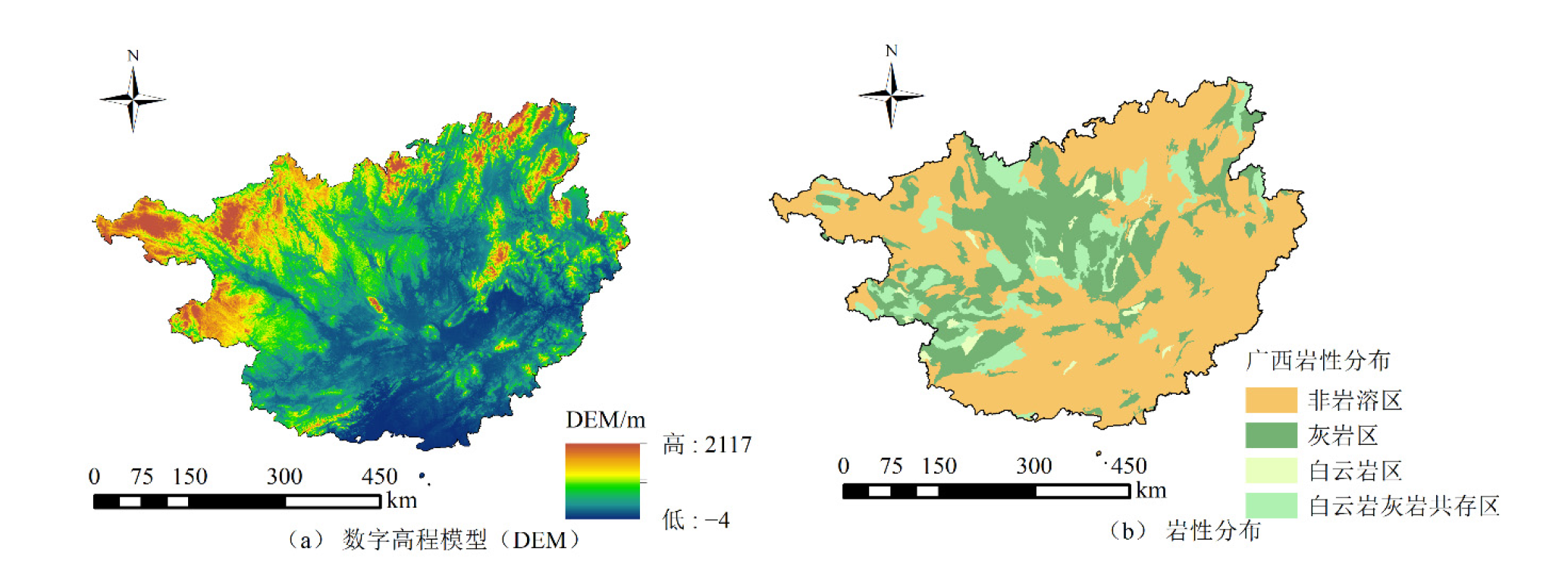
图1 广西数字高程模型(DEM)与岩性分布
Figure 1 Digital elevation model (DEM) and geological setting of Guangxi
| β | Z值 | 趋势类别 | 趋势特征 |
|---|---|---|---|
| β>0 | 2.58<Z | 4 | 极显著增加 |
| 1.96<Z≤2.58 | 3 | 显著增加 | |
| 1.65<Z≤1.96 | 2 | 微显著增加 | |
| Z≤1.65 | 1 | 不显著增加 | |
| β=0 | Z | 0 | 无变化 |
| β<0 | Z≤1.65 | −1 | 不显著减少 |
| 1.65<Z≤1.96 | −2 | 微显著减少 | |
| 1.96<Z≤2.58 | −3 | 显著减少 | |
| 2.58<Z | −4 | 极显著减少 |
表1 Mann-Kendall检验趋势类别
Table 1 Trend categories classified by Mann-Kendall test
| β | Z值 | 趋势类别 | 趋势特征 |
|---|---|---|---|
| β>0 | 2.58<Z | 4 | 极显著增加 |
| 1.96<Z≤2.58 | 3 | 显著增加 | |
| 1.65<Z≤1.96 | 2 | 微显著增加 | |
| Z≤1.65 | 1 | 不显著增加 | |
| β=0 | Z | 0 | 无变化 |
| β<0 | Z≤1.65 | −1 | 不显著减少 |
| 1.65<Z≤1.96 | −2 | 微显著减少 | |
| 1.96<Z≤2.58 | −3 | 显著减少 | |
| 2.58<Z | −4 | 极显著减少 |
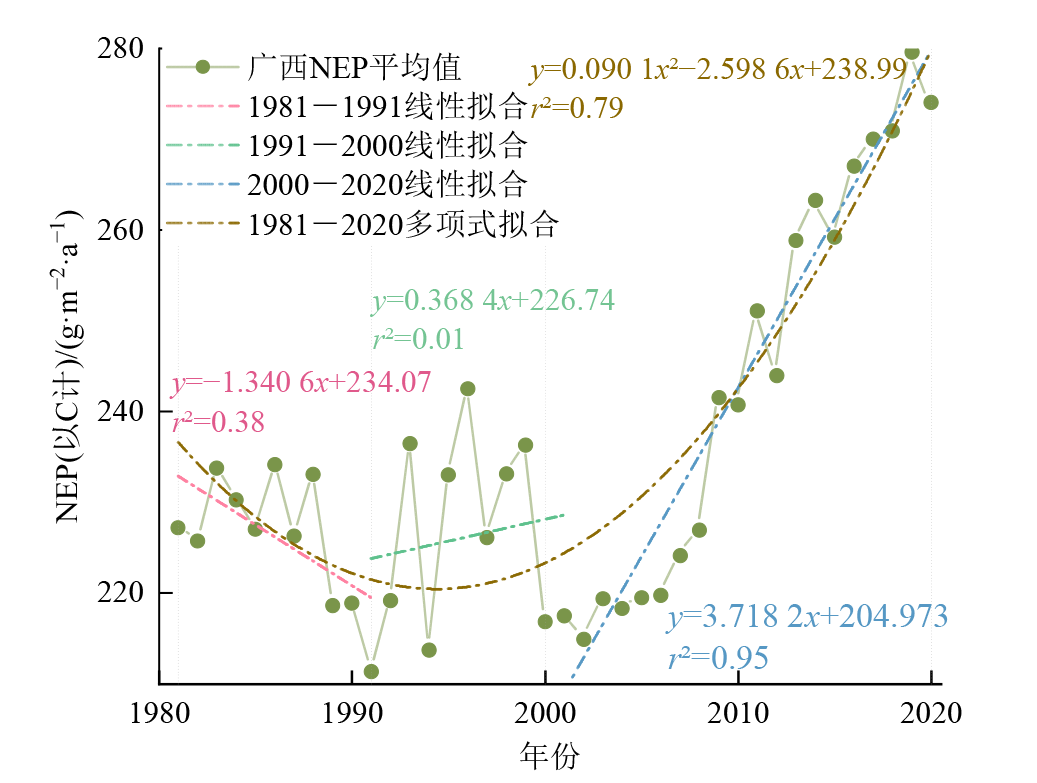
图2 1981-2020年广西年NEP均值时序变化
Figure 2 Interannual variation in mean NEP across Guangxi from 1981 to 2020

图3 2000-2020年广西NEP均值分布
Figure 3 Spatial distribution of mean NEP in Guangxi from 2000 to 2020

图4 2000年-2020年广西NEP变化趋势显著性分布
Figure 4 Significance distribution of NEP trends in Guangxi from 2000 to 2020
| β | Z值 | 趋势特征 | 占比/% | 变化趋势 |
|---|---|---|---|---|
| β>0 | 2.58<Z | 极显著增加 | 36.18% | 增加(60.08%) |
| 1.96<Z≤2.58 | 显著增加 | 7.91% | ||
| 1.65<Z≤1.96 | 微显著增加 | 3.12% | ||
| Z≤1.65 | 不显著增加 | 12.88% | ||
| β=0 | Z | 无变化 | 22.97% | 不变(22.97%) |
| β<0 | Z≤1.65 | 不显著减少 | 8.69% | 减小(16.95%) |
| 1.65<Z≤1.96 | 微显著减少 | 1.27% | ||
| 1.96<Z≤2.58 | 显著减少 | 2.47% | ||
| 2.58<Z | 极显著减少 | 4.53% |
表2 2000年-2020年广西NEP变化趋势显著性比例
Table 2 Proportional distribution of significant NEP trends in Guangxi from 2000 to 2020
| β | Z值 | 趋势特征 | 占比/% | 变化趋势 |
|---|---|---|---|---|
| β>0 | 2.58<Z | 极显著增加 | 36.18% | 增加(60.08%) |
| 1.96<Z≤2.58 | 显著增加 | 7.91% | ||
| 1.65<Z≤1.96 | 微显著增加 | 3.12% | ||
| Z≤1.65 | 不显著增加 | 12.88% | ||
| β=0 | Z | 无变化 | 22.97% | 不变(22.97%) |
| β<0 | Z≤1.65 | 不显著减少 | 8.69% | 减小(16.95%) |
| 1.65<Z≤1.96 | 微显著减少 | 1.27% | ||
| 1.96<Z≤2.58 | 显著减少 | 2.47% | ||
| 2.58<Z | 极显著减少 | 4.53% |

图5 2000-2020年广西岩溶区与非岩溶区NEP变化趋势及其显著性
Figure 5 The changing trend and significance of NEP in the karst area and the non-karst area of Guangxi from 2000 to 2020

图6 2000-2020年广西石灰岩区、白云岩区及白云岩石灰岩共存区的NEP变化趋势及其显著性
Figure 6 The changing trends and significance of NEP in the limestone area, dolomite area, and the coexistence area of limestone and dolomite in Guangxi from 2000 to 2020
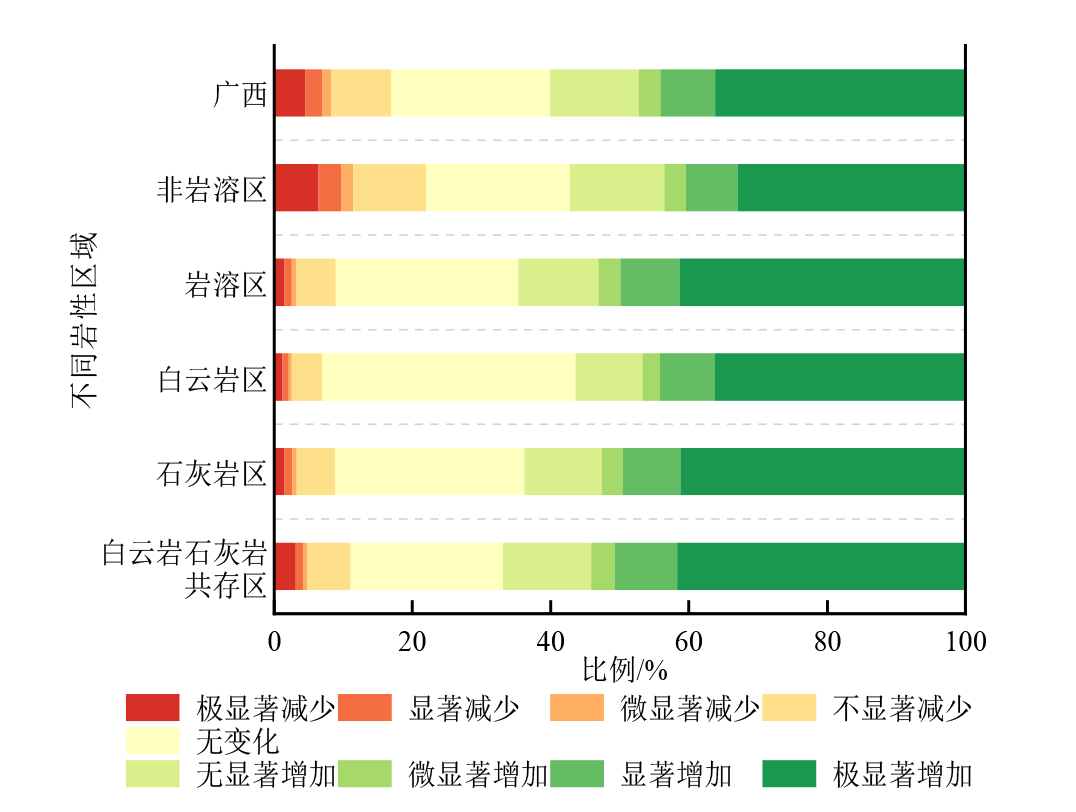
图7 2000-2020年广西不同岩性区域变化趋势占比
Figure 7 Relative contributions of different trend categories across lithological zones in Guangxi from 2000 to 2020
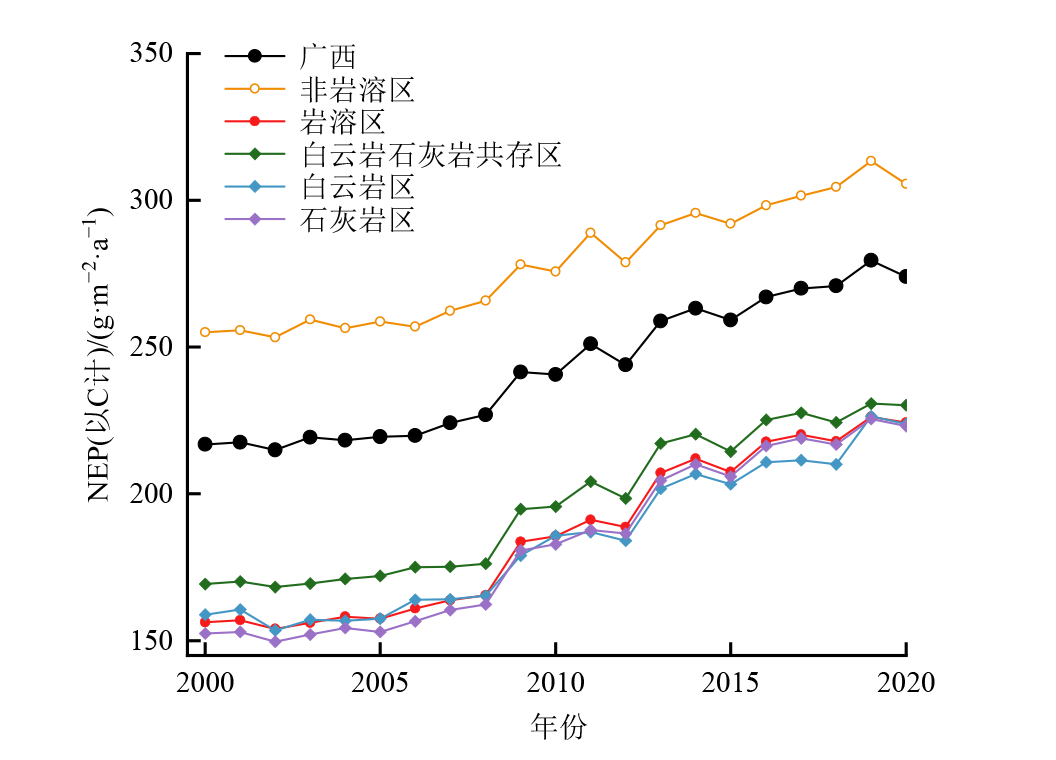
图8 2000-2020年广西不同岩性区域年NEP均值变化
Figure 8 Temporal changes in annual mean NEP across lithological zones in Guangxi from 2000 to 2020
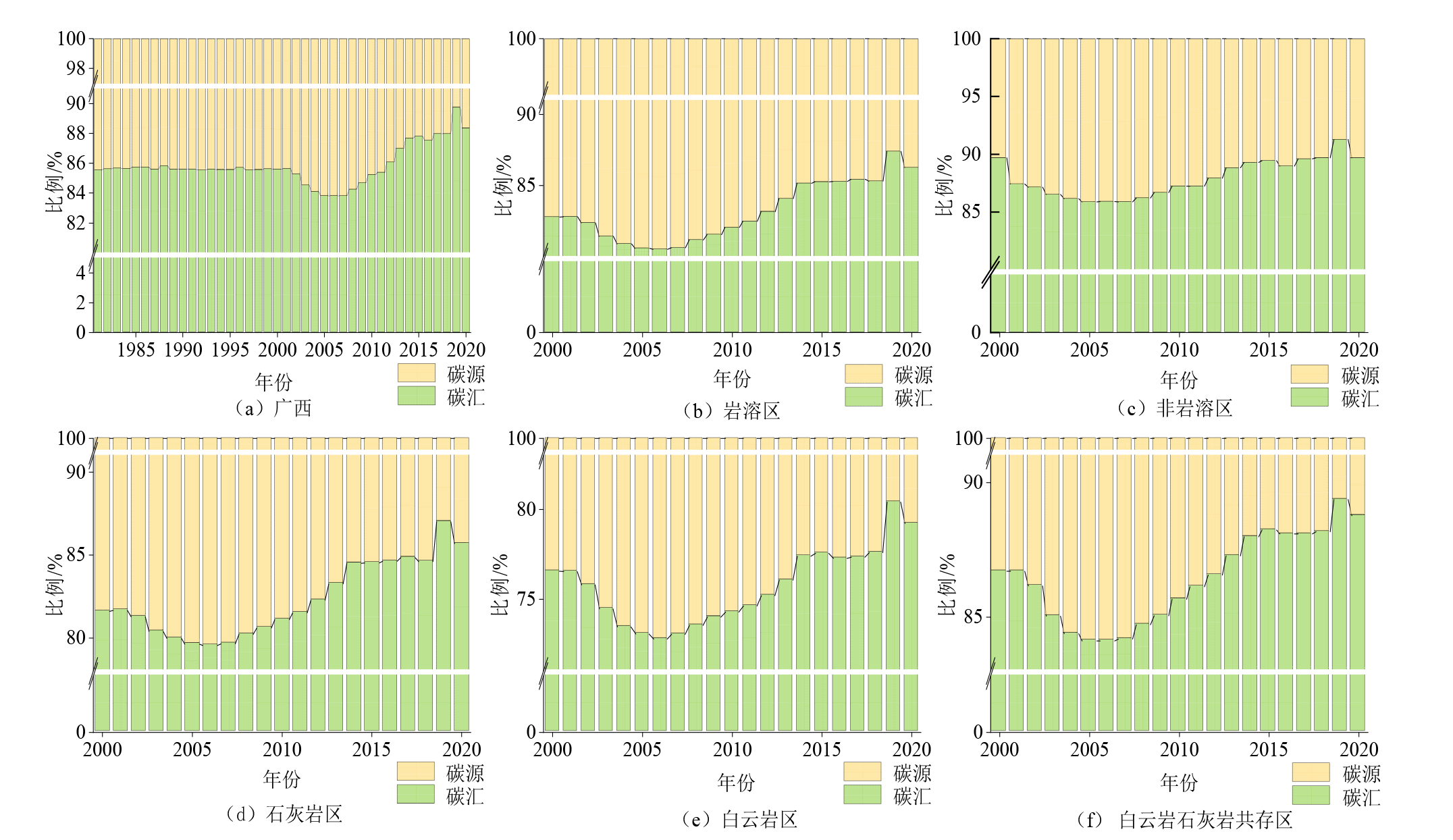
图9 1981-2020年广西、岩溶区、非岩溶区、石灰岩区、白云岩区及白云岩石灰岩共存区年均碳源碳汇占比变化
Figure 9 The changes in the average annual carbon source and carbon sink proportions in Guangxi, karst area, non-karst area, limestone area, dolomite area, and dolomite-limestone coexisting area from 1981 to 2020
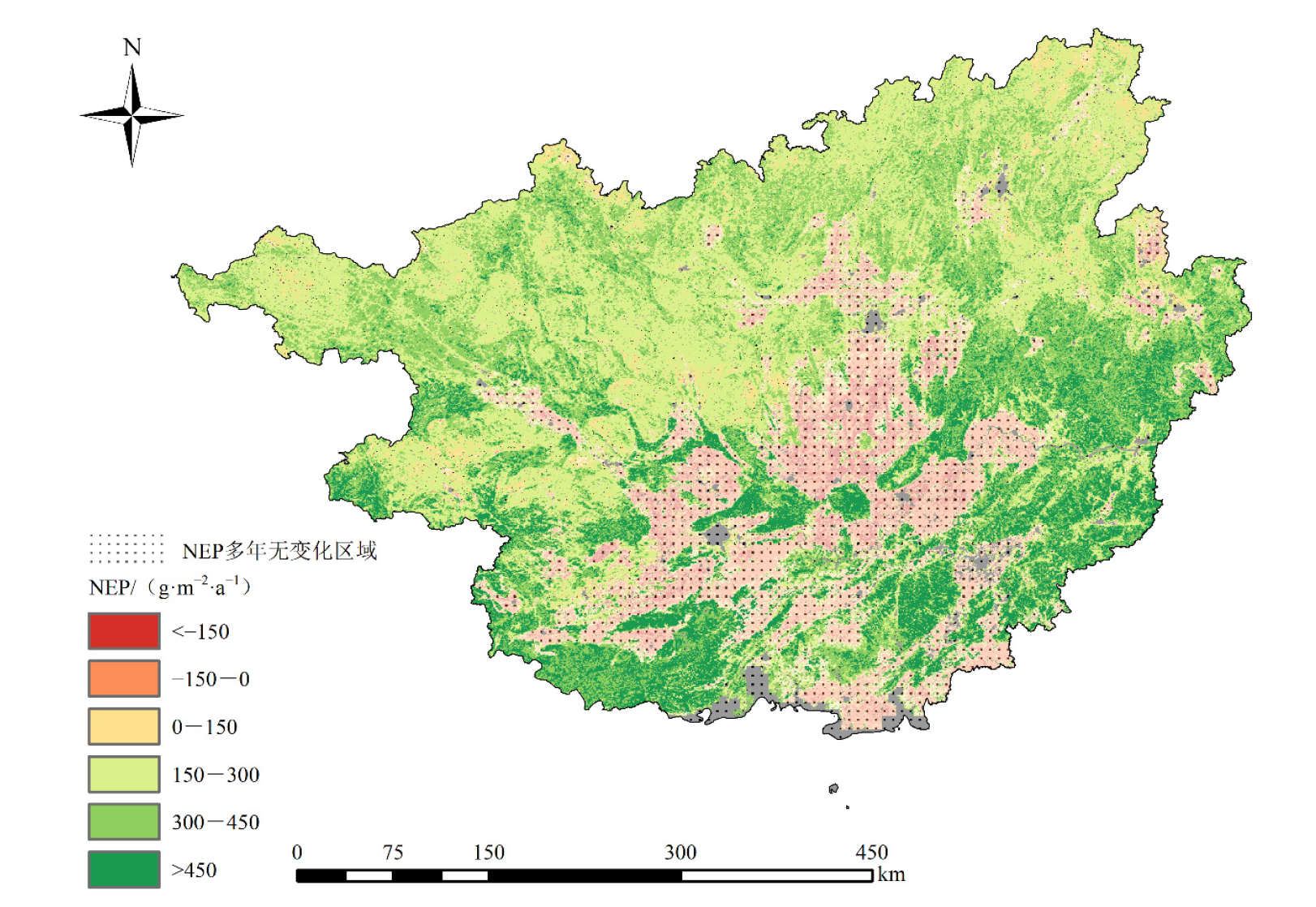
图10 广西NEP无变化区域与NEP均值分布对应
Figure 10 Correlation between stable NEP zones and mean NEP distribution in Guangxi
| [1] |
ANDERSOM-TEIXEIRA K J, DELONG J P, FOX A M, et al., 2011. Differential responses of production and respiration to temperature and moisture drive the carbon balance across a climatic gradient in New Mexico[J]. Global Change Biology, 17(1): 410-424.
DOI URL |
| [2] |
CHEN S, HUANG Y, ZOU J, et al., 2012. Interannual variability in soil respiration from terrestrial ecosystems in China and its response to climate change[J]. Science China Earth Sciences, 55: 2091-2098.
DOI URL |
| [3] |
DU C C, BAI X Y, LI Y B, et al., 2024. The restoration of karst rocky desertification has enhanced the carbon sequestration capacity of the ecosystem in southern China[J]. Global and Planetary Change, 243: 104602.
DOI URL |
| [4] | FRIEDLINGSTEIN P, O’SULLIVAN M, JONES M W, et al., 2024. Global carbon budget 2024[J]. Earth System Science Data Discussions, 17(3): 965-1039. |
| [5] |
HUANG N, WANG L, ZHANG Y L, et al., 2021. Estimating the net ecosystem exchange at Global FLUXNET sites using a Random Forest Model[J]. IEEE Journal of Selected Topics in Applied Earth Observations and Remote Sensing, 14: 9826-9836.
DOI URL |
| [6] | JIANG X Q, LIU J X, PENG C H, et al., 2025. Land use cover changes abated terrestrial ecosystem carbon sink in China during the past four decades[J]. All Earth, 37(1): 1-14. |
| [7] |
JIAO F S, XU X J, ZHANG M Y, et al., 2024. Bedrock regulated climatic controls on the interannual variation of land sink in south-west China karst through soil water availability[J]. Catena, 237: 107819.
DOI URL |
| [8] | WANG L, WU X Q, GUO J B, et al., 2022. Spatial-temporal pattern of vegetation carbon sequestration and its response to rocky desertification control measures in a karst area, in Guangxi Province, China[J]. Lanf Degradation and Development, 34(3): 665-681. |
| [9] |
LIU Y S, WANG J Y, DENG X Z, et al., 2008. Rocky land desertification and its driving forces in the karst areas of rural Guangxi, Southwest China[J]. Journal of Mountain Science, 5: 350-357.
DOI URL |
| [10] |
TAN X, JIANG H, ZHANG Q F, et al., 2024. Lithology constrains the origination of autochthonous carbon in river ecosystems[J]. Water Research, 260: 121860.
DOI URL |
| [11] |
WANG P, BAI B, CAO J H, et al., 2024. Experimental insights into the stability of karst carbon sink by submerged macrophytes[J]. Environmental Earth Sciences, 83: 422.
DOI |
| [12] |
WANG P, ZHANG X R, WANG D W, et al., 2020. Experimental study on growth of Hydrilla verticillata under different concentrations of bicarbonate and its implication in karst aquatic ecosystem[J]. Carbonates Evaporites 35: 83.
DOI |
| [13] | 安国英, 周璇, 温静, 等, 2016. 西南地区石漠化分布, 演变特征及影响因素[J]. 现代地质, 30(5): 1150-1159. |
| AN G Y, ZHOU X, WEN J, et al., 2016. Analysis of characteristics and reason of rocky desertification occurrence and evolution in karst areas of southwestern China[J]. Geoscience, 30(5): 1150-1159. | |
| [14] | 蔡博峰, 于嵘, 2009. 基于遥感的植被长时序趋势特征研究进展及评价[J]. 遥感学报, 13(6): 1170-1186. |
| CAI B F, YU R, 2009. Advance and evaluation in the long time series vegetation trends research based on remote sensing[J]. Journal of Remote Sensing, 13(6): 1170-1186. | |
| [15] | 曹建华, 杨慧, 康志强, 2011. 区域碳酸盐岩溶蚀作用碳汇通量估算初探:以珠江流域为例[J]. 科学通报, 56(26): 2181-2187. |
| CAO J H, YANG H, KANG Z Q, 2011. Preliminary regional estimation of carbon sink flux by carbonate rock corrosion: A case study of the Pearl River Basin[J]. Chinese Science Bulletin, 56(26): 2181-2187. | |
| [16] | 曹建华, 杨慧, 张春来, 等, 2018. 中国西南岩溶关键带结构与物质循环特征[J]. 中国地质调查, 5(5): 1-12. |
| CAO J H, YANG H, ZHANG C L, et al., 2018. Characteristics of structure and material cycling of the karst critical zone in southwest China[J]. Geological Survey of China, 5(5): 1-12. | |
| [17] | 曹建华, 袁道先, 章程, 等, 2004. 受地质条件制约的中国西南岩溶生态系统[J]. 地球与环境, 32(1): 1-8. |
| CAO J H, YUAN D X, ZHANG C, et al., 2004. Karst ecosystem constrained by geological conditions in southwest China[J]. Earth and Environ, 32(1): 1-8. | |
| [18] | 曹云, 陈紫璇, 莫建飞, 等, 2025. 西南地区森林NEP时空演变特征及其驱动因素[J]. 生态学报, 45(7): 3252-3266. |
| CAO Y, CHEN Z X, MO J F, et al., 2025. Study on the spatial-temporal evolution characteristics and driving factors of forest NEP in southwest China[J]. Acta Ecologica Sinica, 45(7): 3252-3266. | |
| [19] | 邓艳, 曹建华, 蒋忠诚, 等, 2016. 西南岩溶石漠化综合治理水-土-植被关键技术进展与建议[J]. 中国岩溶, 35(5): 476-485. |
| DENG Y, CAO J H, JIANG Z C, et al., 2016. Advancement in key technologies for comprehensive treatment of water, soil and vegetation resources in karst rocky desertification areas[J]. Carsologica Sinica, 35(5): 476-485. | |
| [20] | 方精云, 柯金虎, 唐志尧, 等, 2001. 生物生产力的 “4P” 概念, 估算及其相互关系[J]. 植物生态学报, 25(4): 414-419. |
| FANG J Y, KE J H, TANG Z Y, et al., 2001. Implications and estimations of four terrestrial productivity parameters[J]. Acta Phytoecologica Sinica, 25(4): 414-419. | |
| [21] | 符洪铭, 郑冰清, 孙彩云, 等, 2025. 沉水植物对湖泊溶解性有机物的影响——以武汉东湖为例[J]. 水生生物学报, 49(7): 148-157. |
| FU H M, ZHENG B Q, SUN C Y, et al., 2025. The impact of submerged aquatic macrophytes on dissolved organic matter in lakes: A case study of Donghu Lake in Wuhan[J]. Acta Hydrobiologica. Sinica, 49(7): 148-157. | |
| [22] | 何正弘, 2025. 基于CASA模型的黑龙江省植被净生态系统生产力时空分异及预测[J]. 吉林水利 (2): 63-69. |
| HE Z H, 2025. Spatio-temporal differentiation and prediction of vegetation net ecosystem productivity in Heilongjiang Province based on CASA model[J]. Jilin Water Resources (2): 63-69. | |
| [23] | 黄玉清, 王晓英, 陆树华, 等, 2006. 岩溶石漠化治理优良先锋植物种类光合, 蒸腾及水分利用效率的初步研究[J]. 广西植物, 26(2): 171-177. |
| HUANG Y Q, WANG X Y, LU S H, et al., 2006. Studies of photosynthesis, transpiration and water use efficiency of some dominant species in rocky desert area, Guangxi, China[J]. Guihaia, 26(2): 171-177. | |
| [24] | 姜光辉, 张强, 2011. 峰丛洼地自然封育过程岩溶水溶解无机碳的变化[J]. 中国岩溶, 30(4): 397-402. |
| JIANG G H, ZHANG Q, 2011. Change of dissolved inorganic carbon(DIC) in karst peak cluster during natural restoration: A case study in Yaji Station[J]. Carsologica Sinica, 30(4): 397-402. | |
| [25] | 蒋忠诚, 罗为群, 童立强, 等, 2016. 21世纪西南岩溶石漠化演变特点及影响因素[J]. 中国岩溶, 35(5): 461-468. |
| JIANG Z C, LUO W Q, TONG L Q, et al., 2016. Evolution features of rocky desertification and influence factors in karst areas of southwest China in the 21st century[J]. Carsologica Sinica, 35(5): 461-468. | |
| [26] | 蓝家程, 肖时珍, 杨龙, 等, 2016. 石漠化治理对岩溶作用强度的影响及其碳汇效应[J]. 水土保持学报, 30(3): 244-249. |
| LAN J C, XIAO S Z, YANG L, et al., 2016. Impact of rocky desertification treatment on kast carbonate rock dissolution rates and its carbon sink effect[J]. Journal of Soil and Water Conservation, 30(3): 244-249. | |
| [27] | 廖春贵, 熊小菊, 胡宝清, 等, 2018. 广西不同岩性植被覆盖变化及对人类活动的响应[J]. 生态经济, 34(6): 168-173. |
| LIAO C G, XIONG X J, HU B Q, et al., 2018. Variation of Vegetation Cover on Various Lithology and Its Response to Human Activities in Guangxi[J]. Ecological Economy, 34(6): 168-173. | |
| [28] | 刘文利, 姜亮亮, 刘冰, 等, 2024. 中国植被碳源/汇时空演变特征及其驱动因素[J]. 生态学报, 44(4): 1456-1467. |
| LIU W L, JIANG L L, LIU B, et al., 2024. Spatio-temporal evolution characteristics and driving factors analysis of vegetation carbon sources/sinks in China[J]. Acta Ecologica Sinica, 44(4): 1456-1467. | |
| [29] | 彭倩蓉, 田义超, 李春燕, 等, 2024. 桂西南净生态系统生产力时空变化及其影响因素[J]. 生态科学, 43(2): 67-77. |
| PENG Q R, TIAN Y C, LI C Y, et al., 2024. Temporal and spatial variation of net ecosystem productivity and its influencing factors in southwest Guangxi[J]. Ecological Science, 43(2): 67-77. | |
| [30] | 钱小鄂, 2001. 广西岩溶地下水资源及允许开采量的探讨[J]. 中国岩溶, 20(2): 111-116. |
| QIAN X E, 2001. Allowable withdrawal of groundwater in Guangxi karst region[J]. Carsologica Sinica, 20(2): 111-116. | |
| [31] | 宋瑞峰, 2024. 干热事件对广西净初级生产力和碳利用效率的影响研究[D]. 南宁: 广西大学. |
| SONG R F, 2024 The impacts of dry and heat events on net primary productivity and carbon use efficiency in Guangxi[D]. Nanning: Guangxi University. | |
| [32] | 宋同清, 彭晚霞, 曾馥平, 等, 2011. 喀斯特峰丛洼地退耕还林还草的土壤生态效应[J]. 土壤学报, 48(6): 1219-1226. |
| SONG T Q, PENG W X, ZENG F P, et al., 2011. Soil ecological effects of converting cropland to forest and grassland in depressions between karst hills[J]. Acta Pedologica Sinica, 48(6): 1219-1226. | |
| [33] | 宋同清, 彭晚霞, 杜虎, 等, 2014. 中国西南喀斯特石漠化时空演变特征、发生机制与调控对策[J]. 生态学报, 34(18): 5328-5341. |
| SONG T Q, PENG W X, DU H, et al., 2014 Occurrence, spatial-temporal dynamics and regulation strategies of karst rocky desertification in southwest China[J]. Acta Ecologica Sinica, 34(18): 5328-5341. | |
| [34] | 粟维斌, 朱桂田, 2008. 桂西喀斯特石漠化区不同岩性土壤与植被调查分析[J]. 福建林业科技, 35(4): 75-79. |
| SU W B, ZHU G T, 2008. Diagnoses of soil and vegetation upon different rock in karst rocky desertification areas in the west of Guangxi Zhuang Autonomous Region[J]. Journal of Fujian Forestry Science and Technology, 35(4): 75-79. | |
| [35] | 汤颖颖, 吴秀芹, 2022. 广西岩溶碳汇对气候变化和石漠化治理措施的响应[J]. 北京大学学报: 自然科学版, 59(2): 189-196. |
| TANG Y Y, WU X Q, 2022. Response of karst carbon sink to climate change and rocky desertification control measures in Guangxi Zhuang Autonomous Region[J]. Acta Scientiarum Naturalium Universitatis Pekinensis, 59(2): 189-196. | |
| [36] | 王淑彬, 徐慧芳, 宋同清, 等, 2014. 广西森林土壤主要养分的空间异质性[J]. 生态学报, 34(18): 5292-5299. |
| WANG S B, XU H F, SONG T Q, et al., 2014. Spatial heterogeneity of the main nutrients in Guangxi forest soils[J]. Acta Ecologica Sinica, 34(18): 5292-5299. | |
| [37] | 温远光, 李治基, 李信贤, 等, 2014. 广西植被类型及其分类系统[J]. 广西科学, 21(5): 484-513. |
| WEN Y G, LI Z J, LI X X, et al., 2014. Types of vegetation and its classified system in Guangxi[J]. Guangxi Sciences, 21(5): 484-513. | |
| [38] | 余俊琪, 白冰, 李光超, 等, 2022. 岩溶地下水补给河流沉积物理化性质及有机碳来源解析[J]. 水生生物学报, 46(12): 1900-1908. |
| YU J Q, BAI B, LI G C, et al., 2022. Physicochemical properties and organic carbon sources of the sediments in a karst spring-fed river[J]. Acta Hydrobiologica. Sinica, 46(12): 1900-1908. | |
| [39] | 袁丽华, 蒋卫国, 申文明, 等, 2013. 2000-2010年黄河流域植被覆盖的时空变化[J]. 生态学报, 33(24): 7798-7806. |
| YUAN L H, JIANG W G, SHEN W M, et al., 2013. The spatio-temporal variations of vegetation cover in the Yellow River Basin from 2000 to 2010[J]. Acta Ecologica Sinica, 33(24): 7798-7806. | |
| [40] | 张人权, 梁杏, 靳孟贵, 2018. 水文地质学基础[M]. 第7版. 北京: 地质出版社. |
| ZHANG R Q, LIANG X, JIN M G, 2018. Fundamentals of Hydrogeology[M]. 7th Edition. Beijing: Geological Publishing House. | |
| [41] | 张新中, 李育, 张成琦, 等, 2020. 2000-2014年石羊河流域净生态系统生产力变化分析[J]. 兰州大学学报 (自然科学版), 56(3): 309-318. |
| ZHANG X Z, LI Y, ZHANG C Q, et al., 2020. Analysis of the net ecosystem production changes in the Shiyang River basin from 2000 to 2014[J]. Journal of Lanzhou University (Natural Sciences), 56(3): 309-318. | |
| [42] | 周孟霞, 莫碧琴, 杨慧, 2020. 岩溶石漠化区李树林土壤岩溶作用强度及碳汇效应[J]. 农业工程学报, 36(13): 116-123. |
| ZHOU M X, MO B Q, YANG H, 2020. Soil karst process intensity and carbon sink effect in plum forest in karst rocky desertification area[J]. Transactions of the Chinese Society of Agricultural Engineering, 36(13): 116-123. | |
| [43] | 周文辅, 1979. 中国岩溶研究[M]. 北京: 科学出版社. |
| ZHOU W F, 1979. Studies on karst in China[M]. Beijing: Science Press. | |
| [44] | 周怡婷, 严俊霞, 刘菊, 等, 2024. 2000-2021年黄土高原生态分区NEP时空变化及其驱动因子[J]. 环境科学, 45(5): 2806-2816. |
| ZHOU Y T, YAN J X, LLU J, et al., 2024. Spatiotemporal variation and driving factors of NEP in ecological subregions of the Loess Plateau from 2000 to 2021[J]. Environmental Science, 45(5): 2806-2816. | |
| [45] | 朱德根, 杨慧, 赵虎, 等, 2025. 广西岩溶区石漠化演变及其对土地利用变化的响应[J/OL]. 中国岩溶, 1-22[2025-11-30]. https://link.cnki.net/urlid/45.1157.P.20241129.1119.002. |
| ZHU D G, YANG H, ZHAO H, et al., 2025. Evolution of rocky desertification in karst areas of Guangxi and its response to land use changes[J/OL]. Carsologica Sinica, 1-22[2025-11-30]. https://link.cnki.net/urlid/45.1157.P.20241129.1119.002. | |
| [46] | 邹艳娥, 2016. 广西碧水岩流域岩石化学风化过程的碳汇效应[D]. 北京: 中国地质大学(北京). |
| ZOU Y E, 2016. Consumption of atmospheric CO2 by chemical weathering in the Bishuiyan River basin: a mixed silicate and carbonate catchment[D]. Beijing: China University of Geosciences (Beijing). |
| [1] | 杜嘉睿, 宋芊, 高文明. 黄河源区生态系统健康时空演变与多情景模拟研究[J]. 生态环境学报, 2026, 35(4): 551-562. |
| [2] | 丁馨, 刘健, 魏俐宏, 解德威, 郑昭佩. 基于GSMSR模型的山东省植被NEP时空格局及影响因素[J]. 生态环境学报, 2025, 34(7): 1079-1089. |
| [3] | 石镕瑞, 杨小雄, 马骥, 黄珊珊, 杨玥, 卢盛权, 吴广. 滇桂黔石漠化片区生态环境质量时空演变及驱动力分析[J]. 生态环境学报, 2025, 34(7): 1147-1162. |
| [4] | 刘甜甜, 柳杨, 王玉玺, 秦臻. 河南省生态环境质量的时空演变特征及驱动力分析[J]. 生态环境学报, 2025, 34(11): 1778-1787. |
| [5] | 奥勇, 张龙, 王晓峰, 吴彦芸, 唐冰倩, 张亦恒. 基于“自然-社会”视角的陕西省土地利用变化碳核算与演变格局分析[J]. 生态环境学报, 2024, 33(8): 1306-1317. |
| [6] | 王雯, 侯青青, 裴婷婷. 甘肃河东地区坡度对生态系统服务的影响及其阈值效应[J]. 生态环境学报, 2024, 33(7): 1117-1129. |
| [7] | 宋小龙, 马明德, 王鹏, 李陇堂, 米文宝, 宋永永. 2000—2022年宁夏不同地理分区生长季植被覆盖度时空非平稳性特征[J]. 生态环境学报, 2024, 33(6): 853-868. |
| [8] | 胡盈盈, 罗红霞, 戴声佩, 禹萱, 邓春梅, 李海亮, 梁伟红, 郑倩. 基于遥感生态指数的海南五指山市生态环境质量评价及成因分析[J]. 生态环境学报, 2024, 33(10): 1624-1633. |
| [9] | 冯自贤, 佘璐, 王秀慧, 杨璐, 杨晨. 基于改进遥感生态指数的宁夏生态环境质量时空变化[J]. 生态环境学报, 2024, 33(1): 131-143. |
| [10] | 巫晨煜, 许帆帆, 魏士博, 樊晶晶, 刘观鹏, 王坤. 渭河流域地表植被覆盖对气候变化的响应研究[J]. 生态环境学报, 2023, 32(5): 835-844. |
| [11] | 李晖, 李必龙, 葛黎黎, 韩琛惠, 杨倩, 张岳军. 2000-2021年汾河流域植被时空演变特征及地形效应[J]. 生态环境学报, 2023, 32(3): 439-449. |
| [12] | 何艳虎, 龚镇杰, 吴海彬, 蔡宴朋, 杨志峰, 陈晓宏. 粤港澳大湾区城市生态效率时空演变及影响因素[J]. 生态环境学报, 2023, 32(3): 469-480. |
| [13] | 王嘉丽, 冯婧珂, 杨元征, 俎佳星, 蔡文华, 杨健. 南宁市主城区不透水面与热环境效应的空间关系研究[J]. 生态环境学报, 2023, 32(3): 525-534. |
| [14] | 丁诗雨, 贾夏, 赵永华, 钱会, 王欢元, 康宏亮, 孙婴婴. 秦巴山生态功能区生态系统服务供需关系时空演变研究[J]. 生态环境学报, 2023, 32(12): 2236-2248. |
| [15] | 郑晓豪, 陈颖彪, 郑子豪, 郭城, 黄卓男, 周泳诗. 湖北省生态系统服务价值动态变化及其影响因素演变[J]. 生态环境学报, 2023, 32(1): 195-206. |
| 阅读次数 | ||||||
|
全文 |
|
|||||
|
摘要 |
|
|||||
