生态环境学报 ›› 2022, Vol. 31 ›› Issue (9): 1840-1848.DOI: 10.16258/j.cnki.1674-5906.2022.09.014
江明1( ), 张子洋2, 李婷婷2, 林勃机2, 张正恩2, 廖彤1, 袁鸾1, 潘苏红3, 李军2,*(), 张干2
收稿日期:2022-08-18
出版日期:2022-09-18
发布日期:2022-11-07
通讯作者:
*李军,男,研究员,博士,研究方向为环境地球化学。E-mail: junli@gig.ac.cn作者简介:江明(1977年生),男,高级工程师,硕士,主要研究方向环境空气质量监测与研究。E-mail: jm787@139.com
基金资助:
JIANG Ming1(), ZHANG Ziyang2, LI Tingting2, LIN Boji2, ZHANG Zhengen2, LIAO Tong1, YUAN Luan1, PAN Suhong3, LI Jun2,*(), ZHANG Gan2
Received:2022-08-18
Online:2022-09-18
Published:2022-11-07
摘要:
铵根离子(NH4+)可促进颗粒形成和吸湿长大,是雾霾颗粒(PM2.5)的重要组分,但其源贡献尚不清楚。准确解析大气NH4+来源存在一定挑战。最近,基于NH4+氮同位素(δ15N)的源解析方法被广泛应用到大气NH4+来源解析。以珠三角鹤山大气超级站为研究地点,开展为期1年的大气PM2.5样品采集,选取了53个大气PM2.5样品,在分析了水溶性离子、有机碳、元素碳和无机元素的基础上,测试了NH4+的δ15N值。结果表明,鹤山站大气NH4+年均质量浓度为 (3.39±2.21) μg∙m-3,范围为0.07-10.9 μg∙m-3。NH4+与阴离子物质的量比结果显示鹤山地区为富铵状态,且随机森林模型结果表明,NH4+对于鹤山地区PM2.5的生成具有重要影响。大气颗粒物δ15N-NH4+范围为-14.55‰-18.82‰,其中冬季δ15N-NH4+变化最大(-13.27‰-18.82‰),夏季δ15N-NH4+变化最小(-2.32‰-10.94‰)。贝叶斯源解析结果显示,农业源(畜牧和施肥)和非农业源(生物质燃烧、煤燃烧、机动车排放和废弃物)对大气NH3的年均贡献分别为36.26%和63.74%。在冬季重污染天时(2021年1月6日、1月12日和1月18日),NH4+浓度达全年峰值的同时,非农业源排放占比也达全年最高水平,最高达90.80%,其中机动车排放是非污染天的2-4倍,显示化石燃料燃烧是导致冬季污染事件的重要原因。基于同位素源解析方法所得非农业源NH3排放贡献约为源清单方法所得结果的7倍,源清单法可能严重低估了机动车等重要非农业源的排放贡献。为了进一步改善珠三角地区空气质量,需要重视非农业源NH3的排放。
中图分类号:
江明, 张子洋, 李婷婷, 林勃机, 张正恩, 廖彤, 袁鸾, 潘苏红, 李军, 张干. 基于氮同位素的珠三角典型地区大气PM2.5中NH4+来源解析[J]. 生态环境学报, 2022, 31(9): 1840-1848.
JIANG Ming, ZHANG Ziyang, LI Tingting, LIN Boji, ZHANG Zhengen, LIAO Tong, YUAN Luan, PAN Suhong, LI Jun, ZHANG Gan. Source Apportionment of Ammonium in Atmospheric PM2.5 in the Pearl River Delta Based on Nitrogen Isotope[J]. Ecology and Environment, 2022, 31(9): 1840-1848.
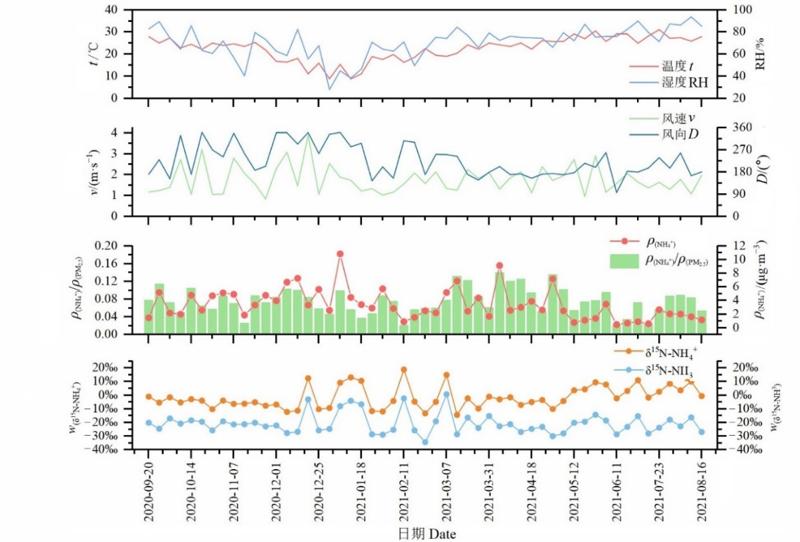
图1 采样期间气象条件,NH4+浓度及其在PM2.5中占比,相应的δ15N-NH4+和δ15N-NH3值
Figure 1 Temperature, humidity, wind speed and direction, NH4+ concentration and its proportion to PM2.5, δ15N-NH4+and δ15N-NH3 values during sampling periods
| 采样时段 Period | NH4+与NO3-的相关性 Correlation between NH4+ and NO3- | NH4+与NO3-的相关性SO42- Correlation between NH4+ and SO42- |
|---|---|---|
| 秋天 Autumn | r2=0.64; P<0.001 | r2=0.39; P=0.031 |
| 冬天 Winter | r2=0.85; P<0.001 | r2=0.52; P<0.001 |
| 春天 Spring | r2=0.76; P<0.001 | r2=0.55; P<0.001 |
| 夏天 Summer | r2=0.34; P=0.076 | r2=0.36; P=0.065 |
| 年均 Annual | r2=0.77; P<0.001 | r2=0.44; P<0.001 |
表1 NH4+与NO3-、SO42-相关性
Table 1 Correlation between NH4+ and NO3-, SO42-
| 采样时段 Period | NH4+与NO3-的相关性 Correlation between NH4+ and NO3- | NH4+与NO3-的相关性SO42- Correlation between NH4+ and SO42- |
|---|---|---|
| 秋天 Autumn | r2=0.64; P<0.001 | r2=0.39; P=0.031 |
| 冬天 Winter | r2=0.85; P<0.001 | r2=0.52; P<0.001 |
| 春天 Spring | r2=0.76; P<0.001 | r2=0.55; P<0.001 |
| 夏天 Summer | r2=0.34; P=0.076 | r2=0.36; P=0.065 |
| 年均 Annual | r2=0.77; P<0.001 | r2=0.44; P<0.001 |
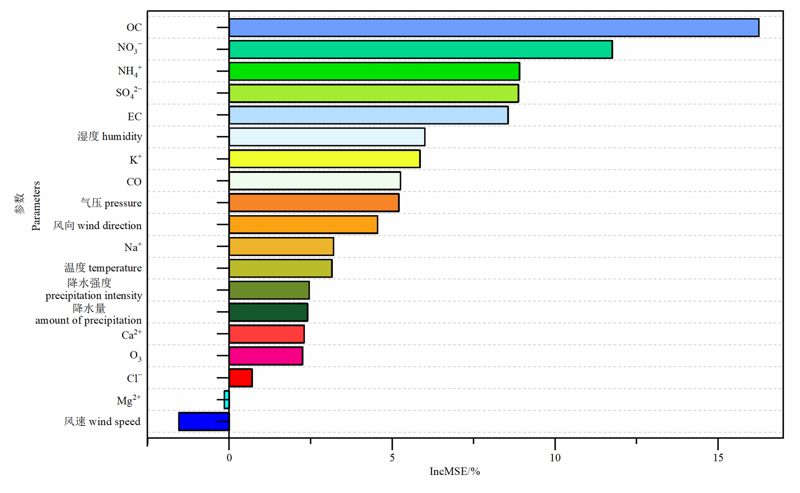
图2 各因素对PM2.5生成的作用(来自随机森林解析结果)
Figure 2 Effects of various factors on the generation of PM2.5 (from Random Forest Analysis results)
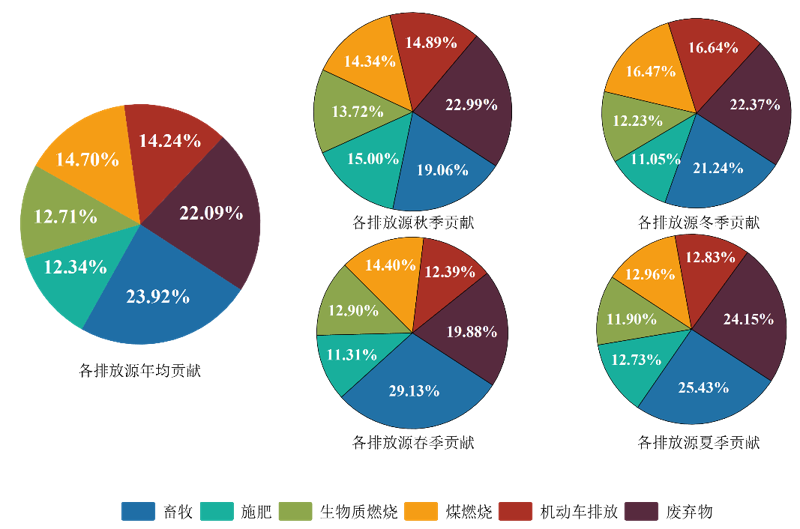
图3 各排放源年均及各季贡献占比
Figure 3 Annual and quarterly contribution of each emission source
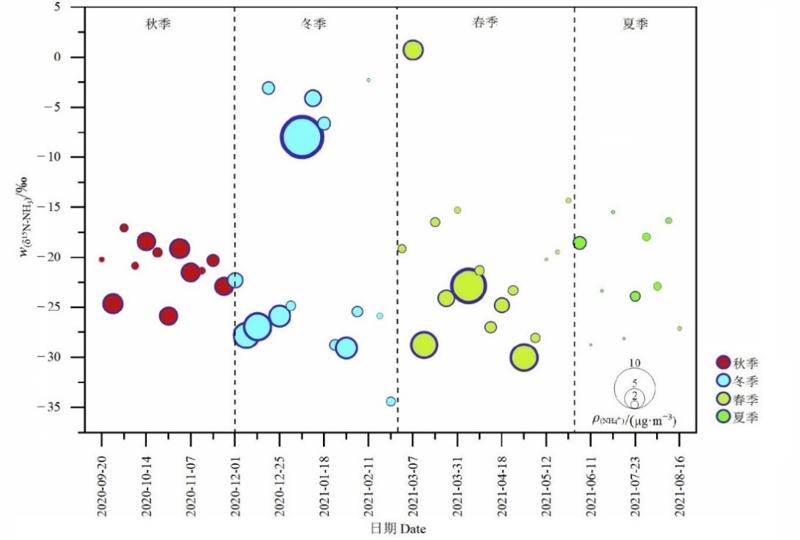
图4 不同季节NH4+浓度与δ15N-NH3值关系
Figure 4 Relationship between NH4+ concentration and δ15N-NH3 in different seasons
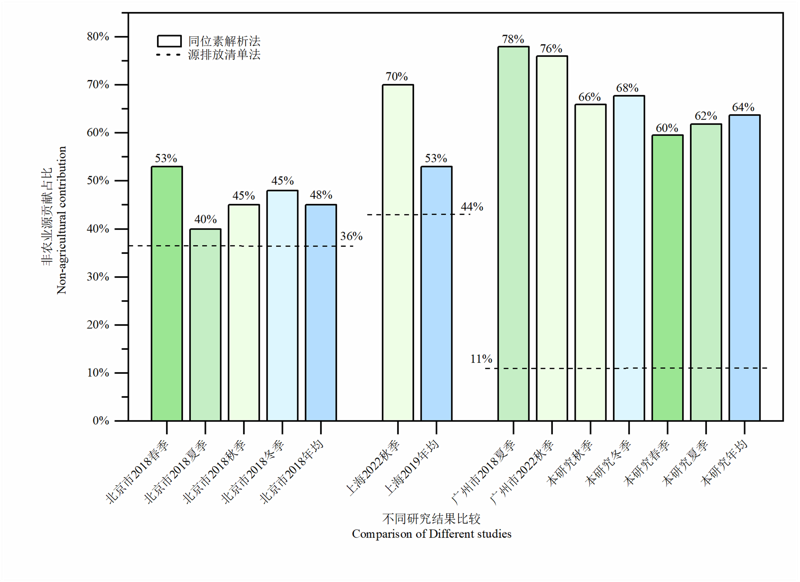
图5 中国典型区域基于同位素方法和源清单方法的非农业源贡献对比
Figure 5 Comparison of NH3 from non-agricultural sources based on isotope and source inventory methods in typical regions of China
| [1] | BERNER A H, DAVID FELIX J, 2020. Investigating ammonia emissions in a coastal urban airshed using stable isotope techniques[J]. Science of the Total Environment, 707: 134952. |
| [2] | BHATTARAI N, WANG S X, PAN Y P, et al., 2021. δ15N-stable isotope analysis of NHx: An overview on analytical measurements, source sampling and its source apportionment[J]. Frontiers of Environmental Science & Engineering, 15(6): 49-59. |
| [3] | BHATTARAI N, WANG S X, XU Q C, et al., 2020. Sources of gaseous NH3 in urban Beijing from parallel sampling of NH3 and NH4+ their nitrogen isotope measurement and modeling[J]. Science of the Total Environment, 747: 141361. |
| [4] |
BREIMAN L, 2001. Random forests[J]. Machine Learning, 45(1): 5-32.
DOI URL |
| [5] |
CHANG D, WANG Z, GUO J, et al., 2019. Characterization of organic aerosols and their precursors in southern China during a severe haze episode in January 2017[J]. Science of the Total Environment, 691: 101-111.
DOI URL |
| [6] |
CHANG Y H, ZOU Z, ZHANG Y L, et al., 2019. Assessing contributions of agricultural and nonagricultural emissions to atmospheric ammonia in a Chinese megacity[J]. Environmental Science & Technology, 53(4): 1822-1833.
DOI URL |
| [7] | CHEN Z X, PEI C L, LIU J W, et al., 2022. Non-agricultural source dominates the ammonium aerosol in the largest city of South China based on the vertical δ15N measurements[J]. Science of the Total Environment, 848: 157750. |
| [8] |
ELLIOTT E M, YU Z J, COLE A S, et al., 2019. Isotopic advances in understanding reactive nitrogen deposition and atmospheric processing[J]. Science of the Total Environment, 662: 393-403.
DOI URL |
| [9] |
FARREN N J, DAVISON J, ROSE R A, et al., 2020. Underestimated ammonia emissions from road vehicles[J]. Environmental Science & Technology, 54(24): 15689-15697.
DOI URL |
| [10] |
FELIX J D, ELLIOTT E M, GAY D A., 2017. Spatial and temporal patterns of nitrogen isotopic composition of ammonia at U.S. ammonia monitoring network sites[J]. Atmospheric Environment, 150: 434-442.
DOI URL |
| [11] |
FELIX J D, ELLIOTT E M, GISH T J, et al., 2013. Characterizing the isotopic composition of atmospheric ammonia emission sources using passive samplers and a combined oxidation-bacterial denitrifier approach[J]. Rapid Commun Mass Spectrom, 27(20): 2239-46.
DOI URL |
| [12] |
FELIX J D, ELLIOTT E M, GISH T, et al., 2014. Examining the transport of ammonia emissions across landscapes using nitrogen isotope ratios[J]. Atmospheric Environment, 95: 563-570.
DOI URL |
| [13] |
GE B Z, XU X B, MA Z Q, et al., 2019. Role of ammonia on the feedback between AWC and inorganic aerosol formation during heavy pollution in the North China Plain[J]. Earth and Space Science, 6(9): 1675-1693.
DOI URL |
| [14] |
GU B J, ZHANG L, VAN DINGENEN R, et al., 2021. Abating ammonia is more cost-effective than nitrogen oxides for mitigating PM2.5 air pollution[J]. Science, 374(6568): 758-762.
DOI URL |
| [15] |
HODAS N, SULLIVAN A P, SKOG K, et al., 2014. Aerosol liquid water driven by anthropogenic nitrate: implications for lifetimes of water-soluble organic gases and potential for secondary organic aerosol formation[J]. Environmental Science & Technology, 48(19): 11127-36.
DOI URL |
| [16] |
HOU L L, DAI Q L, SONG C B, et al., 2022. Revealing drivers of haze pollution by explainable machine learning[J]. Environmental Science & Technology, 9(2): 112-119.
DOI URL |
| [17] |
HUANG C, HU Q Y, LOU S R, et al., 2018a. Ammonia emission measurements for light-duty gasoline vehicles in China and implications for emission modeling[J]. Environmental Science & Technology, 52(19): 11223-11231.
DOI URL |
| [18] |
HUANG R J, ZHANG Y L, BOZZETTI C, et al., 2014. High secondary aerosol contribution to particulate pollution during haze events in China[J]. Nature, 514(7521): 218-22.
DOI URL |
| [19] | HUANG X F, ZOU B B, HE L Y, et al., 2018b. Exploration of PM2.5sources on the regional scale in the Pearl River Delta based on ME-2 modeling[J]. Atmospheric Chemistry and Physics, 18(16): 11563-11580. |
| [20] | HUANG X, SONG Y, LI M M, et al., 2012. A high-resolution ammonia emission inventory in China[J]. Global Biogeochemical Cycles, 26(1): GB1030-1-GB1030. |
| [21] |
KAWASHIMA H, KURAHASHI T, 2011. Inorganic ion and nitrogen isotopic compositions of atmospheric aerosols at Yurihonjo, Japan: Implications for nitrogen sources[J]. Atmospheric Environment, 45(35): 6309-6316.
DOI URL |
| [22] |
KIRKBY J, CURTIUS J, ALMEIDA J, et al., 2011. Role of sulphuric acid, ammonia and galactic cosmic rays in atmospheric aerosol nucleation[J]. Nature, 476(7361): 429-33.
DOI URL |
| [23] |
LIU D W, FANG Y T, TU Y, et al., 2014. Chemical method for nitrogen isotopic analysis of ammonium at natural abundance[J]. Analytical Chemistry, 86(8): 3787-92.
DOI PMID |
| [24] |
LIU J W, DING P, ZONG Z, et al., 2018. Evidence of Rural and Suburban Sources of Urban Haze Formation in China: A case study from the Pearl River Delta Region[J]. Journal of Geophysical Research: Atmospheres, 123(9): 4712-4726.
DOI URL |
| [25] |
LÜ S J, WANG F L, WU C, et al., 2022. Gas-to-Aerosol Phase Partitioning of Atmospheric Water-Soluble Organic Compounds at a Rural Site in China: An Enhancing Effect of NH3 on SOA Formation[J]. Environmental Science & Technology, 56(7): 3915-3924.
DOI URL |
| [26] |
MENG W J, ZHONG Q R, YUN X, et al., 2017. Improvement of a global high-resolution ammonia emission inventory for combustion and industrial sources with new data from the residential and transportation sectors[J]. Environmental Science & Technology, 51(5): 2821-2829.
DOI URL |
| [27] |
PAN Y P, TIAN S L, LIU D W, et al., 2016. Fossil fuel combustion-related emissions dominate atmospheric ammonia sources during severe haze episodes: evidence from 15N-Stable Isotope in size-resolved aerosol ammonium[J]. Environmental Science & Technology, 50(15): 8049-56.
DOI URL |
| [28] |
PAN Y P, TIAN S L, LIU D W, et al., 2018a. Source apportionment of aerosol ammonium in an ammonia-rich atmosphere: an isotopic study of summer clean and hazy days in urban Beijing[J]. Journal of Geophysical Research: Atmospheres, 123(10): 5681-5689.
DOI URL |
| [29] |
PAN Y P, TIAN S L, LIU D W, et al., 2018b. Isotopic evidence for enhanced fossil fuel sources of aerosol ammonium in the urban atmosphere[J]. Environment Pollution, 238: 942-947.
DOI URL |
| [30] |
RENNER E, WOLKE R, 2010. Modelling the formation and atmospheric transport of secondary inorganic aerosols with special attention to regions with high ammonia emissions[J]. Atmospheric Environment, 44(15): 1904-1912.
DOI URL |
| [31] |
WU C, LÜ S J, WANG F L, et al., 2022. Ammonia in urban atmosphere can be substantially reduced by vehicle emission control: A case study in Shanghai, China[J]. Journal of Environmental Sciences, 126: 754-760.
DOI URL |
| [32] | XIAO H W, WU J F, LUO L, et al., 2020. Enhanced biomass burning as a source of aerosol ammonium over cities in central China in autumn[J]. Environment Pollution, 266(Part 3): 115278. |
| [33] | YAN F H, CHEN W H, JIA S G, et al., 2020. Stabilization for the secondary species contribution to PM2.5in the Pearl River Delta (PRD) over the past decade, China: A meta-analysis[J]. Atmospheric Environment, 242: 117817. |
| [34] |
ZHANG Y, BENEDICT K B, TANG A, et al., 2020. Persistent nonagricultural and periodic agricultural emissions dominate sources of ammonia in urban Beijing: Evidence from 15N Stable Isotope in vertical profiles[J]. Environmental Science & Technology, 54(1): 102-109.
DOI URL |
| [35] |
ZHOU Y, CHENG S Y, LANG J L, et al., 2015. A comprehensive ammonia emission inventory with high-resolution and its evaluation in the Beijing-Tianjin-Hebei (BTH) region, China[J]. Atmospheric Environment, 106: 305-317.
DOI URL |
| [36] | 丁萌萌, 周健楠, 刘保献, 等, 2017. 2015年北京城区大气PM2.5中NH4+、NO3-、SO42-及前体气体的污染特征[J]. 环境科学, 38(4): 1307-1316. |
| DING M M, ZHOU J N, LIU B X, et al., 2017. Pollution characteristics of NH4+, NO3-, SO42- in PM2.5 and Their Precursor Gases During 2015 in an Urban Area of Beijing[J]. Environmental Science, 38(4): 1307-1316. | |
| [37] | 廖碧婷, 吴兑, 常越, 等, 2014. 广州地区SO42-, NO3-, NH4+与相关气体污染特征研究[J]. 环境科学学报, 34(6): 1551-1559. |
| LIAO B T, WU D, CHANG Y, et al., 2014. Characteristics of particulate SO42-, NO3-, NH4+ and related gaseous pollutants in Guangzhou[J]. Acta Scientiae Circumstantiae, 34(6): 1551-1559. | |
| [38] | 沈兴玲, 尹沙沙, 郑君瑜, 等, 2014. 广东省人为源氨排放清单及减排潜力研究[J]. 环境科学学报, 34(1): 43-53. |
| SHEN X L, YIN S S, ZHENG J Y, et al., 2014. Anthropogenic ammonia emission inventory and its mitigation potential in Guangdong Province[J]. Acta Scientiae Circumstantiae, 34(1): 43-53. | |
| [39] | 王琛, 尹沙沙, 于世杰, 等. 2018. 河南省2013年大气氨排放清单建立及分布特征[J]. 环境科学, 39(3): 1023-1030. |
| WANG C, YIN S S, YU S J, et al., 2018. A 2013-based atmospheric ammonia emission inventory and its characteristic of spatial distribution in Henan Province[J]. Environmental Science, 39(3): 1023-1030. | |
| [40] | 尹沙沙, 郑君瑜, 张礼俊, 等, 2010. 珠江三角洲人为氨源排放清单及特征[J]. 环境科学, 31(5): 1146-1151. |
| YIN S S, ZHENG J Y, ZHANG L J, et al., 2010. Anthropogenic ammonia emission inventory and characteristics in the Pearl River Delta Region[J]. Environmental Science, 31(5): 1146-1151. | |
| [41] |
赵艳艳, 张晓平, 陈明星, 等, 2021. 中国城市空气质量的区域差异及归因分析[J]. 地理学报, 76(11): 2814-2829
DOI |
| ZHAO Y Y, ZHANG X P, CHEN M X, et al., 2021. Regional differences and attribution analysis of urban air quality in China[J]. Acta Geographica Sinica, 76(11): 2814-2829. | |
| [42] | 庄志, 胡婧, 罗笠, 等, 2022. 利用NH4+浓度及其同位素值分析西安污染物来源[J]. 应用化工, 51(5): 1351-1355, 1359. |
| ZHUANG Z, HU Q, LUO L, et al., 2022. Using NH4+ concentration and its isotope value to analyze the source of pollutants in Xi’an[J]. Applied Chemical Industry, 51(5): 1351-1355, 1359. |
| [1] | 董洁芳, 邓椿, 张仲伍. 渭河流域PM2.5时空演化及人口暴露风险[J]. 生态环境学报, 2023, 32(6): 1078-1088. |
| [2] | 许肖云, 饶芝菡, 蒋红斌, 张巍, 陈超, 杨永安, 胡艳丽, 魏海川. 遂宁工业园区夏季VOCs污染特征及其对O3、SOA生成潜势研究[J]. 生态环境学报, 2023, 32(5): 956-968. |
| [3] | 李建辉, 党争, 陈琳. 黄河几字弯都市圈PM2.5时空特征及影响因素分析[J]. 生态环境学报, 2023, 32(4): 697-705. |
| [4] | 张莉, 李铖, 谭皓泽, 韦家怡, 程炯, 彭桂香. 广州典型城市林地对大气颗粒物的削减效应及影响因素[J]. 生态环境学报, 2023, 32(2): 341-350. |
| [5] | 樊珂宇, 高原, 赖子尼, 曾艳艺, 刘乾甫, 李海燕, 麦永湛, 杨婉玲, 魏敬欣, 孙金辉, 王超. 珠三角河网鱼类微塑料污染特征研究[J]. 生态环境学报, 2022, 31(8): 1590-1598. |
| [6] | 石文静, 周翰鹏, 孙涛, 黄金涛, 杨文焕, 李卫平. 矿区周边土壤重金属污染优先控制因子及健康风险评价研究[J]. 生态环境学报, 2022, 31(8): 1616-1628. |
| [7] | 梁俊芬, 蔡勋, 冯珊珊, 陶亮. 珠三角地区农业农村现代化发展程度评价及制约因子研究[J]. 生态环境学报, 2022, 31(8): 1680-1689. |
| [8] | 魏小锋, 韩红, 闫学军, 王在峰, 李圣增, 田勇, 梁第, 马明亮, 张桂芹. 基于卫星遥感与CMB模型的济南市冬季重污染过程PM2.5溯源分析[J]. 生态环境学报, 2022, 31(6): 1175-1183. |
| [9] | 施建飞, 靳正忠, 周智彬, 王鑫. 额尔齐斯河流域典型尾矿库区周边土壤重金属污染评价[J]. 生态环境学报, 2022, 31(5): 1015-1023. |
| [10] | 王薇, 程歆玥. 合肥市不同功能街道峡谷PM2.5和PM10时空分布特征及影响因素分析[J]. 生态环境学报, 2022, 31(3): 524-534. |
| [11] | 文典, 赵沛华, 陈楚国, 李富荣, 杜瑞英, 黄永东, 李蕾, 王富华. 珠三角典型区域蔬菜产地土壤Cd安全阈值研究[J]. 生态环境学报, 2022, 31(3): 603-609. |
| [12] | 赵锐, 詹梨苹, 周亮, 张军科. 地理探测联合地理加权岭回归的PM2.5驱动因素分析[J]. 生态环境学报, 2022, 31(2): 307-317. |
| [13] | 蒋斌, 陈多宏, 张涛, 袁鸾, 周炎, 沈劲, 张春林, 王伯光. 华南水稻秸秆焚烧期碳质气溶胶组分特征及源贡献评估[J]. 生态环境学报, 2022, 31(12): 2358-2366. |
| [14] | 邢冉, 沈国锋, 程和发, 陶澍. 东北地区农村生活能源结构变迁及其对区域污染物排放的影响[J]. 生态环境学报, 2022, 31(12): 2367-2373. |
| [15] | 李圣增, 郝赛梅, 谭路遥, 张怀成, 徐标, 谷树茂, 潘光, 王淑妍, 闫怀忠, 张桂芹. 济南市PM2.5中二次组分的时空变化特征及其影响因素[J]. 生态环境学报, 2022, 31(1): 100-109. |
| 阅读次数 | ||||||
|
全文 |
|
|||||
|
摘要 |
|
|||||
