生态环境学报 ›› 2026, Vol. 35 ›› Issue (7): 1025-1036.DOI: 10.16258/j.cnki.1674-5906.2026.07.004
黄煦涵( ), 刘洋*(), 杨思琪, 李炎燃, 赵婧, 张廷琴, 郎笛
收稿日期:2025-05-09
修回日期:2026-02-13
接受日期:2026-04-25
出版日期:2026-07-18
发布日期:2026-07-17
通讯作者:
*刘洋,minipig6@163.com
作者简介:黄煦涵(1997年生),女(回族),硕士研究生,主要研究方向为微塑料与矿物间相互作用。E-mail: 903124678@qq.com
基金资助:
Huang Xuhan(), Liu Yang*(), Yang Siqi, Li Yanran, ZHAO Jing, Zhang Tingqin, Lang Di
Received:2025-05-09
Revised:2026-02-13
Accepted:2026-04-25
Online:2026-07-18
Published:2026-07-17
摘要:
塑料污染已成为全球性环境问题,特别是常用化妆品和洗涤剂中添加的原生微塑料和由塑料破碎、氧化、分解形成的次生微塑料,在土壤、水体和空气中广泛存在,难以降解。它们不可避免地与环境介质中的矿物质发生相互作用,从而影响微塑料的环境行为和生态风险。通过系统梳理各种微/纳塑料与水体、土壤中典型矿物的界面反应规律及其相互作用机制,详细讨论了环境因子(如温度、pH、离子强度等)和微生物对反应过程的影响,发现矿物表面羟基和不饱和金属位点通过静电吸引、配位络合及“阳离子桥”促使微塑料发生异相团聚。矿物相通过类芬顿反应或光催化产生活性氧物种(ROS),显著加速微塑料的链断裂与氧化过程。进一步提出了“矿物-微生物-微塑料”三元协同作用,揭示了微塑料作为可移动基质,富集金属并供给电子供体/受体,参与微生物介导的碳酸盐沉淀(MICP)和铁锰氧化成矿过程。该过程既可能固定微塑料,也可能成为二次污染源并协同富集重金属,放大食物链暴露风险。对未来微塑料降解过程的可视化技术开发、降解产物的分子表征以及微生物介导的成矿技术优化等方面进行了展望,以期为后续理解自然环境中微塑料的迁移转化及长期归宿提供理论基础。
中图分类号:
黄煦涵, 刘洋, 杨思琪, 李炎燃, 赵婧, 张廷琴, 郎笛. 微塑料-矿物界面作用机制及其环境调控因素[J]. 生态环境学报, 2026, 35(7): 1025-1036.
Huang Xuhan, Liu Yang, Yang Siqi, Li Yanran, ZHAO Jing, Zhang Tingqin, Lang Di. The Mechanism of Microplastic-mineral Interface and Its Environmental Regulation Factors[J]. Ecology and Environmental Sciences, 2026, 35(7): 1025-1036.
| 环境介质 | 区域 | 丰度 | 微塑料主要类型 | 微塑料提取方法 | 微塑料形状 | 参考文献 |
|---|---|---|---|---|---|---|
| 土壤 | 云南高原耕地 | 90-4080 piece kg−1 | - | 密度分离法 | 碎片、纤维 | Huang et al., |
| 长江下游地区 | 4.94-252.70 item·kg−1 | PP、PE | 密度分离法 | 碎片、纤维 | Cao et al., | |
| 丹江口库区 | 645-15161 piece·kg−1 | PP、PA | 密度分离法 | 碎片、纤维 | 王峰 等, | |
| 北疆棉区 | 1565-3560 item·kg−1 | PE、PP、PA | 密度分离法 | 薄膜、碎片、 纤维、泡沫 | 孙霞 等, | |
| 中国西南部 | 780-9420 item·kg−1 | PE、PET、PP | 密度分离法 | 颗粒、纤维、碎片 | Zhang et al., | |
| 凤凰城及索诺兰沙漠周边地区 | 122-1399 piece·kg−1 | PE、PS、PVC、PA | 收集后添加H2O2、Fe2+溶液降解 有机物,使用玻璃纤维滤膜过滤 | 纤维、碎片 | Chandrakanthan et al., | |
| 波兰西南部 | 200-9600 piece·kg−1 | - | 浮选法+密度分离法 | 纤维、碎片、颗粒 | Medyńska-Juraszek and Szczepańska, | |
| 亚阿姆河- 里海盆地 | 182-17841 item·kg−1 | PU、SR、CPE | 称取土壤置于ZnCl2溶液中静置24 h,倾倒上清液后在悬浊液中加入H2O2降解有机物,使用铝膜过滤 | 颗粒 | Zhang et al., | |
| 水体 | 长江流域 | 21-44080 piece ·m−3 | PE、PP | - | 纤维、碎片 | 李思琼 等, |
| 中国丹江水库 | 0.03-2.36 piece·L−1 | PE、PP | 浮选法 | 纤维、碎片、颗粒 | Huo et al., | |
| 乌兰苏海 | 1.05-14.21 piece·L−1 | PE、PS、PET | Teflon泵收集后使用不锈钢筛子 过滤,添加H2O2降解有机物, 使用玻璃纤维滤膜过滤 | 薄膜、碎片、纤维 | Wang et al., | |
| 黄河主要支流 | 208.90-686.67 item·kg−1 | PE、PS | 密度分离法 | 纤维、颗粒 | Zhao et al., | |
| 珠江干流和河口 | 4.00-16.33 item·L−1 | POE、PET、PUA、EP | H2O2降解有机物后使用玻璃纤维滤膜过滤 | 碎片、纤维、薄膜 | Mai et al., | |
| 西太平洋 | 0.03-2.36 piece·m−3 | PE、PP、PET、PS | Manta拖网收集后添加H2O2、 NaCl、Fe2+溶液降解有机物, 使用玻璃纤维滤膜过滤 | 纤维、碎片 | Huo et al., | |
| 北太平洋中部 | 0.06-1.23 item·m−3 | PP、PS、PE | Manta拖网收集后添加H2O2、 NaCl、Fe2+溶液降解有机物, 使用玻璃纤维滤膜过滤 | 碎片、纤维 | Pan et al., | |
| 约旦 | 6691-12907 item·m−3 | PET、PE | 金属网筛过滤后添加H2O2降解有机物,使用硝酸纤维素膜过滤 | - | Jiries et al., | |
| 尼泊尔费瓦湖 | 55.0-122.5 item·m−3 | PP、PE | 收集后添加H2O2、NaCl、Fe2+溶液降解有机物,使用玻璃纤维滤膜过滤 | 纤维、碎片 | Malla-Pradhan et al., | |
| 大气 | 昆明市 | 0.47-2.24 piece (m2·d−1) | PET、PMMA、PE、PVC、PP | 密度浮选法 | 纤维、颗粒 | 乐永宣 等, |
| 中国北部 | 130-624 piece (m2·d−1) | PET、PV、PP、PS | 流量空气采样器采样后 用玻璃纤维滤膜收集 | 纤维、碎片 | Long et al., | |
| 长江三角洲 南部地区 | 0.017-0.430 item·m−3 | Rayon、PET | 使用连续总悬浮颗粒采样器 取样后用石英微纤维滤膜收集 | 纤维、碎片 | Nafea et al., | |
| 南海和东印度洋上空 | (0.4±0.6)-(4.2±2.5) item·100 m−3 | PET、PP | 使用大气总悬浮颗粒采样器 采样后用铝箔捕集 | 纤维、碎片 | Wang et al., | |
| 西北太平洋 | 0.005-0.064 item·m−3 | Rayon、PET | 使用大气总悬浮颗粒采样器 采样后用玻璃纤维滤膜过滤 | 纤维、碎片、薄膜 | Ding et al., | |
| 墨西哥城 | 0.050-0.309 item·m−3 | PE、PET、PA、Rayon | PM10和PM2.5活性采样器收集 | 纤维、碎片 | Shruti et al., | |
| 印度 | 0.90-1.46 g·m−3 | PET、PP | 密度浮选法 | 纤维、碎片 | Parashar and Hait, |
表1 部分地区环境介质中微塑料分布特征
Table 1 Distribution characteristics of microplastics in environmental media in some areas
| 环境介质 | 区域 | 丰度 | 微塑料主要类型 | 微塑料提取方法 | 微塑料形状 | 参考文献 |
|---|---|---|---|---|---|---|
| 土壤 | 云南高原耕地 | 90-4080 piece kg−1 | - | 密度分离法 | 碎片、纤维 | Huang et al., |
| 长江下游地区 | 4.94-252.70 item·kg−1 | PP、PE | 密度分离法 | 碎片、纤维 | Cao et al., | |
| 丹江口库区 | 645-15161 piece·kg−1 | PP、PA | 密度分离法 | 碎片、纤维 | 王峰 等, | |
| 北疆棉区 | 1565-3560 item·kg−1 | PE、PP、PA | 密度分离法 | 薄膜、碎片、 纤维、泡沫 | 孙霞 等, | |
| 中国西南部 | 780-9420 item·kg−1 | PE、PET、PP | 密度分离法 | 颗粒、纤维、碎片 | Zhang et al., | |
| 凤凰城及索诺兰沙漠周边地区 | 122-1399 piece·kg−1 | PE、PS、PVC、PA | 收集后添加H2O2、Fe2+溶液降解 有机物,使用玻璃纤维滤膜过滤 | 纤维、碎片 | Chandrakanthan et al., | |
| 波兰西南部 | 200-9600 piece·kg−1 | - | 浮选法+密度分离法 | 纤维、碎片、颗粒 | Medyńska-Juraszek and Szczepańska, | |
| 亚阿姆河- 里海盆地 | 182-17841 item·kg−1 | PU、SR、CPE | 称取土壤置于ZnCl2溶液中静置24 h,倾倒上清液后在悬浊液中加入H2O2降解有机物,使用铝膜过滤 | 颗粒 | Zhang et al., | |
| 水体 | 长江流域 | 21-44080 piece ·m−3 | PE、PP | - | 纤维、碎片 | 李思琼 等, |
| 中国丹江水库 | 0.03-2.36 piece·L−1 | PE、PP | 浮选法 | 纤维、碎片、颗粒 | Huo et al., | |
| 乌兰苏海 | 1.05-14.21 piece·L−1 | PE、PS、PET | Teflon泵收集后使用不锈钢筛子 过滤,添加H2O2降解有机物, 使用玻璃纤维滤膜过滤 | 薄膜、碎片、纤维 | Wang et al., | |
| 黄河主要支流 | 208.90-686.67 item·kg−1 | PE、PS | 密度分离法 | 纤维、颗粒 | Zhao et al., | |
| 珠江干流和河口 | 4.00-16.33 item·L−1 | POE、PET、PUA、EP | H2O2降解有机物后使用玻璃纤维滤膜过滤 | 碎片、纤维、薄膜 | Mai et al., | |
| 西太平洋 | 0.03-2.36 piece·m−3 | PE、PP、PET、PS | Manta拖网收集后添加H2O2、 NaCl、Fe2+溶液降解有机物, 使用玻璃纤维滤膜过滤 | 纤维、碎片 | Huo et al., | |
| 北太平洋中部 | 0.06-1.23 item·m−3 | PP、PS、PE | Manta拖网收集后添加H2O2、 NaCl、Fe2+溶液降解有机物, 使用玻璃纤维滤膜过滤 | 碎片、纤维 | Pan et al., | |
| 约旦 | 6691-12907 item·m−3 | PET、PE | 金属网筛过滤后添加H2O2降解有机物,使用硝酸纤维素膜过滤 | - | Jiries et al., | |
| 尼泊尔费瓦湖 | 55.0-122.5 item·m−3 | PP、PE | 收集后添加H2O2、NaCl、Fe2+溶液降解有机物,使用玻璃纤维滤膜过滤 | 纤维、碎片 | Malla-Pradhan et al., | |
| 大气 | 昆明市 | 0.47-2.24 piece (m2·d−1) | PET、PMMA、PE、PVC、PP | 密度浮选法 | 纤维、颗粒 | 乐永宣 等, |
| 中国北部 | 130-624 piece (m2·d−1) | PET、PV、PP、PS | 流量空气采样器采样后 用玻璃纤维滤膜收集 | 纤维、碎片 | Long et al., | |
| 长江三角洲 南部地区 | 0.017-0.430 item·m−3 | Rayon、PET | 使用连续总悬浮颗粒采样器 取样后用石英微纤维滤膜收集 | 纤维、碎片 | Nafea et al., | |
| 南海和东印度洋上空 | (0.4±0.6)-(4.2±2.5) item·100 m−3 | PET、PP | 使用大气总悬浮颗粒采样器 采样后用铝箔捕集 | 纤维、碎片 | Wang et al., | |
| 西北太平洋 | 0.005-0.064 item·m−3 | Rayon、PET | 使用大气总悬浮颗粒采样器 采样后用玻璃纤维滤膜过滤 | 纤维、碎片、薄膜 | Ding et al., | |
| 墨西哥城 | 0.050-0.309 item·m−3 | PE、PET、PA、Rayon | PM10和PM2.5活性采样器收集 | 纤维、碎片 | Shruti et al., | |
| 印度 | 0.90-1.46 g·m−3 | PET、PP | 密度浮选法 | 纤维、碎片 | Parashar and Hait, |
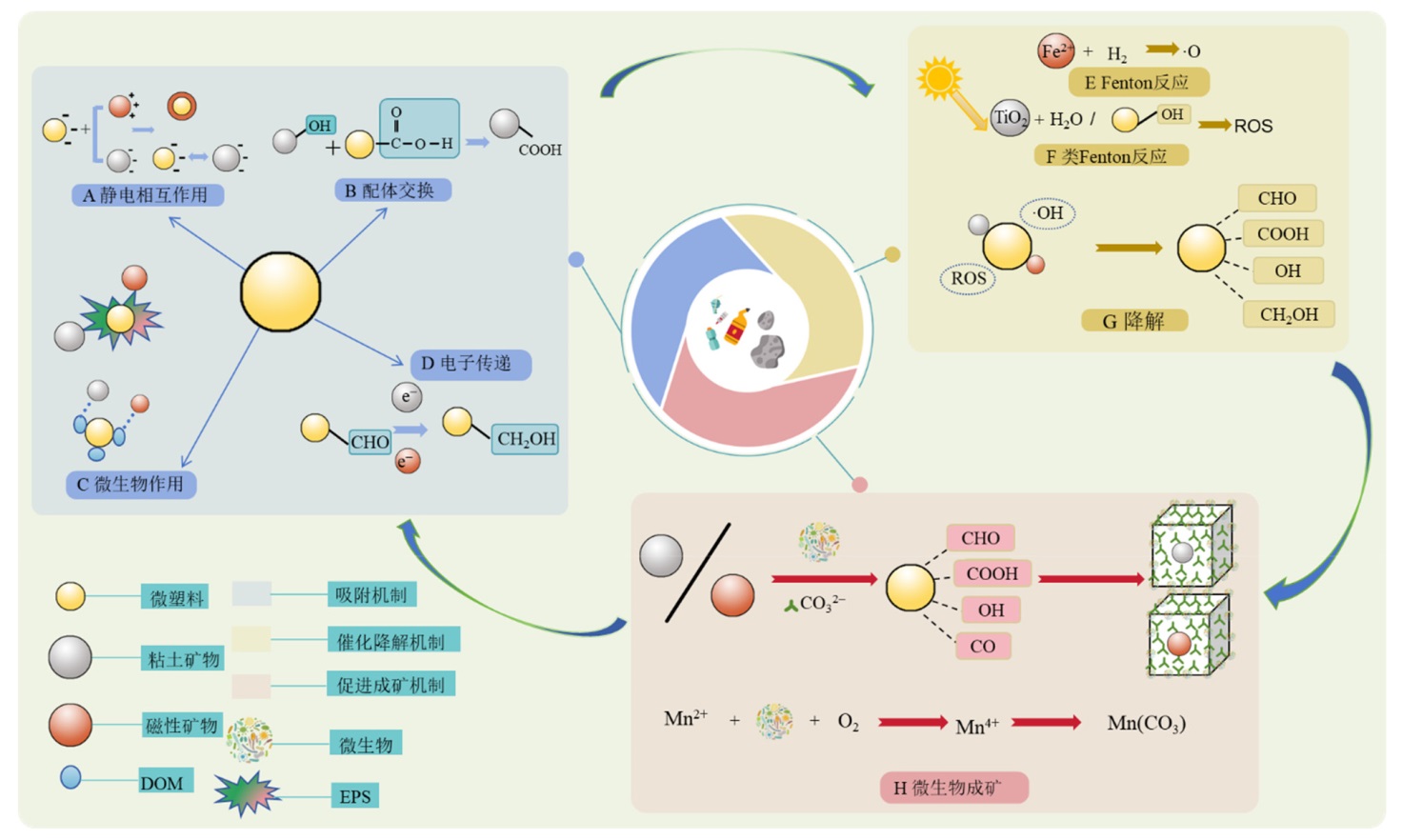
图1 微塑料与矿物间相互作用机制图
Figure 1 Interaction mechanism between microplastics and minerals
| [1] |
Auta H S, Emenike C U, Fauziah S H, 2017. Screening of Bacillus strains isolated from mangrove ecosystems in Peninsular Malaysia for microplastic degradation[J]. Environmental Pollution, 231(Part 2): 1552-1559.
DOI URL |
| [2] |
Cao L, Wu D, Liu P, et al., 2021. Occurrence, distribution and affecting factors of microplastics in agricultural soils along the lower reaches of Yangtze River, China[J]. Science of The Total Environment, 794: 148694.
DOI URL |
| [3] |
Chandrakanthan K, Fraser M P, Herckes P, 2023. Microplastics are ubiquitous and increasing in soil of a sprawling urban area, Phoenix (Arizona)[J]. Science of The Total Environment, 906: 167617.
DOI URL |
| [4] |
Chen Q Q, GAO Z, Wang K, et al., 2023. High accumulation of microplastic fibers in fish hindgut induces an enhancement of triphenyl phosphate hydroxylation[J]. Environmental Pollution, 317: 120804.
DOI URL |
| [5] |
Ding H X, LI Y, Hou J, et al., 2015. Sorption behavior and modeling of endocrine-disrupting chemicals on natural sediments: role of biofilm covered on surface[J]. Environmental Science and Pollution Research, 22: 1380-1388.
DOI URL |
| [6] |
Ding J F, Sun C J, He C F, et al., 2022. Atmospheric microplastics in the Northwestern Pacific Ocean: Distribution, source, and deposition[J]. Science of The Total Environment, 829: 154337.
DOI URL |
| [7] |
Dong Y M, Gao M L, Song Z G, et al., 2020. As(III) adsorption onto different-sized polystyrene microplastic particles and its mechanism[J]. Chemosphere, 239: 124792.
DOI URL |
| [8] | Fadli M H, Ibadurrohman M, Slamet S, 2021. Microplastic pollutant degradation in water using modified TiO2 photocatalyst under UV-irradiation[C]// IOP conference series: materials science and engineering. IOP Publishing, 1011(1): 012055. |
| [9] | He S Y, Jia M Y, Xiang Y P, et al., 2022. Biofilm on microplastics in aqueous environment: Physicochemical properties and environmental implications[J]. Journal of Hazardous Materials, 424(Part B): 127286. |
| [10] |
Huang B, Sun L Y, Liu M R, et al., 2021. Abundance and distribution characteristics of microplastic in plateau cultivated land of Yunnan Province, China[J]. Environmental Science and Pollution Research, 28(2): 1675-1688.
DOI |
| [11] |
Huo C, Zhang S F, Qu L, et al., 2024. Distribution characteristics of microplastics in surface waters in the western Pacific Ocean[J]. Journal of Oceanology and Limnology, 43(2): 492-501.
DOI |
| [12] |
Jin M, Yu X B, Yao Z Y, et al., 2020. How biofilms affect the uptake and fate of hydrophobic organic compounds (HOCs) in microplastic: Insights from an in situ study of Xiangshan Bay, China[J]. Water Research, 184(1): 116118.
DOI URL |
| [13] |
Jiries A, Al-Omari A, Fraihat S, et al., 2024. Abundance and distribution of microplastics in irrigation canal water in Jordan[J]. Desalination and Water Treatment, 318: 100409.
DOI URL |
| [14] |
Kang J, Zhou L, Duan X G, et al., 2019. Degradation of cosmetic microplastics via functionalized carbon nanosprings[J]. Matter, 1(3): 745-758.
DOI URL |
| [15] |
Kleber M, Sollins P, Sutton R, 2007. A conceptual model of organo-mineral interactions in soils: Self-assembly of organic molecular fragments into zonal structures on mineral surfaces[J]. Biogeochemistry, 85: 9-24.
DOI URL |
| [16] | Kooi M, Koelmans A A, 2019. Simplifying microplastic via continuous probability distributions for size, shape, and density[J]. Environmental Science & Technology Letters, 6(9): 551-557. |
| [17] |
Koppenol W H, 1993. The centennial of the Fenton reaction[J]. Free Radical Biology and Medicine, 15(6): 645-651.
PMID |
| [18] |
Kumar E, Bhatnagar A, Hogland W, et al., 2014. Interaction of anionic pollutants with Al-based adsorbents in aqueous media: A review[J]. Chemical Engineering Journal, 241: 443-456.
DOI URL |
| [19] |
Kumar R, Pandit P, Kumar D, et al., 2021. Landfill microbiome harbour plastic degrading genes: A metagenomic study of solid waste dumping site of Gujarat, India[J]. Science of The Total Environment, 779: 146184.
DOI URL |
| [20] |
Larese-Casanova P, Haderlein S B, Kappler A, 2010. Biomineralization of lepidocrocite and goethite by nitrate-reducing Fe(II)-oxidizing bacteria: effect of pH, bicarbonate, phosphate, and humic acids[J]. Geochimica et Cosmochimica Acta, 74(13): 3721-3734.
DOI URL |
| [21] |
Lee Y K, Hur J, 2020. Adsorption of microplastic-derived organic matter onto minerals[J]. Water Research, 187: 116426.
DOI URL |
| [22] |
Li S, Yang M X, Wang H J, et al., 2022. Adsorption of microplastics on aquifer media: Effects of the action time, initial concentration, ionic strength, ionic types and dissolved organic matter[J]. Environmental Pollution, 308: 119482.
DOI URL |
| [23] |
Li Z M, Wang J M, Gao X, et al, 2023. Investigation of Microplastics (≥10 μm) in Meconium by Fourier Transform Infrared Microspectroscopy[J]. Toxics, 11(4): 310.
DOI URL |
| [24] |
Liu C, Zhang X R, Liu J F, et al., 2023a. Ageing characteristics and microplastic release behavior from rainwater facilities under ROS oxidation[J]. Science of The Total Environment, 866: 161397.
DOI URL |
| [25] |
Liu L P, Jiang Z Z, Chu F Y, 2023b. Sedimentary Mn Metallogenesis and Coupling among Major Geo-Environmental Events during the Sturtian Glacial-Interglacial Transition[J]. Minerals, 13(6): 712.
DOI URL |
| [26] | Long X, Zhang S, Huang D S, et al., 2024. Atmospheric microplastics emission source potentials and deposition patterns in semi‐arid croplands of Northern China[J]. Journal of Geophysical Research: Atomosphere, 129(20): 15. |
| [27] |
Lu J X, Qiu Y Z, Zhang L X, et al., 2024. Effects of Fe3O4 NMs based Fenton-like reactions on biodegradable plastic bags in compost: new insight into plastisphere community succession, co-composting efficiency and free radical in situ aging theory[J]. Journal of Hazardous Materials, 467(5): 133689.
DOI URL |
| [28] |
Mai Y Z, Peng S Y, Lai Z N, et al., 2021. Measurement, quantification, and potential risk of microplastics in the mainstream of the Pearl River (Xijiang River) and its estuary, Southern China[J]. Environmental Science and Pollution Research, 28(38): 53127-53140.
DOI |
| [29] |
Malla-Pradhan R, Pradhan B L, Phoungthong K, et al., 2022. Occurrence and Distribution of Microplastics from Nepal’s Second Largest Lake[J]. Water Air and Soil Pollution, 233(10): 423.
DOI |
| [30] |
Medyńska-Juraszek A, Szczepańska A, 2023. Microplastic pollution in EU farmland soils: Preliminary findings from agricultural soils (southwestern Poland)[J]. Agriculture, 13(9): 1733.
DOI URL |
| [31] |
Mendonça E S, Rowell D L, 1996. Mineral and organic fractions of two oxisols and their influence on effective cation‐exchange capacity[J]. Soil Science Society of America Journal, 60(6): 1888-1892.
DOI URL |
| [32] |
Miao F, Liu Y F, Gao M M, et al., 2020. Degradation of polyvinyl chloride microplastics via an electro-Fenton-like system with a TiO2/graphite cathode[J]. Journal of Hazardous Materials, 399: 123023.
DOI URL |
| [33] | Michels J, Stippkugel A, Lenz M, et al., 2018. Rapid aggregation of biofilm-covered microplastics with marine biogenic particles[J]. Proceedings of the Royal Society B, 285(1885): 1-9. |
| [34] |
Nafea T H, Chan F K S, Xu Y Y, et al., 2025. Unveiling the seasonal transport and exposure risks of atmospheric microplastics in the southern area of the Yangtze River Delta, China[J]. Environmental Pollution, 367: 125567.
DOI URL |
| [35] |
Nie X, Xing X H, Xie R Y, et al., 2023. Impact of iron/aluminum (hydr)oxide and clay minerals on heteroaggregation and transport of nanoplastics in aquatic environment[J]. Journal of Hazardous Materials, 446: 130649.
DOI URL |
| [36] | Nizzetto L, Langaas S, Futter M, 2016. Pollution: Do microplastics spill on to farm soils?[J]. Nature, 537(7621): 488-488. |
| [37] |
Pan J R, Zhang S, Qiu X, et al., 2024. Molecular Weights of dissolved organic matter significantly affect photoaging of microplastics[J]. Environmental Science & Technology, 58(31): 13973-13985.
DOI URL |
| [38] | Pan Z, Liu Q L, Sun X W, et al., 2022. Widespread occurrence of microplastic pollution in open sea surface waters: Evidence from the mid-North Pacific Ocean[J]. Gondwana Research,108: 31-40. |
| [39] |
Parashar N, Hait S, 2023. Plastic rain—Atmospheric microplastics deposition in urban and peri-urban areas of Patna City, Bihar, India: Distribution, characteristics, transport, and source analysis[J]. Journal of Hazardous Materials, 458: 131883.
DOI URL |
| [40] |
Penesyan A, Tebben J, Lee M, et al., 2011. Identification of the antibacterial compound produced by the marine epiphytic bacterium Pseudovibrio sp. D323 and related sponge-associated bacteria [J]. Marine Drugs, 9(8): 1391-1402.
DOI PMID |
| [41] |
Petrash D A, Bialik O M, Bontognali T R R, et al., 2017. Microbially catalyzed dolomite formation: from near-surface to burial[J]. Earth-Science Reviews, 171: 558-582.
DOI URL |
| [42] |
Polgári M, Gyollai I, 2022. Comparative study of formation conditions of Fe-Mn ore microbialites based on mineral assemblages: A critical self-overview[J]. Minerals, 12(10): 1273.
DOI URL |
| [43] |
Reddy C N, Kallem P, Mounika K V S S N, et al., 2023. Review of microplastic degradation: Understanding metagenomic approaches for microplastic degrading organisms[J]. Polymer Testing, 128: 108223.
DOI URL |
| [44] |
Shruti V C, Kutralam-Muniasamy G, Pérez-Guevara F, et al., 2022. Occurrence and characteristics of atmospheric microplastics in Mexico City[J]. Science of The Total Environment, 847: 157601.
DOI URL |
| [45] |
Shu X H, Yang M H, Lin H Y, et al., 2023. Oxalic-activated minerals enhance the stabilization of polypropylene and polyamide microplastics in soil: Crucial roles of mineral dissolution coupled surface oxygen-functional groups[J]. Science of The Total Environment, 875: 162563.
DOI URL |
| [46] |
Suhrhoff T J, Scholz-Böttcher B M, 2016. Qualitative impact of salinity, UV radiation and turbulence on leaching of organic plastic additives from four common plastics—A lab experiment[J]. Marine pollution bulletin, 102(1): 84-94.
DOI PMID |
| [47] | Thompson R C, Courtene-Jones W, Boucher J, et al., 2024. Twenty years of microplastic pollution research— what have we learned?[J]. Science, 386(6720): eadl2746. |
| [48] |
Thompson R C, Olsen Y, Mitchell R P, et al., 2004. Lost at sea: where is all the plastic?[J]. Science, 304(5672): 838-838.
PMID |
| [49] |
Vasconcelos C, Mckenzie J A, Bernasconi S, et al., 1995. Microbial mediation as a possible mechanism for natural dolomite formation at low temperatures[J]. Nature, 377(6546): 220-222.
DOI |
| [50] | Vu T T T, Nguyen D T, Nguyen N T M, et al., 2022. Coaggregation of micro polystyrene particles and suspended minerals under concentrated salt solution: A perspective of terrestrial-to-ocean transfer of microplastics[J]. Marine Pollution Bulletin, 185(Part B): 114317. |
| [51] | Lambert S, Wagner M, 2016. Formation of microscopic particles during the degradation of different polymers[J]. Chemosphere: Environmental Toxicology and Risk Assessment, 161: 510-517. |
| [52] |
Wang L W, Bank M S, Rinklebe J, et al., 2023b. Plastic-rock complexes as hotspots for microplastic generation[J]. Environmental Science & Technology, 57(17): 7009-7017.
DOI URL |
| [53] |
Wang X H, Li C J, Liu K, et al., 2020. Atmospheric microplastic over the South China Sea and East Indian Ocean: Abundance, distribution and source[J]. Journal of Hazardous Materials, 389: 121846.
DOI URL |
| [54] |
Wang Y M, Qu S N, Li T, et al., 2024. Association between ambient air pollution and outpatient visits of cardiovascular diseases in Zibo, China: A time series analysis[J]. Frontiers in Public Health, 12: 1492056.
DOI URL |
| [55] |
Wang Y, Chen X W, Wang F F, et al., 2023a. Influence of typical clay minerals on aggregation and settling of pristine and aged polyethylene microplastics[J]. Environmental Pollution, 316(Part 2): 120649.
DOI URL |
| [56] |
Wang Z C, Qin Y M, Li W P, et al., 2019. Microplastic contamination in freshwater: First observation in lake Ulansuhai, yellow river basin, China[J]. Environmental Chemistry Letters, 17: 1821-1830.
DOI |
| [57] |
Xue Z H, Yu X, Ke X B, et al., 2024. A novel route for microplastic mineralization: visible-light-driven heterogeneous photocatalysis and photothermal Fenton-like reaction[J]. Environmental Science: Nano, 11(1): 113-122.
DOI URL |
| [58] |
Ye X Y, Zhou C, Wu M, et al., 2022. Effects of clay minerals on the transport of polystyrene nanoplastic in groundwater[J]. Water Research, 223: 118978.
DOI URL |
| [59] |
Yuan J H, Ma J, Sun Y R, et al., 2020. Microbial degradation and other environmental aspects of microplastics/plastics[J]. Science of The Total Environment, 715: 136968.
DOI URL |
| [60] |
Zettler E R, Mincer T J, Amaral-Zettler L A, 2013. Life in the “plastisphere”: Microbial communities on plastic marine debris[J]. Environmental Science & Technology, 47(13): 7137-7146.
DOI URL |
| [61] |
Zhang F D, Yang X Y, Zhang Z M, 2024a. Effects of soil properties and land use patterns on the distribution of microplastics: A case study in southwest China[J]. Journal of Environmental Management, 356: 120598.
DOI URL |
| [62] | Zhang M W, Ding L, Qiu X R, et al., 2024b. Interactions between iron minerals and dissolved organic matter derived from microplastics inhibited the ferrihydrite transformation as revealed at the molecular scale[J]. Environmental Science & Technology, 58(30): 13478-13489. |
| [63] |
Zhang P, Wang J, Huang L, et al., 2023. Microplastic transport during desertification in drylands: Abundance and characterization of soil microplastics in the Amu Darya-Aral Sea basin, Central Asia[J]. Journal of Environmental Management, 348: 119353.
DOI URL |
| [64] |
Zhao X L, Qiang M M, Yuan Y, et al., 2023. Distribution of microplastic contamination in the major tributaries of the Yellow River on the Loess Plateau[J]. Science of The Total Environment, 905: 167431.
DOI URL |
| [65] | 范秀磊, 邹晔锋, 刘加强, 等, 2021. 老化前后轮胎磨损微粒与聚氯乙烯微粒对抗生素的吸附-解吸行为[J]. 环境科学, 42(4): 1901-1912. |
| Fan X L, Zou Y F, Liu J Q, et al., 2021. Adsorption and desorption behaviors of antibiotics on TWP and PVC particles before and after aging[J]. Environmental Science, 42(4): 1901-1912. | |
| [66] | 耿海波, 付世骞, 师明川, 等, 2023. 东胜铀矿床中主要微生物成矿因素实验研究[J]. 沉积学报, 41(3): 684-692. |
| Geng H B, Fu S Q, Shi M C, et al., 2023. Experimental study on the main microbial ore-forming factors in dongsheng uranium deposit[J]. Acta Sedimentologica Sinica, 41(3): 684-692. | |
| [67] | 黄雪刚, 刘洋, 李博文, 等, 2023. 三种热点工程颗粒材料的性质与环境行为和细胞毒性的关系[J]. 材料导报, 37(6): 57-64. |
| Huang X G, Liu Y, Li B W, et al., 2023. Relationships between the properties of three hot Engineering Granular Materials and their environmental behaviors or cytotoxicity[J]. Materials Reports, 37(6): 57-64. | |
| [68] | 蒋文斌, 姜晨晨, 韦选香, 等, 2024. PET微塑料水解再造缺陷铁基金属有机框架及其应用研究[J]. 中国环境科学, 44(9): 5222-5233. |
| Jiang W B, Jiang C C, Wei X X, et al., 2024. Upcycling PET microplastics via alkaline hydrolysis to defective iron metal-organic frameworks for water treatment[J]. China Environmental Science, 44(9): 5222-5233. | |
| [69] | 乐永宣, 史正涛, 罗淘源, 等, 2024. 昆明市大气微塑料的沉降特性及呼吸暴露风险[J]. 环境化学, 43(9): 3114-3127. |
| Le Y X, Shi Z T, Luo T Y, et al., 2024. The settlement characteristics and respiratory exposure risk of atmospheric microplastics in Kunming City[J]. Environmental Chemistry, 43(9): 3114-3127. | |
| [70] | 李雪, 罗玉华, 李华, 等, 2024. 水环境中微塑料与微生物的相互作用研究进展[J]. 中国环境科学, 44(12): 6962-6971. |
| Li X, Luo Y H, Li H, et al., 2024. Advances in the study of microplastic-microbial interactions in the aquatic environment[J]. China Environmental Science, 44(12): 6962-6971. | |
| [71] | 李思琼, 王华, 储林佑, 等, 2024. 长江流域微塑料污染特征及生态风险评价[J]. 环境科学, 45(3): 1439-1447. |
| Li S Q, Wang H, Chu L Y, et al., 2024. Pollution characteristics and ecological risk assessment of microplastics in the Yangtze River Basin[J]. Environmental Science, 45(3): 1439-1447. | |
| [72] | 刘亚萱, 刘慧, 王为木, 等, 2025. 微塑料在土壤和作物体内的迁移转运机制及影响因素研究进展[J]. 植物营养与肥料学报, 31(9): 1862-1876. |
| Liu Y X, Liu H, Wang W M, et al., 2025. Research advances of the side effects of microplastics on crops and their transport pathways and influence factors in soil and crops[J]. Journal of Plant Nutrition and Fertilizers, 31(9): 1862-1876. | |
| [73] | 宋永伟, 王鹤茹, 梁剑茹, 等, 2016. 温度和pH对生物成因羟基硫酸铁矿物的综合影响研究[J]. 环境科学学报, 36(10): 3683-3690. |
| Song Y W, Wang H R, Liang J R, et al., 2016. Effects of temperature and pH on the formation of biogenic Fe(Ⅲ) hydroxysulfate precipitates[J]. Acta Scientiae Circumstantiae, 36(10): 3683-3690. | |
| [74] | 孙霞, 苟燕如, 严涵, 等, 2024. 北疆典型棉区土壤微塑料污染现状及分布特征[J]. 农业环境科学学报, 43(3): 571-580. |
| Sun X, Gou Y R, Yan H, et al., 2024. Soil microplastic pollution and distribution characteristics in a typical cotton field in northern Xinjiang, China[J]. Journal of Agro-Environment Science, 43(3): 571-580. | |
| [75] | 唐婕, 郝鑫瑞, 易筱筠, 等, 2021. 胞外聚合物对微生物还原含镉聚合硫酸铁絮体过程次生矿物形成及镉迁移转化的影响[J]. 环境科学学报, 41(5): 1828-1839. |
| Tang J, Hao X R, Yi X Y, et al., 2021. The role of extracellular polymeric substances on secondary mineral formation andcadmium migration and transformation during microbial reduction of cadmium-loaded polyferric sulfate[J]. Acta Scientiae Circumstantiae, 41(5): 1828-1839. | |
| [76] | 唐子超, 唐晋, 梁伦套, 等, 2024. 微塑料对土壤磷吸附的影响[J]. 重庆大学学报, 47(4): 12-21, 156. |
| Tang Z C, Tang J, Liang L T, et al., 2024. Effect of microplastics on soil phosphorus adsorption[J]. Journal of Chongqing University, 47(4): 12-21, 156. | |
| [77] | 王峰, 公玮, 刘哲, 等, 2023. 南水北调丹江口库区土壤中微塑料分布特征及风险评估[J]. 环境科学, 44(11): 6279-6286. |
| Wang F, Gong W, Liu Z, et al., 2023. Distribution Characteristics and Risk Assessment of Microplastics in Soilin Danjiangkou Reservoir Area of South-to-North Water Diversion Project[J]. Environmental Science, 44(11): 6279-6286. | |
| [78] | 王刘炜, 侯德义, 2023. 塑岩: 成因、分布与微塑料释放特征[J]. 环境科学研究, 36(8): 1457-1466. |
| Wang L W, Hou D Y, 2023. Plastistone: Diagenesis, global distribution, and microplastic generation characteristics[J]. Research of Environmental Sciences, 36(8): 1457-1466. | |
| [79] |
王庆宏, 姜晨旭, 王鑫, 等, 2023. 天然矿物催化氧化水中难降解有机污染物研究进展[J]. 化工进展, 42(1): 417-434.
DOI |
|
Wang Q H, Jiang C X, Wang X, et al., 2023. An overview of natural mineral catalytic oxidation of refractory organic contaminants in wastewater[J]. Chemical Industry and Engineering Progress, 42(1): 417-434.
DOI |
|
| [80] | 仵庆华, 王誉泽, 2021. 生物刺激脲酶微生物诱导碳酸盐成矿的机理与应用[C]// 2021年中国地球科学联合学术年会论文集(二十二)—专题六十四前寒武纪地质与超大陆演化、专题六十五矿物科学与工程、专题六十六高压实验矿物学、岩石学与地球化学. 广州: 中国会议: 61-64. |
| Wu Q H, Wang Y Z, 2021. Mechanism and Application of Biological Stimulation of Urease Microorganisms to Induce Carbonate Mineralization[C]// Collection of Papers of China Geosciences Joint Annual Conference 2021 (22): Thematic Sixty-four Precambrian Geology and Supercontinent Evolution, Thematic Sixty-five Mineral Science and Engineering, Thematic Sixty-six High Pressure Experimental Mineralogy, Petrology and Geochemistry. Guangzhou: China Conference: 61-64. | |
| [81] | 夏学惠, 东野脉兴, 2002. 滇池磷的现代沉积与微生物成矿作用[J]. 矿床地质, 21(S1): 925-926. |
| Xia X H, Dong Y M X, 2002. Modern sedimentation and microbiological mineralization of phosphorus in Dianchi Lake[J]. Mineral Deposits, 21(S1): 925-926. | |
| [82] | 薛向东, 王星源, 梅雨晨, 等, 2020. 微塑料对水中铜离子和四环素的吸附行为[J]. 环境科学, 41(8): 3675-3683. |
| Xue X D, Wang X Y, Mei Y C, et al., 2020. Sorption behaviors of Copper Ions and Tetracycline on microplastics in aqueous[J]. Environmental Science, 41(8): 3675-3683. | |
| [83] | 张现荣, 孙治雷, 魏合龙, 等, 2017. 自生黄铁矿的微生物成矿机理及对冷泉泄漏的指示意义[J]. 海洋地质与第四纪地质, 37(2): 25-32. |
| Zhang X R, Sun Z L, Wei H L, et al., 2017. Micro-biomineralization of authigenic pyrite and its implications for seafloor cold seeps[J]. Marine Geology & Quaternary Geology, 37(2): 25-32. | |
| [84] | 张杨洋, 2021. 聚苯乙烯纳米塑料与矿物在水溶液中的交互作用机制研究[D]. 杨凌: 西北农林科技大学. |
| Zhang Y Y, 2021. The interaction mechanism between polystyrene nanoplastic and minerals in aqueous phase[D]. Yangling: College of Natural Resources and Environment Northwest A & F University. | |
| [85] | 张玉燕, 刘红旭, 修晓茜, 2016. 我国北西部地区层间氧化带砂岩型铀矿床微生物与铀成矿作用研究初探[J]. 地质学报, 90(12): 3508-3518. |
| Zhang Y Y, Liu H X, Xiu X Q, 2016. Relationship between Micro-organisms and Uranium Metallogeny of the Interlayer Oxidation Zone Sandstone-type Uranium Deposits in NW China[J]. Acta Geologica Sinica, 90(12): 3508-3518. | |
| [86] | 郑大中, 郑若锋, 2007. 锰的迁移形式成矿机理新探[J]. 地质找矿论丛, 22(4): 241-247, 263. |
| Zheng D Z, Zheng R F, 2007. A new approach to Mn mobolization and metallogenic mechanism[J]. Contributions to Geology and Mineral Resources Research, 22(4): 241-247, 263. | |
| [87] | 郑大中, 郑若锋, 1999. 小秦岭金矿床金的迁移富集机理新探[J]. 黄金, 20(8): 1-5. |
| Zheng D Z, Zheng R F, 1999. The preliminary exploration on mechanism of migration and enrichment of gold in Xiaoqinling gold deposits[J]. Gold, 20(8): 1-5. |
| [1] | 李赢, 黄华丽, 张帆, 韩艳刚. 邻体相互作用对温带次生林树木生长及稳定性的影响[J]. 生态环境学报, 2026, 35(6): 922-927. |
| [2] | 刘沙沙, 张佳莹, 肖舒淇, 林静雯, 吴文胜, 杨成方. 聚丙烯和聚氯乙烯微塑料降解菌的筛选及降解特性[J]. 生态环境学报, 2026, 35(3): 333-344. |
| [3] | 周浩然, 何涛, 彭恋, 钟志明, 钱宝. 长江流域重要水源地微塑料赋存特征及生态风险评估[J]. 生态环境学报, 2026, 35(3): 345-351. |
| [4] | 张义栋, 杨旭楠, 陈艳姣, 汪涛, 许玫英. FT-IR技术在水体沉积物有机碳分析中的应用研究进展[J]. 生态环境学报, 2025, 34(9): 1483-1494. |
| [5] | 肖咏茵, 王帆, 李灿桦, 汪超, 王万军. 淡水中可生物降解微塑料生物膜上耐药基因的富集特征及其健康风险[J]. 生态环境学报, 2025, 34(7): 1029-1041. |
| [6] | 李雪, 王震, 毛雪飞. 聚乙烯与聚丙烯微塑料对镉胁迫下水稻幼苗生长及抗氧化作用的影响[J]. 生态环境学报, 2025, 34(7): 1053-1063. |
| [7] | 梁亚迪, 姚雪雯, 李涵博, 陈志怀, 历红波, 欧阳铭韩, 罗小三. 典型轮胎磨损颗粒中重金属的含量特征及生态和健康风险评估[J]. 生态环境学报, 2025, 34(11): 1770-1777. |
| [8] | 汪彩琴, 杨潜英, 周名玉, 张道勇, 潘响亮. 微塑料对滨海湿地中污染物行为和元素循环的影响研究进展[J]. 生态环境学报, 2025, 34(10): 1519-1531. |
| [9] | 何艺, 秦欣欣, 张翔, 孙楠, 杨雅淋, 连军锋. 微塑料断面分布的不均一性——以赣江水域赣州段为例[J]. 生态环境学报, 2024, 33(4): 626-632. |
| [10] | 林健晖, 李萍萍, 刘敏, 邓希, 康子歆, 杨涛, 展舒悦, 曾映旭. 不同生物膜附着微塑料对文蛤鳃的毒性效应[J]. 生态环境学报, 2024, 33(1): 111-118. |
| [11] | 陈鸿展, 区晖, 叶四化, 张倩华, 周树杰, 麦磊. 珠江广州段水体微塑料的时空分布特征及生态风险评估[J]. 生态环境学报, 2023, 32(9): 1663-1672. |
| [12] | 宋孝帅, 丁武泉, 刘新敏, 李廷真. 离子特异性效应对紫色土孔隙状况的影响机制研究[J]. 生态环境学报, 2023, 32(2): 292-298. |
| [13] | 李海燕, 杨小琴, 简美鹏, 张晓然. 城市水体中微塑料的来源、赋存及其生态风险研究进展[J]. 生态环境学报, 2023, 32(2): 407-420. |
| [14] | 何文宣, 李垒, 孙思宇, 李昌, 李久义, 田秀君. 北运河水体、沉积物和鱼类中微塑料的分布特征研究[J]. 生态环境学报, 2023, 32(11): 1901-1912. |
| [15] | 李文菁, 黄月群, 黄亮亮, 李向通, 苏琼源, 孙扬言. 北部湾海洋鱼类微塑料污染特征及其风险评估[J]. 生态环境学报, 2023, 32(11): 1913-1921. |
| 阅读次数 | ||||||
|
全文 |
|
|||||
|
摘要 |
|
|||||
