
Ecology and Environmental Sciences ›› 2026, Vol. 35 ›› Issue (4): 654-664.DOI: 10.16258/j.cnki.1674-5906.2026.04.015
• Research Article [Environmental Science] • Previous Articles
ZHOU Zhiluo1,2,3( ), YANG Qiu1,*(), LIU Xiaohuang2,3, LIU Run2,3, LIU Jiufen2,3, MA Min2,3, ZHU Ping2,3, LI Chaozhu2,3
Received:2025-07-13
Revised:2026-02-25
Accepted:2026-03-10
Online:2026-04-18
Published:2026-04-14
周致泺1,2,3(), 杨秋1,*(), 刘晓煌2,3, 刘润2,3, 刘玖芬2,3, 马敏2,3, 祝萍2,3, 李朝柱2,3
通讯作者:
*E-mail: 作者简介:周致泺(2000年生),男,硕士研究生,研究方向为土地生态与生态空间。E-mail: zzl31869093@gmail.com
基金资助:CLC Number:
ZHOU Zhiluo, YANG Qiu, LIU Xiaohuang, LIU Run, LIU Jiufen, MA Min, ZHU Ping, LI Chaozhu. Spatio-temporal Distribution Changes and Coupling Coordination Analysis of the “Production-Living-Ecological Space” at the Township Scale on Hainan Island[J]. Ecology and Environmental Sciences, 2026, 35(4): 654-664.
周致泺, 杨秋, 刘晓煌, 刘润, 刘玖芬, 马敏, 祝萍, 李朝柱. 海南岛乡镇尺度上“三生空间”时空分布变化与耦合协调分析[J]. 生态环境学报, 2026, 35(4): 654-664.
Add to citation manager EndNote|Ris|BibTeX
URL: https://www.jeesci.com/EN/10.16258/j.cnki.1674-5906.2026.04.015
| 编号 | 土地利用分类系统的二级分类 | 生产分值 | 生活分值 | 生态分值 |
|---|---|---|---|---|
| 11 | 水田 | 3 | 0 | 3 |
| 12 | 旱地 | 3 | 0 | 3 |
| 21 | 有林地 | 0 | 0 | 5 |
| 22 | 灌木林 | 0 | 0 | 5 |
| 23 | 疏林地 | 0 | 0 | 5 |
| 24 | 其它林地 | 0 | 1 | 3 |
| 31 | 高覆盖度草地 | 1 | 0 | 5 |
| 32 | 中覆盖度草地 | 1 | 0 | 5 |
| 33 | 低覆盖度草地 | 1 | 0 | 3 |
| 41 | 河渠 | 1 | 0 | 5 |
| 42 | 湖泊 | 0 | 0 | 1 |
| 43 | 水库坑塘 | 1 | 0 | 5 |
| 44 | 永久性冰川雪地 | 0 | 0 | 3 |
| 45 | 滩涂 | 0 | 0 | 5 |
| 46 | 滩地 | 0 | 0 | 5 |
| 51 | 城镇用地 | 3 | 5 | 0 |
| 52 | 农村居民点 | 3 | 5 | 0 |
| 53 | 其它建设用地 | 5 | 1 | 0 |
| 61 | 沙地 | 0 | 0 | 5 |
| 62 | 戈壁 | 0 | 0 | 5 |
| 63 | 盐碱地 | 0 | 0 | 5 |
| 64 | 沼泽地 | 0 | 0 | 5 |
| 65 | 裸土地 | 0 | 0 | 5 |
| 66 | 裸岩石质地 | 0 | 0 | 5 |
| 67 | 其它未利用地 | 0 | 0 | 5 |
| 99 | 海洋 | 0 | 0 | 5 |
Table 1 Score table of initial value for production-living-ecological spatial function
| 编号 | 土地利用分类系统的二级分类 | 生产分值 | 生活分值 | 生态分值 |
|---|---|---|---|---|
| 11 | 水田 | 3 | 0 | 3 |
| 12 | 旱地 | 3 | 0 | 3 |
| 21 | 有林地 | 0 | 0 | 5 |
| 22 | 灌木林 | 0 | 0 | 5 |
| 23 | 疏林地 | 0 | 0 | 5 |
| 24 | 其它林地 | 0 | 1 | 3 |
| 31 | 高覆盖度草地 | 1 | 0 | 5 |
| 32 | 中覆盖度草地 | 1 | 0 | 5 |
| 33 | 低覆盖度草地 | 1 | 0 | 3 |
| 41 | 河渠 | 1 | 0 | 5 |
| 42 | 湖泊 | 0 | 0 | 1 |
| 43 | 水库坑塘 | 1 | 0 | 5 |
| 44 | 永久性冰川雪地 | 0 | 0 | 3 |
| 45 | 滩涂 | 0 | 0 | 5 |
| 46 | 滩地 | 0 | 0 | 5 |
| 51 | 城镇用地 | 3 | 5 | 0 |
| 52 | 农村居民点 | 3 | 5 | 0 |
| 53 | 其它建设用地 | 5 | 1 | 0 |
| 61 | 沙地 | 0 | 0 | 5 |
| 62 | 戈壁 | 0 | 0 | 5 |
| 63 | 盐碱地 | 0 | 0 | 5 |
| 64 | 沼泽地 | 0 | 0 | 5 |
| 65 | 裸土地 | 0 | 0 | 5 |
| 66 | 裸岩石质地 | 0 | 0 | 5 |
| 67 | 其它未利用地 | 0 | 0 | 5 |
| 99 | 海洋 | 0 | 0 | 5 |

Figure 1 Spatial distribution for function of “production-living-ecological” space in Hainan island
| 空间类型 | 年份 | 全局莫兰指数 (Global Moran’s I) | Z值 | p值 |
|---|---|---|---|---|
| 生产空间 | 2000 | 0.6870 | 19.2840 | 0.0000 |
| 2010 | 0.6996 | 19.6180 | 0.0000 | |
| 2020 | 0.7460 | 20.9012 | 0.0000 | |
| 生活空间 | 2000 | 0.7514 | 21.5360 | 0.0000 |
| 2010 | 0.8107 | 23.1202 | 0.0000 | |
| 2020 | 0.8485 | 24.1434 | 0.0000 | |
| 生态空间 | 2000 | 0.7203 | 20.4857 | 0.0000 |
| 2010 | 0.7636 | 21.6499 | 0.0000 | |
| 2020 | 0.8105 | 22.9552 | 0.0000 |
Table 2 Analysis results of global space autocorrelation
| 空间类型 | 年份 | 全局莫兰指数 (Global Moran’s I) | Z值 | p值 |
|---|---|---|---|---|
| 生产空间 | 2000 | 0.6870 | 19.2840 | 0.0000 |
| 2010 | 0.6996 | 19.6180 | 0.0000 | |
| 2020 | 0.7460 | 20.9012 | 0.0000 | |
| 生活空间 | 2000 | 0.7514 | 21.5360 | 0.0000 |
| 2010 | 0.8107 | 23.1202 | 0.0000 | |
| 2020 | 0.8485 | 24.1434 | 0.0000 | |
| 生态空间 | 2000 | 0.7203 | 20.4857 | 0.0000 |
| 2010 | 0.7636 | 21.6499 | 0.0000 | |
| 2020 | 0.8105 | 22.9552 | 0.0000 |

Figure 2 Cold and hot spot of the “production-living-ecological” space in Hainan island
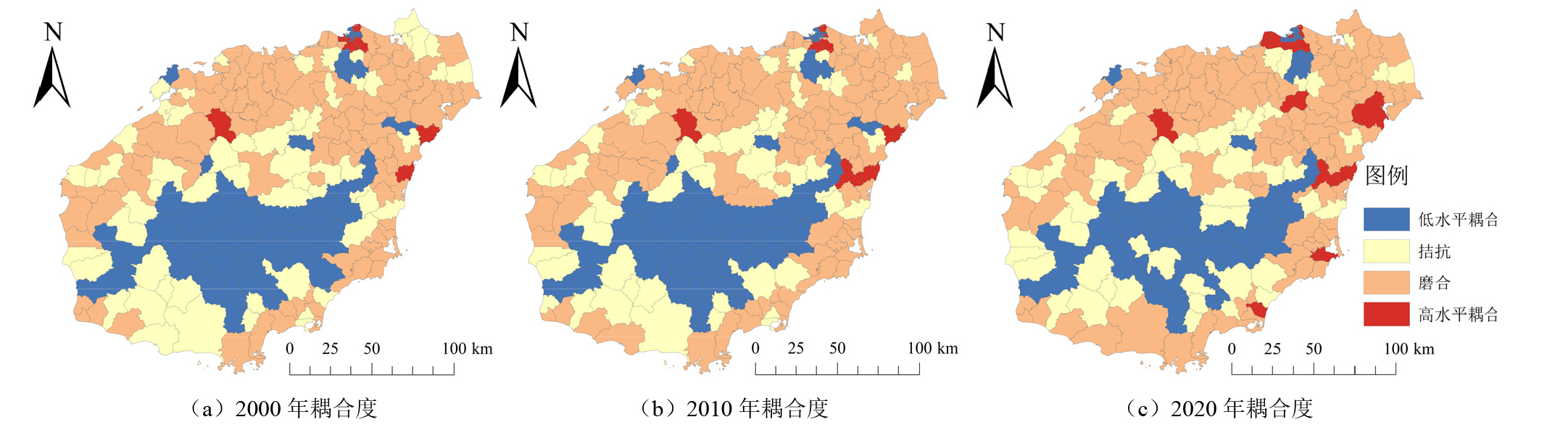
Figure3 Degree of coupling of the “production-living-ecological” space in Hainan island

Figure 4 Degree of coupling Coordination of the “production-living-ecological” space in Hainan island
| [1] |
GETIS A, ORD J K, 1992. The analysis of spatial association by use of distance statistics[J]. Geographical Analysis, 24(3): 189-206.
DOI URL |
| [2] |
HOU Y Z, ZHANG Z L, WANG Y R, et al., 2022. Function Evaluation and coordination analysis of production-living-ecological space based on the perspective of Type-Intensity-Connection: A case study of Suzhou, China[J]. Land, 11(11): 1954.
DOI URL |
| [3] |
LI J S, SUN W, LI M Y, et al., 2021. Coupling coordination degree of production, living and ecological spaces and its influencing factors in the Yellow River Basin[J]. Journal of cleaner production, 298: 126803.
DOI URL |
| [4] |
PENG Y C, LUAN Q L, XIONG C S, 2023. Evaluation of spatial functions and scale effects of “production-living-ecological” space in Hainan Island[J]. Land, 12(8): 1637.
DOI URL |
| [5] |
SHI K F, YANG Q Y, LI Y Q, et al., 2019. Mapping and evaluating cultivated land fallow in Southwest China using multisource data[J]. Science of the Total Environment, 654: 987-999.
DOI URL |
| [6] |
XU H W, ZHANG F, LI W P, et al., 2024. Spatial-temporal pattern of change in production-living-ecological space of Nanchong City from 2000 to 2020 and underlying factors[J]. Environmental Monitoring and Assessment, 196(1): 94.
DOI |
| [7] |
ZHANG X L, JIN X B, LIANG X Y, et al., 2024. Assessment and management for future habitat risks under the implementation of China’s territorial spatial planning: A case study from Hainan Island[J]. Environmental Impact Assessment Review, 106: 107474.
DOI URL |
| [8] |
ZHANG X S, XU Z J, 2021. Functional coupling degree and human activity intensity of production-living-ecological space in underdeveloped regions in China: Case study of Guizhou Province[J]. Land, 10(1): 56.
DOI URL |
| [9] |
陈洁茹, 叶长盛, 魏嶶, 等, 2025. 环鄱阳湖城市群县域 “三生空间” 耦合协调性及影响因素分析[J]. 生态环境学报, 34(5): 807-818.
DOI |
| CHEN J R, YE C S, WEI W, et al., 2025. Analysis of “production-living-ecological space” coupling coordination and influencing factors in county areas of Poyang Lake city cluster[J]. Ecology and Environmental Sciences, 34(5): 807-818. | |
| [10] | 程明洋, 2022. 地理学视角下中国新型城镇化研究进展[J]. 地域研究与开发, 41(2): 46-51. |
| CHENG M Y, 2022. Research progress on China’s new-type urbanization from a geographical perspective[J]. Areal Research and Development, 41(2): 46-51. | |
| [11] | 崔家兴, 顾江, 孙建伟, 等, 2018. 湖北省三生空间格局演化特征分析[J]. 中国土地科学, 32(8): 67-73. |
| CUI J X, GU J, SUN J W, et al., 2018. Analysis of the evolution characteristics of the “production-living-ecological” space pattern in Hubei Province[J]. China Land Science, 32(8): 67-73. | |
| [12] | 崔树强, 朱佩娟, 周国华, 等, 2020. “三生” 视角下的城市空间功能变化及调控路径——以长沙市为例[J]. 长江流域资源与环境, 29(8): 1733-1745. |
| CUI S Q, ZHU P J, ZHOU G H, et al., 2020. Urban spatial function change and regulation path from the perspective of “production-living-ecological” space: A case study of Changsha City[J]. Resources and Environment in the Yangtze Basin, 29(8): 1733-1745. | |
| [13] |
付晶莹, 郜强, 江东, 等, 2022. 黑土保护与粮食安全背景下齐齐哈尔市国土空间优化调控路径[J]. 地理学报, 77(7): 1662-1680.
DOI |
| FU J Y, GAO Q, JIANG D, et al., 2022. Optimization and regulation path of territorial spatial planning in Qiqihar City under the background of black soil protection and food security[J]. Acta Geographica Sinica, 77(7): 1662-1680. | |
| [14] | 耿静, 徐栋, 吴御豪, 等, 2022. 海南岛生态环境质量时空变化及其对气候变化与人类活动的响应[J]. 生态学报, 42(12): 4795-4806. |
| GENG J, XU D, WU Y G, et al., 2022. Spatio-temporal evolution of eco-environment quality and the response to climate change and human activities in Hainan Island[J]. Acta Ecologica Sinica, 42(12): 4795-4806. | |
| [15] |
贺三维, 邵玺, 2018. 京津冀地区人口-土地-经济城镇化空间集聚及耦合协调发展研究[J]. 经济地理, 38(1): 95-102.
DOI |
|
HE S W, SHAO X, 2018. Spatial clustering and coupling coordination of Population-Land-Economic urbanization in Beijing-Tianjin-Hebei Region[J]. Economic Geography, 38(1): 95-102.
DOI |
|
| [16] | 胡兴定, 白中科, 2016. 基于耕作半径的采矿复垦区农村居民点安置规模预测[J]. 农业工程学报, 32(3): 259-266. |
| HU X D, BAI Z K, 2016. Prediction for relocation scale of rural settlements based on farming radius in reclamation area of open-pit coal mine[J]. Transactions of the Chinese Society of Agricultural Engineering (Transactions of the CSAE), 32(3): 259-266. | |
| [17] | 胡耀文, 尹强, 2016. 海南省空间规划的探索与实践——以《海南省总体规划(2015-2030)》为例[J]. 城市规划学刊 (3): 55-62. |
| HU Y W, YIN Q, 2016. Exploration and practice of spatial planning in Hainan Province: A case study of the Hainan Provincial Master Plan (2015-2030)[J]. Urban Planning Forum (3): 55-62. | |
| [18] |
李建新, 杨永春, 蒋小荣, 等, 2018. 中国制造业产业结构高级度的时空格局与影响因素[J]. 地理研究, 37(8): 1558-1574.
DOI |
| LI J X, YANG Y C, JIANG X R, et al., 2018. Spatio-temporal patterns and influencing factors of the industrial structure sophistication in China’s manufacturing industry[J]. Geographical Research, 37(8): 1558-1574. | |
| [19] | 李凯, 侯鹰, 付奇, 等, 2023. 都市圈 “三生空间” 协同变化及其对生态系统服务的影响[J]. 水土保持研究, 30(3): 430-439. |
| LI K, HOU Y, FU Q, et al., 2023. Synergistic changes of production-living-ecological space and their influences on ecosystem services in the metropolitan area[J]. Research of Soil and Water Conservation, 30(3): 430-439. | |
| [20] | 李科, 毛德华, 李健, 等, 2020. 湘江流域 “三生” 空间时空演变及格局分析[J]. 湖南师范大学自然科学学报, 43(2): 9-19. |
| LI K, MAO D H, LI J, et al., 2020. On the evolution of Spatial-temporal patterns of production-living-ecological space in Xiangjiang River Basin[J]. Journal of Natural Science of Hunan Normal University, 43(2): 9-19. | |
| [21] | 李强, 苏迎庆, 冯珍珍, 等, 2021. 汾河流域三生空间功能耦合协调研究[J]. 中国水土保持科学, 19(5): 115-125. |
| LI Q, SU Y Q, FENG Z Z, et al., 2021. Study on the coupling coordination of “production-living-ecological” space functions in the Fenhe River Basin[J]. Science of Soil and Water Conservation, 19(5): 115-125. | |
| [22] |
李欣, 方斌, 殷如梦, 等, 2020. 村域尺度 “三生” 功能与生活质量感知空间格局及其关联——以江苏省扬中市为例[J]. 地理科学, 40(4): 599-607.
DOI |
| LI X, FANG B, YIN R M, et al., 2020. Spatial pattern and correlation between “production-living-ecological” functions and perceived quality of life at the village scale: A case study of Yangzhong City, Jiangsu Province[J]. Scientia Geographica Sinica, 40(4): 599-607. | |
| [23] | 李奕淇, 蒋卫国, 邓雅文, 2023. 河北雄安新区 “三生空间” 人地系统及耦合协调度探究[J]. 地理与地理信息科学, 39(6): 91-97. |
| LI Y Q, JIANG W G, DENG Y W, 2023. Study on the human-land system and coupling coordination degree of “production-living-ecological” space in Xiong’an New Area, Hebei Province[J]. Geography and Geo-Information Science, 39(6): 91-97. | |
| [24] | 刘传明, 范观宇, 王呈祥, 等, 2022. 淮河生态经济带城镇化与粮食生产耦合协调性时空特征[J]. 地域研究与开发, 41(1): 38-44. |
| LIU C M, FAN G Y, WANG C X, et al., 2022. Spatio-temporal characteristics of the coupling coordination between urbanization and grain production in the Huaihe River Ecological Economic Belt[J]. Areal Research and Development, 41(1): 38-44. | |
| [25] |
刘继来, 刘彦随, 李裕瑞, 2017. 中国 “三生空间” 分类评价与时空格局分析[J]. 地理学报, 72(7): 1290-1304.
DOI |
| LIU J L, LIU Y S, LI Y R, 2017. Classification evaluation and spatio-temporal pattern analysis of production-living-ecological space in China[J]. Acta Geographica Sinica, 72(7): 1290-1304. | |
| [26] |
廖李红, 戴文远, 陈娟, 等, 2017. 平潭岛快速城市化进程中三生空间冲突分析[J]. 资源科学, 39(10): 1823-1833.
DOI |
|
LIAO L H, DAI W Y, CHEN J, et al., 2017. Spatial conflict between ecological-production-living spaces on Pingtan Island during rapid urbanization[J]. Resources Science, 39(10): 1823-1833.
DOI |
|
| [27] | 刘涛, 侯兰功, 2021. 成都平原城市群 “三生” 空间功能耦合协调的时空演化[J]. 湖北农业科学, 60(16): 76-83, 105. |
| LIU T, HOU L G, 2021. Spatial-temporal evolution characteristics of the production-living-ecological spatial function coupling coordination in the western Sichuan urban agglomeration[J]. Hubei Agricultural Sciences, 60(16): 76-83, 105. | |
| [28] | 刘莹, 耿文亮, 邵静文, 等, 2021. “三生空间” 视角下土地利用变化与生态系统服务价值响应——以黄河下游地区为例[J]. 地域研究与开发, 40(4): 129-135. |
| LIU Y, GENG W L, SHAO J W, et al., 2021. Land use change and response of ecosystem service value from the perspective of production-living-ecological space: A case study of the lower Yellow River region[J]. Areal Research and Development, 40(4): 129-135. | |
| [29] |
刘耀林, 张扬, 张琰, 等, 2018. 特大城市 “三线冲突” 空间格局及影响因素[J]. 地理科学进展, 37(12): 1672-1681.
DOI |
| LIU Y L, ZHANG Y, ZHANG Y, et al., 2018. Spatial pattern and influencing factors of “three-line conflict” in megacities[J]. Progress in Geography, 37(12): 1672-1681. | |
| [30] |
马晓熠, 裴韬, 2010. 基于探索性空间数据分析方法的北京市区域经济差异[J]. 地理科学进展, 29(12): 1555-1561.
DOI |
| MA X Y, PEI T, 2010. Regional economic disparity in Beijing based on exploratory spatial data analysis[J]. Progress in Geography, 29(12): 1555-1561. | |
| [31] | 冉娜, 2018. 江苏省国土空间 “三生” 功能评价及耦合协调特征分析[D]. 南京: 南京大学. |
| RAN N, 2018. Analysis on the Function Evaluation and Coupling Features of “production-living-ecological” in Jiangsu Province[D]. Nanjing: Nanjing University. | |
| [32] | 武爱彬, 2019. 京津冀区域 “三生空间” 分类评价与格局演变[J]. 中国农业资源与区划, 40(11): 237-242. |
| WU A B, 2019. Classification evaluation and pattern evolution of “production-living-ecological” space in the Beijing-Tianjin-Hebei region[J]. China Agricultural Resources and Regional Planning, 40(11): 237-242. | |
| [33] | 吴姬, 伍成成, 唐闻雄, 2023. 海南省农产品基地土壤理化指标和主要无机元素监测与评价[J]. 安徽农业科学, 51(4): 68-72. |
| WU J, WU C C, TANG W X, 2023. Monitoring and evaluation of soil physical and chemical indexes and main inorganic elements of agricultural products base in Hainan Province[J]. Journal of Anhui Agricultural Sciences, 51(4): 68-72. | |
| [34] | 王强, 陈田田, 李爱迪, 等, 2020. “三生” 视角下的国土空间利用质量评价——以攀西地区为例[J]. 山地学报, 38(2): 290-302. |
| WANG Q, CHEN T T, LI A D, et al., 2020. Evaluation of territorial spatial use quality from the “production-living-ecological” perspective: A case study of the Panxi region[J]. Journal of Mountain Research, 38(2): 290-302. | |
| [35] | 许景权, 沈迟, 胡天新, 等, 2017. 构建我国空间规划体系的总体思路和主要任务[J]. 规划师, 33(2): 5-11. |
| XU J Q, SHEN C, HU T X, et al., 2017. Overall framework and main tasks for building China's spatial planning system[J]. Planners, 33(2): 5-11. | |
| [36] |
杨金礼, 吴洋洋, 李思亮, 等. 2024. 雄安新区 “三生空间” 耦合协调评估及生态安全格局优化[J]. 生态环境学报, 33(11): 1816-1826.
DOI |
| YANG J L, WU Y Y, LI S L, et al., 2024. Assessing the coupling and coordination of ‘production-living-ecological’ spaces in Xiong’an New Area: Towards an optimized ecological security pattern[J]. Ecology and Environmental Sciences, 33(11): 1816-1826. | |
| [37] | 尹琴, 黄娟, 陈亚颦, 等. 2023. 西南地区 “三生” 空间功能耦合协调发展水平及时空分异特征[J]. 乐山师范学院学报, 38(4): 107-115. |
| YIN Q, HUANG J, CHEN Y P, et al., 2023. Coupling coordination level and spatio-temporal differentiation characteristics of “production-living-ecological” space functions in Southwest China[J]. Journal of Leshan Normal University, 38(4): 107-115. | |
| [38] | 杨政琨, 张雪松, 雷自耕, 等, 2024. 鄂北低丘岗地乡村三生空间功能耦合协调度时空变化研究——以湖北省广水市长岭镇为例[J]. 长江流域资源与环境, 33(6): 1354-1368. |
| YANG Z K, ZHANG X S, LEI Z G, et al., 2024. Spatio-temporal variation in the coupling coordination degree of rural “production-living-ecological” space functions in the low hilly areas of northern Hubei: A case study of Changling Town, Guangshui City[J]. Resources and Environment in the Yangtze Basin, 33(6): 1354-1368. | |
| [39] | 张雪松, 徐梓津, 2021. 少数民族聚集区 “三生空间” 功能耦合协调度时空演变及与人类活动强度关系——以贵州省少数民族自治州为例[J]. 水土保持研究, 28(6): 268-273. |
| ZHANG X S, XU Z J, 2021. Spatio-temporal evolution of the coupling coordination degree of “production-living-ecological” space functions in ethnic minority areas and its relationship with human activity intensity: A case study of ethnic autonomous prefectures in Guizhou Province[J]. Research of Soil and Water Conservation, 28(6): 268-273. | |
| [40] | 张扬, 陈雨露, 张杨, 等, 2022. 成渝城市群 “三生空间” 时空格局与耦合协调分析[J]. 地域研究与开发, 41(5): 119-125. |
| ZHANG Y, CHEN Y L, ZHANG Y, et al., 2022. Spatio-temporal pattern and coupling coordination analysis of “production-living-ecological” space in the Chengdu-Chongqing urban agglomeration[J]. Areal Research and Development, 41(5): 119-125. | |
| [41] | 张永蕾, 栾乔林, 熊昌盛, 等, 2021. 基于多源空间数据的 “三生” 空间异质性评价与分区划定[J]. 农业工程学报, 37(10): 214-223, 317. |
| ZHANG Y L, LUAN Q L, XIONG C S, et al., 2021. Spatial heterogeneity evaluation and zoning of production-living-ecological space based on multi-source spatial data[J]. Transactions of the Chinese Society of Agricultural Engineering, 37(10): 214-223, 317. | |
| [42] | 邹艳, 张绍良, 谢译诣, 等, 2020. 徐州市三生空间分布格局与时空演化特征分析[J]. 测绘科学, 45(7): 154-162. |
| ZOU Y, ZHANG S L, XIE Y Y, et al., 2020. Spatial distribution pattern and spatio-temporal evolution characteristics of “production-living-ecological” space in Xuzhou City[J]. Science of Surveying and Mapping, 45(7): 154-162. |
| Viewed | ||||||
|
Full text |
|
|||||
|
Abstract |
|
|||||
Copyright © 2021 Editorial Office of ACTA PETROLEI SINICA
Address:No. 6 Liupukang Street, Xicheng District, Beijing, P.R.China, 510650
Tel: 86-010-62067128, 86-010-62067137, 86-010-62067139
Fax: 86-10-62067130
Email: syxb@cnpc.com.cn
Support byBeijing Magtech Co.ltd, E-mail:support@magtech.com.cn
