
生态环境学报 ›› 2026, Vol. 35 ›› Issue (7): 1098-1113.DOI: 10.16258/j.cnki.1674-5906.2026.07.010
黄思琦1,2( ), 李婷苑1,2,*(), 王俊彬1,2, 陈靖扬1,2, 沈劲3
收稿日期:2025-12-22
修回日期:2026-04-20
接受日期:2026-04-24
出版日期:2026-07-18
发布日期:2026-07-17
通讯作者:
*李婷苑,l-tiny@163.com
作者简介:黄思琦(1996年生),女,工程师,硕士,主要从事大气环境污染研究工作。E-mail: 41112834@qq.com
基金资助:
Huang Siqi1,2(), Li Tingyuan1,2,*(), Wang Junbin1,2, Chen Jingyang1,2, Shen Jin3
Received:2025-12-22
Revised:2026-04-20
Accepted:2026-04-24
Online:2026-07-18
Published:2026-07-17
摘要:
为研究海陆风对广东沿海大气O3浓度的影响,该研究以珠海、汕尾为典型城市,基于空气质量与气象要素监测数据,结合统计分析与机器学习方法,系统探究O3浓度变化特征及海陆风的驱动作用。研究以气象因子和污染物因子为输入变量,构建区分海陆风场景的O3浓度随机森林评估模型。研究结果表明,1)2016-2024年珠海和汕尾研究站点海陆风日O3浓度及超标率均高于无海陆风日,且海陆风日和无海陆风日O3质量浓度分别在秋季和冬季差异最大,差异值分别是49.0 μg·m−3和22.0 μg·m−3。2)与无海陆风日相比,海陆风日海风方向上的O3浓度明显偏高。3)2023年11月17-27日,在静稳天气及区域输送背景下,海陆风回流加剧O3污染,珠海、汕尾海陆风日O3值分别为167.2 μg·m−3和128.2 μg·m−3。4)海陆风日PM2.5、PM10是影响O3浓度的主要污染物;就气象因子而言,相对湿度与O3浓度的相关性最大,风向和温度是影响珠海站点O3浓度重要程度最高的气象变量,在汕尾站点则是相对湿度和温度。5)选取气象因子和污染物因子建立O3浓度随机森林模型,两个研究站点海陆风日的随机森林模型的R2分别达0.83和0.82,标准化均方根误差εr分别低至0.13和0.12。该研究结果明晰了海陆风对沿海O3污染的驱动效应,可应用于广东沿海地区O3污染差异化防控及策略制定。
中图分类号:
黄思琦, 李婷苑, 王俊彬, 陈靖扬, 沈劲. 广东沿海地区海陆风对本地臭氧的影响研究[J]. 生态环境学报, 2026, 35(7): 1098-1113.
Huang Siqi, Li Tingyuan, Wang Junbin, Chen Jingyang, Shen Jin. The Impact of Sea-Land Breeze on Local Ozone in Coastal Areas of Guangdong[J]. Ecology and Environmental Sciences, 2026, 35(7): 1098-1113.
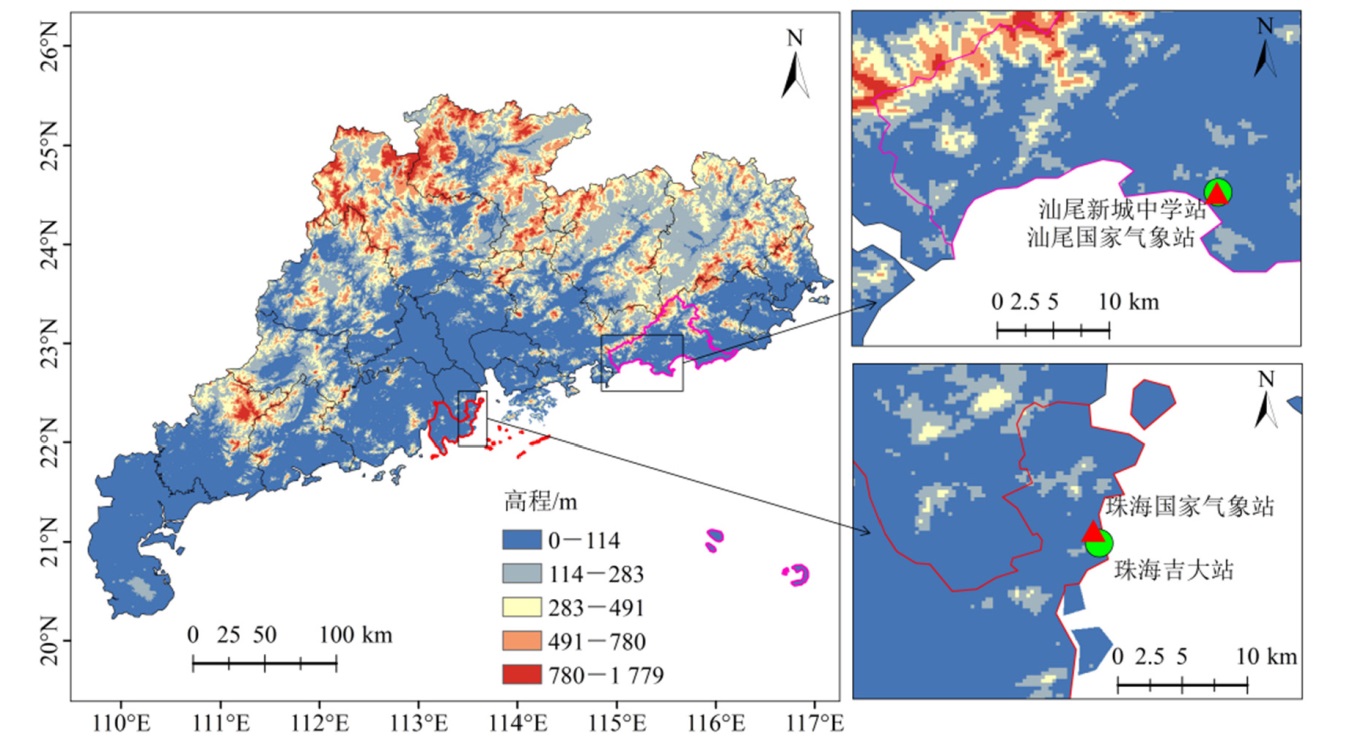
图1 珠海、汕尾站点分布图 底图来源于国家地理信息公共服务平台,审图号为GS(2024)0650号;底图边界无修改
Figure 1 Distribution map of stations in Zhuhai and Shanwei
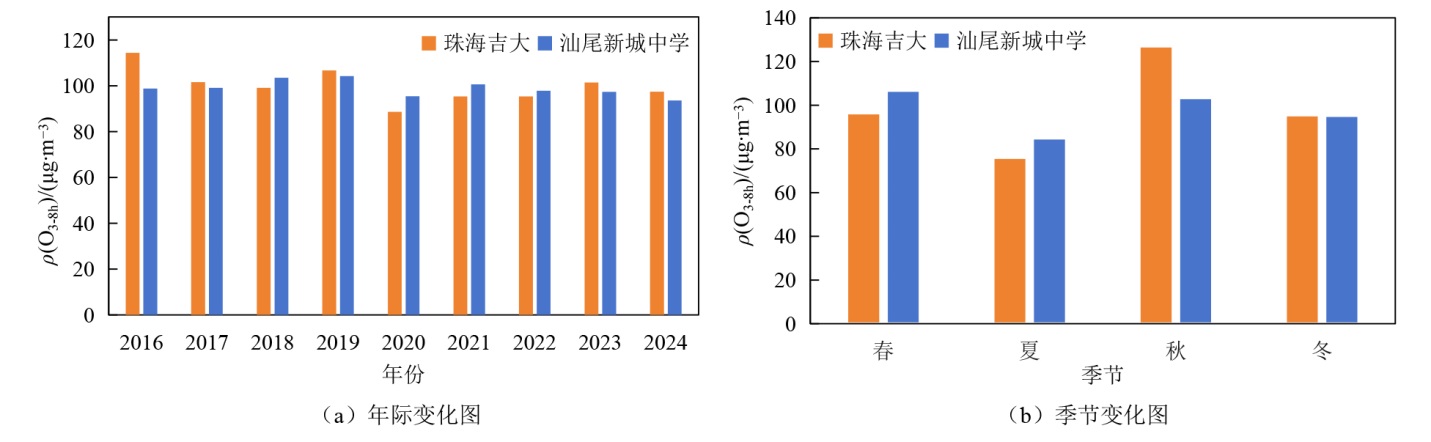
图2 2016-2024年不同站点O3-8h质量浓度年际变化与季节变化图
Figure 2 Inter-annual and seasonal variations in O3-8h mass concentration at different stations from 2016 to 2024
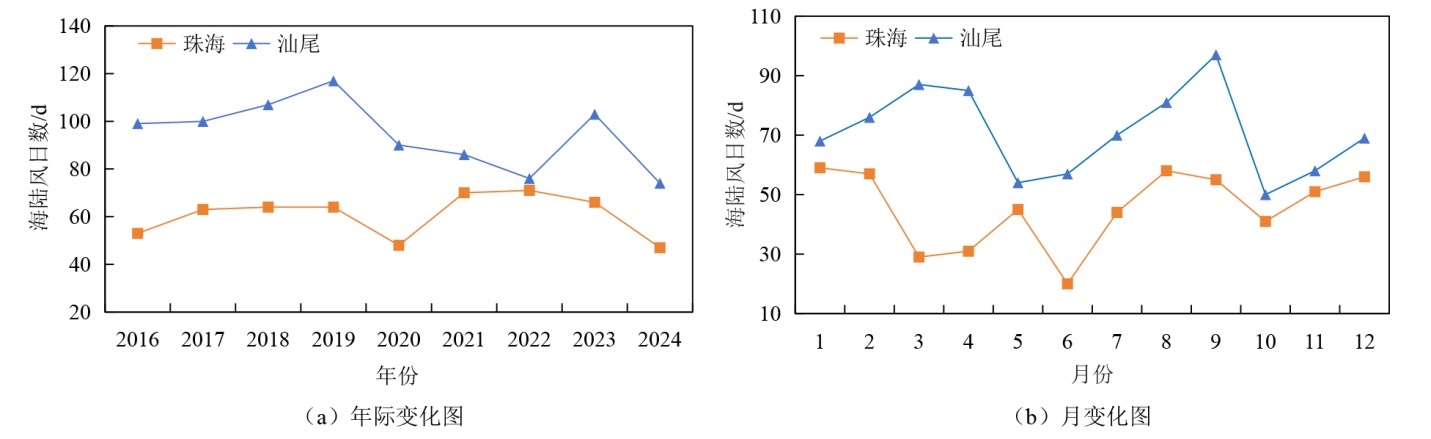
图3 2016-2024年不同站点海陆风日的年际变化与月变化曲线图
Figure 3 Annual and monthly variation curve of SLB days at different stations from 2016 to 2024
| 城市 | 条件 | 春 | 夏 | 秋 | 冬 |
|---|---|---|---|---|---|
| 珠海 | 有海陆风 | 67.7 | 60 | 96.8 | 77.5 |
| 无海陆风 | 49.7 | 11.4 | 64.9 | 30.5 | |
| 汕尾 | 有海陆风 | 59.2 | 17.9 | 70.2 | 66.7 |
| 无海陆风 | 57.7 | 13.1 | 50.4 | 31.2 |
表1 珠海、汕尾O3-8h超标率统计
Table 1 O3-8h Exceedance Rate Statistics for Zhuhai and Shanwei %
| 城市 | 条件 | 春 | 夏 | 秋 | 冬 |
|---|---|---|---|---|---|
| 珠海 | 有海陆风 | 67.7 | 60 | 96.8 | 77.5 |
| 无海陆风 | 49.7 | 11.4 | 64.9 | 30.5 | |
| 汕尾 | 有海陆风 | 59.2 | 17.9 | 70.2 | 66.7 |
| 无海陆风 | 57.7 | 13.1 | 50.4 | 31.2 |
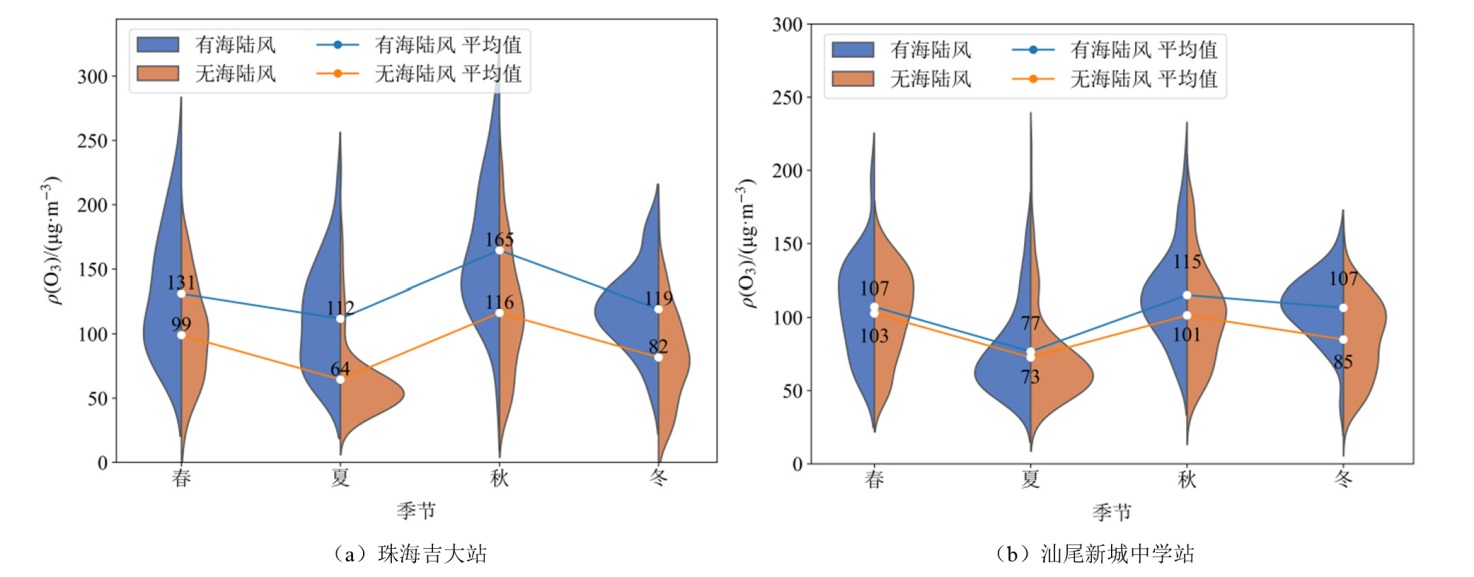
图4 不同站点在海陆风日与无海陆风日的O3质量浓度分布季节变化
Figure 4 Seasonal variation of O3 mass concentration distribution of different stations in SLB day and non-SLB day
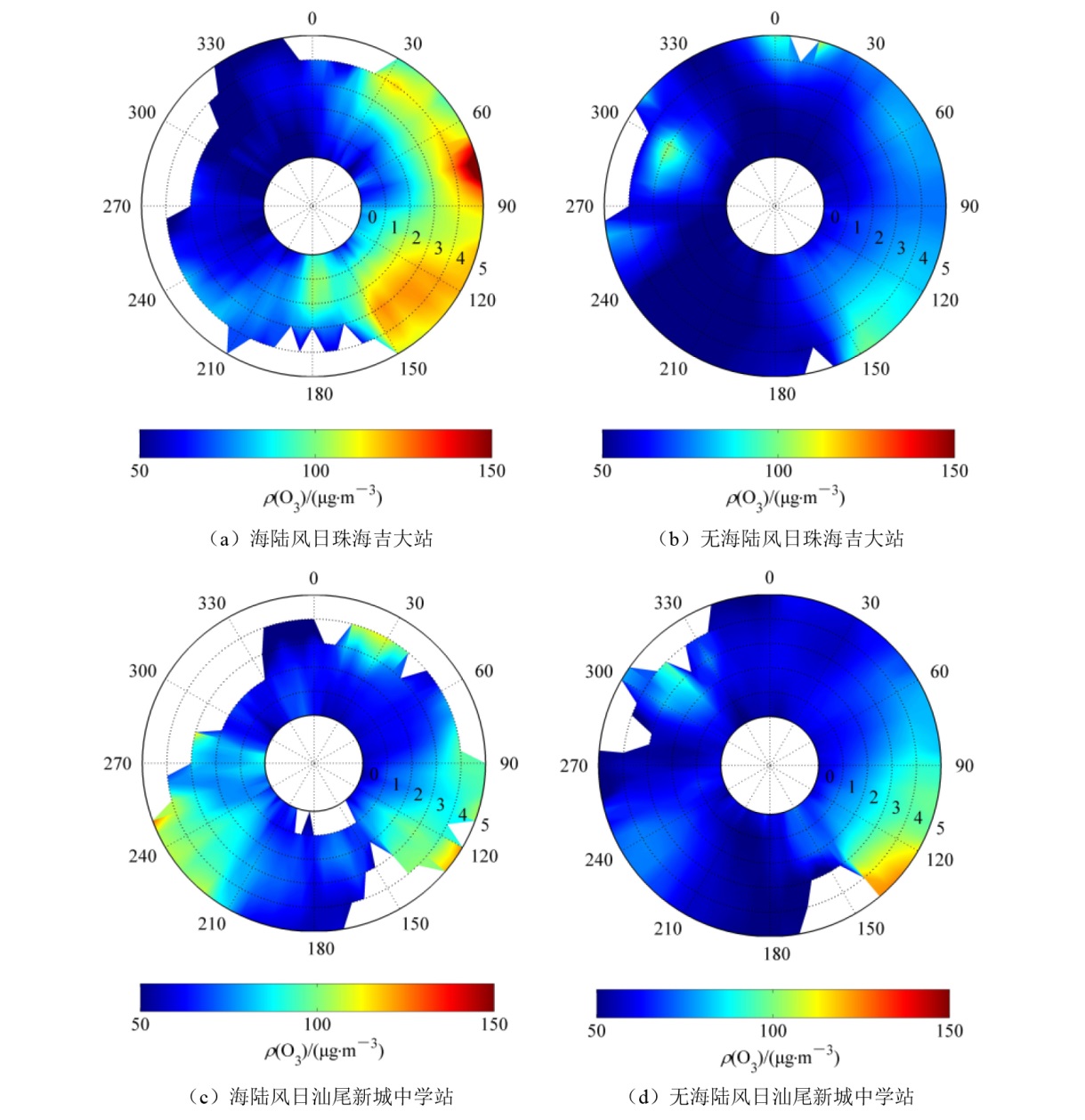
图5 2022-2023年不同站点有无海陆风时O3质量浓度风玫瑰图
Figure 5 Wind rose diagram of O3 mass concentration at different stations with and without SLB from 2022 to 2023
| 污染过程 | 日平均 气温/℃ | 平均最高气温/℃ | 相对湿度/ % | 平均风速/ (m·s−1) | ρ(O3-8h)/ (µg·m−3) |
|---|---|---|---|---|---|
| 海陆风日 | 21.0 | 24.9 | 68.5 | 1.6 | 167.2 |
| 无海陆风日 | 20.5 | 23.4 | 59.0 | 2.8 | 160.0 |
表2 珠海典型污染过程期间有无海陆风日主要气象要素比较
Table 2 Comparison of the main meteorological elements in SLB days and non-SLB day during the typical pollution process in Zhuhai
| 污染过程 | 日平均 气温/℃ | 平均最高气温/℃ | 相对湿度/ % | 平均风速/ (m·s−1) | ρ(O3-8h)/ (µg·m−3) |
|---|---|---|---|---|---|
| 海陆风日 | 21.0 | 24.9 | 68.5 | 1.6 | 167.2 |
| 无海陆风日 | 20.5 | 23.4 | 59.0 | 2.8 | 160.0 |
| 污染过程 | 日平均 气温/℃ | 平均最高气温/℃ | 相对湿度/ % | 平均风速/ (m·s−1) | ρ(O3-8h)/ (µg·m−3) |
|---|---|---|---|---|---|
| 海陆风日 | 20.3 | 26.1 | 71.0 | 1.3 | 128.2 |
| 无海陆风日 | 20.0 | 25.0 | 56.8 | 2.2 | 119.5 |
表3 汕尾典型污染过程期间有无海陆风日主要气象要素比较
Table 3 Comparison of the main meteorological elements in SLB day and non-SLB day during the typical pollution process in Shanwei
| 污染过程 | 日平均 气温/℃ | 平均最高气温/℃ | 相对湿度/ % | 平均风速/ (m·s−1) | ρ(O3-8h)/ (µg·m−3) |
|---|---|---|---|---|---|
| 海陆风日 | 20.3 | 26.1 | 71.0 | 1.3 | 128.2 |
| 无海陆风日 | 20.0 | 25.0 | 56.8 | 2.2 | 119.5 |
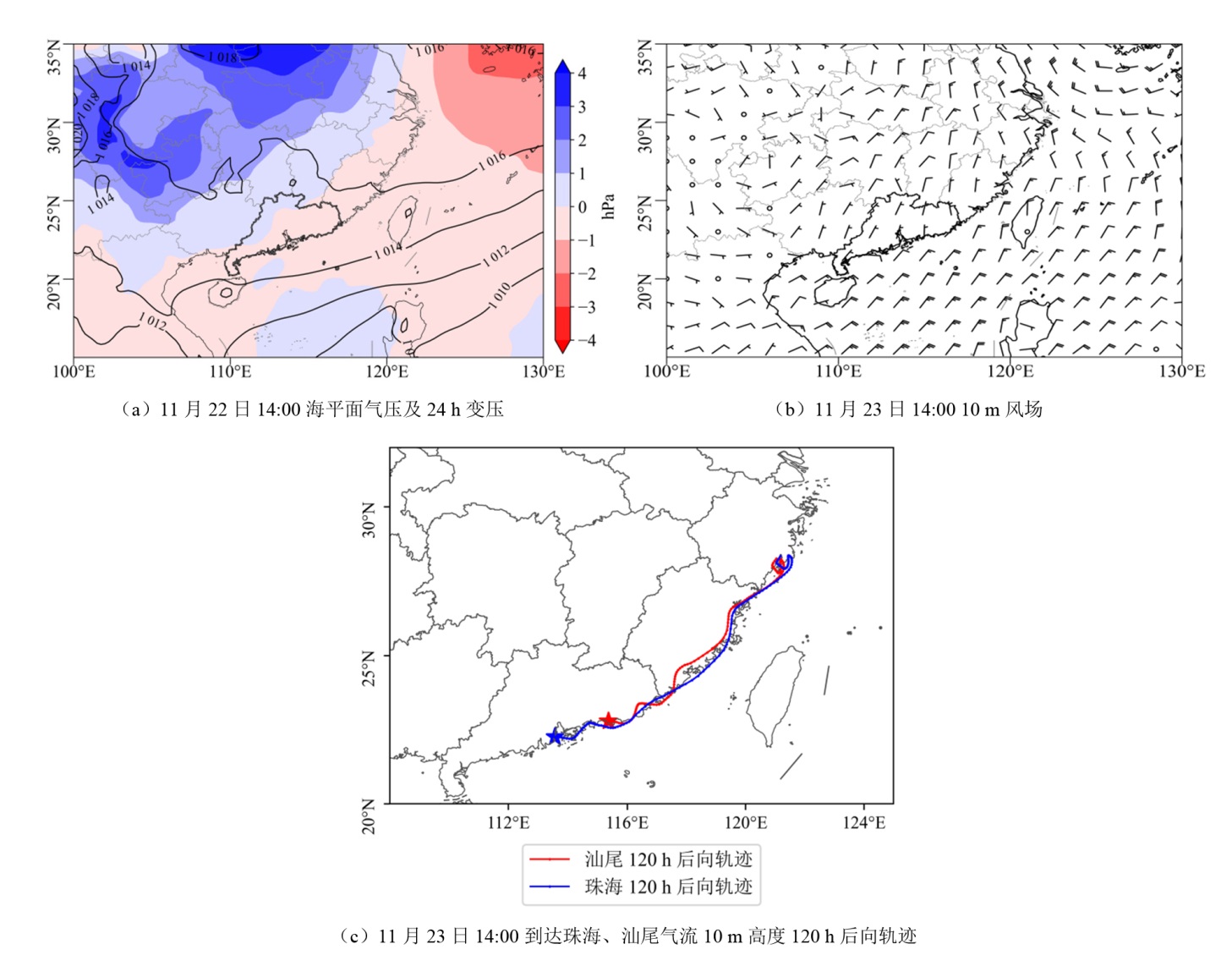
图6 2023年11月22-23日天气形势和后向轨迹分析 底图来源:国家地理信息公共服务平台;审图号:GS(2024)0650号,底图边界无修改
Figure 6 Synoptic circulation and backward trajectory analysis on November 22 and 23, 2023
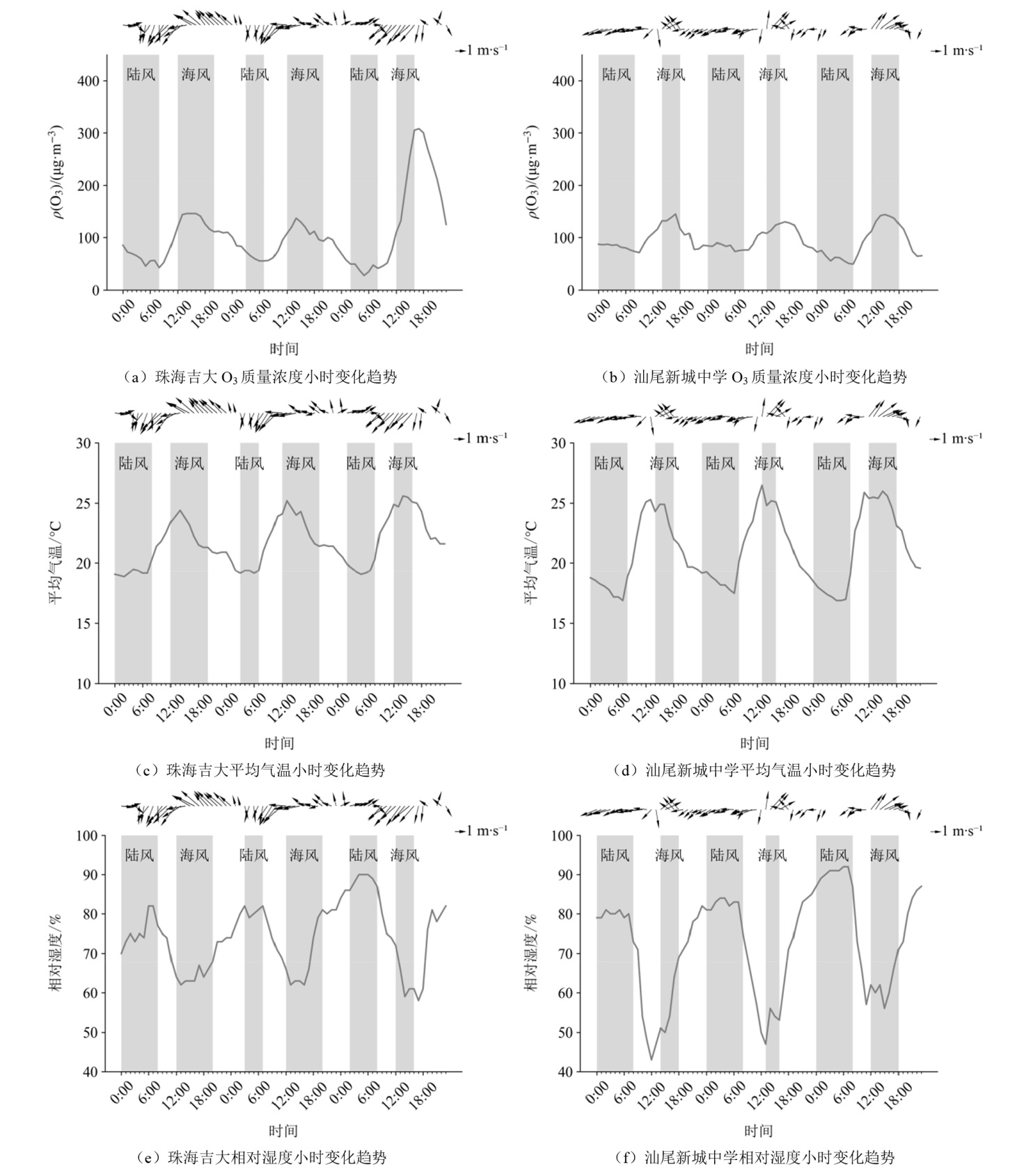
图7 11月21-23日不同站点在海风和陆风场景下O3质量浓度、气象要素小时变化趋势
Figure 7 Hourly variation trends of O3 mass concentration and meteorological elements under sea-breeze and land-breeze scenarios at different stations from November 21 to 23
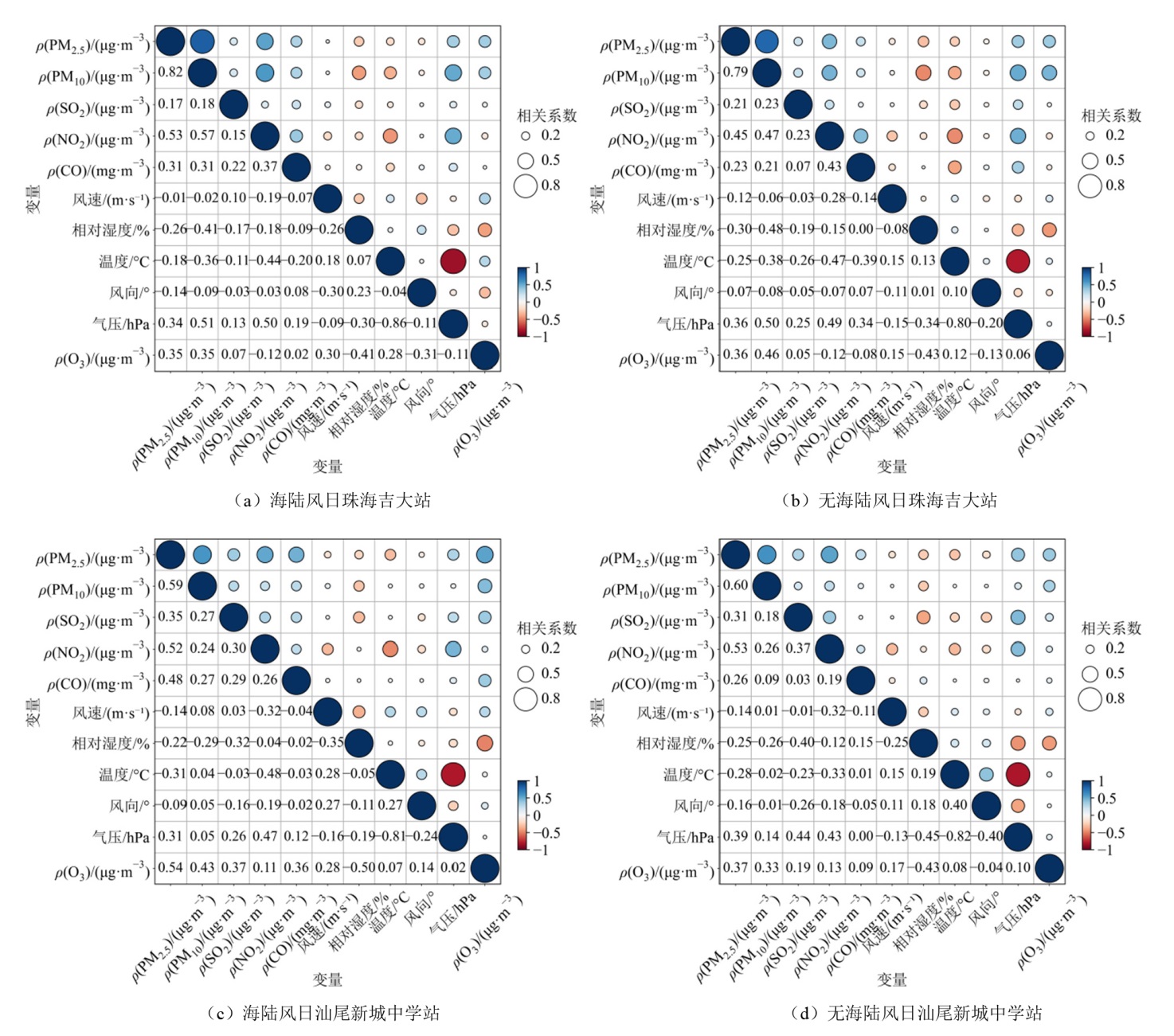
图8 有无海陆风场景下不同站点相关性热力图
Figure 8 Correlation heat map of different stations under the scenario with and without SLB
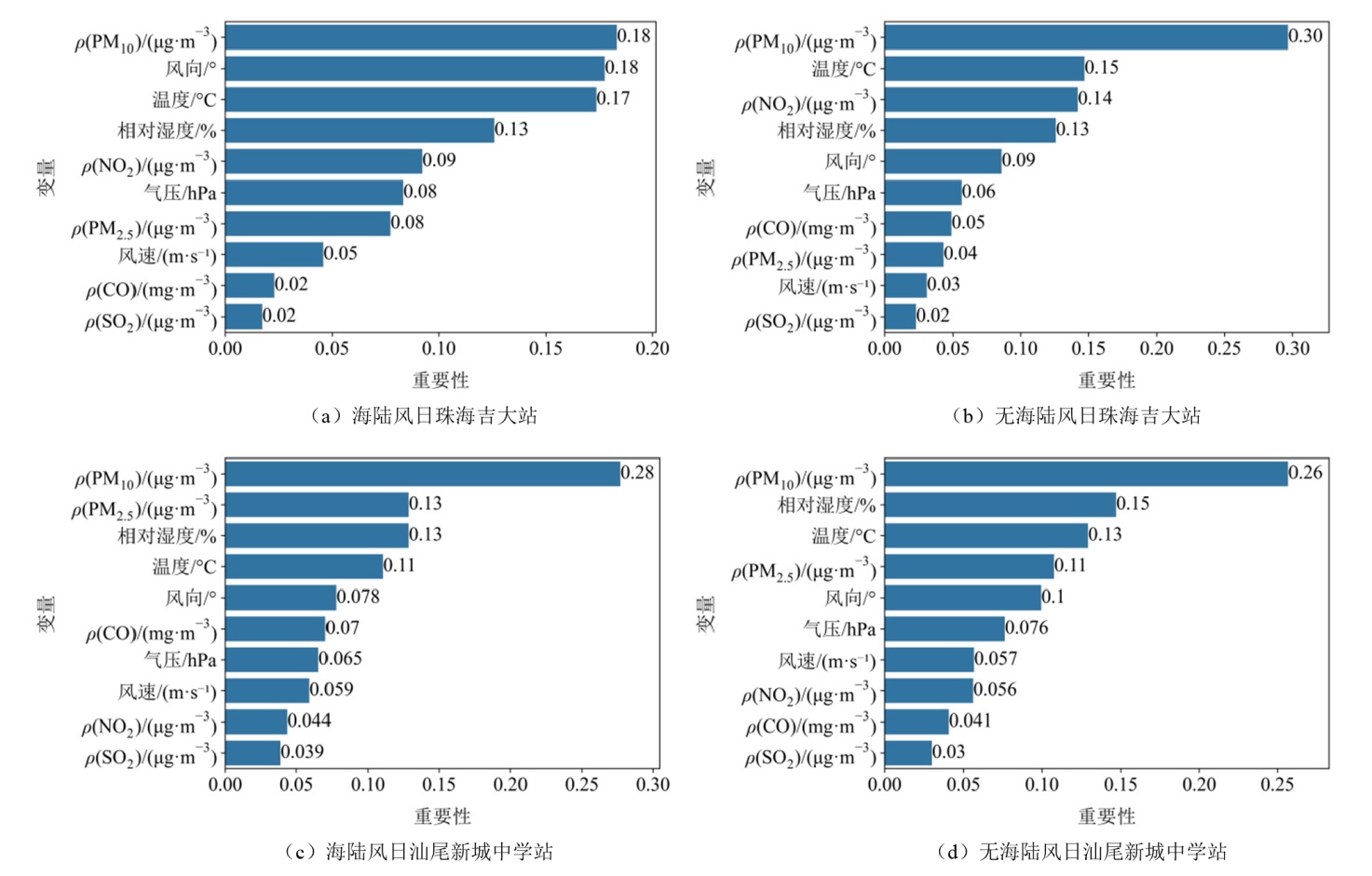
图9 有无海陆风场景下不同站点变量重要性图
Figure 9 Variable importance map of different stations under the scenarios with and without SLB
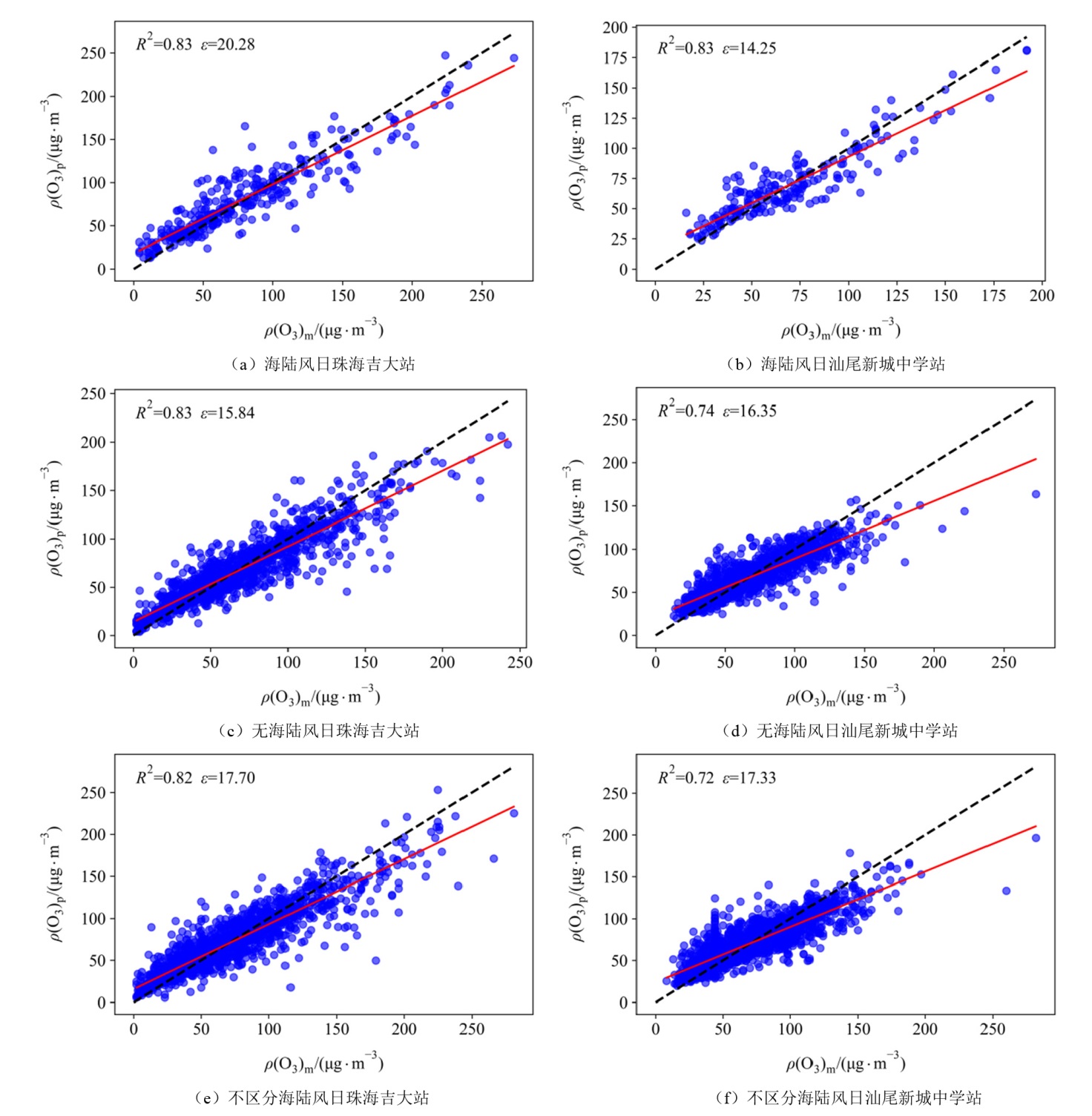
图10 不同海陆风场景不同站点O3质量浓度模型性能表现 ρ(O3)m为O3质量浓度监测值,ρ(O3)p为O3质量浓度预测值
Figure 10 Performance of O3 mass concentration models in two stations in different SLB scenarios
| 天气类型 | R2 | 均方根误差ε/(µg·m−3) | 标准化均方根误差εr |
|---|---|---|---|
| 海陆风日 | 0.83 | 20.28 | 0.13 |
| 无海陆风日 | 0.83 | 15.84 | 0.16 |
| 不区分海陆风日 | 0.82 | 17.70 | 0.16 |
表4 珠海随机森林模型拟合结果评估
Table 4 Evaluation of the prediction results of the random forest model in Zhuhai
| 天气类型 | R2 | 均方根误差ε/(µg·m−3) | 标准化均方根误差εr |
|---|---|---|---|
| 海陆风日 | 0.83 | 20.28 | 0.13 |
| 无海陆风日 | 0.83 | 15.84 | 0.16 |
| 不区分海陆风日 | 0.82 | 17.70 | 0.16 |
| 天气类型 | R2 | 均方根误差ε/(µg·m−3) | 标准化均方根误差εr |
|---|---|---|---|
| 海陆风日 | 0.83 | 14.25 | 0.12 |
| 无海陆风日 | 0.74 | 16.35 | 0.17 |
| 不区分海陆风日 | 0.72 | 17.33 | 0.17 |
表5 汕尾随机森林模型拟合结果评估
Table 5 Evaluation of the prediction results of the random forest model in Shanwei
| 天气类型 | R2 | 均方根误差ε/(µg·m−3) | 标准化均方根误差εr |
|---|---|---|---|
| 海陆风日 | 0.83 | 14.25 | 0.12 |
| 无海陆风日 | 0.74 | 16.35 | 0.17 |
| 不区分海陆风日 | 0.72 | 17.33 | 0.17 |
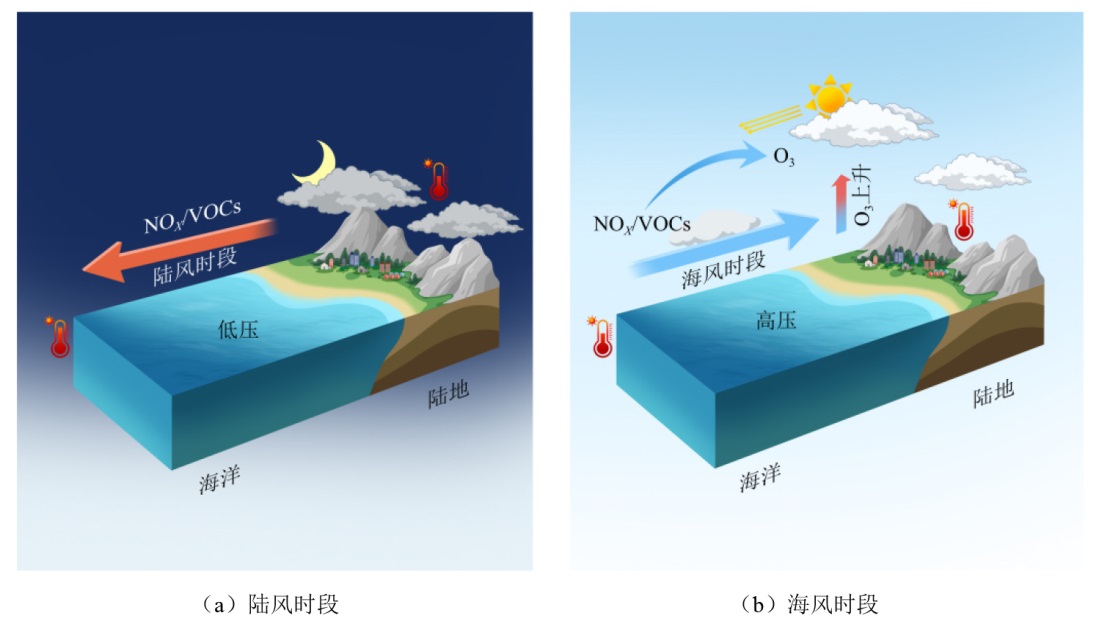
图11 海陆风对O3影响机制概念图
Figure 11 Conceptual diagram of the impact mechanism of SLB on O3
| [1] |
Hu B Y, Liu T T, Yang Y X, et al., 2019. Characteristics and formation mechanism of surface ozone in a coastal island of southeast China: Influence of sea-land breezes and regional transport[J]. Aerosol and Air Quality Research, 19(8): 1734-1748.
DOI URL |
| [2] |
Miao Y C, Liu S H, Zheng Y J, et al., 2015. Numerical study of the effects of local atmospheric circulations on a pollution event over Beijing-Tianjin-Hebei, China[J]. Journal of Environmental Sciences, 30: 9-20.
DOI PMID |
| [3] |
Shukla K, Dadheech N, Kumar P, et al., 2021. Regression-based flexible models for photochemical air pollutants in the national capital territory of megacity Delhi[J]. Chemosphere, 272(10): 129611.
DOI URL |
| [4] |
Silibello C, Carlino G, Stafoggia M, et al., 2021. Spatial- temporal prediction of ambient nitrogen dioxide and ozone levels over Italy using a random forest model for population exposure assessment[J]. Air Quality, Atmosphere and Health, 14(6): 817-829.
DOI |
| [5] | Wang H, Lyu X P, Guo H, et al., 2018. Ozone pollution around a coastal region of South China Sea: Interaction between marine and continental air[J]. Atmospheric Chemistry and Physics, 18(6): 4277-4295. |
| [6] |
Xiong K L, Xie X D, Mao J J, et al., 2023. Improving the accuracy of O3 prediction from a chemical transport model with a random forest model in the Yangtze River Delta region, China[J]. Environmental Pollution, 319: 120926.
DOI URL |
| [7] |
Yin Y Q, Shan W P, Ji X, et al., 2020. Analysis of the surface ozone during summer and autumn at a coastal site in east China[J]. Bulletin of Environmental Contamination and Toxicology, 85: 10-14.
DOI URL |
| [8] |
Zhao D D, Xin J Y, Wang W F, et al., 2022. Effects of the sea-land breeze on coastal ozone pollution in the Yangtze River Delta, China[J]. Science of The Total Environment, 807(Part 2): 150306.
DOI URL |
| [9] | 陈晶, 刘雨晨, 付晓, 2026. 陆海气团交互过程对深圳市臭氧污染的影响[J]. 中国环境科学, 46(3): 1185-1193. |
| Chen J, Liu Y C, Fu X, 2026. The impact of land-sea air mass interaction process on ozone pollution in Shenzhen[J]. China Environmental Science, 46(3): 1185-1193. | |
| [10] | 陈靖扬, 李婷苑, 邓涛, 等, 2025. 广东省不同天气形势下GRACEs模式臭氧预报检验及误差来源分析[J]. 热带气象学报, 41(3): 400-412. |
| Chen J Y, Li T Y, Deng T, et al., 2025. Ozone forecasting performance evaluation and error source analysis of GRACEs model under different synoptic patterns in Guangdong[J]. Journal of Tropical Meteorology, 41(3): 400-412. | |
| [11] | 邓雪娇, 周秀骥, 吴兑, 等, 2011. 珠江三角洲大气气溶胶对地面臭氧变化的影响[J]. 中国科学: 地球科学, 41(1): 93-102. |
|
Deng X J, Zhou X J, Wu D, et al., 2011. Effect of atmospheric aerosol on surface ozone variation over the Pearl River Delta region[J]. Science China: Earth Sciences, 41(1): 93-102.
DOI URL |
|
| [12] | 高佳琦, 苗峻峰, 许启慧, 2013. 海陆风识别方法研究进展[J]. 气象科技, 41(1): 97-102. |
| Gao J Q, Miao J F, Xu Q H, 2013. Research on progress in methods of identifying sea and land breezes[J]. Meteorological Science and Technology, 41(1): 97-102. | |
| [13] | 龚安保, 解欢, 于阳春, 等, 2024. 基于随机森林算法的山东省区域臭氧污染事件中气象条件和排放贡献影响研究[J]. 环境科学研究, 37(3): 493-501. |
| Gong A B, Xie H, Yu Y C, et al., 2024. Random forest-based analysis of meteorological condition and emission contribution to regional ozone pollution incidents in Shandong province[J]. Research of Environmental Sciences, 37(3): 493-501. | |
| [14] | 黄志新, 2011. 上海市郊春季臭氧及其前体物观测研究[J]. 环境科学与技术, 34(5): 87-89. |
| Huang Z X, 2011. Observational study of surface ozone and its precursors in the suburb of Shanghai during spring[J]. Environmental Science & Technology, 34(5): 87-89. | |
| [15] | 李婷苑, 陈靖扬, 翁佳烽, 等, 2022. 广东省臭氧污染天气型及其变化特征[J]. 中国环境科学, 42(5): 2015-2024. |
| Li T Y, Chen J Y, Weng J F, et al., 2022. Ozone pollution synoptic patterns and their variation characteristics in Guangdong Province[J]. China Environmental Science, 42(5): 2015-2024. | |
| [16] | 李婷苑, 陈靖扬, 龚宇, 等, 2023. 2022年广东省冬季一次臭氧污染过程的气象成因及潜在源区分析[J]. 环境科学, 44(7): 3695-3704. |
| Li T Y, Chen J Y, Gong Y, et al., 2023. Meteorological formation mechanisms and potential sources of an ozone pollution process in winter of 2022 in Guangdong province[J]. Environmental Science, 44(7): 3695-3704. | |
| [17] |
梁俊宁, 马启翔, 汪平, 等, 2019. 陕西省西咸新区空港新城夏季臭氧与气象因子关系分析[J]. 生态环境学报, 28(10): 2020-2026.
DOI |
| Liang J N, Ma Q X, Wang P, et al., 2019. Analysis of the relationship between ozone and meteorological factors in summer in airport new city of Xixian New Area, China[J]. Ecology and Environmental Sciences, 28(10): 2020-2026. | |
| [18] | 刘楚薇, 连鑫博, 黄建平, 2020. 我国臭氧污染时空分布及其成因研究进展[J]. 干旱气象, 38(3): 355-361. |
| Liu C W, Lian X B, Huang J P, 2020. Research review on the spatio-temporal distribution of ozone pollution and its causes in China[J]. Journal of Arid Meteorology, 38(3): 355-361. | |
| [19] | 刘蕾蕾, 聂椿力, 张梦, 等, 2021. 海陆风对广东沿海地区秋冬季污染物的影响研究[J]. 成都信息工程大学学报, 36(3): 316-322. |
| Liu L L, Nie C L, Zhang M, et al., 2021. Effects of land-sea breeze on autumn and winter pollution in some costal areas of Guangdong province[J]. Journal of Chengdu University of Information Technology, 36(3): 316-322. | |
| [20] | 刘玉, 佟磊, 何莲, 等, 2023a. 沿海天气系统对中国大气臭氧的影响研究概述[J]. 环境科学与技术, 46(S1): 26-34. |
| Liu Y, Tong L, He L, et al., 2023a. The impact of typical coastal weather systems on atmospheric ozone in China[J]. Environmental Science & Technology, 46(S1): 26-34. | |
| [21] | 刘玉, 蔡秋亮, 佟磊, 等, 2023b. 海陆风对宁波东南滨海郊区大气臭氧变化特征及预测的影响[J]. 环境科学学报, 43(4): 27-39. |
| Liu Y, Cai Q L, Tong L, et al., 2023b. Influence of sea-land breeze on the variation characteristics and prediction of ozone in the suburban coastal atmosphere of southeast Ningbo[J]. Acta Scientiae Circumstantiae, 43(4): 27-39. | |
| [22] | 麦健华, 于玲玲, 邓涛, 等, 2025. 海陆风对环珠江口地区臭氧污染的影响[J]. 中国环境科学, 45(3): 1198-1209. |
| Mai J H, Yu L L, Deng T, et al., 2025. Impact of sea-land breezes on the ozone pollution over the Pearl River Estuary[J]. China Environmental Science, 45(3): 1198-1209. | |
| [23] | 孟丽红, 李英华, 韩素芹, 等, 2019. 海陆风对天津市PM2.5和O3质量浓度的影响[J]. 环境科学研究, 32(3): 390-398. |
| Meng L H, Li Y H, Han S Q, et al., 2019. Influence of sea-land breeze on the concentrations of PM2.5 and O3 in Tianjin city[J]. Research of Environmental Sciences, 32(3): 390-398. | |
| [24] | 潘巧英, 李婷苑, 陈靖扬, 等, 2023. 广州地区臭氧污染天气条件垂直结构特征分析[J]. 气象与环境科学, 46(2): 92-100. |
| Pan Q Y, Li T Y, Chen J Y, et al., 2023. Analysis of vertical structure characteristics of ozone pollution weather conditions in Guangzhou[J]. Meteorological and Environmental Science, 46(2): 92-100. | |
| [25] | 钱冬林, 李照勇, 1991. 海陆风环流情况下的大气扩散模式[J]. 环境科学研究, 4(5): 29-33. |
| Qian D L, Li Z Y, 1991. A transport and diffusion model of atmospheric pollutants for sea and land breeze in shore line[J]. Research of Environmental Sciences, 4(5): 29-33. | |
| [26] | 邱晓媛, 范绍佳, 2013. 海陆风研究进展与我国沿海三地海陆风主要特征[J]. 气象, 39(2): 186-193. |
| Qiu X Y, Fan S J, 2013. Progress of sea-land breeze study and the characteristics of sea-land breeze in three costal areas in China[J]. Meteorology, 39(2): 186-193. | |
| [27] | 任芝花, 张志富, 孙超, 等, 2015. 全国自动气象站实时观测资料三级质量控制系统研制[J]. 气象, 41(10): 1268-1277. |
| Ren Z H, Zhang Z F, Sun C, et al., 2015. Development of three-step quality control system of real-time observation data from AWS in China[J]. Meteorological Monthly, 41(10): 1268-1277. | |
| [28] | 孙璐, 田文寿, 张文煜, 等, 2022. 上海周边地区海陆风特征及其对PM2.5和O3浓度的影响研究[J]. 环境科学学报, 42(9): 339-350. |
| Sun L, Tian W S, Zhang W Y, et al., 2022. Characteristics of sea-land breezes and their impact on PM2.5 and O3 in Shanghai and adjacent areas[J]. Acta Scientiae Circumstantiae, 42(9): 339-350. | |
| [29] | 王红丽, 2015. 上海市光化学污染期间挥发性有机物的组成特征及其对臭氧生成的影响研究[J]. 环境科学学报, 35(6): 1603-1611. |
| Wang H L, 2015. Characterization of volatile organic compounds (VOCs) and the impact on ozone formation during the photochemical smog episode in Shanghai, China[J]. Acta Scientiae Circumstantiae, 35(6): 1603-1611. | |
| [30] | 王郁聪, 裴波妮, 许瑞广, 等, 2025. 基于随机森林的臭氧污染事件分析: 以邯郸市为例[J]. 环境科学学报, 45(2): 320-333. |
| Wang Y C, Pei B N, Xu R G, et al., 2025. Analysis of ozone pollution events based on random forests: A case study of Handan City[J]. Acta Scientiae Circumstantiae, 45(2): 320-333. | |
| [31] | 魏巍, 张玉卿, 方渊, 等, 2025. 海陆风对胶东沿海城市臭氧污染的影响[J]. 环境科学研究, 38(7): 1485-1495. |
| Wei W, Zhang Y Q, Fang Y, et al., 2025. Effects of sea-land breeze on ozone pollution in Jiaodong coastal cities[J]. Research of Environmental Sciences, 38(7): 1485-1495. | |
| [32] | 辛泊达, 吕连宏, 王培, 等, 2024. 基于随机森林模型的臭氧浓度时空变化特征及关键影响因子识别: 以滁州市为例[J]. 环境科学, 45(9): 5117-5126. |
| XIn B D, Lü L H, Wang P, et al., 2024. Spatiotemporal variation characteristics of ozone and identification of key influencing factors based on random forest model: a case study of Chuzhou city[J]. Environmental Science, 45(9): 5117-5126. | |
| [33] | 杨晓彤, 康平, 王安怡, 等, 2024. 基于随机森林模型的四川盆地臭氧污染预测[J]. 环境科学, 45(5): 2507-2515. |
| Yang X T, Kang P, Wang A P, et al., 2024. Prediction of ozone pollution in Sichuan basin based on random forest model[J]. Environmental Science, 45(5): 2507-2515. | |
| [34] | 杨宇辉, 张金强, 陈洪滨, 等, 2024. 渤海湾海陆风环流及臭氧特征分析[J]. 气象研究与应用, 45(2): 8-15. |
| Yang Y H, Zhang J Q, Chen H B, et al., 2024. Characteristics analysis of sea-land breeze circulation and ozone in Bohai Bay[J]. Journal of Meteorological Research and Application, 45(2): 8-15. | |
| [35] | 俞小鼎, 2013. 短时强降水临近预报的思路与方法[J]. 暴雨灾害, 32(3): 202-209. |
| Yu X D, 2013. Nowcasting thinking and method of flash heavy rain[J]. Torrential rain and disasters, 32(3): 202-209. | |
| [36] | 张亮, 林洁萍, 邵英贤, 等, 2024. 珠海地区海陆风对臭氧污染的影响[J]. 环境科学学报, 44(1): 74-85. |
| Zhang L, Lin J P, Shao Y X, et al., 2024. Understanding the impact of sea and land breezes on ozone pollution in the Pearl River Delta[J]. Acta Scientiae Circumstantiae, 44(1): 74-85. | |
| [37] | 张远航, 郑君瑜, 陈长虹, 等, 2020. 中国大气臭氧污染防治蓝皮书 (2020年)[R]. 北京: 中国环境科学学会臭氧污染控制专业委员会. |
| Zhang Y H, Zheng J Y, Chen C H, et al., 2020. China blue book of atmospheric ozone pollution prevention and control (2020)[R]. Beijing: Professional Committee of Ozone Pollution Control, Chinese Society of Environmental Sciences. | |
| [38] | 中华人民共和国环境保护部, 2013. 国务院关于印发大气污染防治行动计划的通知[EB/OL]. (2013-9-12) [2025-10-10]. https://www.gov.cn/zwgk/2013-09/12/content_2486773.htm. |
| Ministry of Environmental Protection of the People’s Republic of China, 2013. Under the state council concerning the action plan for the control of air pollution[EB/OL]. (2013-9-12) [2025-10-10]. https://www.gov.cn/zwgk/2013-09/12/content_2486773.htm. | |
| [39] | 中华人民共和国环境保护部, 2018. 国务院关于印发打赢蓝天保卫战三年行动计划的通知[EB/OL]. (2018-7-3) [2025-10-10]. https://www.gov.cn/xinwen/2018-07/03/content_5303212.htm. |
| Ministry of Environmental Protection of the People’s Republic of China, 2018. Three-year action plan to fight air pollution[EB/OL]. (2018-7-3) [2025-10-10]. https://www.gov.cn/xinwen/2018-07/03/content_5303212.htm. | |
| [40] | 中华人民共和国环境保护部, 2012. 环境空气质量标准: GB 3095—2012[S]. 北京: 中国环境科学出版社:3. |
| Ministry of Environmental Protection of the People’s Republic of China, 2012. Ambient air quality standards: GB 3095—2012[S]. Beijing: China Environmental Science Press:3. | |
| [41] | 周士茹, 宋金妹, 陆倩, 等, 2021. 气象因子和海风对秦皇岛市臭氧污染的影响[J]. 气象与环境学报, 37(2): 64-70. |
| ZHOU S R, SONG J M, LU Q, et al., 2021. The influences of meteorological factors and sea breeze on ozone pollution in Qinhuangdao[J]. Journal of Meteorology and Environment, 37(2): 64-70. |
| [1] | 周家豪, 张沛, 彭煜文, 钟松雄, 邹建平, 侯冬梅. 基于机器学习识别赣江流域重金属污染主控因素[J]. 生态环境学报, 2026, 35(6): 976-985. |
| [2] | 张舒婷, 王明洁, 倪睿婧. 夏秋季热带气旋对珠三角O3浓度的影响[J]. 生态环境学报, 2026, 35(4): 575-585. |
| [3] | 童玮, 储晓燕, 童志鹏, 吴文骁, 吴家森. 基于生态位和随机森林的常绿落叶混交林演替规律研究[J]. 生态环境学报, 2026, 35(2): 199-208. |
| [4] | 吴璇, 余佳丽, 陈笔, 娄云剀, 何敏, 苗芃, 杨帆, 唐涛. 基于胁迫-响应关系的赤水河氮磷生态承载力研究[J]. 生态环境学报, 2026, 35(1): 134-146. |
| [5] | 吴锡言, 李维军, 卡那特, 彭玉杰. 基于随机森林和OCO-2遥感数据分析2023年中国连续时空xCO2变化特征[J]. 生态环境学报, 2025, 34(9): 1341-1350. |
| [6] | 张蔷, 李令军, 鹿海峰, 刘保献, 李琪, 王涵霖. 北京地区9种典型绿化树种的BVOCs释放及二次污染生成潜势[J]. 生态环境学报, 2025, 34(9): 1432-1441. |
| [7] | 赵文琪, 张佳华, 张鹏, 白林燕, 姚凤梅. 植被物候监测技术与遥感反演方法研究进展[J]. 生态环境学报, 2025, 34(9): 1473-1482. |
| [8] | 张晟博, 吴作航, 党皓飞, 廖廓, 陆灯盛, 李登秋. 近20年武夷山地区不同遥感指标对极端气候事件的响应及差异[J]. 生态环境学报, 2025, 34(8): 1240-1254. |
| [9] | 冯珊珊, 陶亮, 梁俊芬. 高质量发展视角下县域农业产业集聚的时空演化与驱动机制——以广东省蔬菜生产为例[J]. 生态环境学报, 2025, 34(8): 1293-1304. |
| [10] | 祁珣, 冯鑫鑫, 陈颖军, 冯艳丽, 陈田, 李军, 张干. 轻型汽油卡车尾气颗粒物中氨和有机胺的排放特征及影响因素[J]. 生态环境学报, 2025, 34(7): 997-1006. |
| [11] | 孟洁, 朱星宇, 徐明月, 荣凌云, 吴川福, 汪群慧. 腐熟牛粪沼渣对模拟含氨臭气的去除效能及建模分析研究[J]. 生态环境学报, 2025, 34(6): 922-930. |
| [12] | 张丹丹, 毋振海, 吴渴, 毕方, 李云凤, 安聪, 韩翼昕, 刘正阳, 朱玲, 王学中. 基于不同类型臭氧污染日的臭氧污染特征及影响因素分析:以亳州市为例[J]. 生态环境学报, 2025, 34(5): 720-730. |
| [13] | 陈鹏, 马育军, 张梦雅, 陈婉婷, 江晓鹏. 基于kNDVI的广东省植被动态变化分析[J]. 生态环境学报, 2025, 34(4): 499-510. |
| [14] | 陈思宇, 孙丽娟, 苏枞枞, 于兴娜. 太原市春夏季VOCs组成特征及其对二次有机气溶胶和臭氧的贡献[J]. 生态环境学报, 2025, 34(4): 548-555. |
| [15] | 王恭斌, 花利忠, 卢璇, 李琳, 章欣欣, 李兰晖. 基于遥感与机器学习的中国城市夏季热岛气候带分异特征(2003-2022年)及其驱动因子分析[J]. 生态环境学报, 2025, 34(10): 1609-1617. |
| 阅读次数 | ||||||
|
全文 |
|
|||||
|
摘要 |
|
|||||
