
生态环境学报 ›› 2026, Vol. 35 ›› Issue (1): 75-87.DOI: 10.16258/j.cnki.1674-5906.2026.01.007
范强( ), 相梦雪*(), 张兵, 王丽芳
收稿日期:2025-04-26
修回日期:2025-10-07
接受日期:2025-10-28
出版日期:2026-01-18
发布日期:2026-01-05
通讯作者:
* E-mail: 作者简介:范强(1979年生),男(满族),副教授,博士,研究方向为遥感图像处理及专题地理信息系统。E-mail: lntufanqiang@126.com
基金资助:
FAN Qiang(), XIANG Mengxue*(), ZHANG Bing, WANG Lifang
Received:2025-04-26
Revised:2025-10-07
Accepted:2025-10-28
Online:2026-01-18
Published:2026-01-05
摘要:
地表温度(LST)作为衡量城市热环境的关键指标,其时空分异特征与驱动机制已成为当前研究的前沿方向。传统线性模型在解析热环境系统的非线性动力学特征时存在局限性,而LightGBM模型结合Shapley加性解释(SHAP)的可解释性算法为揭示复杂驱动机制提供了新方法。该研究针对现有研究中“源-汇”尺度景观效应量化与季节动态机制解析的不足,创新性地构建了以局地气候区为依托的“季节-源汇”二维分析框架。以济南市主城区为研究区,融合多源遥感数据与地理空间数据,深入探究了城市空间形态、自然环境要素及人类活动对LST的耦合影响机制,量化分析了9类驱动因子在四季“源-汇”景观中对LST的贡献度,发现自然环境因素在城市热环境调控中占据主导地位,数字高程、归一化植被指数和改进归一化水体指数是关键调控因子。城市空间形态对LST的影响虽小于自然环境因素,但建筑容积率、天空开阔度和建筑覆盖率等因素仍具有显著作用。人类活动对LST的影响相对较小,但兴趣点数据和道路密度在局部区域仍存在一定的影响。这些发现为不同季节和源汇区域的差异化规划提供了战略性建议,为城市热环境管理提供了科学依据。应充分利用自然环境资源,合理规划建筑布局,以优化城市热环境,提升城市生态宜居性。
中图分类号:
范强, 相梦雪, 张兵, 王丽芳. 基于“季节-源汇”下的济南市主城区热环境驱动因素分析[J]. 生态环境学报, 2026, 35(1): 75-87.
FAN Qiang, XIANG Mengxue, ZHANG Bing, WANG Lifang. Based on the Analysis of the Driving Factors of Thermal Environment in the Main Urban Area of Ji’nan City under the “Seasonal-Source-Sink” Situation[J]. Ecology and Environmental Sciences, 2026, 35(1): 75-87.
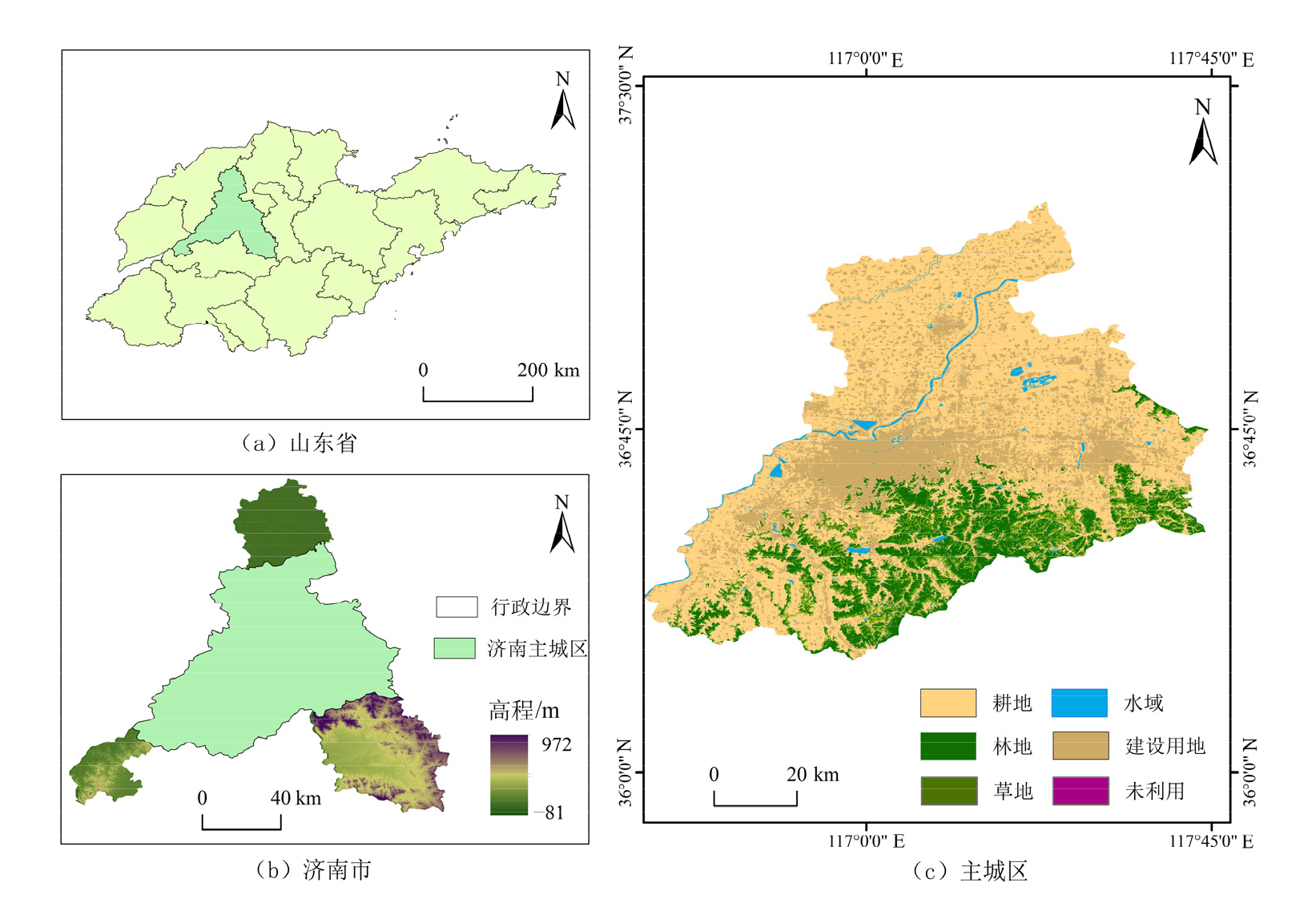
图1 研究区示意图 底图采用自然资源部标准地图制作,审图号为GS(2024)0650号,对底图边界无修改
Figure 1 The studied area
| 数据名称 | 时间 | 数据来源 | 用途 |
|---|---|---|---|
| 边界矢量数据 | 2022年 | https://www.ngcc.cn | 精确界定地理边界 |
| Landsat 8 | 2022-1-9(冬)、2022-4-20(春)、 2022-7-4(夏)、2022-9-19(秋) | https://earthexplorer.usgs.gov/ | 反演地表温度以及计算NDVI、MNDWI |
| 主城区道路数据 | 2022年 | https://www.openstreetmap.org/ | 获取ROAD数据 |
| 主城区建筑数据 | 2022年 | 高德 | 计算BCR、MBH、FAR及SVF |
| 主城区高程数据 | 2022年 | https://www.gscloud.cn/ | 获取DEM数据 |
| 主城区兴趣点数据 | 2022年 | https://www.openstreetmap.org/ | 获取POI数据 |
表1 数据来源及用途统计
Table 1 Statistics of data sources and purposes
| 数据名称 | 时间 | 数据来源 | 用途 |
|---|---|---|---|
| 边界矢量数据 | 2022年 | https://www.ngcc.cn | 精确界定地理边界 |
| Landsat 8 | 2022-1-9(冬)、2022-4-20(春)、 2022-7-4(夏)、2022-9-19(秋) | https://earthexplorer.usgs.gov/ | 反演地表温度以及计算NDVI、MNDWI |
| 主城区道路数据 | 2022年 | https://www.openstreetmap.org/ | 获取ROAD数据 |
| 主城区建筑数据 | 2022年 | 高德 | 计算BCR、MBH、FAR及SVF |
| 主城区高程数据 | 2022年 | https://www.gscloud.cn/ | 获取DEM数据 |
| 主城区兴趣点数据 | 2022年 | https://www.openstreetmap.org/ | 获取POI数据 |
| 研究区域 | 相关维度 | 因子 | 文献 |
|---|---|---|---|
| 天津市 | 自然环境 | NDVI、NDBI、MNDWI、DEM | 国巧真等, |
| 合肥市主城区 | 自然环境 | NDBI、NDVI、MNDWI | 王爱等, |
| 城市空间形态 | FAR、BH、BD、SVF | ||
| 人类活动 | DP、NP | ||
| 西安市主城区 | 景观格局 | PD、LSI、SHDI、CONTAG | Chen et al., |
| 城市空间形态 | MAH、BD、FAR | ||
| 人类活动 | POD、NL | ||
| 西安市 | 自然环境 | NDVI、MNDWI、VD | 李明哲等, |
| 城市空间形态 | BD | ||
| 人类活动 | PD、POI | ||
| 长沙市 | 自然环境 | FVC、MNDWI、DEM、CONTAG、SHDI、DIVISION、NDISI、NDBBI、Albedo | 熊鹰等, |
| 人类活动 | POI |
表2 热环境驱动因素选取相关文献
Table 2 Relevant literature on selection of driving factors for thermal environment
| 研究区域 | 相关维度 | 因子 | 文献 |
|---|---|---|---|
| 天津市 | 自然环境 | NDVI、NDBI、MNDWI、DEM | 国巧真等, |
| 合肥市主城区 | 自然环境 | NDBI、NDVI、MNDWI | 王爱等, |
| 城市空间形态 | FAR、BH、BD、SVF | ||
| 人类活动 | DP、NP | ||
| 西安市主城区 | 景观格局 | PD、LSI、SHDI、CONTAG | Chen et al., |
| 城市空间形态 | MAH、BD、FAR | ||
| 人类活动 | POD、NL | ||
| 西安市 | 自然环境 | NDVI、MNDWI、VD | 李明哲等, |
| 城市空间形态 | BD | ||
| 人类活动 | PD、POI | ||
| 长沙市 | 自然环境 | FVC、MNDWI、DEM、CONTAG、SHDI、DIVISION、NDISI、NDBBI、Albedo | 熊鹰等, |
| 人类活动 | POI |

图2 研究流程图
Figure 2 Flow chart of the study
| 建筑类型 | 土地覆盖类型 | ||
|---|---|---|---|
| 分类 | 类型 | 分类 | 类型 |
| LCZ1 | 紧凑型高层建筑 | LCZ11 | 稠密树木 |
| LCZ2 | 紧凑型中高层建筑 | LCZ12 | 稀疏树木 |
| LCZ3 | 紧凑型低层建筑 | LCZ13 | 灌木丛 |
| LCZ4 | 开敞式高层建筑 | LCZ14 | 低矮植被 |
| LCZ5 | 开敞式中高层建筑 | LCZ15 | 硬化地面 |
| LCZ6 | 开敞式低层建筑 | LCZ16 | 裸地泥沙 |
| LCZ7 | 轻质建筑 | LCZ17 | 水体 |
| LCZ8 | 大型低层建筑 | ||
| LCZ9 | 稀疏建筑 | ||
| LCZ10 | 重工业区 | ||
表3 局地气候区类型定义
Table 3 Definitions of local climate zones
| 建筑类型 | 土地覆盖类型 | ||
|---|---|---|---|
| 分类 | 类型 | 分类 | 类型 |
| LCZ1 | 紧凑型高层建筑 | LCZ11 | 稠密树木 |
| LCZ2 | 紧凑型中高层建筑 | LCZ12 | 稀疏树木 |
| LCZ3 | 紧凑型低层建筑 | LCZ13 | 灌木丛 |
| LCZ4 | 开敞式高层建筑 | LCZ14 | 低矮植被 |
| LCZ5 | 开敞式中高层建筑 | LCZ15 | 硬化地面 |
| LCZ6 | 开敞式低层建筑 | LCZ16 | 裸地泥沙 |
| LCZ7 | 轻质建筑 | LCZ17 | 水体 |
| LCZ8 | 大型低层建筑 | ||
| LCZ9 | 稀疏建筑 | ||
| LCZ10 | 重工业区 | ||
| LST等级 | 分级标准 |
|---|---|
| 高温区 | ts≥tmean+2Sd |
| 次高温区 | tmean+0.05Sd£ts<tmean+2Sd |
| 中温区 | tmean−0.05Sd£ts<tmean+0.05Sd |
| 次低温区 | tmean−2Sd£ts<tmean−0.05Sd |
| 低温区 | ts<tmean−2Sd |
表4 地表温度等级划分
Table 4 Land surface temperature classification
| LST等级 | 分级标准 |
|---|---|
| 高温区 | ts≥tmean+2Sd |
| 次高温区 | tmean+0.05Sd£ts<tmean+2Sd |
| 中温区 | tmean−0.05Sd£ts<tmean+0.05Sd |
| 次低温区 | tmean−2Sd£ts<tmean−0.05Sd |
| 低温区 | ts<tmean−2Sd |
| 因子 | VIF值 | 因子 | VIF值 |
|---|---|---|---|
| BCR | 2.1 | MNDWI | 1.8 |
| MBH | 3.8 | DEM | 1.2 |
| FAR | 4.2 | SPOI | 1.4 |
| SVF | 1.5 | ROAD | 2.0 |
| NDVI | 2.3 |
表5 驱动因子VIF值
Table 5 Variance inflation factor value of driving factors
| 因子 | VIF值 | 因子 | VIF值 |
|---|---|---|---|
| BCR | 2.1 | MNDWI | 1.8 |
| MBH | 3.8 | DEM | 1.2 |
| FAR | 4.2 | SPOI | 1.4 |
| SVF | 1.5 | ROAD | 2.0 |
| NDVI | 2.3 |

图3 局地气候区空间分布
Figure 3 Spatial distribution of LCZs
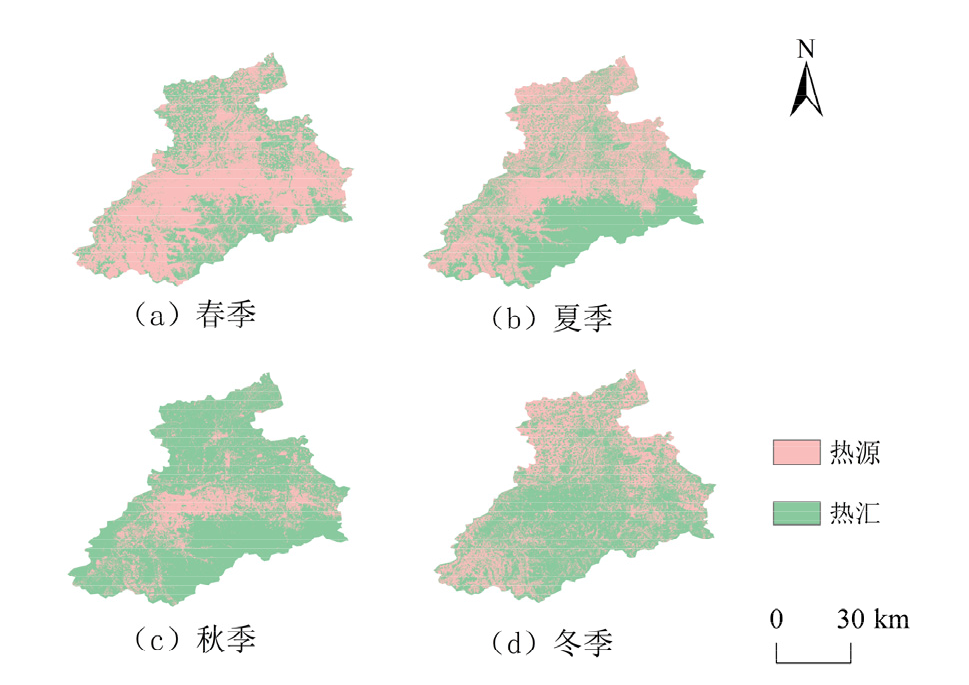
图4 “源-汇”景观空间分布
Figure 4 Spatial distribution of source-sink landscape

图5 驱动因子空间分布特征图
Figure 5 Spatial distribution characteristics of driving factors
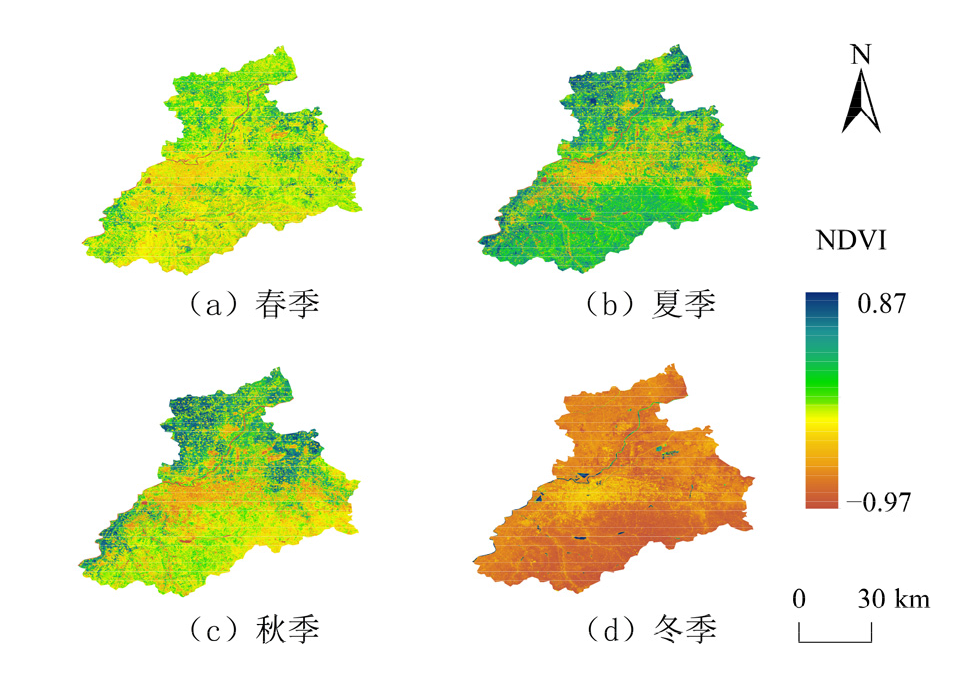
图6 四季NDVI分布
Figure 6 Distribution of NDVI in four seasons

图7 特征贡献排名
Figure 7 Feature contribution ranking
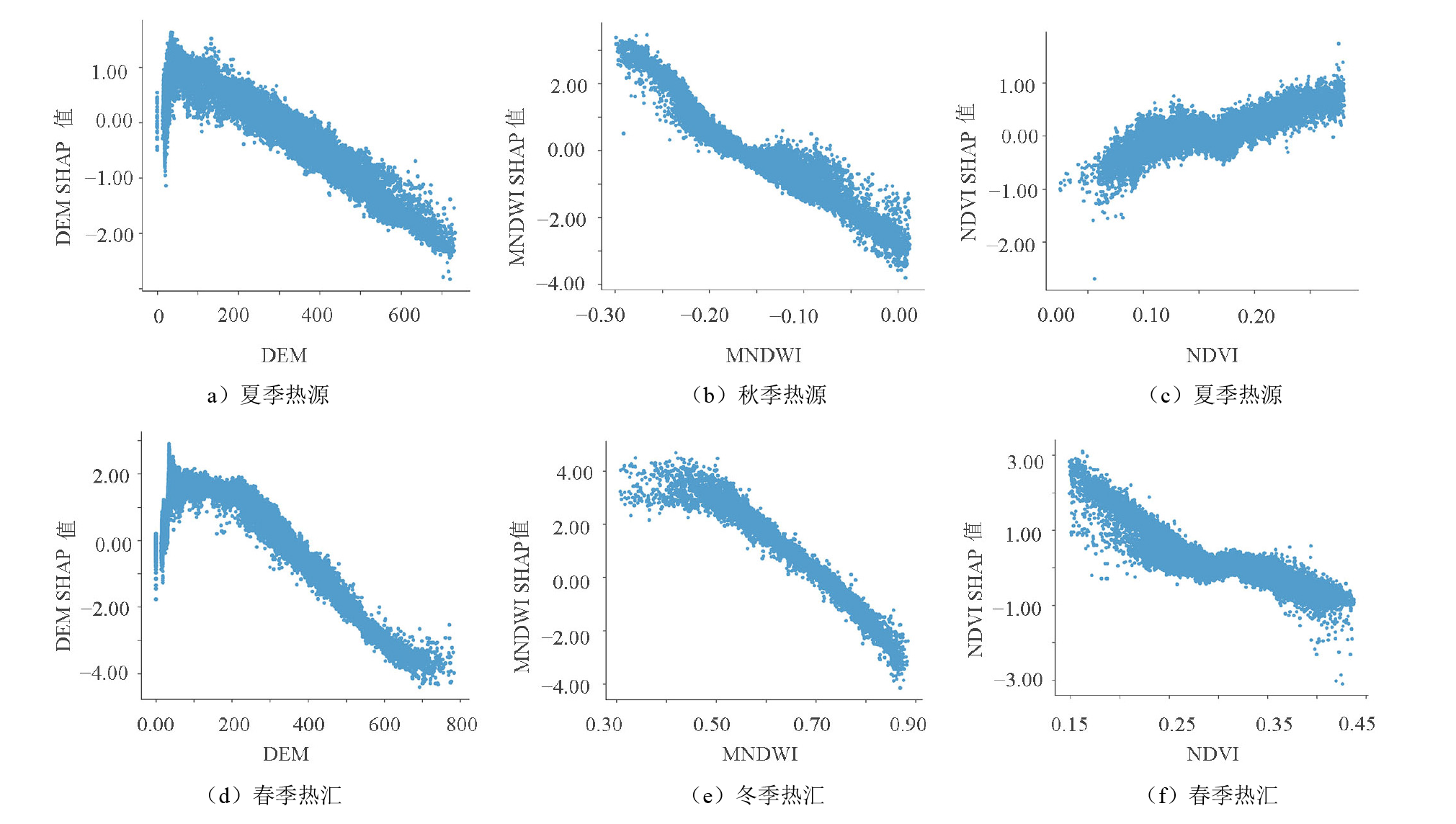
图8 自然环境单因子作用图
Figure 8 Single-factor action map of the natural environment

图9 城市空间形态单因子作用结果图
Figure 9 Single-factor effect diagram of urban spatial morphology
| [1] |
AMANI-BENI M, ZHANG B, XIE G D, et al., 2019. Impacts of urban green landscape patterns on land surface temperature: evidence from the adjacent area of Olympic Forest Park of Beijing, China[J]. Sustainability, 11(2): 513.
DOI URL |
| [2] |
BECHTEL B, ALEXANDER P J, BÖHNER J, et al., 2015. Mapping local climate zones for a worldwide database of the form and function of cities[J]. ISPRS International Journal of Geo-Information, 4(1): 199-219.
DOI URL |
| [3] |
CHEN Y, YANG J, YU W B, et al., 2023. Relationship between urban spatial form and seasonal land surface temperature under different grid scales[J]. Sustainable Cities and Society, 89: 104374.
DOI URL |
| [4] |
DEMUZERE M, KITTNER J, BECHTEL B, 2021. LCZ Generator: A web application to create local climate zone maps[J]. Frontiers in Environmental Science, 9: 637455.
DOI URL |
| [5] |
KUMAR S V S, KONDAVEETI H K, 2024. Towards transparency in AI: Explainable bird species image classification for ecological research[J]. Ecological Indicators, 169: 112886.
DOI URL |
| [6] | LI C, ZHAO J, HOU W, 2023. Nonlinear effects of landscape patterns on ecosystem services at multiple scales based on gradient boosting decision tree models[J]. Remote Sensing, 15(7): 15071919. |
| [7] |
LI W F, CAO Q W, LANG K, et al., 2017. Linking potential heat source and sink to urban heat island: Heterogeneous effects of landscape pattern on land surface temperature[J]. Science of the Total Environment, 586: 457-465.
DOI URL |
| [8] |
LI Y F, SCHUBERT S, JÜRGEN P KROPP, et al., 2020. On the influence of density and morphology on the Urban Heat Island intensity[J]. Nature Communications, 11: 2647.
DOI PMID |
| [9] |
LIANG Z, HUANG J, WANG Y Y, et al., 2021. The mediating effect of air pollution in the Impacts of urban form on nighttime urban heat island intensity[J]. Sustainable Cities and Society, 74: 102985.
DOI URL |
| [10] |
LU L L, PENG F, DEWAN A, et al., 2023. Contrasting determinants of land surface temperature in three megacities: Implications to cool tropical metropolitan regions[J]. Sustainable Cities and Society, 92: 104505.
DOI URL |
| [11] |
LUO P Y, YU B J, LI P F, et al., 2023. How 2D and 3D built environments impact urban surface temperature under extreme heat: A study in Chengdu, China[J]. Building and Environment, 231: 110035.
DOI URL |
| [12] |
NIU J B, CHEN J K, ZANG Y F, et al., 2025. Deciphering the roles of 2-D and 3-D urban landscape metrics in diurnal surface thermal environment along urban gradients[J]. IEEE Journal of Selected Topics in Applied Earth Observations and Remote Sensing, 17: 16449-16466.
DOI URL |
| [13] |
NIU L, TANG R L, JIANG Y Z, et al., 2020. Spatiotemporal patterns and drivers of the surface urban heat island in 36 major cities in China: a comparison of two different methods for delineating rural areas[J]. Sustainability, 12(2): 478.
DOI URL |
| [14] |
OUYANG N L, RUI X P, ZHANG X P, et al., 2024. Spatiotemporal evolution of ecosystem health and its driving factors in the southwestern karst regions of China[J]. Ecological Indicators, 166: 112530.
DOI URL |
| [15] | WANGHE K H, GUO X L, WANG M, et al., 2020. Gravity model toolbox: An automated and open-source ArcGIS tool to build and prioritize ecological corridors in urban landscapes[J]. Global Ecology and Conservation, 22: e01012. |
| [16] |
YANG C B, YAN F Q, LEI X, et al., 2020. Investigating Seasonal effects of dominant driving factors on urban land surface temperature in a Snow-Climate city in China[J]. Remote Sensing, 12: 3006.
DOI URL |
| [17] |
YANG F, YOUSEFPOUR R, ZHANG, et al., 2023. The assessment of cooling capacity of blue-green spaces in rapidly developing cities: a case study of Tianjin’s central urban area, Sustain[J]. Sustainable Cities and Society, 99: 104918.
DOI URL |
| [18] |
YIN H Y, XIAO R, FEI X F, et al., 2023. Analyzing “Economy-Society-Environment” sustainability from the perspective of urban spatial structure: A case study of the Yangtze River Delta Urban Agglomeration[J]. Sustainable Cities and Society, 96: 104691.
DOI URL |
| [19] |
YOO C, HAN D, IM J, et al., 2019. Comparison between convolutional neural networks and random forest for local climate zone classification in mega urban areas using Landsat images[J]. ISPRS Journal of Photogrammetry and Remote Sensing, 157: 155-170.
DOI URL |
| [20] | 白龙发, 李保珠, 时鹏程, 2024. 基于EO-LightGBM融合模型的边坡稳定性预测方法研究[J]. 地质灾害与环境保护, 35(4): 105-111. |
| BAI L F, LI B Z, SHI P C, 2024. Study on slope stability prediction method based on EO-LightGBM fusion model[J]. Journal of Geological Hazards and Environment Preservation, 35(4): 105-111. | |
| [21] | 蔡智, 韩贵锋, 2018. 山地城市空间形态的地表热环境效应: 基于LCZ的视角[J]. 山地学报, 36(4): 617-627. |
| CAI Z, HAN G F, 2018. Assessing land surface temperature in the mountain city with different urban spatial form based on local climate zone scheme[J]. Mountain Research, 36(4): 617-627. | |
| [22] | 国巧真, 闫兵, 杨光, 等, 2024. 天津市热环境时空演变及影响因素分析[J]. 地球环境学报, 15(1): 129-139. |
| GUO Q Z, YAN B, YANG G, et al., 2024. Spatiotemporal evolution of thermal environment in Tianjin City and its influencing factors[J]. Journal of Earth Environment, 15(1): 129-139. | |
| [23] | 候宗民, 2025. 基于LightGBM和SHAP模型的叶尔羌河流域大气环流对气象干旱的影响研究[J]. 水利科技与经济, 31(2): 51-56. |
| HOU Z M, 2025. Analysis of meteorological drought return period in the Yarkant River Basin based on copula function[J]. Water Conservancy Science and Technology and Economy, 31(2): 51-56. | |
| [24] | 胡德勇, 乔琨, 王兴玲, 等, 2017. 利用单窗算法反演Landsat 8 TIRS数据地表温度[J]. 武汉大学学报(信息科学版), 42(7): 869-876. |
| HU D Y, QIAO K, WANG X L, et al., 2017. Comparison of three single-window algorithms for retrieving land-surface temperature with landsat8 TIRS data[J]. Geomatics and Information Science of Wuhan University, 42(7): 869-876. | |
| [25] | 李明哲, 周庆, 杨艳, 2023. 基于支持向量机的西安城市要素影响地表温度研究[J]. 智能建筑与智慧城市 (11): 13-15. |
| LI M Z, ZHOU Q, YANG Y, 2023. Study on the influence of urban factors on land surface temperature in Xi’an based on support vector machine[J]. Intelligent Building & Smart City (11): 13-15. | |
| [26] |
刘诗喆, 谢苗苗, 武蓉蓉, 等, 2021. 地理单元划分对城市热环境响应规律的影响:以北京为例[J]. 地理科学进展, 40(6): 1037-1047.
DOI |
| LIU S Z, XIE M M, WU R R, et al., 2021. Influence of the choice of geographic unit on the response of urban thermal environment: taking Beijing as an example[J]. Progress in Geography, 40(6): 1037-1047. | |
| [27] | 毛洋, 白杨, 刘文俊, 等, 2018. 基于遥感技术的昆明主城区地表温度与土地覆盖关系研究[J]. 亚热带植物科学, 47(1): 62-68. |
| MAO Y, BAI Y, LIU W J, et al., 2018. Relationships between land surface temperature and land cover in main urban areas of Kunming using remote sensing[J]. Subtropical Plant Science, 47(1): 62-68. | |
| [28] | 沈中健, 赵亚琛, 2024. 济南市主城区空间形态对地表温度影响的交互关系及空间效应[J]. 干旱区资源与环境, 38(3): 65-74. |
| SHEN Z J, ZHAO Y C, 2024. Effect of spatial morphology on land surface temperature and their interaction: a case study of main urban area of Jinan City[J]. Journal of Arid Land Resources and Environment, 38(3): 65-74. | |
| [29] |
宋鑫博, 李根, 梁冬坡, 等, 2023. 城市空间形态与夏季地表温度关系及其响应阈值研究: 以天津市中心城区为例[J]. 地理科学, 43(2): 360-369.
DOI |
| SONG X B, LI G, LIANG D P, et al., 2023. Relationship between urban spatial morphology factors and land surface temperature in summer: a case of the central district of Tianjin[J]. Scientia Geographic Sinica, 43(2): 360-369. | |
| [30] |
孙康慧, 肖安, 夏侯杰, 2024. 基于LightGBM机器学习算法的江西气温短期预报模型研究[J]. 高原气象, 43(6): 1520-1535.
DOI |
|
SUN K H, XIAO A, XIA H J, 2024. Study on short term temperature forecast model in Jiangxi province based on LightGBM machine learning algorithm[J]. Plateau Meteorology, 43(6): 1520-1535.
DOI |
|
| [31] | 孙应龙, 王慧芳, 李根, 等, 2020. 2000-2019年北京市热岛效应时空变化特征及影响因素[J]. 环境生态学, 2(8): 43-50. |
|
SUN Y L, WANG H F, LI G, et al., 2020. Study and influence factors of heat is land spatiotemporal changes in Beijing from 2000 to 2019[J]. Environmental Ecology, 2(8): 43-50.
DOI URL |
|
| [32] |
孙喆, 2020. 高密度城区形态要素对热环境的影响作用: 以北京市五环内区域为例[J]. 生态环境学报, 29(10): 2020-2027.
DOI |
| SUN Z, 2020. Impact of urban morphology factors on thermal environment in high density urban areas: A case of Beijing within 5th ring road[J]. Ecology and Environmental Sciences, 29(10): 2020-2027. | |
| [33] | 王爱, 张迅, 刘少婷, 等, 2024. 合肥市主城区热环境驱动因素的空间非平稳性分析[J]. 测绘科学, 49(10): 202-216. |
| WANG A, ZHANG X, LIU S T, et al., 2024. Spatial non-stationarity analysis of thermal environment driving factors in main urban area of Hefei City[J]. Science of Surveying and Mapping, 49(10): 202-216. | |
| [34] | 汪祖民, 王恺锋, 李艳志, 等, 2023. 基于LightGBM和SHAP的云南省森林火灾预测研究[J]. 消防科学与技术, 42(11): 1567-1571. |
| WANG Z M, WANG K F, LI Y Z, et al., 2023. Research on forest fire prediction in Yunnan province based on LightGBM and SHAP[J]. Fire Science and Technology, 42(11): 1567-1571. | |
| [35] |
熊鹰, 章芳, 2020. 基于多源数据的长沙市人居热环境效应及其影响因素分析[J]. 地理学报, 75(11): 2443-2458.
DOI |
| XIONG Y, ZHANG F, 2020. Effect of human settlements on urban thermal environment and factor analysis based on multisource data: A case study of Changsha city[J]. Journal of Geographical Sciences, 75(11): 2443-2458. | |
| [36] | 阴瑜鑫, 张华, 安慧敏, 等, 2023. 基于GEE的长江经济带城市群热岛特征及影响因素[J]. 生态学杂志, 42(1): 160-169. |
|
YIN Y X, ZHANG H, AN H M, et al., 2023. Heat island characteristics and influencing factors of urban agglomerations in the Yangtze River Economic Zone based on GEE[J]. Chinese Journal of Ecology, 42(1): 160-169.
DOI |
|
| [37] | 赵强, 韩露, 杨世植, 等, 2016. 利用超光谱红外卫星数据反演大气廓线研究[J]. 大气与环境光学学报, 11(2): 118-124. |
| ZHAO Q, HAN L, YANG S Z, et al., 2016. Retrieval of atmospheric profile by hyperspectral infrared satellite data[J]. Journal of Atmospheric and Environmental Optics, 11(2): 118-124. |
| [1] | 王恭斌, 花利忠, 卢璇, 李琳, 章欣欣, 李兰晖. 基于遥感与机器学习的中国城市夏季热岛气候带分异特征(2003-2022年)及其驱动因子分析[J]. 生态环境学报, 2025, 34(10): 1609-1617. |
| [2] | 张俊美, 王志宇, 杨本勇, 杨书申, 杨凌霄. PM2.5中水溶性有机碳的污染特征、吸光特性和来源研究[J]. 生态环境学报, 2024, 33(7): 1072-1078. |
| [3] | 卢睿霖, 曹芳, 林煜棋, 吴长流, 章炎麟. 南京大气颗粒物化学组分的粒径分布和来源解析[J]. 生态环境学报, 2024, 33(7): 1079-1088. |
| [4] | 张怀成, 韩红, 王在峰, 韩立钊, 刘克, 张桂芹, 范晶, 魏小锋. 济南市城市扬尘的微观形貌和化学组分特征分析[J]. 生态环境学报, 2023, 32(3): 545-555. |
| [5] | 郝金虎, 韦玮, 李胜男, 马牧源, 李肖夏, 杨洪国, 姜琦宇, 柴沛东. 基于GEE平台的京津冀长时序水体时空格局及其影响因素[J]. 生态环境学报, 2023, 32(3): 556-566. |
| [6] | 李少宁, 李婷婷, 陶雪莹, 赵娜, 徐晓天, 鲁绍伟. 4种落叶树种释放有益挥发性有机物的比较研究[J]. 生态环境学报, 2023, 32(1): 123-128. |
| [7] | 陈小南, 李琼雯, 余建平, 余顺海, 李双, 曹铭昌. 钱江源国家公园白颈长尾雉生境适宜性评价研究[J]. 生态环境学报, 2022, 31(9): 1832-1839. |
| [8] | 姜鹏, 秦美欧, 李荣平, 孟莹, 杨霏云, 温日红, 孙沛, 方缘. 中国典型生态系统GPP的季节变异及其影响要素[J]. 生态环境学报, 2022, 31(4): 643-651. |
| [9] | 王瑞, 宋祥云, 柳新伟. 黄河三角洲不同植被类型土壤酶活性的季节变化[J]. 生态环境学报, 2022, 31(1): 62-69. |
| [10] | 董鑫, 郎嘉钰, 楚原梦冉, 赵姗姗, 张晋东, 白文科. 川金丝猴家域的季节性差异[J]. 生态环境学报, 2021, 30(7): 1342-1352. |
| [11] | 冉晓追, 刘鸿雁, 涂宇, 顾小凤, 于恩江. 大气TSP微观形貌、重金属分布特征及健康风险评价——以黔西北地质高背景与污染叠加区典型小流域为例[J]. 生态环境学报, 2021, 30(12): 2339-2350. |
| [12] | 佟富春, 邓适彦, 黄子峻, 何欣瞳, 莫晓东, 邓露茜, 李涓, 任雅文, 肖以华. 广东三水云东海国家湿地公园鸟类多样性初步研究[J]. 生态环境学报, 2021, 30(11): 2142-2149. |
| 阅读次数 | ||||||
|
全文 |
|
|||||
|
摘要 |
|
|||||
