
生态环境学报 ›› 2026, Vol. 35 ›› Issue (10): 1611-1625.DOI: 10.16258/j.cnki.1674-5906.2026.10.011
谢国梁1( ), 段颖2, 丁丹3, 孙玉永1, 徐新宇1, 袁静1
收稿日期:2025-11-17
修回日期:2026-08-26
接受日期:2026-09-07
出版日期:2026-10-18
发布日期:2026-10-21
作者简介:谢国梁(1988年生),男,副教授,博士,从事黑色页岩风化环境效应研究。E-mail: 010032@tlu.edu.cn
基金资助:
Xie Guoliang1(), Duan Ying2, Ding Dan3, Sun Yuyong1, Xu Xinyu1, Yuan Jing1
Received:2025-11-17
Revised:2026-08-26
Accepted:2026-09-07
Online:2026-10-18
Published:2026-10-21
摘要:
【目的】以皖南地质高背景区富硒耕地为研究对象,对富硒土壤重金属来源、分布及其生态与健康风险进行评价,为制定有效的土壤污染治理策略提供科学依据。【方法】采集并分析了51份表层(0-20 cm)富硒耕地土壤样品中重金属As、Cd、Cr、Cu、Ni、Pb、Sb和Zn的质量分数,运用Pearson相关性分析、PMF和Monte Carlo模型,开展重金属来源解析、生态风险与人体健康风险评估。【结果】结果表明,1)8种重金属元素的平均质量分数均高于安徽省土壤背景值,其中Cd的变异系数最高,受人类活动影响显著。2)研究区重金属来源分为综合源(33.5%)、自然源(23.5%)、采矿源(18.1%)和农业源(24.6%)。3)基于PMF模型的“双重风险评价模型”显示,自然源和采矿源是潜在生态风险的主要贡献源,自然源和农业源是人群非致癌与致癌风险的主要贡献因素;Monte Carlo模型表明,土壤重金属对当地人群存在一定的非致癌与致癌健康风险,主要暴露途径为间接饮食摄入,As是最主要的风险元素。【结论】研究区富硒土壤存在多重来源的重金属累积,生态与健康风险贡献源存在差异,需制定分区分类管控措施。
中图分类号:
谢国梁, 段颖, 丁丹, 孙玉永, 徐新宇, 袁静. 皖南地质高背景区富硒土壤重金属污染源解析与风险评价[J]. 生态环境学报, 2026, 35(10): 1611-1625.
Xie Guoliang, Duan Ying, Ding Dan, Sun Yuyong, Xu Xinyu, Yuan Jing. Source Apportionment and Risk Assessment of Heavy Metals in Selenium-Rich Soils in the High Geochemical Background Area of Southern Anhui Province[J]. Ecology and Environmental Sciences, 2026, 35(10): 1611-1625.
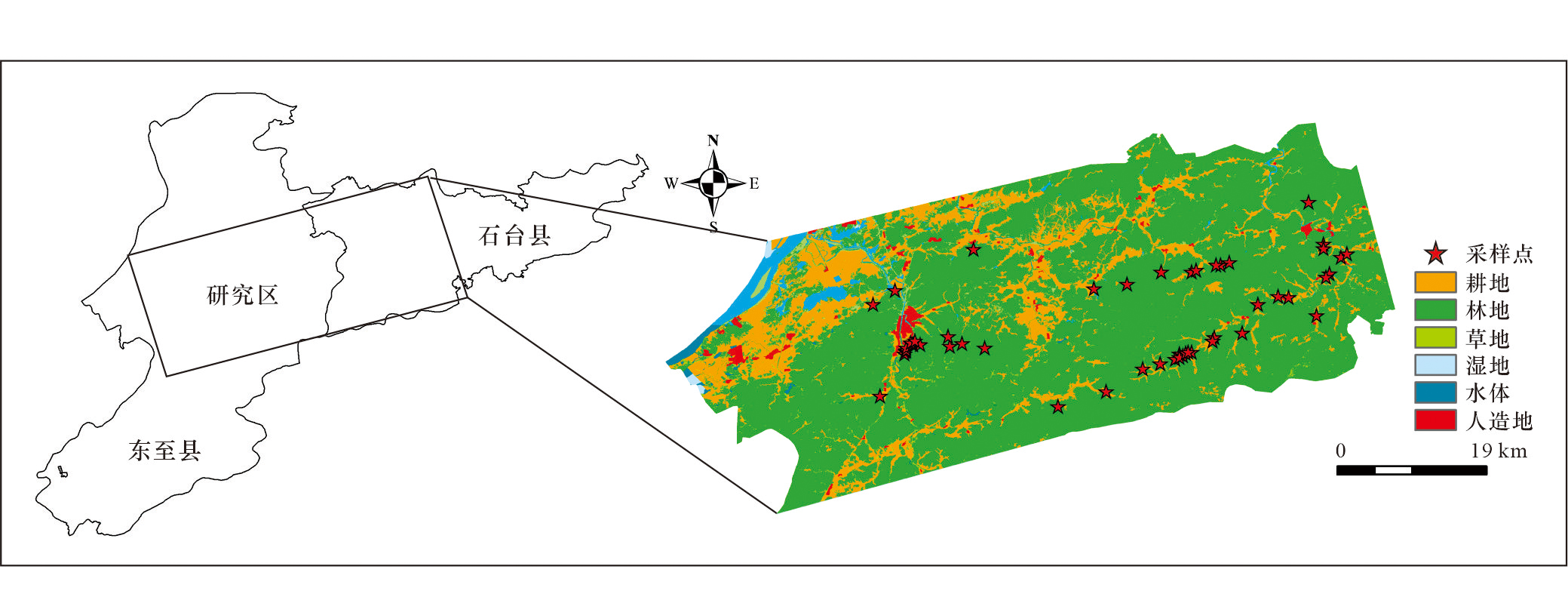
图1 研究区位置及采样点位示意
Figure 1 Location of the study area and sampling points
| 参数 | 参数名称 | 单位 | 参考值 | 参考文献 |
|---|---|---|---|---|
| IR,ing | 每日摄入土壤量 | mg∙d−1 | 成人20;儿童50 | USEPA, |
| IR,diet | 每日食物摄入量 | g∙d−1 | 成人1288.6;儿童57.8 | Yang et al., |
| IR,inh | 每日土壤吸入量 | m3∙d−1 | 成人16;儿童7.6 | Yang et al., |
| SA | 皮肤土壤接触面积 | cm2 | 成人5700;儿童2800 | USEPA, |
| AF | 土壤-皮肤附着系数 | kg∙cm−2∙d−1 | 成人2×10⁻⁷;儿童10−6 | USEPA, |
| ABS | 吸收因子 | 无量纲 | 成人0.03;儿童0.001 | USEPA, |
| EF | 暴露频率 | d∙t−1 | 350 | USEPA, |
| t1 | 暴露时间 | a | 成人24;儿童6 | USEPA, |
| mB | 体质量 | kg | 成人63;儿童29 | Yang et al., |
| t2 | 暴露污染土壤的平均时间 | d | 非致癌风险t1×365;致癌风险70×365 |
表1 污染源导向的人体健康风险评价模型参数
Table 1 Parameters of the human health risk assessment model based on pollution source orientation
| 参数 | 参数名称 | 单位 | 参考值 | 参考文献 |
|---|---|---|---|---|
| IR,ing | 每日摄入土壤量 | mg∙d−1 | 成人20;儿童50 | USEPA, |
| IR,diet | 每日食物摄入量 | g∙d−1 | 成人1288.6;儿童57.8 | Yang et al., |
| IR,inh | 每日土壤吸入量 | m3∙d−1 | 成人16;儿童7.6 | Yang et al., |
| SA | 皮肤土壤接触面积 | cm2 | 成人5700;儿童2800 | USEPA, |
| AF | 土壤-皮肤附着系数 | kg∙cm−2∙d−1 | 成人2×10⁻⁷;儿童10−6 | USEPA, |
| ABS | 吸收因子 | 无量纲 | 成人0.03;儿童0.001 | USEPA, |
| EF | 暴露频率 | d∙t−1 | 350 | USEPA, |
| t1 | 暴露时间 | a | 成人24;儿童6 | USEPA, |
| mB | 体质量 | kg | 成人63;儿童29 | Yang et al., |
| t2 | 暴露污染土壤的平均时间 | d | 非致癌风险t1×365;致癌风险70×365 |
| 项目 | 最小值/ (mg∙kg−1) | 最大值/ (mg∙kg−1) | 平均值/ (mg∙kg−1) | 标准差 | 变异系数/ % | 背景值/ (mg∙kg−1) | 风险筛选值/ (mg∙kg−1) | 背景值 超标率/% | 筛选值 超标率/% | |||
|---|---|---|---|---|---|---|---|---|---|---|---|---|
| pH | 3.73 | 7.92 | 6.43 | 0.93 | 14 | 5.85 | pH≤5.5 | 5.5<pH≤6.5 | 6.5<pH≤7.5 | pH>7.5 | - | - |
| Se | 0.18 | 18.6 | 1.93 | 3.02 | 47 | 0.23 | - | - | - | - | - | - |
| As | 7.02 | 97.7 | 27.82 | 18.75 | 67 | 9.4 | 40 | 40 | 30 | 25 | 92.16 | 17.65 |
| Cd | 0.04 | 6.43 | 0.86 | 1.06 | 124 | 0.1 | 0.3 | 0.3 | 0.3 | 0.6 | 88.23 | 78.43 |
| Cr | 52.5 | 197 | 75.94 | 24.97 | 33 | 69.4 | 150 | 150 | 200 | 250 | 47.06 | 1.96 |
| Cu | 27.1 | 200 | 57.36 | 34.48 | 60 | 24.9 | 50 | 50 | 100 | 100 | 100 | 29.41 |
| Ni | 26.1 | 147 | 43.65 | 20.99 | 48 | 25 | 60 | 70 | 100 | 190 | 100 | 3.92 |
| Pb | 20.4 | 80.6 | 30.2 | 8.43 | 28 | 25.9 | 70 | 90 | 120 | 170 | 76.47 | 0 |
| Sb | 0.67 | 25.7 | 4.43 | 5.09 | 115 | 0.83 | - | - | - | - | 98.03 | - |
| Zn | 25 | 330 | 115.38 | 53.72 | 47 | 53.2 | 200 | 200 | 250 | 300 | 88.24 | 3.92 |
表2 研究区富硒土壤重金属描述性统计
Table 2 Descriptive statistics of heavy metals in selenium-rich soil in the study area
| 项目 | 最小值/ (mg∙kg−1) | 最大值/ (mg∙kg−1) | 平均值/ (mg∙kg−1) | 标准差 | 变异系数/ % | 背景值/ (mg∙kg−1) | 风险筛选值/ (mg∙kg−1) | 背景值 超标率/% | 筛选值 超标率/% | |||
|---|---|---|---|---|---|---|---|---|---|---|---|---|
| pH | 3.73 | 7.92 | 6.43 | 0.93 | 14 | 5.85 | pH≤5.5 | 5.5<pH≤6.5 | 6.5<pH≤7.5 | pH>7.5 | - | - |
| Se | 0.18 | 18.6 | 1.93 | 3.02 | 47 | 0.23 | - | - | - | - | - | - |
| As | 7.02 | 97.7 | 27.82 | 18.75 | 67 | 9.4 | 40 | 40 | 30 | 25 | 92.16 | 17.65 |
| Cd | 0.04 | 6.43 | 0.86 | 1.06 | 124 | 0.1 | 0.3 | 0.3 | 0.3 | 0.6 | 88.23 | 78.43 |
| Cr | 52.5 | 197 | 75.94 | 24.97 | 33 | 69.4 | 150 | 150 | 200 | 250 | 47.06 | 1.96 |
| Cu | 27.1 | 200 | 57.36 | 34.48 | 60 | 24.9 | 50 | 50 | 100 | 100 | 100 | 29.41 |
| Ni | 26.1 | 147 | 43.65 | 20.99 | 48 | 25 | 60 | 70 | 100 | 190 | 100 | 3.92 |
| Pb | 20.4 | 80.6 | 30.2 | 8.43 | 28 | 25.9 | 70 | 90 | 120 | 170 | 76.47 | 0 |
| Sb | 0.67 | 25.7 | 4.43 | 5.09 | 115 | 0.83 | - | - | - | - | 98.03 | - |
| Zn | 25 | 330 | 115.38 | 53.72 | 47 | 53.2 | 200 | 200 | 250 | 300 | 88.24 | 3.92 |

图2 研究区富硒土壤重金属空间分布
Figure 2 Spatial distribution of heavy metal contents in Se-enriched soil in the study area
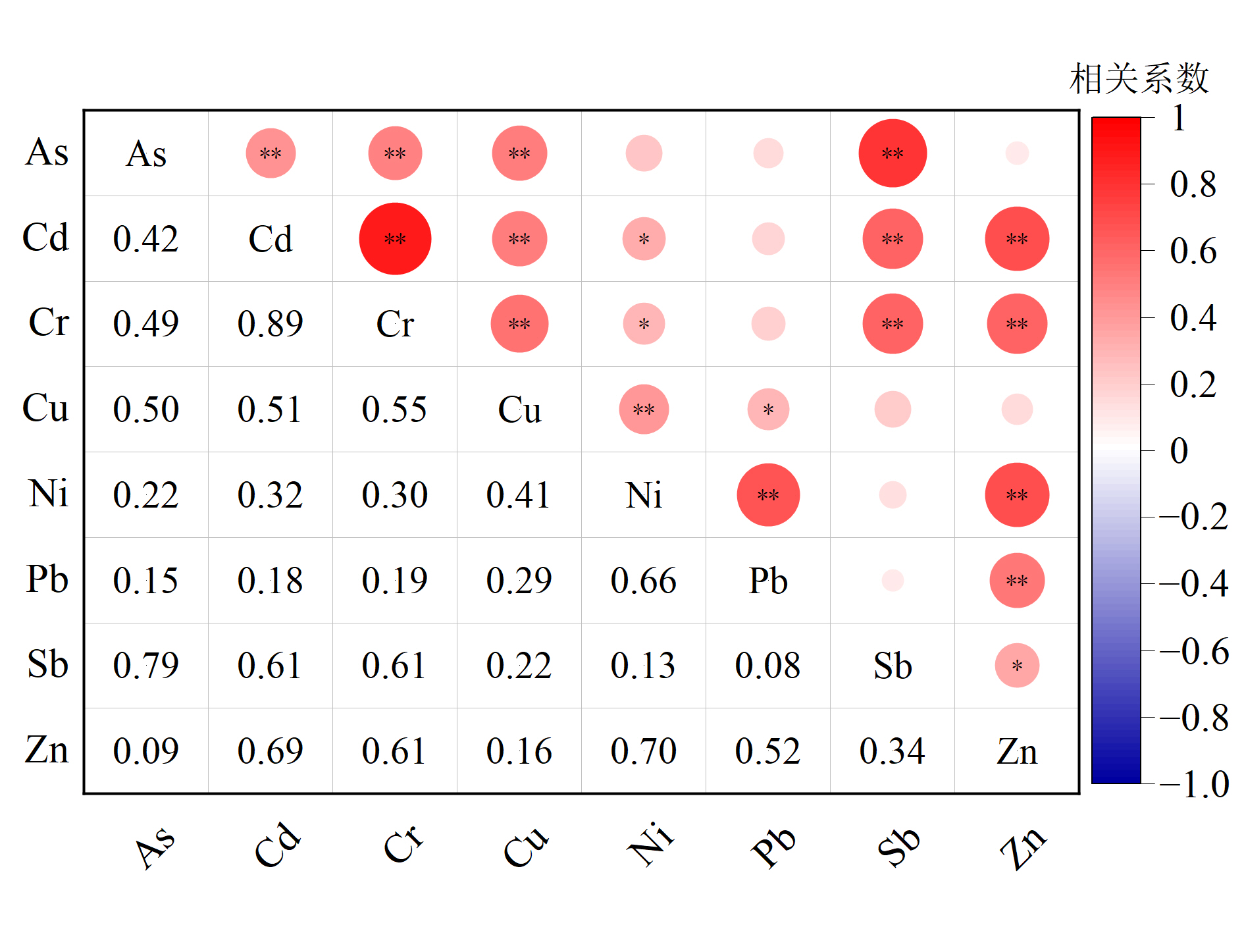
图3 富硒土壤重金属Pearson相关性分析 **在0.01水平(双侧)上显著相关,*在0.05水平(双侧)上显著相关;红色代表正相关,蓝色代表负相关;颜色越深、圆越大表示相关系数值越大
Figure 3 Pearson analysis of heavy metals in Se-enriched soil
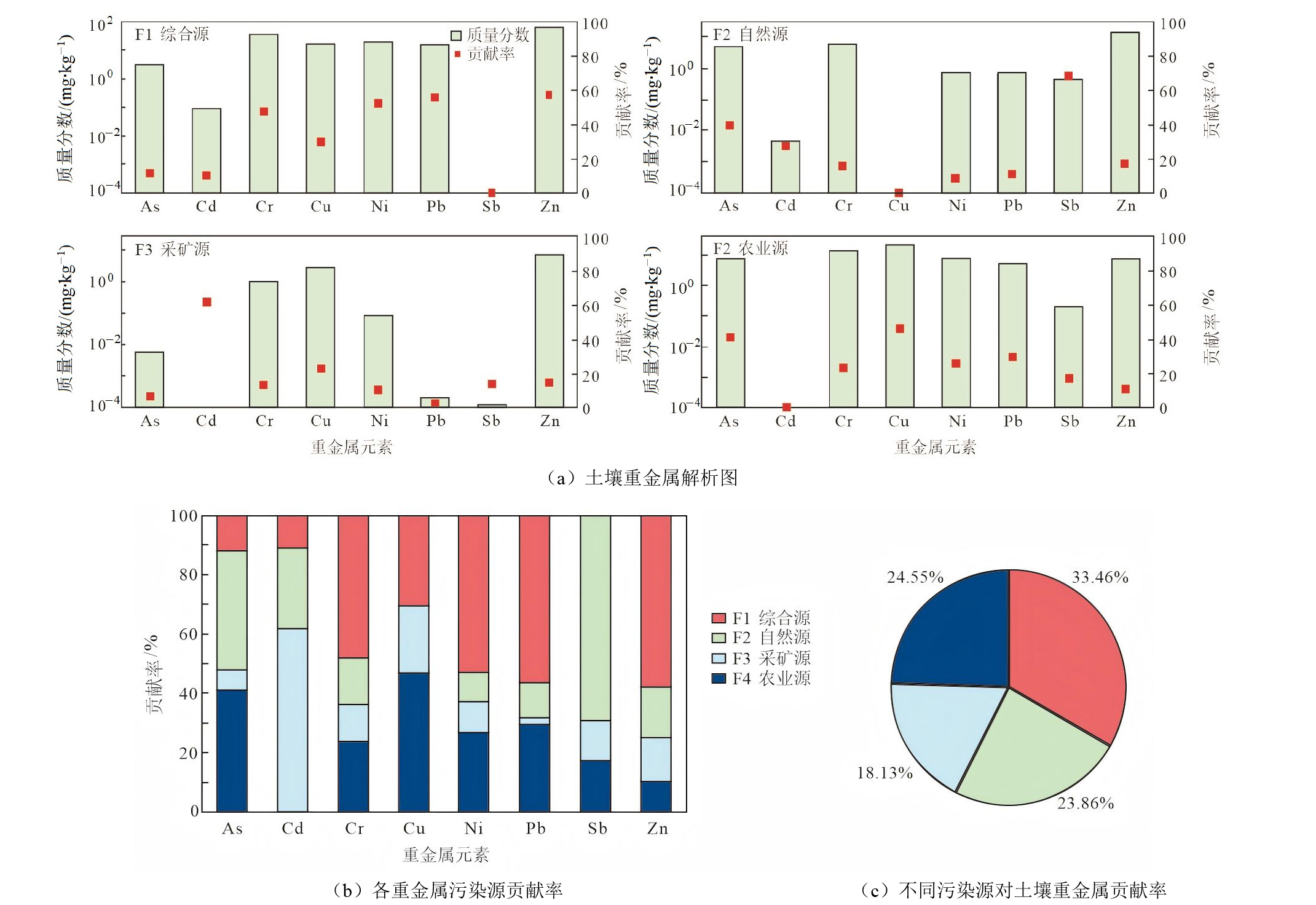
图4 基于PMF模型的皖南富硒土壤重金属污染源解析
Figure 4 Source apportionment of heavy metal pollution in selenium-rich soils in southern Anhui using PMF model

图5 不同污染源潜在生态风险空间分布
Figure 5 Spatial distribution of the potential ecological risks from different pollution sources
| 项目 | 成人 | 儿童 | |||||||||
|---|---|---|---|---|---|---|---|---|---|---|---|
| 综合源 | 自然源 | 采矿源 | 农业源 | 总和 | 综合源 | 自然源 | 采矿源 | 农业源 | 总和 | ||
| As | 2.36×10⁻¹ | 7.82×10⁻¹ | 1.34×10⁻¹ | 8.13×10⁻¹ | 1.96 | 3.36×10⁻¹ | 1.11 | 1.90×10⁻¹ | 1.16 | 2.80 | |
| Cd | 2.07×10⁻³ | 5.03×10⁻³ | 1.15×10⁻² | 3.73×10⁻⁵ | 1.86×10⁻² | 3.12×10⁻³ | 7.58×10⁻³ | 1.73×10⁻² | 5.62×10⁻⁵ | 2.81×10⁻² | |
| Cr | 2.51×10⁻¹ | 8.43×10⁻² | 6.48×10⁻² | 1.26×10⁻¹ | 5.27×10⁻¹ | 3.39×10⁻¹ | 1.14×10⁻¹ | 8.73×10⁻² | 1.70×10⁻¹ | 1.70×10⁻¹ | |
| Cu | 8.71×10⁻³ | 0 | 6.56×10⁻³ | 1.34×10⁻² | 2.86×10⁻² | 1.03×10⁻² | 0 | 7.79×10⁻³ | 1.59×10⁻² | 1.59×10⁻² | |
| Ni | 2.31×10⁻² | 4.19×10⁻³ | 4.63×10⁻³ | 1.18×10⁻² | 4.37×10⁻² | 2.75×10⁻² | 4.98×10⁻³ | 5.50×10⁻³ | 1.40×10⁻² | 5.19×10⁻² | |
| Pb | 9.70×10⁻² | 2.07×10⁻² | 3.98×10⁻³ | 5.12×10⁻² | 1.73×10⁻¹ | 1.16×10⁻¹ | 2.49×10⁻² | 4.77×10⁻³ | 6.14×10⁻² | 2.07×10⁻¹ | |
| Sb | 0 | 1.53×10⁻¹ | 2.98×10⁻² | 3.84×10⁻² | 2.21×10⁻¹ | 0 | 1.80×10⁻¹ | 3.51×10⁻² | 4.53×10⁻² | 2.60×10⁻¹ | |
| Zn | 4.42×10⁻³ | 1.34×10⁻³ | 1.15×10⁻³ | 7.85×10⁻⁴ | 7.69×10⁻³ | 5.28×10⁻³ | 1.60×10⁻³ | 1.37×10⁻³ | 9.36×10⁻⁴ | 9.18×10⁻³ | |
| RN | 6.22×10⁻¹ | 1.05 | 2.56×10⁻¹ | 1.06 | 2.98 | 8.37×10⁻¹ | 1.45 | 3.50×10⁻¹ | 1.47 | 4.10 | |
| As | 3.64×10⁻⁵ | 1.21×10⁻⁴ | 2.06×10⁻⁵ | 1.26×10⁻⁴ | 3.03×10⁻⁴ | 1.30×10⁻⁵ | 4.30×10⁻⁵ | 7.34×10⁻⁶ | 4.47×10⁻⁵ | 1.08×10⁻⁴ | |
| Cd | 3.98×10⁻⁶ | 9.68×10⁻⁶ | 2.21×10⁻⁵ | 7.17×10⁻⁸ | 3.58×10⁻⁵ | 1.17×10⁻⁶ | 2.85×10⁻⁶ | 6.52×10⁻⁶ | 2.11×10⁻⁸ | 1.06×10⁻⁵ | |
| Cr | 1.32×10⁻⁴ | 4.42×10⁻⁵ | 3.40×10⁻⁵ | 6.64×10⁻⁵ | 2.77×10⁻⁴ | 4.21×10⁻⁵ | 1.41×10⁻⁵ | 1.09×10⁻⁵ | 2.12×10⁻⁵ | 8.83×10⁻⁵ | |
| Ni | 5.89×10⁻⁶ | 1.07×10⁻⁶ | 1.18×10⁻⁶ | 2.99×10⁻⁶ | 1.11×10⁻⁵ | 7.80×10⁻⁶ | 1.42×10⁻⁶ | 1.56×10⁻⁶ | 3.97×10⁻⁶ | 1.47×10⁻⁵ | |
| Pb | 9.85×10⁻⁷ | 2.11×10⁻⁷ | 4.04×10⁻⁸ | 5.20×10⁻⁷ | 1.76×10⁻⁶ | 2.91×10⁻⁷ | 6.23×10⁻⁸ | 1.19×10⁻⁸ | 1.54×10⁻⁷ | 5.19×10⁻⁷ | |
| RC | 1.79×10⁻⁴ | 1.76×10⁻⁴ | 7.80×10⁻⁵ | 1.95×10⁻⁴ | 6.28×10⁻⁴ | 6.43×10⁻⁵ | 6.14×10⁻⁵ | 2.63×10⁻⁵ | 7.00×10⁻⁵ | 2.22×10⁻⁴ | |
表3 基于污染源的研究区富硒土壤重金属对人体非致癌、致癌风险评价
Table 3 Risk assessment of non-cancerous and carcinogenic effects of heavy metals from different pollution sources
| 项目 | 成人 | 儿童 | |||||||||
|---|---|---|---|---|---|---|---|---|---|---|---|
| 综合源 | 自然源 | 采矿源 | 农业源 | 总和 | 综合源 | 自然源 | 采矿源 | 农业源 | 总和 | ||
| As | 2.36×10⁻¹ | 7.82×10⁻¹ | 1.34×10⁻¹ | 8.13×10⁻¹ | 1.96 | 3.36×10⁻¹ | 1.11 | 1.90×10⁻¹ | 1.16 | 2.80 | |
| Cd | 2.07×10⁻³ | 5.03×10⁻³ | 1.15×10⁻² | 3.73×10⁻⁵ | 1.86×10⁻² | 3.12×10⁻³ | 7.58×10⁻³ | 1.73×10⁻² | 5.62×10⁻⁵ | 2.81×10⁻² | |
| Cr | 2.51×10⁻¹ | 8.43×10⁻² | 6.48×10⁻² | 1.26×10⁻¹ | 5.27×10⁻¹ | 3.39×10⁻¹ | 1.14×10⁻¹ | 8.73×10⁻² | 1.70×10⁻¹ | 1.70×10⁻¹ | |
| Cu | 8.71×10⁻³ | 0 | 6.56×10⁻³ | 1.34×10⁻² | 2.86×10⁻² | 1.03×10⁻² | 0 | 7.79×10⁻³ | 1.59×10⁻² | 1.59×10⁻² | |
| Ni | 2.31×10⁻² | 4.19×10⁻³ | 4.63×10⁻³ | 1.18×10⁻² | 4.37×10⁻² | 2.75×10⁻² | 4.98×10⁻³ | 5.50×10⁻³ | 1.40×10⁻² | 5.19×10⁻² | |
| Pb | 9.70×10⁻² | 2.07×10⁻² | 3.98×10⁻³ | 5.12×10⁻² | 1.73×10⁻¹ | 1.16×10⁻¹ | 2.49×10⁻² | 4.77×10⁻³ | 6.14×10⁻² | 2.07×10⁻¹ | |
| Sb | 0 | 1.53×10⁻¹ | 2.98×10⁻² | 3.84×10⁻² | 2.21×10⁻¹ | 0 | 1.80×10⁻¹ | 3.51×10⁻² | 4.53×10⁻² | 2.60×10⁻¹ | |
| Zn | 4.42×10⁻³ | 1.34×10⁻³ | 1.15×10⁻³ | 7.85×10⁻⁴ | 7.69×10⁻³ | 5.28×10⁻³ | 1.60×10⁻³ | 1.37×10⁻³ | 9.36×10⁻⁴ | 9.18×10⁻³ | |
| RN | 6.22×10⁻¹ | 1.05 | 2.56×10⁻¹ | 1.06 | 2.98 | 8.37×10⁻¹ | 1.45 | 3.50×10⁻¹ | 1.47 | 4.10 | |
| As | 3.64×10⁻⁵ | 1.21×10⁻⁴ | 2.06×10⁻⁵ | 1.26×10⁻⁴ | 3.03×10⁻⁴ | 1.30×10⁻⁵ | 4.30×10⁻⁵ | 7.34×10⁻⁶ | 4.47×10⁻⁵ | 1.08×10⁻⁴ | |
| Cd | 3.98×10⁻⁶ | 9.68×10⁻⁶ | 2.21×10⁻⁵ | 7.17×10⁻⁸ | 3.58×10⁻⁵ | 1.17×10⁻⁶ | 2.85×10⁻⁶ | 6.52×10⁻⁶ | 2.11×10⁻⁸ | 1.06×10⁻⁵ | |
| Cr | 1.32×10⁻⁴ | 4.42×10⁻⁵ | 3.40×10⁻⁵ | 6.64×10⁻⁵ | 2.77×10⁻⁴ | 4.21×10⁻⁵ | 1.41×10⁻⁵ | 1.09×10⁻⁵ | 2.12×10⁻⁵ | 8.83×10⁻⁵ | |
| Ni | 5.89×10⁻⁶ | 1.07×10⁻⁶ | 1.18×10⁻⁶ | 2.99×10⁻⁶ | 1.11×10⁻⁵ | 7.80×10⁻⁶ | 1.42×10⁻⁶ | 1.56×10⁻⁶ | 3.97×10⁻⁶ | 1.47×10⁻⁵ | |
| Pb | 9.85×10⁻⁷ | 2.11×10⁻⁷ | 4.04×10⁻⁸ | 5.20×10⁻⁷ | 1.76×10⁻⁶ | 2.91×10⁻⁷ | 6.23×10⁻⁸ | 1.19×10⁻⁸ | 1.54×10⁻⁷ | 5.19×10⁻⁷ | |
| RC | 1.79×10⁻⁴ | 1.76×10⁻⁴ | 7.80×10⁻⁵ | 1.95×10⁻⁴ | 6.28×10⁻⁴ | 6.43×10⁻⁵ | 6.14×10⁻⁵ | 2.63×10⁻⁵ | 7.00×10⁻⁵ | 2.22×10⁻⁴ | |
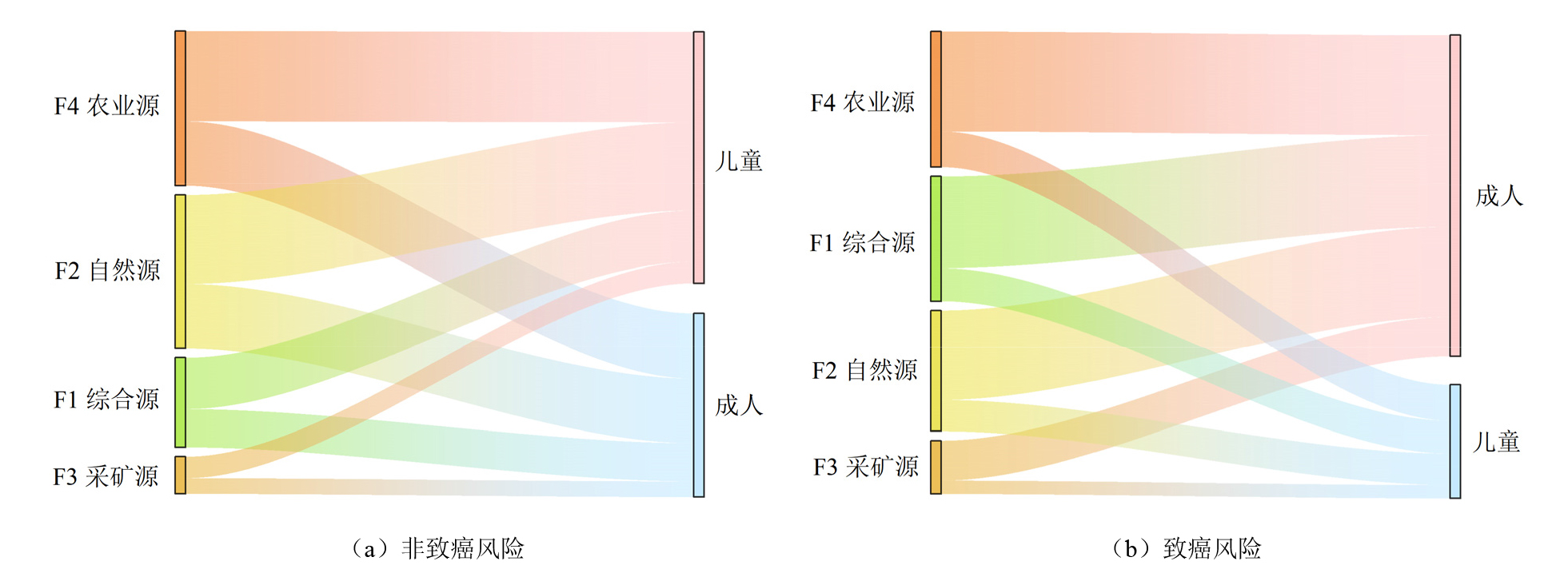
图6 成人、儿童重金属健康风险与污染源的关系
Figure 6 Health risks of heavy metals in adults and children and their relationship with pollution sources
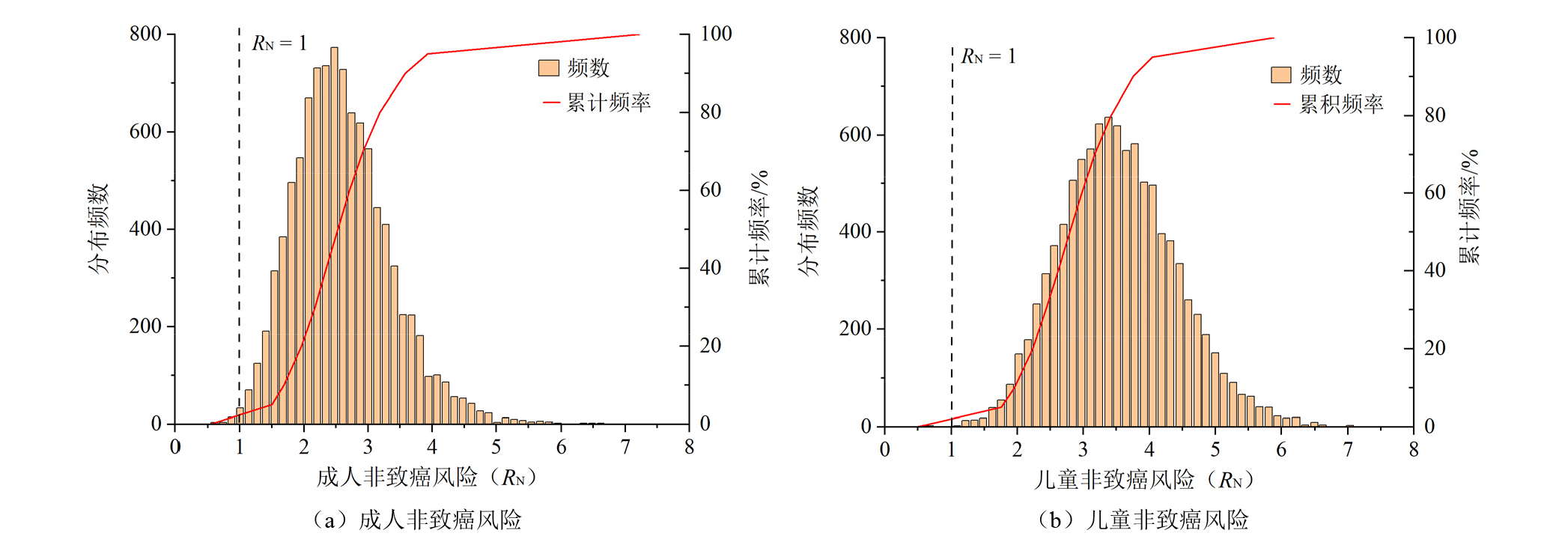
图7 研究区富硒土壤重金属对成人、儿童的非致癌风险概率分布
Figure 7 Non-carcinogenic risk probability distribution of heavy metals in selenium-rich soil in the study area for adults and children
| 元素 | 成人 | 儿童 | |||||||||
|---|---|---|---|---|---|---|---|---|---|---|---|
| 偶然摄入 | 皮肤接触 | 间接饮食摄入 | 呼吸摄入 | RN | 偶然摄入 | 皮肤接触 | 间接饮食摄入 | 呼吸摄入 | RN | ||
| As | 2.82×10⁻² | 1.05×10⁻¹ | 1.82 | 1.65×10⁻⁵ | 1.95 | 1.53×10⁻¹ | 5.50×10⁻¹ | 2.02 | 1.71×10⁻⁵ | 2.72 | |
| Cd | 2.62×10⁻⁴ | 1.33×10⁻³ | 1.69×10⁻² | 1.54×10⁻⁵ | 1.85×10⁻² | 1.42×10⁻³ | 6.96×10⁻³ | 1.87×10⁻² | 1.59×10⁻⁵ | 2.71×10⁻² | |
| Cr | 7.60×10⁻³ | 1.93×10⁻² | 4.90×10⁻¹ | 4.69×10⁻⁴ | 5.17×10⁻¹ | 4.13×10⁻² | 1.01×10⁻¹ | 5.43×10⁻¹ | 4.86×10⁻⁴ | 6.86×10⁻¹ | |
| Cu | 4.43×10⁻⁴ | 7.47×10⁻⁵ | 2.85×10⁻² | 2.59×10⁻⁷ | 2.90×10⁻² | 2.40×10⁻³ | 3.91×10⁻⁴ | 3.15×10⁻² | 2.66×10⁻⁷ | 3.43×10⁻² | |
| Ni | 6.55×10⁻⁴ | 1.23×10⁻⁴ | 4.22×10⁻² | 8.56×10⁻⁵ | 4.30×10⁻² | 3.56×10⁻³ | 6.44×10⁻⁴ | 4.68×10⁻² | 8.83×10⁻⁵ | 5.10×10⁻² | |
| Pb | 2.63×10⁻³ | 8.91×10⁻⁴ | 1.70×10⁻¹ | 1.54×10⁻⁶ | 1.73×10⁻¹ | 1.43×10⁻² | 4.67×10⁻³ | 1.88×10⁻¹ | 1.59×10⁻⁶ | 2.07×10⁻¹ | |
| Sb | 3.38×10⁻³ | 1.71×10⁻⁴ | 2.17×10⁻¹ | 1.98×10⁻⁶ | 2.21×10⁻¹ | 1.83×10⁻² | 8.98×10⁻⁴ | 2.41×10⁻¹ | 2.05×10⁻⁶ | 2.60×10⁻¹ | |
| Zn | 1.17×10⁻⁴ | 2.97×10⁻⁵ | 7.53×10⁻³ | 6.90×10⁻⁸ | 7.68×10⁻³ | 6.37×10⁻⁴ | 1.56×10⁻⁴ | 8.37×10⁻³ | 7.10×10⁻⁸ | 9.16×10⁻³ | |
| RN | 2.96 | 3.99 | |||||||||
表4 基于Monte Carlo模型的研究区富硒土壤重金属对成人、儿童的非致癌健康风险指数
Table 4 Non-carcinogenic health risk index of heavy metals in selenium-rich soil based on Monte Carlo model in the study area for adults and children
| 元素 | 成人 | 儿童 | |||||||||
|---|---|---|---|---|---|---|---|---|---|---|---|
| 偶然摄入 | 皮肤接触 | 间接饮食摄入 | 呼吸摄入 | RN | 偶然摄入 | 皮肤接触 | 间接饮食摄入 | 呼吸摄入 | RN | ||
| As | 2.82×10⁻² | 1.05×10⁻¹ | 1.82 | 1.65×10⁻⁵ | 1.95 | 1.53×10⁻¹ | 5.50×10⁻¹ | 2.02 | 1.71×10⁻⁵ | 2.72 | |
| Cd | 2.62×10⁻⁴ | 1.33×10⁻³ | 1.69×10⁻² | 1.54×10⁻⁵ | 1.85×10⁻² | 1.42×10⁻³ | 6.96×10⁻³ | 1.87×10⁻² | 1.59×10⁻⁵ | 2.71×10⁻² | |
| Cr | 7.60×10⁻³ | 1.93×10⁻² | 4.90×10⁻¹ | 4.69×10⁻⁴ | 5.17×10⁻¹ | 4.13×10⁻² | 1.01×10⁻¹ | 5.43×10⁻¹ | 4.86×10⁻⁴ | 6.86×10⁻¹ | |
| Cu | 4.43×10⁻⁴ | 7.47×10⁻⁵ | 2.85×10⁻² | 2.59×10⁻⁷ | 2.90×10⁻² | 2.40×10⁻³ | 3.91×10⁻⁴ | 3.15×10⁻² | 2.66×10⁻⁷ | 3.43×10⁻² | |
| Ni | 6.55×10⁻⁴ | 1.23×10⁻⁴ | 4.22×10⁻² | 8.56×10⁻⁵ | 4.30×10⁻² | 3.56×10⁻³ | 6.44×10⁻⁴ | 4.68×10⁻² | 8.83×10⁻⁵ | 5.10×10⁻² | |
| Pb | 2.63×10⁻³ | 8.91×10⁻⁴ | 1.70×10⁻¹ | 1.54×10⁻⁶ | 1.73×10⁻¹ | 1.43×10⁻² | 4.67×10⁻³ | 1.88×10⁻¹ | 1.59×10⁻⁶ | 2.07×10⁻¹ | |
| Sb | 3.38×10⁻³ | 1.71×10⁻⁴ | 2.17×10⁻¹ | 1.98×10⁻⁶ | 2.21×10⁻¹ | 1.83×10⁻² | 8.98×10⁻⁴ | 2.41×10⁻¹ | 2.05×10⁻⁶ | 2.60×10⁻¹ | |
| Zn | 1.17×10⁻⁴ | 2.97×10⁻⁵ | 7.53×10⁻³ | 6.90×10⁻⁸ | 7.68×10⁻³ | 6.37×10⁻⁴ | 1.56×10⁻⁴ | 8.37×10⁻³ | 7.10×10⁻⁸ | 9.16×10⁻³ | |
| RN | 2.96 | 3.99 | |||||||||
| 元素 | 成人 | 儿童 | |||||||||
|---|---|---|---|---|---|---|---|---|---|---|---|
| 偶然摄入 | 皮肤接触 | 间接饮食摄入 | 呼吸摄入 | RC | 偶然摄入 | 皮肤接触 | 间接饮食摄入 | 呼吸摄入 | RC | ||
| As | 4.36×10⁻⁶ | 1.62×10⁻⁵ | 2.81×10⁻⁴ | 2.56×10⁻⁸ | 3.01×10⁻⁴ | 5.91×10⁻⁶ | 2.12×10⁻⁵ | 7.78×10⁻⁵ | 6.61×10⁻⁹ | 1.02×10⁻⁴ | |
| Cd | 5.48×10⁻⁷ | 2.78×10⁻⁸ | 3.53×10⁻⁵ | 3.33×10⁻¹⁰ | 3.59×10⁻⁵ | 7.44×10⁻⁷ | 3.64×10⁻⁸ | 9.78×10⁻⁶ | 8.58×10⁻¹¹ | 1.02×10⁻⁵ | |
| Cr | 3.91×10⁻⁶ | 7.95×10⁻⁶ | 2.52×10⁻⁴ | 1.93×10⁻⁷ | 2.64×10⁻⁴ | 5.30×10⁻⁶ | 1.04×10⁻⁵ | 6.99×10⁻⁵ | 4.99×10⁻⁸ | 8.28×10⁻⁵ | |
| Ni | 1.35×10⁻⁹ | 9.68×10⁻⁶ | 8.67×10⁻⁸ | 2.22×10⁻⁹ | 9.77×10⁻⁶ | 1.83×10⁻⁹ | 1.27×10⁻⁵ | 2.40×10⁻⁸ | 5.72×10⁻¹⁰ | 1.27×10⁻⁵ | |
| Pb | 2.69×10⁻⁸ | 2.73×10⁻⁹ | 1.73×10⁻⁶ | 7.81×10⁻¹¹ | 1.76×10⁻⁶ | 3.65×10⁻⁸ | 3.57×10⁻⁹ | 4.80×10⁻⁷ | 2.02×10⁻¹¹ | 5.01×10⁻⁷ | |
| RC | 6.13×10⁻⁴ | 2.14×10⁻⁴ | |||||||||
表5 基于Monte Carlo模型的研究区富硒土壤重金属对成人、儿童的致癌健康风险指数
Table 5 Carcinogenic health risk index of heavy metals in selenium-rich soil based on Monte Carlo model in the study area for adults and children
| 元素 | 成人 | 儿童 | |||||||||
|---|---|---|---|---|---|---|---|---|---|---|---|
| 偶然摄入 | 皮肤接触 | 间接饮食摄入 | 呼吸摄入 | RC | 偶然摄入 | 皮肤接触 | 间接饮食摄入 | 呼吸摄入 | RC | ||
| As | 4.36×10⁻⁶ | 1.62×10⁻⁵ | 2.81×10⁻⁴ | 2.56×10⁻⁸ | 3.01×10⁻⁴ | 5.91×10⁻⁶ | 2.12×10⁻⁵ | 7.78×10⁻⁵ | 6.61×10⁻⁹ | 1.02×10⁻⁴ | |
| Cd | 5.48×10⁻⁷ | 2.78×10⁻⁸ | 3.53×10⁻⁵ | 3.33×10⁻¹⁰ | 3.59×10⁻⁵ | 7.44×10⁻⁷ | 3.64×10⁻⁸ | 9.78×10⁻⁶ | 8.58×10⁻¹¹ | 1.02×10⁻⁵ | |
| Cr | 3.91×10⁻⁶ | 7.95×10⁻⁶ | 2.52×10⁻⁴ | 1.93×10⁻⁷ | 2.64×10⁻⁴ | 5.30×10⁻⁶ | 1.04×10⁻⁵ | 6.99×10⁻⁵ | 4.99×10⁻⁸ | 8.28×10⁻⁵ | |
| Ni | 1.35×10⁻⁹ | 9.68×10⁻⁶ | 8.67×10⁻⁸ | 2.22×10⁻⁹ | 9.77×10⁻⁶ | 1.83×10⁻⁹ | 1.27×10⁻⁵ | 2.40×10⁻⁸ | 5.72×10⁻¹⁰ | 1.27×10⁻⁵ | |
| Pb | 2.69×10⁻⁸ | 2.73×10⁻⁹ | 1.73×10⁻⁶ | 7.81×10⁻¹¹ | 1.76×10⁻⁶ | 3.65×10⁻⁸ | 3.57×10⁻⁹ | 4.80×10⁻⁷ | 2.02×10⁻¹¹ | 5.01×10⁻⁷ | |
| RC | 6.13×10⁻⁴ | 2.14×10⁻⁴ | |||||||||
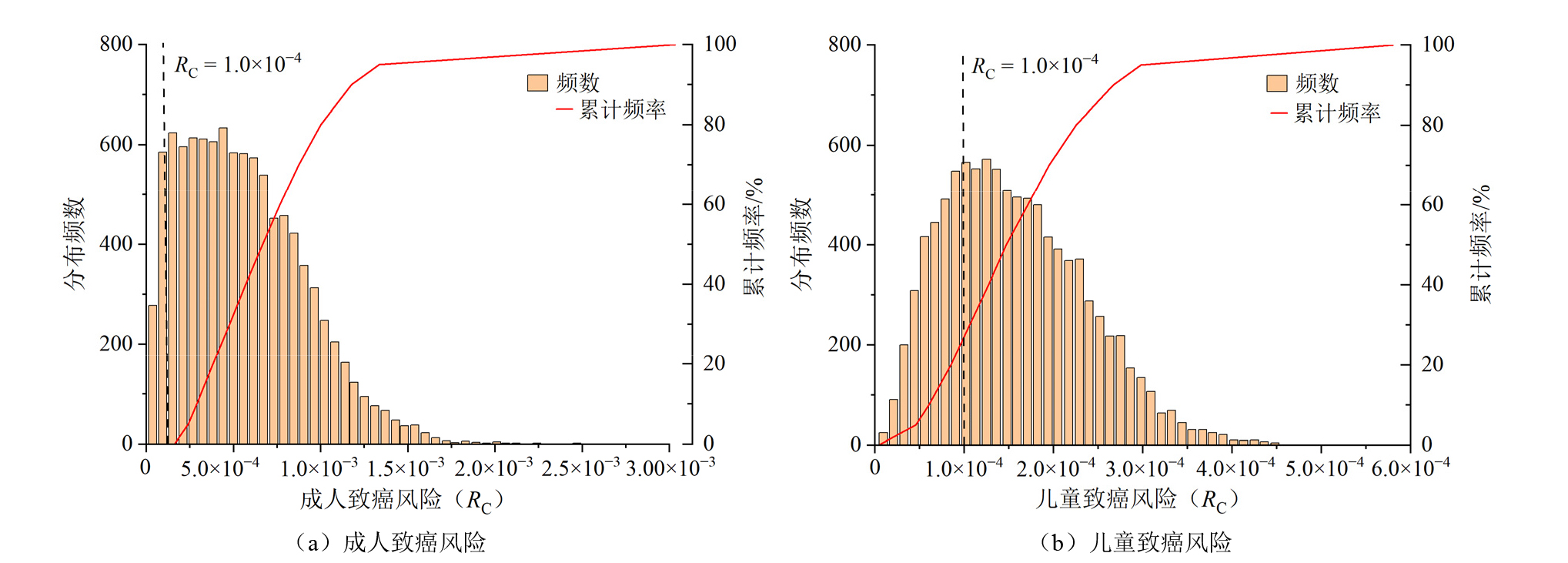
图8 研究区富硒土壤重金属对成人、儿童的致癌风险概率分布
Figure 8 Carcinogenic risk probability distribution of heavy metals in selenium-rich soil in the study area for adults and children
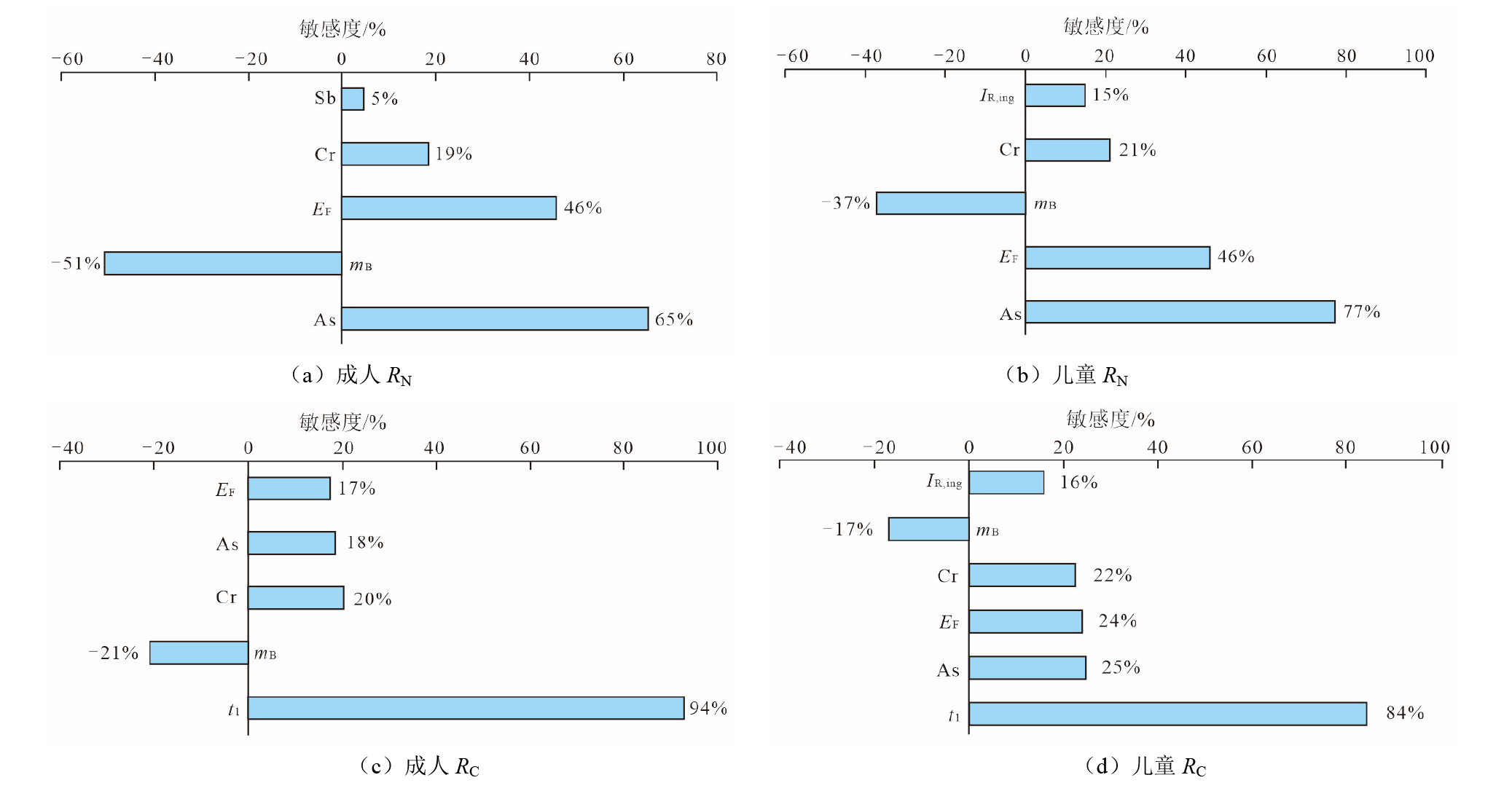
图9 研究区成人、儿童非致癌、致癌健康风险敏感度分析
Figure 9 Health risk sensitivity analysis of non-cancer and cancer in adults and children in the study area
| [1] |
Abdullah , Wani K I, Hayat K, et al., 2025. Multifaceted role of selenium in plant physiology and stress resilience: A review[J]. Plant Science, 355: 112456.
DOI URL |
| [2] |
Ali W, Zhang H, Junaid M, et al., 2021. Insights into the mechanisms of arsenic-selenium interactions and the associated toxicity in plants, animals, and humans: A critical review[J]. Critical Reviews in Environmental Science and Technology, 51(7): 704-750.
DOI URL |
| [3] |
Al-Makishah N H, Taleb M A, Barakat M A, 2020. Arsenic bioaccumulation in arsenic-contaminated soil: A review[J]. Chemical Papers, 74: 2743-2757.
DOI |
| [4] |
Brown S G, Eberly S, Paatero P, et al., 2015. Methods for estimating uncertainty in PMF solutions: Examples with ambient air and water quality data and guidance on reporting PMF results[J]. Science of the Total Environment, 518-519: 626-635.
DOI URL |
| [5] |
Chen Z F, Ding Y F, Jiang X Y, et al., 2022. Combination of UNMIX, PMF model and Pb-Zn-Cu isotopic compositions for quantitative source apportionment of heavy metals in suburban agricultural soils[J]. Ecotoxicology and Environmental Safety, 234: 113369.
DOI URL |
| [6] |
Dinh Q T, Cui Z, Huang J, et al., 2018. Selenium distribution in the Chinese environment and its relationship with human health: A review[J]. Environment International, 112: 294-309.
DOI PMID |
| [7] |
Feng C X, Liu S, Song W L, et al., 2024. Mineralogy and selenium speciation analysis of Early Cambrian selenium-rich black shale in southern Shaanxi Province, China[J]. Minerals, 14(6): 612.
DOI URL |
| [8] |
Fu Z B, He N J, Ma M, et al., 2023. Source apportionment and probabilistic risk assessment of heavy metals in selenium-rich soils in Hainan Province, China[J]. Journal of Geochemical Exploration, 251: 107241.
DOI URL |
| [9] |
Guo G H, Wu F C, Xie F Z, et al., 2012. Spatial distribution and pollution assessment of heavy metals in urban soils from southwest China[J]. Journal of Environmental Sciences, 24(3): 410-418.
PMID |
| [10] |
Häkanson L, 1980. An ecological risk index for aquatic pollution control: A sedimentological approach[J]. Water Research, 14(8): 975-1001.
DOI URL |
| [11] |
He J, Peng Z H, Zeng J Q, et al., 2023. Source apportionment and quantitative risk assessment of heavy metals at an abandoned zinc smelting site based on GIS and PMF models[J]. Journal of Environmental Management, 336: 117565.
DOI URL |
| [12] |
Ma Y D, Sun Y Y, Wang J, et al., 2025. Analysis of heavy metal sources and potential ecological risk assessment of mangroves in Aojiang Estuary[J]. Ecological Indicators, 173: 113343.
DOI URL |
| [13] |
Paatero P, Tapper U, 1994. Positive matrix factorization: A non-negative factor model with optimal utilization of error estimates of data values[J]. Environmetrics, 5(2): 111-126.
DOI URL |
| [14] |
Paikaray S, 2012. Environmental hazards of arsenic associated with black shales: A review on geochemistry, enrichment and leaching mechanism[J]. Reviews in Environmental Science and Bio/Technology, 11: 289-303.
DOI URL |
| [15] |
Podgorski J, Berg M, 2020. Global threat of arsenic in groundwater[J]. Science, 368(6493): 845-850.
DOI PMID |
| [16] |
Qian L, Wang T, Shi Y J, et al., 2023. Topsoil selenium (Se) under Se-rich farming in China: Current status, cropping impacts and ecological risk assessment[J]. Journal of Environmental Management, 345: 118918.
DOI URL |
| [17] |
Shetty B R, Pai B J, Salmataj S A, et al., 2024. Assessment of carcinogenic and non-carcinogenic risk indices of heavy metal exposure in different age groups using Monte Carlo simulation approach[J]. Scientific Reports, 14: 30319.
DOI |
| [18] | Speer R M, Zhou X X, Volk L B, et al., 2023. Arsenic and cancer: Evidence and mechanisms[J]. Advances in Pharmacology, 96: 151-202. |
| [19] | USEPA, 2011. Exposure factors handbook: Chapter 5-Soil and dust ingestion: EPA/600/R-09/052F[R]. 09/2011: 62-65. https://www.epa.gov/expobox/exposure-factors-handbook-2011-edition. |
| [20] |
Wen T, Cheng Y B, Yuan Y L, et al., 2025. Quantitative analysis and risk assessment of heavy metal pollution in an intensive industrial and agricultural region[J]. Ecotoxicology and Environmental Safety, 289: 117634.
DOI URL |
| [21] |
Wu J H, Wang H J, Han Z L, et al., 2025. Application of a PMF+BMR hybrid model for source apportionment and ecological risk assessment of soil heavy metal(loid)s[J]. Journal of Hazardous Materials, 494: 138734.
DOI URL |
| [22] |
Xie G L, Zong Z R, Song S X, et al., 2025. Enrichment and source apportionment of heavy metals in selenium-enriched soils in eastern China[J]. ACS Omega, 10(17): 17661-17672.
DOI URL |
| [23] |
Yang S Y, He M J, Zhi Y Y, et al., 2019. An integrated analysis on source-exposure risk of heavy metals in agricultural soils near intense electronic waste recycling activities[J]. Environment International, 133: 105239.
DOI URL |
| [24] |
Zhang H, Ouyang Z C, Li M C, et al., 2024. Spatial distribution and main drivers of soil selenium in Taihu Lake basin, southeast China[J]. Journal of Hazardous Materials, 465: 133091.
DOI URL |
| [25] | 陈兴仁, 陈富荣, 贾十军, 等, 2012. 安徽省江淮流域土壤地球化学基准值与背景值研究[J]. 中国地质, 39(2): 302-310. |
| Chen X R, Chen F R, Jia S J, et al., 2012. Soil geochemical baseline and background in Yangtze River-Huaihe River basin of Anhui Province[J]. Geology In China, 39(2): 302-310. | |
| [26] | 董騄睿, 胡文友, 黄标, 等, 2014. 南京沿江典型蔬菜生产系统土壤重金属异常的源解析[J]. 土壤学报, 51(6): 1251-1261. |
| Dong L R, Hu W Y, Huang B, et al., 2014. Sources of heavy metals in soils of a typical vegetable production system along Yangtze River in Nanjing[J]. Acta Pedologica Sinica, 51(6): 1251-1261. | |
| [27] | 方嘉, 何影, 黄乃涛, 等, 2023. 基于PMF模型的农田土壤重金属源暴露风险综合评价: 以浙江省某电子垃圾拆解区为例[J]. 环境科学, 44(7): 4027-4038. |
| Fang J, He Y, Huang N T, et al., 2023. Integrated analysis on source-exposure risk of heavy metals in farmland soil based on PMF model: A case study in the E-waste dismantling area in Zhejiang Province[J]. Environmental Science, 44(7): 4027-4038. | |
| [28] | 高雅, 胡晨, 张春雷, 等, 2022. 安徽石台地区富硒土壤分布及硒的富集迁移规律探讨[J]. 西北地质, 55(2): 284-291. |
| Gao Y, Hu C, Zhang C L, et al., 2022. Study on the distribution of Selenium-rich soil and the regularity of selenium enrichment-migration in Shitai area, Anhui, China[J]. Northwestern Geology, 55(2): 284-291. | |
| [29] | 韩伟, 宋云涛, 郭志娟, 等, 2025. 宣威地区土壤重金属潜在污染风险评价及影响因素解析[J]. 中国环境科学, 45(5): 2643-2653. |
| Han W, Song Y T, Guo Z J, et al., 2025. Evaluation and analysis influencing factors of potential heavy metal pollution risk in soil of Xuanwei city[J]. China Environmental Science, 45(5): 2643-2653. | |
| [30] | 李强, 曹莹, 何连生, 等, 2021. 典型冶炼行业场地土壤重金属空间分布特征及来源解析[J]. 环境科学, 42(12): 5930-5937. |
| Li Q, Cao Y, He L S, et al., 2021. Spatial distribution characteristics and source analysis of soil heavy metals at typical smelting industry sites[J]. Environmental Science, 42(12): 5930-5937. | |
| [31] | 刘春英, 曹依, 李嘉薇, 等, 2024. 基于APCS-MLR模型的城市绿地土壤重金属污染源解析研究[J]. 干旱区资源与环境, 38(7): 146-154. |
| Liu C Y, Cao Y, Li J W, et al., 2024. Heavy metals pollution sources in urban green space soils: An APCS-MLR model-based analysis[J]. Journal of Arid Land Resources and Environment, 38(7): 146-154. | |
| [32] | 刘涛, 沈利娜, 于奭, 等, 2025. 基于PMF和APCS-MLR模型的会仙湿地沉积物重金属源解析及污染风险评价[J]. 环境科学, 46(9): 6024-6036. |
| Liu T, Shen L N, Yu S, et al., 2025. Source apportionment and pollution risk assessment of heavy metals in sediments of Huixian wetland based on PMF and APCS-MLR models[J]. Environmental Science, 46(9): 6024-6036. | |
| [33] | 彭驰, 何亚磊, 郭朝晖, 等, 2022. 中国主要城市土壤重金属累积特征与风险评价[J]. 环境科学, 43(1): 1-10. |
|
Peng C, He Y L, Guo Z H, et al., 2022. Characteristics and risk assessment of heavy metals in urban soils of major cities in China[J]. Environmental Science, 43(1): 1-10.
DOI URL |
|
| [34] | 王玮, 王政, 孔祥意, 等, 2025. 基于INLA-SPDE模型的区域土壤硒元素空间预测及富硒区优选[J]. 环境科学, 46(6): 3902-3912. |
| Wang W, Wang Z, Kong X Y, et al., 2025. Spatial prediction of selenium in soils by using INLA-SPDE approach and the delimitation of selenium-enriched land with low heavy metal pollution risk[J]. Environmental Science, 46(6): 3902-3912. | |
| [35] |
吴文伟, 沈城, 沙晨燕, 等, 2024. 城市工业地块土壤重金属污染风险评价与源解析[J]. 生态环境学报, 33(5): 791-801.
DOI |
| Wu W W, Shen C, Sha C Y, et al., 2024. Soil heavy metal enrichment characteristics, risk assessment, and source analysis in redevelopment areas during urban industrial plots[J]. Ecology and Environmental Sciences, 33(5): 791-801. | |
| [36] | 熊润光, 乔强龙, 桂智凡. 2022. 黄石市绿地土壤重金属污染风险评价及来源解析[J]. 土壤通报, 53(4): 972-980. |
| Xiong R G, Qiao Q L, Gui Z F, 2022. Risk assessment and source analysis of heavy metal pollution in green space soil in Huangshi city[J]. Chinese Journal of Soil Science, 53(4): 972-980. | |
| [37] | 张迪, 周明忠, 熊康宁, 等, 2021. 贵州遵义下寒武统黑色页岩区土壤重金属污染和人体健康风险评价[J]. 环境科学研究, 34(5): 1247-1257. |
| Zhang D, Zhou M Z, Xiong K N, et al., 2021. Assessment of pollution and human health risk from heavy metals in soils and crops in the Lower Cambrian black shale area, Zunyi, Guizhou Province[J]. Research of Environmental Sciences, 34(5): 1247-1257. | |
| [38] | 张迪, 周明忠, 杨善进, 等, 2025. 贵州遵义下寒武统黑色页岩区土壤重金属综合污染评价及来源分析[J]. 贵州师范大学学报(自然科学版), 43(2): 68-76. |
| Zhang D, Zhou M Z, Yang S J, et al., 2025. Assessment and source analysis of heavy metal comprehensive pollution in soils in the Lower Cambrian black shale area, Zunyi, Guizhou Province[J]. Journal of Guizhou Normal University (Natural Sciences), 43(2): 68-76. | |
| [39] | 张军, 谢厚雨, 宿睿颖, 等, 2025. 基于PMF模型的蔡家坡镇燃煤供暖电厂周边土壤重金属污染源解析及风险评价[J]. 干旱区资源与环境, 39(9): 147-156. |
| Zhang J, Xie H Y, Su R Y, et al., 2025. Source apportionment and risk assessment of heavy metal pollution in soils around a coal-fired heating power plant in Caijiapo town based on PMF model[J]. Journal of Arid Land Resources and Environment, 39(9): 147-156. | |
| [40] | 张文强, 滕跃, 柳浩然, 等, 2024. 聊城市典型农业区土壤重金属分布特征、生态风险及来源解析[J]. 干旱区资源与环境, 38(4): 171-180. |
| Zhang W Q, Teng Y, Liu H R, et al., 2024. Distribution, ecological risks, and sources of heavy metals in soil of typical agricultural areas in Liaocheng city[J]. Journal of Arid Land Resources and Environment, 38(4): 171-180. | |
| [41] | 张小敏, 张秀英, 钟太洋, 等, 2014. 中国农田土壤重金属富集状况及其空间分布研究[J]. 环境科学, 35(2): 692-703. |
| Zhang X M, Zhang X Y, Zhong T Y, et al., 2014. Spatial distribution and accumulation of heavy metals in arable land soil of China[J]. Environmental Science, 35(2): 692-703. | |
| [42] |
张煜坤, 陈懂懂, 李奇, 等, 2026. 基于多元统计分析和PMF模型的土壤重金属源解析——以三江源为例[J]. 生态环境学报, 35(3): 458-468.
DOI |
| Zhang Y K, Chen D D, Li Q, et al., 2026. Source analysis of soil heavy metals based on multivariate statistical analysis and PMF model: A case study of Sanjiangyuan[J]. Ecology and Environmental Sciences, 35(3): 458-468. |
| [1] | 陈盈巧, 关净文, 王蕴赟, 于兴娜. 杭州城区夏季VOCs光化学损耗特征及其来源分析[J]. 生态环境学报, 2026, 35(9): 1436-1444. |
| [2] | 刘颖志, 张超, 李茵, 贺峰, 郭军康. 金属矿山废弃地不同先锋植物根际土壤理化性质、酶活性及植物重金属积累特征[J]. 生态环境学报, 2026, 35(9): 1469-1482. |
| [3] | 邹志琦, 敦力民, 王井利, 唐玉兰. 基于NRBO−XGBoost优化无人机高光谱土壤重金属铜(Cu)含量反演研究[J]. 生态环境学报, 2026, 35(9): 1483-1494. |
| [4] | 张军梅, 方艳丽, 杨玉庆. 黄河流域三门峡段水体重金属含量特征及对斑马鱼胚胎和仔鱼的生物毒性研究[J]. 生态环境学报, 2026, 35(7): 1114-1124. |
| [5] | 邵佳丽, 谷海红, 张莹, 任宇松, 原心如, 艾艳君. 紫花苜蓿-AMF-根瘤菌双共生系统对铜和铬污染尾矿的修复作用[J]. 生态环境学报, 2026, 35(7): 1136-1150. |
| [6] | 潘玉, 孟庆玖, 徐君, 崔中华, 李章涛, 柳检, 孟俊. 生物炭与石灰对稻田福寿螺重金属积累及肠道微生物影响[J]. 生态环境学报, 2026, 35(7): 1151-1162. |
| [7] | 周家豪, 张沛, 彭煜文, 钟松雄, 邹建平, 侯冬梅. 基于机器学习识别赣江流域重金属污染主控因素[J]. 生态环境学报, 2026, 35(6): 976-985. |
| [8] | 魏龙毅, 林亲铁, 刘煜欣, 万家豪, 姚丽敏, 钟松雄. 广州某地质高背景地块土壤砷污染特征及成因分析[J]. 生态环境学报, 2026, 35(5): 819-830. |
| [9] | 张煜坤, 陈懂懂, 李奇, 贺福全, 张莉, 赵亮. 基于多元统计分析和PMF模型的土壤重金属源解析——以三江源为例[J]. 生态环境学报, 2026, 35(3): 458-468. |
| [10] | 韩存亮, 邓一荣, 常春英, 林龙勇, 程胜, 李俊春. 基于风险管控的土壤重金属高背景特征识别方法探讨[J]. 生态环境学报, 2026, 35(2): 278-288. |
| [11] | 史广宇, 沈新怡. 共热解技术对污泥中重金属的固定及资源化利用研究进展[J]. 生态环境学报, 2026, 35(2): 323-332. |
| [12] | 江落雁, 钟嘉劲, 黎铭洋, 张池, 曾曙才, 仇荣亮, 蒋成爱. 涉重金属企业周边土壤不同营养级生物响应阈值受体分异特征[J]. 生态环境学报, 2026, 35(10): 1600-1610. |
| [13] | 蒋凯, 柯常栋, 王丽萍, 李朋辉, 赖迪智, 张杨, 吴永洁, 吴仁人, 肖利平. 珠江广州河段粪便污染和溶解有机质的来源解析及分布特征[J]. 生态环境学报, 2025, 34(9): 1452-1462. |
| [14] | 孟畅, 红梅, 李斐. 高光谱敏感波段筛选与机器学习协同提升土壤重金属预测精度[J]. 生态环境学报, 2025, 34(6): 950-960. |
| [15] | 刘鸿林, 赵方凯, 杨磊, 沈琳钧, 杨恺丰, 李敏, 陈利顶. 城市公园土壤重金属污染及影响因素研究——以宁波市为例[J]. 生态环境学报, 2025, 34(5): 773-783. |
| 阅读次数 | ||||||
|
全文 |
|
|||||
|
摘要 |
|
|||||
