
生态环境学报 ›› 2026, Vol. 35 ›› Issue (9): 1402-1411.DOI: 10.16258/j.cnki.1674-5906.2026.09.007
刘晓朋1,2( ), 徐成1,2, 唐罗忠1,2,3,*()
收稿日期:2026-01-05
修回日期:2026-07-06
接受日期:2026-08-13
出版日期:2026-09-18
发布日期:2026-09-16
通讯作者:
唐罗忠, E-mail: 作者简介:刘晓朋(1998年生),男,硕士,主要从事林农复合经营理论与技术研究。E-mail: liuxp19981222@163.com
基金资助:
Liu Xiaopeng1,2(), Xu Cheng1,2, Tang Luozhong1,2,3,*()
Received:2026-01-05
Revised:2026-07-06
Accepted:2026-08-13
Online:2026-09-18
Published:2026-09-16
摘要:
【目的】为了解杨树与农作物复合经营以及施肥对土壤养分和植物生长的影响。【方法】采用盆栽控制试验研究了3种种植模式[杨树(Populus deltoides)单作、小麦(Triticum aestivum)/大豆(Glycine max)单作、杨农(杨树与小麦/杨树与大豆)间作]和3种施肥量(每盆分别施复合肥10、5、0 g)对土壤养分和植物生长的影响。【结果】施肥使土壤pH降低了0.1-0.4个单位;相同种植模式下的土壤硝态氮、有效磷和速效钾的质量分数均随施肥量的增加而增加;相同施肥量下,杨树单作和杨农间作的土壤有效磷和速效钾的质量分数比小麦/大豆单作分别提高了80%和20%以上。不论是单作还是间作,每盆施10 g肥料的作物产量和杨树生长量均最高,其次是每盆施5 g肥料,不施肥的最低;相同施肥量下,杨农间作的作物产量低于单作作物50%左右,杨农间作的杨树生长量低于单作杨树10%左右,但是杨农间作的土地当量比大于1,其综合生产力高于单作。【结论】种植杨树能促进土壤磷的活化和钾的释放,提高土壤有效磷和速效钾的质量分数,施肥能增加作物产量和杨树生长量,杨农间作对肥料的需求量大于杨树单作和作物单作,杨农间作有利于提高土地综合生产力。
中图分类号:
刘晓朋, 徐成, 唐罗忠. 杨树农作物间作与施肥对土壤养分和植物生长的影响[J]. 生态环境学报, 2026, 35(9): 1402-1411.
Liu Xiaopeng, Xu Cheng, Tang Luozhong. Effects of Poplar-crop Intercropping and Fertilization on the Soil Nutrients and Plant Growth[J]. Ecology and Environmental Sciences, 2026, 35(9): 1402-1411.
| 处理 | 种植模式 | 施肥量/(g·pot−1) |
|---|---|---|
| P10 | 杨树 | 10 |
| P5 | 杨树 | 5 |
| P0 | 杨树 | 0 |
| PA10 | 杨树+小麦+大豆 | 10 |
| PA5 | 杨树+小麦+大豆 | 5 |
| PA0 | 杨树+小麦+大豆 | 0 |
| A10 | 小麦+大豆 | 10 |
| A5 | 小麦+大豆 | 5 |
| A0 | 小麦+大豆 | 0 |
| CK | 不种植 | 0 |
表1 种植模式和施肥处理
Table 1 Planting patterns and fertilization treatments
| 处理 | 种植模式 | 施肥量/(g·pot−1) |
|---|---|---|
| P10 | 杨树 | 10 |
| P5 | 杨树 | 5 |
| P0 | 杨树 | 0 |
| PA10 | 杨树+小麦+大豆 | 10 |
| PA5 | 杨树+小麦+大豆 | 5 |
| PA0 | 杨树+小麦+大豆 | 0 |
| A10 | 小麦+大豆 | 10 |
| A5 | 小麦+大豆 | 5 |
| A0 | 小麦+大豆 | 0 |
| CK | 不种植 | 0 |
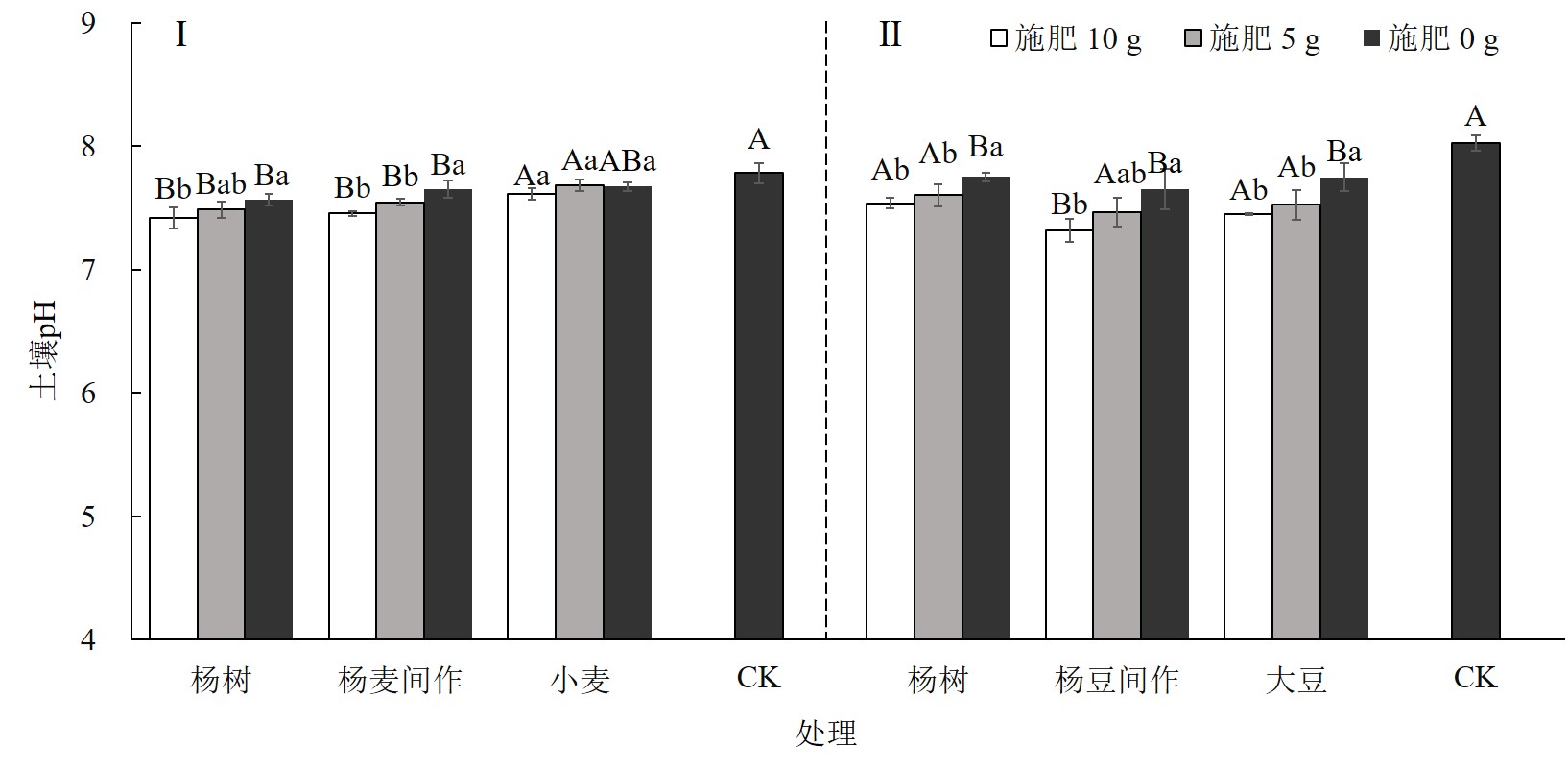
图1 不同种植模式和施肥量下的土壤pH Ⅰ:小麦种植季;Ⅱ:大豆种植季。不同大写字母表示在相同种植季、相同施肥量下不同种植模式之间存在显著差异(p<0.05);不同小写字母表示在相同种植季、相同种植模式下,不同施肥量之间存在显著差异(p<0.05)。样本重复数(n=3)。下同
Figure 1 Soil pH under different planting patterns and different fertilization amount
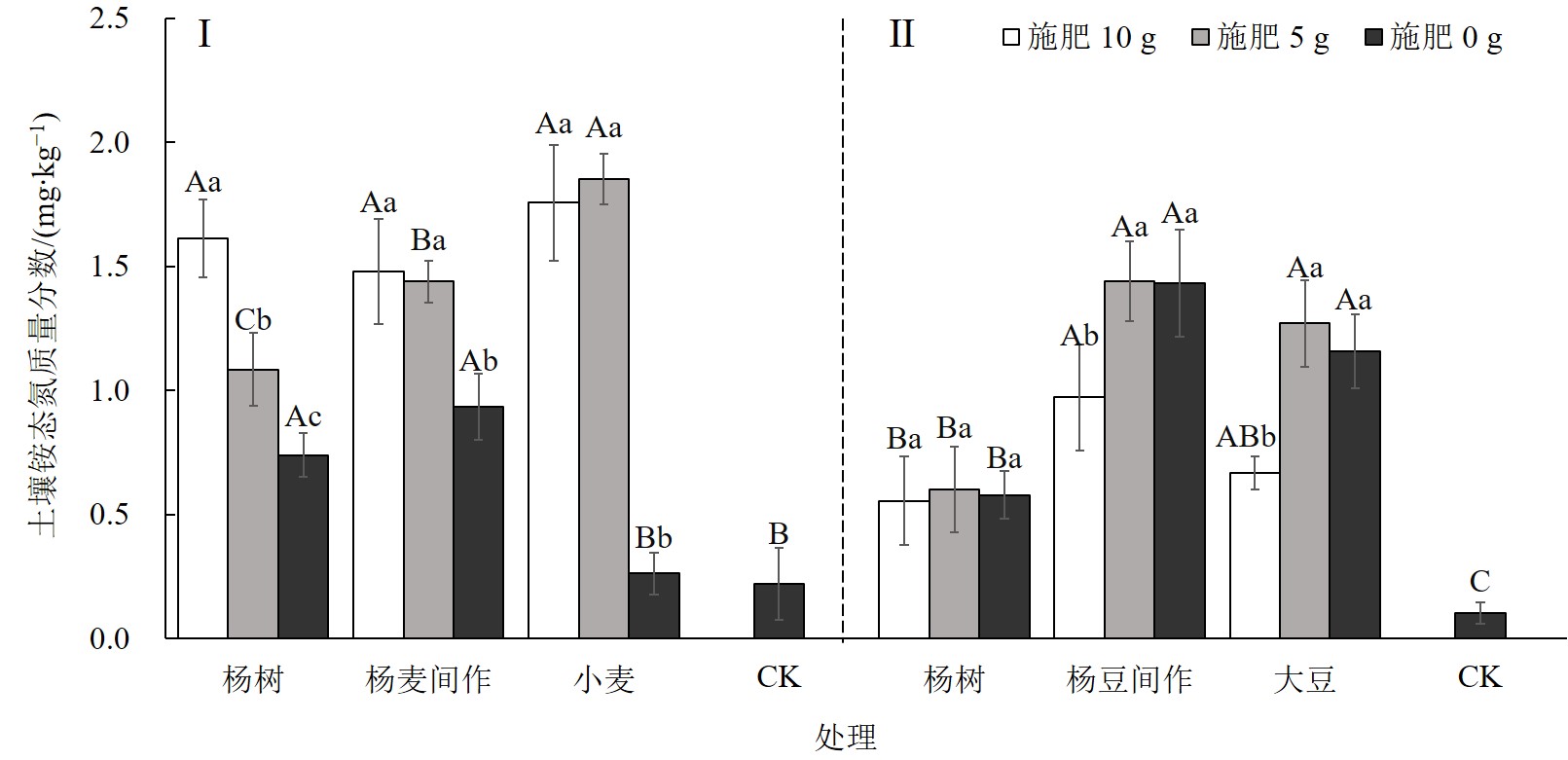
图2 不同种植模式和施肥量下的土壤铵态氮质量分数
Figure 2 Soil ammonium nitrogen mass fraction under different planting patterns and different fertilization amount
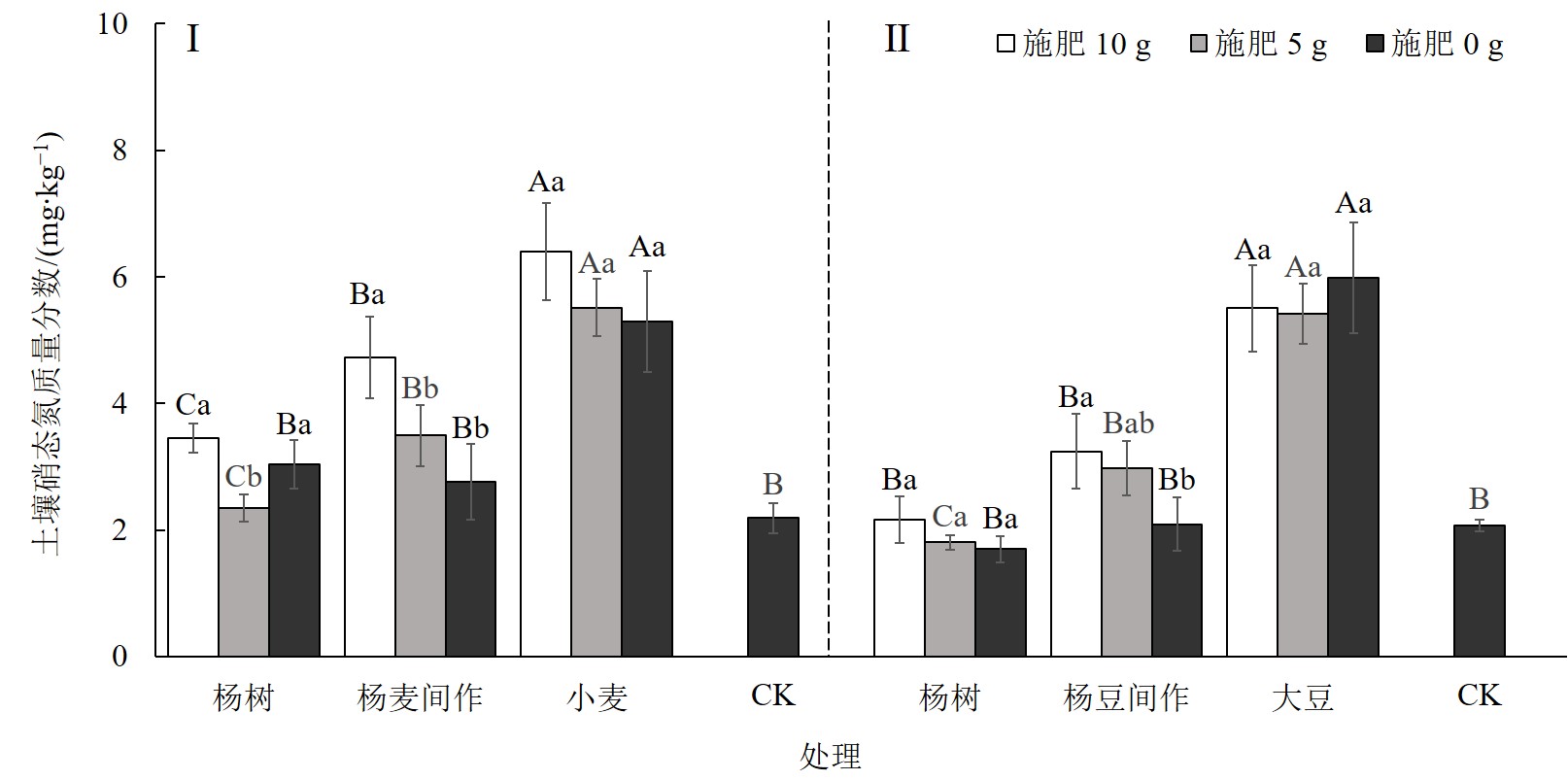
图3 不同种植模式和不同施肥量下的土壤硝态氮质量分数
Figure 3 Soil nitrate nitrogen mass fraction under different planting patterns and different fertilization amount
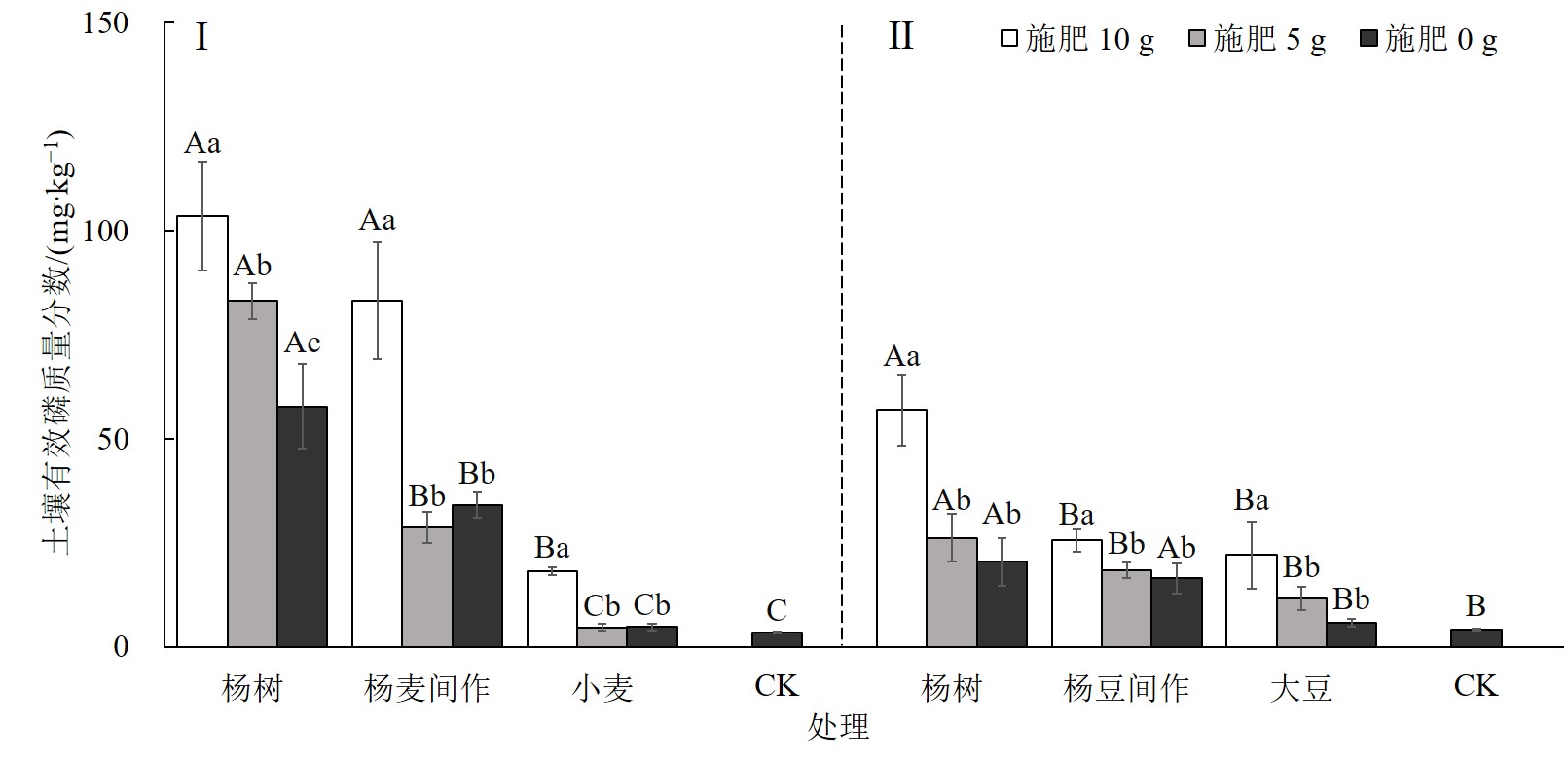
图4 不同种植模式和不同施肥量下的土壤有效磷质量分数
Figure 4 Soil available phosphorus mass fraction under different planting patterns and different fertilization amount
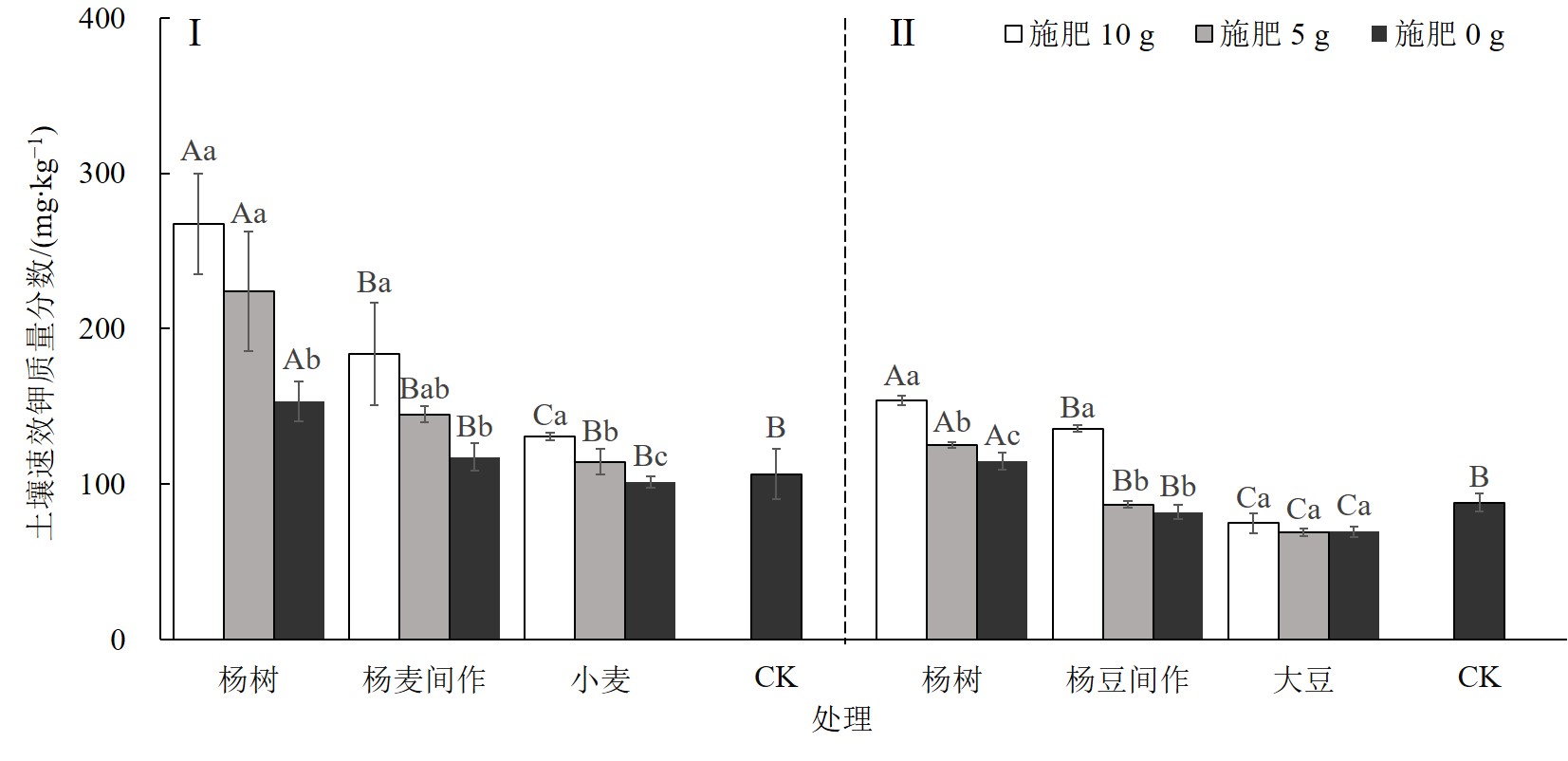
图5 不同种植模式和不同施肥量下的土壤速效钾质量分数
Figure 5 Soil available potassium mass fraction under different planting patterns and different fertilization amount
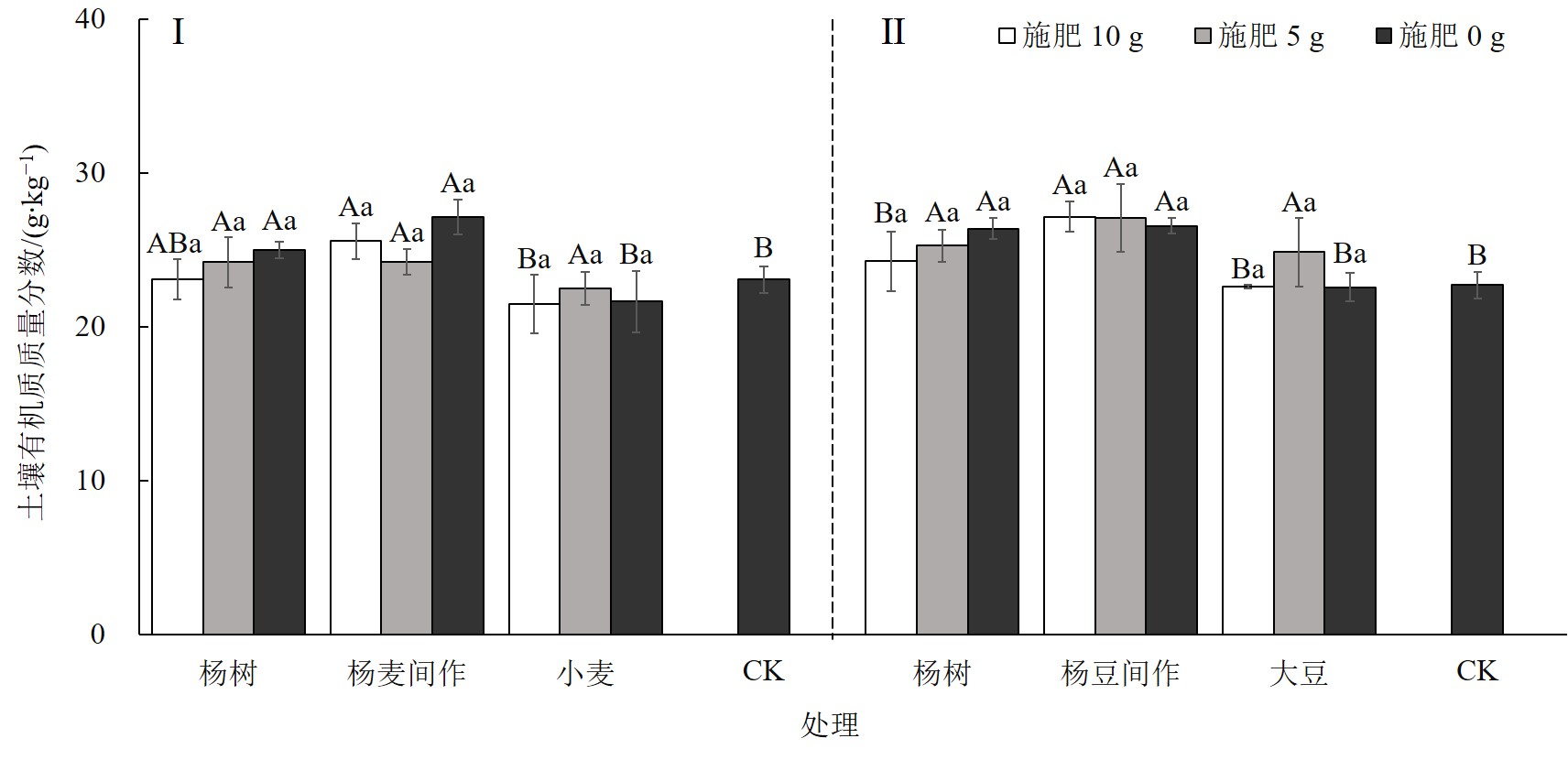
图6 不同种植模式和不同施肥量下的土壤有机质质量分数
Figure 6 Soil organic matter mass fraction under different planting patterns and different fertilization amount
| 处理 | 苗高/cm | 地径/mm |
|---|---|---|
| P10 | 311.2±17.8Aa | 23.9±0.6Aa |
| P5 | 302.3±17.0Aa | 21.1±0.7Ab |
| P0 | 245.7±14.9Ab | 15.3±0.4Ac |
| PA10 | 302.6±16.5Aa | 20.6±0.7Ba |
| PA5 | 268.4±7.0Bb | 18.0±0.3Bb |
| PA0 | 205.2±12.7Bc | 14.2±0.4Bc |
表2 不同种植模式和施肥量下的杨树生长量
Table 2 Poplar growth under different planting patterns and different fertilization amount
| 处理 | 苗高/cm | 地径/mm |
|---|---|---|
| P10 | 311.2±17.8Aa | 23.9±0.6Aa |
| P5 | 302.3±17.0Aa | 21.1±0.7Ab |
| P0 | 245.7±14.9Ab | 15.3±0.4Ac |
| PA10 | 302.6±16.5Aa | 20.6±0.7Ba |
| PA5 | 268.4±7.0Bb | 18.0±0.3Bb |
| PA0 | 205.2±12.7Bc | 14.2±0.4Bc |
| 处理 | 籽粒数/(grain·pot−1) | 千粒质量/g | 产量/(kg·hm−2) |
|---|---|---|---|
| 杨麦间作+施肥10g | 456.3±86.0Ba | 33.4±2.5Aab | 2308.9±487.0Ba |
| 杨麦间作+施肥5g | 226.7±34.5Bb | 34.7±1.4Aa | 1197.6±227.4Bb |
| 杨麦间作+施肥0g | 26.1±3.3Bc | 30.0±1.8Ab | 118.1±20.2Bc |
| 小麦单作+施肥10g | 928.2±137.4Aa | 35.3±1.2Aab | 4977.0±875.1Aa |
| 小麦单作+施肥5g | 525.3±66.8Ab | 37.8±2.9Aa | 2998.4±362.4Ab |
| 小麦单作+施肥0g | 152.0±20.7Ac | 32.0±2.6Ab | 735.1±57.1Ac |
表3 不同种植模式和施肥量下的小麦千粒质量和产量
Table 3 Thousand grain weight and yield of wheat under different planting patterns and different fertilization amount
| 处理 | 籽粒数/(grain·pot−1) | 千粒质量/g | 产量/(kg·hm−2) |
|---|---|---|---|
| 杨麦间作+施肥10g | 456.3±86.0Ba | 33.4±2.5Aab | 2308.9±487.0Ba |
| 杨麦间作+施肥5g | 226.7±34.5Bb | 34.7±1.4Aa | 1197.6±227.4Bb |
| 杨麦间作+施肥0g | 26.1±3.3Bc | 30.0±1.8Ab | 118.1±20.2Bc |
| 小麦单作+施肥10g | 928.2±137.4Aa | 35.3±1.2Aab | 4977.0±875.1Aa |
| 小麦单作+施肥5g | 525.3±66.8Ab | 37.8±2.9Aa | 2998.4±362.4Ab |
| 小麦单作+施肥0g | 152.0±20.7Ac | 32.0±2.6Ab | 735.1±57.1Ac |
| 处理 | 籽粒数/(grain·pot−1) | 百粒质量/g | 产量/(kg·hm−2) |
|---|---|---|---|
| 杨豆间作+施肥10 g | 71.0±13.9Ba | 16.6±1.8Aa | 1767.7±267.4Ba |
| 杨豆间作+施肥5 g | 69.3±11.0Ba | 15.1±1.7Aa | 1551.8±148.2Ba |
| 杨豆间作+施肥0 g | 63.2±15.5Ba | 14.2±1.4Aa | 1399.9±107.4Ba |
| 大豆单作+施肥10 g | 186.3±9.2Aa | 16.3±1.1Aa | 4601.3±311.9Aa |
| 大豆单作+施肥5 g | 120.0±11.1Ab | 16.2±0.5Aa | 2946.8±245.7Ab |
| 大豆单作+施肥0 g | 94.7±11.9Ac | 14.3±0.5Ab | 2054.1±187.9Ac |
表4 不同种植模式和施肥量下的大豆百粒质量和产量
Table 4 Hundred grain weight and yield of soybean under different planting patterns and different fertilization amount
| 处理 | 籽粒数/(grain·pot−1) | 百粒质量/g | 产量/(kg·hm−2) |
|---|---|---|---|
| 杨豆间作+施肥10 g | 71.0±13.9Ba | 16.6±1.8Aa | 1767.7±267.4Ba |
| 杨豆间作+施肥5 g | 69.3±11.0Ba | 15.1±1.7Aa | 1551.8±148.2Ba |
| 杨豆间作+施肥0 g | 63.2±15.5Ba | 14.2±1.4Aa | 1399.9±107.4Ba |
| 大豆单作+施肥10 g | 186.3±9.2Aa | 16.3±1.1Aa | 4601.3±311.9Aa |
| 大豆单作+施肥5 g | 120.0±11.1Ab | 16.2±0.5Aa | 2946.8±245.7Ab |
| 大豆单作+施肥0 g | 94.7±11.9Ac | 14.3±0.5Ab | 2054.1±187.9Ac |
| 施肥量 | Lp | La | L |
|---|---|---|---|
| 10 g | 0.93±0.01a | 0.44±0.07a | 1.37±0.04a |
| 5 g | 0.88±0.01b | 0.48±0.03a | 1.36±0.05ab |
| 0 g | 0.86±0.02b | 0.41±0.01a | 1.27±0.02b |
表5 不同施肥量下的杨农间作土地当量比
Table 5 Land equivalent ratio of poplar-crop intercropping under different fertilization amount
| 施肥量 | Lp | La | L |
|---|---|---|---|
| 10 g | 0.93±0.01a | 0.44±0.07a | 1.37±0.04a |
| 5 g | 0.88±0.01b | 0.48±0.03a | 1.36±0.05ab |
| 0 g | 0.86±0.02b | 0.41±0.01a | 1.27±0.02b |
| 植物性状 | pH | 铵态氮 | 硝态氮 | 有效磷 | 速效钾 | 有机质 |
|---|---|---|---|---|---|---|
| 小麦籽粒数 | −0.107 | 0.712 | 0.815* | −0.034 | 0.225 | −0.558 |
| 小麦千粒质量 | 0.045 | 0.768 | 0.592 | −0.280 | 0.074 | −0.571 |
| 小麦产量 | −0.067 | 0.731 | 0.814* | −0.072 | 0.191 | −0.568 |
| 大豆籽粒数 | −0.125 | −0.766 | 0.708 | 0.071 | −0.430 | −0.759 |
| 大豆百粒质量 | −0.847* | −0.637 | 0.229 | 0.614 | 0.442 | 0.030 |
| 大豆产量 | −0.200 | −0.783 | 0.675 | 0.138 | −0.368 | −0.707 |
| 杨树苗高 | −0.798 | 0.006 | 0.341 | 0.791 | 0.868* | −0.694 |
| 杨树地径 | −0.758 | 0.087 | 0.261 | 0.874* | 0.924** | −0.779 |
表6 土壤养分质量分数与农作物和杨树生长的相关性分析
Table 6 Correlation analysis between soil nutrient mass fraction and growth of crops and poplar seedlings
| 植物性状 | pH | 铵态氮 | 硝态氮 | 有效磷 | 速效钾 | 有机质 |
|---|---|---|---|---|---|---|
| 小麦籽粒数 | −0.107 | 0.712 | 0.815* | −0.034 | 0.225 | −0.558 |
| 小麦千粒质量 | 0.045 | 0.768 | 0.592 | −0.280 | 0.074 | −0.571 |
| 小麦产量 | −0.067 | 0.731 | 0.814* | −0.072 | 0.191 | −0.568 |
| 大豆籽粒数 | −0.125 | −0.766 | 0.708 | 0.071 | −0.430 | −0.759 |
| 大豆百粒质量 | −0.847* | −0.637 | 0.229 | 0.614 | 0.442 | 0.030 |
| 大豆产量 | −0.200 | −0.783 | 0.675 | 0.138 | −0.368 | −0.707 |
| 杨树苗高 | −0.798 | 0.006 | 0.341 | 0.791 | 0.868* | −0.694 |
| 杨树地径 | −0.758 | 0.087 | 0.261 | 0.874* | 0.924** | −0.779 |
| [1] |
Dollinger J, Jose S, 2018. Agroforestry for soil health[J]. Agroforestry Systems, 92(2): 213-219.
DOI |
| [2] |
Guo J H, Liu X J, Zhang Y, et al., 2010. Significant acidification in major Chinese croplands[J]. Science, 327(5968): 1008-1010.
DOI PMID |
| [3] |
Hildreth L A, 2008. The economic impacts of agroforestry in the northern plains of China[J]. Agroforestry Systems, 72(2): 119-126.
DOI URL |
| [4] | Mcrae S M, 2024. Agroforestry in temperate-climate commercial agriculture: Feedback from agroforestry practitioners in the Mid-Atlantic United States[J]. Elementa-Science of the Anthropocene, 12(1): 00136. |
| [5] |
Moreno G, Obrador J J, Garcia A, 2007. Impact of evergreen oaks on soil fertility and crop production in intercropped dehesas[J]. Agriculture Ecosystems and Environment, 119(3-4): 270-280.
DOI URL |
| [6] |
Panozzo A, Quataert P, De Swaef T, et al., 2026. A meta-analysis on the impact of trees on yield of intercrops in alley-cropping systems of temperate climates[J]. Agricultural Systems, 232: 104578.
DOI URL |
| [7] |
Rao M R, Willey R W, 1980. Evaluation of yield stability in intercropping: Studies on sorghum/pigeonpea[J]. Experimental Agriculture, 16(2): 105-116.
DOI URL |
| [8] |
Udawatta R P, Rankoth L M, Jose S, 2019. Agroforestry and biodiversity[J]. Sustainability, 11(10): 2879.
DOI URL |
| [9] |
Wanvestraut R H, Jose S, Nair P K R, et al., 2004. Competition for water in a pecan (Carya illinoensis K. Koch) - cotton (Gossypium hirsutum L.) alley cropping system in the southern United States[J]. Agroforestry Systems, 60(2): 167-179.
DOI URL |
| [10] |
Xu C, Qian Z Z, Wang B, et al., 2023. Effects of poplar agroforestry systems on soil nutrient and enzyme activity in the coastal region of eastern China[J]. Journal of Soils and Sediments, 23: 3108-3123.
DOI |
| [11] |
Yang T, Ouyang X Y, Wang B, et al., 2023. Understanding the effects of tree-crop intercropping systems on crop production in China by combining field experiments with a meta-analysis[J]. Agricultural Systems, 210: 103705.
DOI URL |
| [12] | Zomer R J, Trabucco A, Coe R, et al., 2014. Trees on farms: An update and reanalysis of agroforestry’s global extent and socio-ecological characteristics[C]// Working Paper 179, Bogor, Indonesia: World Agroforestry Centre (ICRAF) Southeast Asia Regional Program. |
| [13] | 蔡宇星, 黄山, 阳小凤, 等, 2025. 根瘤菌与施肥量对洞庭湖区春大豆生长与产量的影响[J]. 四川农业大学学报, 43(4): 975-984. |
| Cai Y X, Huang S, Yang X F, et al., 2025. Effects of rhizobia and fertilizer application rate on growth and yield of spring soybean in the Dongting Lake Area[J]. Journal of Sichuan Agricultural University, 43(4): 975-984. | |
| [14] | 蔡智才, 毕华兴, 许华森, 等, 2018. 晋西黄土区苹果花生间作系统小气候效应[J]. 干旱地区农业研究, 36(2): 234-241. |
| Cai Z C, Bi H X, Xu H S, et al., 2018. The microclimate effect of Malus pumila and Arachis hypogaea intercropping system in the loess plateau of West Shanxi Province[J]. Agricultural Research in the Arid Areas, 36(2): 234-241. | |
| [15] | 方升佐, 徐锡增, 吕士行, 2004. 杨树定向培育[M]. 合肥: 安徽科学技术出版社. |
| Fang S Z, Xu X Z, Lü S X, 2004. Poplar cultivation under target determination[M]. Hefei: Anhui Science and Technology Publishing House. | |
| [16] | 富丰珍, 徐程扬, 李广德, 2010. 我国杨树林农复合经营现状及存在的问题[J]. 西北林学院学报, 25(2): 221-224. |
| Fu F Z, Xu C Y, Li G D, 2010. Current situations and problems in the agroforestry management model of poplar plantation in China[J]. Journal of Northwest Forestry University, 25(2): 221-224. | |
| [17] |
洪壮壮, 曾占奎, 宋俊乔, 等, 2024. 小麦籽粒钙和钾含量的QTL定位及遗传效应分析[J]. 华北农学报, 39(4): 37-46.
DOI |
|
Hong Z Z, Zeng Z K, Song J Q, et al., 2024. QTL mapping and genetic effect analysis of calcium and potassium content in wheat grain[J]. Acta Agriculturae Boreali-Sinica, 39(4): 37-46.
DOI |
|
| [18] | 李俊祥, 宛志沪, 2002. 淮北平原杨-麦间作系统的小气候效应与土壤水分变化研究[J]. 应用生态学报, 13(4): 390-394. |
| Li J X, Wan Z H, 2002. Microclimatic effect and soil moisture change of poplar-wheat intercropping systems in Huaibei Plain[J]. Chinese Journal of Applied Ecology, 13(4): 390-394. | |
| [19] | 李玫, 王天华, 魏刚, 等, 1995. 杨树、刺槐混交及缺钾情况下对矿物钾的利用[J]. 北京林业大学学报, 17(2): 99-103. |
| Li M, Wang T H, Wei G, et al., 1995. Studies on the uptake of mineral K by mixed plantings of poplar and black locust under K-deficiency[J]. Journal of Beijing Forestry University, 17(2): 99-103. | |
| [20] |
祁雪连, 葛晓敏, 钱壮壮, 等, 2021. 武夷山天然针阔混交林与毛竹人工林土壤性质差异[J]. 生态环境学报, 30(8): 1599-1606.
DOI |
| Qi X L, Ge X M, Qian Z Z, et al., 2021. Differences of soil properties between natural mixed coniferous and broad-leaved forest and Moso bamboo plantation in Wuyi Mountains[J]. Ecology and Environmental Sciences, 30(8): 1599-1606. | |
| [21] | 滕应, 沈仁芳, 李九玉, 等, 2025. 中国耕地土壤酸化现状、研究进展与重点方向[J]. 土壤, 57(6): 1219-1227. |
| Teng Y, Shen R F, Li J Y, et al., 2025. Current situation, research progress and key directions of soil acidification in cultivated land in China[J]. Soils, 57(6): 1219-1227. | |
| [22] | 魏万玲, 2024. 施肥与根瘤菌对黑土大豆根际微生物组的影响及固氮溶磷菌群构建[D]. 北京: 中国农业科学院. |
| Wei W L, 2024. Effects of fertilization and rhizobium on rhizosphere microbiome of soybean in black soil and construction of nitrogen-fixing and phosphorus-solubilizing bacterial community[D]. Beijing: Chinese Academy of Agricultural Sciences. | |
| [23] |
魏勇, 张焕朝, 张金龙, 2003. 杨树根际土壤磷的分布特征及其有效性[J]. 南京林业大学学报(自然科学版), 27(5): 20-24.
DOI |
| Wei Y, Zhang H C, Zhang J L, 2003. Poplar root-induced distribution characteristics of soil phosphorus and its availability[J]. Journal of Nanjing Forestry University (Natural Sciences Edition), 27(5): 20-24. | |
| [24] | 吴存荣, 魏立立, 乔丽娜, 等, 2018. 谷物与豆类千粒重的测定: GB/T 5519-2018[S]. 北京: 中国标准出版社: 1-7. |
| Wu C R, Wei L L, Qiao L N, et al., 2018. Cereals and pulses- Determination of the mass of 1000 grains: GB/T 5519-2018[S]. Beijing: China Standard Press: 1-7. | |
| [25] | 夏玄, 2018. 氮素营养对大豆结瘤固氮及相关调控物质影响的研究[D]. 哈尔滨: 东北农业大学. |
| Xia X, 2018. Study on the effect of nitrogen nutrition on soybean nodulation and nitrogen fixation and related regulation substances[D]. Harbin: Northeast Agricultural University. | |
| [26] | 许华森, 毕华兴, 高路博, 等, 2014. 晋西黄土区苹果+大豆间作系统小气候及其对作物生产力的影响[J]. 中国水土保持科学, 12(2): 9-15. |
| Xu H S, Bi H X, Gao L B, et al., 2014. Microclimate and its effects on crop productivity in the Malus pumila and Glycine max intercropping systems on the Loess Plateau of West Shanxi Province[J]. Science of Soil and Water Conservation, 12(2): 9-15. | |
| [27] | 杨灿, 李建军, 黄静, 等, 2017. 洞庭湖洲滩人工林林农复合经营模式与综合效益研究[J]. 中南林业科技大学学报, 37(5): 106-112. |
| Yang C, Li J J, Huang J, et al., 2017. Research of agroforestry compound management model and general benefits on Dongting Lake marshland plantation[J]. Journal of Central South University of Forestry and Technology, 37(5): 106-112. | |
| [28] | 张焕朝, 王改萍, 徐锡增, 等, 2003. 根际酸化作用对杨树无性系磷营养效率的影响[J]. 应用生态学报, 14(10): 1607-1611. |
| Zhang H C, Wang G P, Xu X Z, et al., 2003. Effects of rhizosphere acidification on phosphorus efficiency in clones of poplar[J]. Chinese Journal of Applied Ecology, 14(10): 1607-1611. | |
| [29] | 张占田, 樊兆博, 冷伟锋, 等, 2025. 硅钙钾镁肥对小麦土壤、产量、养分利用的影响[J]. 中国土壤与肥料 (5): 141-153. |
| Zhang Z T, Fan Z B, Leng W F, et al., 2025. Effects of silicon-calcium-potassium-magnesium fertilizer on wheat soil, yield and nutrient utilization[J]. Soil and Fertilizer Sciences in China (5): 141-153. | |
| [30] |
周苗苗, 汤锐恒, 台玉莹, 等, 2023. 大豆钾营养及其分子调控机制研究进展[J]. 中国油料作物学报, 45(3): 444-453.
DOI |
| Zhou M M, Tang R H, Tai Y Y, et al., 2023. Research progress on potassium nutrient and molecular regulatory mechanism of soybean[J]. Chinese Journal of Oil Crop Sciences, 45(3): 444-453. |
| [1] | 曹云, 程春香, 陈紫璇, 博宇, 孙应龙, 于敏. 东北林区固碳能力时空分异特征及其气候驱动研究[J]. 生态环境学报, 2026, 35(9): 1329-1341. |
| [2] | 张继, 杨世琦, 张天宇, 刘志强, 敖杨. 基于CASA-GSMSR模型的重庆市NEP时空演变特征及驱动因素分析[J]. 生态环境学报, 2026, 35(9): 1342-1355. |
| [3] | 王湘阳, 李晨华, 梁萌, 刘燕. 灰漠土开垦与长期施肥对土壤nifH基因多样性的影响[J]. 生态环境学报, 2026, 35(8): 1256-1266. |
| [4] | 秦美欧, 姜鹏, 温日红, 朱梦媛, 杨霏云, 冯艾琳, 方缘, 蔡福. 大气干旱对中国典型温带生态系统植被生产力的影响[J]. 生态环境学报, 2026, 35(7): 1037-1044. |
| [5] | 姚旭兵, 张玲, 车四方, 邓晓霞. 数字乡村建设对农业生态效率的影响研究[J]. 生态环境学报, 2026, 35(7): 1045-1058. |
| [6] | 蔡娜娜, 吴柳翠, 刘志晖, 钱龙, 杨梅花, 王孟谍, 杨国姣, 胡中民. 不同降水背景下氮水添加对内蒙古温带典型草原生态系统生产力的影响[J]. 生态环境学报, 2026, 35(6): 939-947. |
| [7] | 陈煖杏, 向云燕, 廖敬, 杨元征, 俎佳星. 中国草地峰值物候特征时空变化及其影响因素分析[J]. 生态环境学报, 2026, 35(5): 679-690. |
| [8] | 张涛, 杨慧, 曹建华, 周孟霞, 康志强. 基于岩性分区的广西植被净生态系统生产力时空演变特征研究[J]. 生态环境学报, 2026, 35(5): 702-713. |
| [9] | 鲁濠, 曹广超, 苏万峰, 赵美亮, 薛峰. 共和盆地植被总初级生产力对干旱的响应[J]. 生态环境学报, 2026, 35(4): 509-519. |
| [10] | 程文杰, 倪用鑫, 吕锡芝, 马力, 张秋芬, 王建伟, 张恒硕, 邓文彦. 黄河源区植被总生产力对气候干旱的响应[J]. 生态环境学报, 2026, 35(3): 393-402. |
| [11] | 余燕鞠, 丁雪. 滇中城市群森林植被净初级生产力时空变化特征及其影响因素研究[J]. 生态环境学报, 2026, 35(2): 209-222. |
| [12] | 许达, 宫程程, 张在勇, 冉彬, 胡月, 王寒冰, 陈晨. 毛乌素沙地植被净初级生产力的时空变化规律及影响因素[J]. 生态环境学报, 2025, 34(9): 1361-1372. |
| [13] | 丁馨, 刘健, 魏俐宏, 解德威, 郑昭佩. 基于GSMSR模型的山东省植被NEP时空格局及影响因素[J]. 生态环境学报, 2025, 34(7): 1079-1089. |
| [14] | 袁艳峰, 胡永红, 王鹤松, 鲁显楷, 侯美亭, 贾根锁. 高温热浪对北欧极地植被生产力的影响[J]. 生态环境学报, 2025, 34(6): 831-844. |
| [15] | 宋双双, 秦世姣, 孙彭成, 付兴涛. 基于多源遥感数据的汾河流域植被碳汇量估算及预测[J]. 生态环境学报, 2025, 34(3): 345-357. |
| 阅读次数 | ||||||
|
全文 |
|
|||||
|
摘要 |
|
|||||
