
生态环境学报 ›› 2026, Vol. 35 ›› Issue (9): 1423-1435.DOI: 10.16258/j.cnki.1674-5906.2026.09.009
江天杰( ), 杨昊*(), 张欢, 文武
收稿日期:2025-10-23
修回日期:2026-04-09
接受日期:2026-07-31
出版日期:2026-09-18
发布日期:2026-09-16
通讯作者:
杨昊, E-mail: 作者简介:江天杰(1997年生),男,硕士研究生,研究方向为智慧气象。E-mail: 3230604018@stu.cuit.edu.cn
基金资助:
Jiang Tianjie(), Yang Hao*(), Zhang Huan, Wen Wu
Received:2025-10-23
Revised:2026-04-09
Accepted:2026-07-31
Online:2026-09-18
Published:2026-09-16
摘要:
【目的】针对卫星气溶胶光学厚度(AOD)反演地面PM2.5现有方法在特征差异化建模和物理约束引入方面的不足,提出一种融合物理约束的UNet-LSTM时空反演模型,旨在解决地面监测站点分布稀疏导致的数据不连续问题,提升反演结果的精度、物理合理性与可解释性。【方法】模型以UNet编码-解码结构结构为主干,利用卷积块注意力机制(CBAM)自适应强化关键空间特征响应,并结合长短期记忆网络(LSTM)捕捉PM2.5的时序动态变化。同时,将大气平流-扩散方程以物理约束形式嵌入损失函数,在数据驱动的基础上确保预测结果的物理一致性与泛化能力。研究以四川盆地2015-2020年为研究区域,开展了样本、时间与站点三重交叉验证。【结果】实验结果显示,该模型在样本、时间、站点交叉验证中的R2分别达到0.87、0.86和0.83。与CNN、LSTM、Conv-LSTM等主流深度模型相比,R2提升了5%-11%,RMSE与MAE分别降低了5%-25%和6%-23%。时空分布分析与典型污染过程追踪表明,模型能够稳定重建四川盆地PM2.5的空间连续分布,并准确反映污染积累与消散的动态演变。【结论】融合物理机理与时空特征的深度建模框架可显著提升AOD反演PM2.5的精度与物理一致性,为区域空气质量监测与污染防控提供了新的技术支撑。
中图分类号:
江天杰, 杨昊, 张欢, 文武. 基于遥感和物理约束时空模型估算地面PM2.5浓度[J]. 生态环境学报, 2026, 35(9): 1423-1435.
Jiang Tianjie, Yang Hao, Zhang Huan, Wen Wu. Estimating Ground-Level PM2.5 Concentrations Using a Remote Sensing-Based Spatiotemporal Model with Physical Constraints[J]. Ecology and Environmental Sciences, 2026, 35(9): 1423-1435.
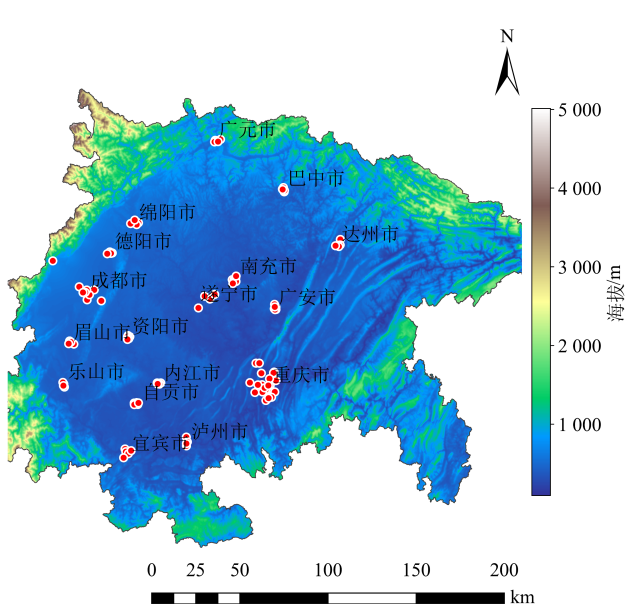
图1 四川盆地的PM2.5监测点分布 所有涉及四川盆地行政边界的插图(图1和图6-9)均标注来源于“国家地理信息公共服务平台(天地图服务中心)”(https://cloudcenter.tianditu.gov.cn/administrativeDivision/),审图号:GS(2024)0650号)
Figure 1 Distribution of PM2.5 monitoring stations in the Sichuan Basin
| 变量类别 | 变量名称 | 时间分辨率 | 空间分辨率 | 单位 | 数据来源 |
|---|---|---|---|---|---|
| PM2.5数据 | PM2.5 | 小时 | - | μg·m−3 | CNEMC |
| AOD数据 | AOD | 日 | 1 km | - | LGAPH |
| 气象数据 | T2M | 日 | 0.25° | K | ERA5 |
| U | 日 | 0.25° | m·s−1 | ||
| V | 日 | 0.25° | m·s−1 | ||
| RH | 日 | 0.25° | % | ||
| SP | 日 | 0.25° | Pa | ||
| PBLH | 日 | 0.25° | m | ||
| 其他数据 | DEM | 年 | 90 m | m | SRTM |
| NDVI | 月 | 1 km | - | MOD13A3 | |
| Landuse | 年 | 30 m | - | GLC_FCS30D | |
| lon | - | - | ° | - | |
| lat | - | - | ° | - |
表1 实验数据
Table 1 Summary of experimental data
| 变量类别 | 变量名称 | 时间分辨率 | 空间分辨率 | 单位 | 数据来源 |
|---|---|---|---|---|---|
| PM2.5数据 | PM2.5 | 小时 | - | μg·m−3 | CNEMC |
| AOD数据 | AOD | 日 | 1 km | - | LGAPH |
| 气象数据 | T2M | 日 | 0.25° | K | ERA5 |
| U | 日 | 0.25° | m·s−1 | ||
| V | 日 | 0.25° | m·s−1 | ||
| RH | 日 | 0.25° | % | ||
| SP | 日 | 0.25° | Pa | ||
| PBLH | 日 | 0.25° | m | ||
| 其他数据 | DEM | 年 | 90 m | m | SRTM |
| NDVI | 月 | 1 km | - | MOD13A3 | |
| Landuse | 年 | 30 m | - | GLC_FCS30D | |
| lon | - | - | ° | - | |
| lat | - | - | ° | - |
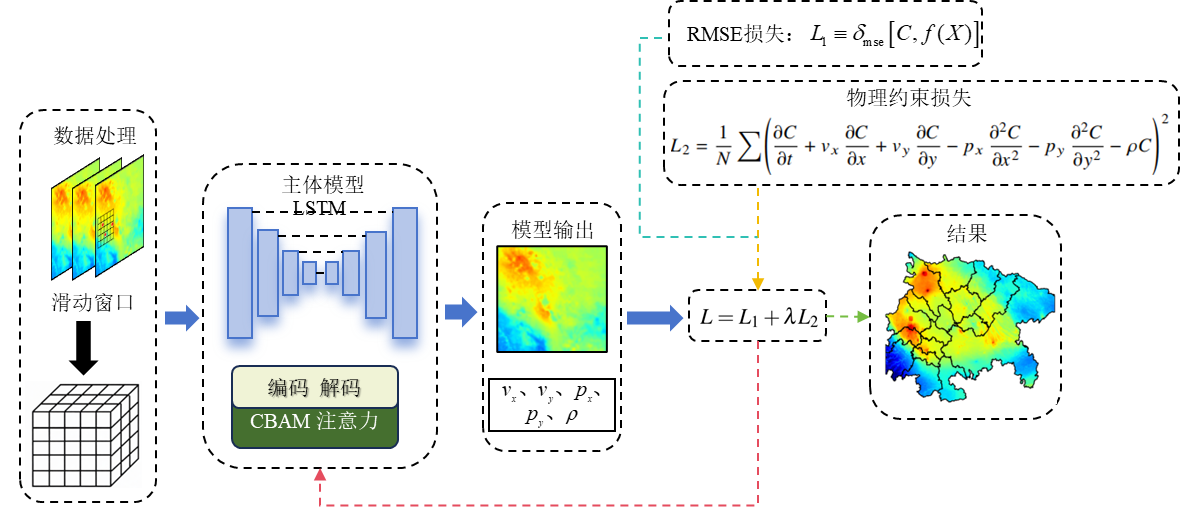
图2 模型架构图
Figure 2 Model architecture diagram
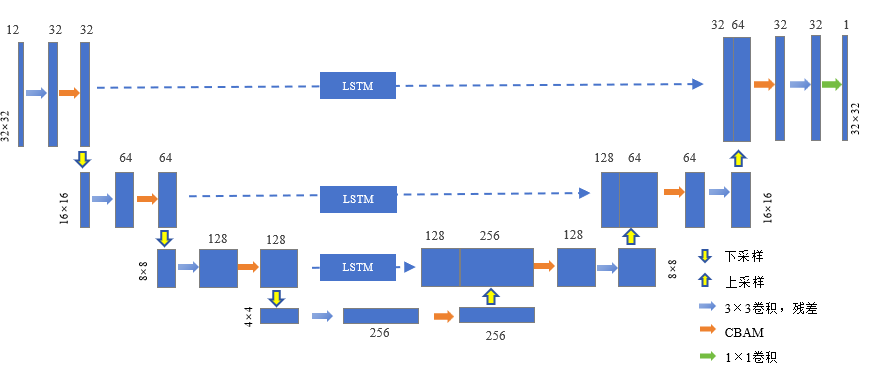
图3 模型主体图
Figure 3 Main body diagram of the model
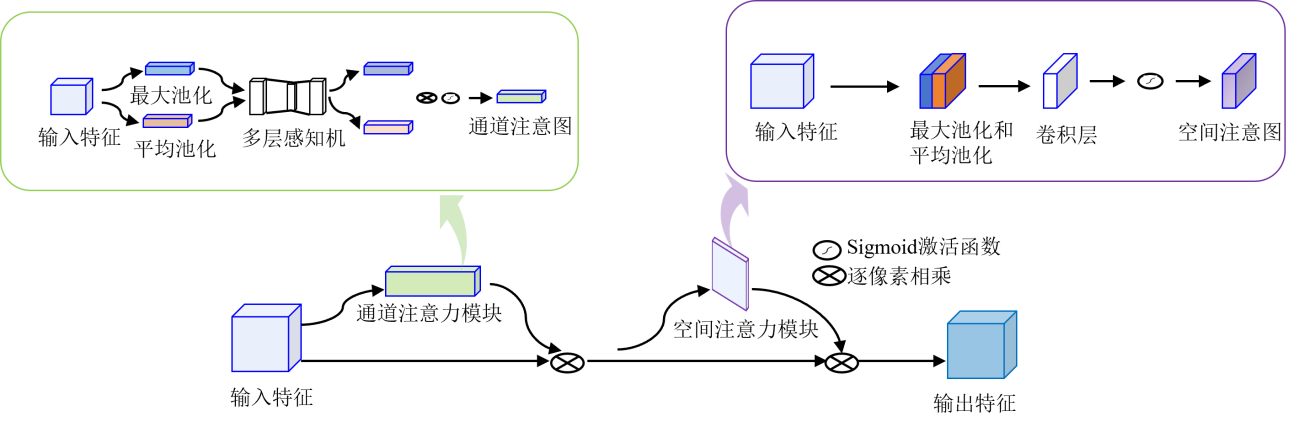
图4 卷积块注意力模块
Figure 4 Convolutional block attention module
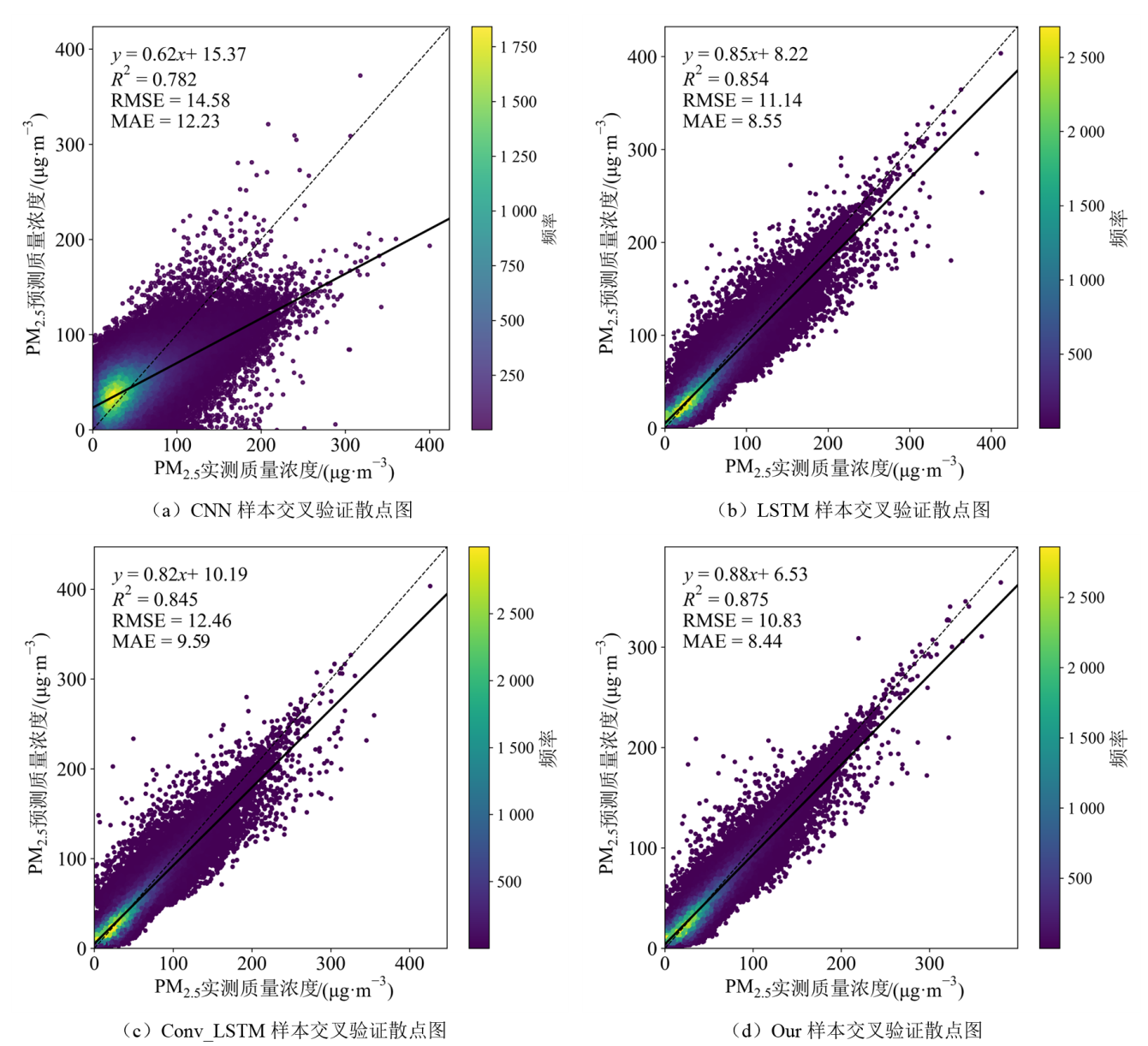
图5 不同模型样本交叉验证散点图
Figure 5 Scatter plots of sample cross-validation for different models
| 模型 | 时间交叉验证 | 站点交叉验证 | |||||
|---|---|---|---|---|---|---|---|
| R2 | RMSE | MAE | R2 | RMSE | MAE | ||
| CNN | 0.77 | 16.58 | 13.23 | 0.74 | 19.75 | 14.39 | |
| LSTM | 0.82 | 14.93 | 10.76 | 0.79 | 18.61 | 12.28 | |
| Conv-LSTM | 0.83 | 15.87 | 11.05 | 0.81 | 16.48 | 13.78 | |
| our | 0.86 | 12.46 | 9.59 | 0.83 | 13.70 | 12.92 | |
表2 不同模型时间和站点交叉验证交结果
Table 2 Temporal and station-based cross-validation results of different models
| 模型 | 时间交叉验证 | 站点交叉验证 | |||||
|---|---|---|---|---|---|---|---|
| R2 | RMSE | MAE | R2 | RMSE | MAE | ||
| CNN | 0.77 | 16.58 | 13.23 | 0.74 | 19.75 | 14.39 | |
| LSTM | 0.82 | 14.93 | 10.76 | 0.79 | 18.61 | 12.28 | |
| Conv-LSTM | 0.83 | 15.87 | 11.05 | 0.81 | 16.48 | 13.78 | |
| our | 0.86 | 12.46 | 9.59 | 0.83 | 13.70 | 12.92 | |
| 模型 | R2 | RMSE | MAE |
|---|---|---|---|
| Baseline | 0.79 | 16.62 | 14.63 |
| B_CBAM | 0.82 | 14.37 | 13.25 |
| B_CBAM&Phy/ours | 0.87 | 11.21 | 8.83 |
表3 模型消融实验结果
Table 3 Model ablation experiment results
| 模型 | R2 | RMSE | MAE |
|---|---|---|---|
| Baseline | 0.79 | 16.62 | 14.63 |
| B_CBAM | 0.82 | 14.37 | 13.25 |
| B_CBAM&Phy/ours | 0.87 | 11.21 | 8.83 |
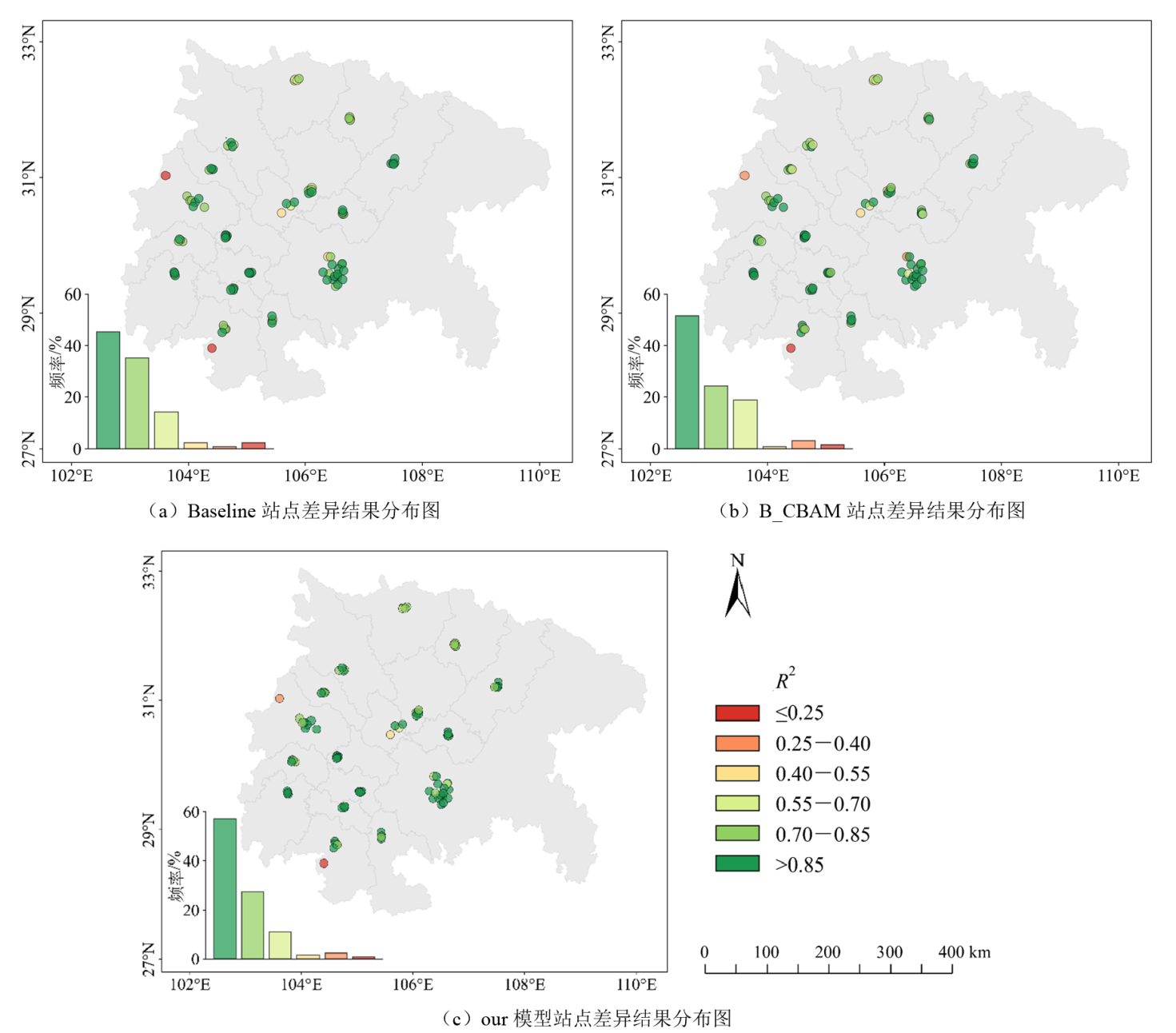
图6 模型不同模块站点差异结果分布图
Figure 6 Distribution of station-wise differences across model modules
| 指标影响程度 | AOD | SP | T2M | DEM | RH | PBLH | NDVI | V | U | Landuse |
|---|---|---|---|---|---|---|---|---|---|---|
| 重要性 | 40.63% | 15.75% | 12.38% | 10.22% | 8.53% | 5.05% | 3.61% | 1.32% | 1.08% | 0.84% |
| 对R2的影响 | 0.338 | 0.131 | 0.103 | 0.085 | 0.071 | 0.042 | 0.030 | 0.011 | 0.009 | 0.007 |
| 对RMSE的影响 | 12.27 | 7.68 | 4.36 | 5.53 | 3.84 | 2.58 | 1.93 | 1.85 | 1.28 | 1.21 |
表4 特征重要性分析
Table 4 Feature importance analysis
| 指标影响程度 | AOD | SP | T2M | DEM | RH | PBLH | NDVI | V | U | Landuse |
|---|---|---|---|---|---|---|---|---|---|---|
| 重要性 | 40.63% | 15.75% | 12.38% | 10.22% | 8.53% | 5.05% | 3.61% | 1.32% | 1.08% | 0.84% |
| 对R2的影响 | 0.338 | 0.131 | 0.103 | 0.085 | 0.071 | 0.042 | 0.030 | 0.011 | 0.009 | 0.007 |
| 对RMSE的影响 | 12.27 | 7.68 | 4.36 | 5.53 | 3.84 | 2.58 | 1.93 | 1.85 | 1.28 | 1.21 |

图7 2015-2020年四川盆地PM2.5年均时空分布图
Figure 7 Spatial-temporal distribution of annual average PM2.5 in the Sichuan Basin from 2015 to 2020

图8 四川盆地季均PM2.5时空分布图
Figure 8 Spatiotemporal distribution of seasonal mean PM2.5 in the Sichuan Basin

图9 2020年12月20-28日四川盆地空气污染过程
Figure 9 Air pollution process in the Sichuan Basin from December 20 to 28, 2020
| [1] |
Bai K X, Li K, Ma M L, et al., 2022. LGHAP: The Long-term Gap-free High-resolution Air Pollutant concentration dataset, derived via tensor-flow-based multimodal data fusion[J]. Earth System Science Data, 14(2): 907-927.
DOI URL |
| [2] |
Bai M L, Fang Z L, Tao S Y, et al., 2025. Ultrafast 24-h solar irradiance forecasts outperform numerical weather predictions across the USA[J]. Cell Reports Physical Science, 6(12): 102996.
DOI URL |
| [3] | Ding Y, Li S W, Xing J, et al., 2025. Global hourly seamless AOD through measurement-adjusted machine learning fusion of multi-satellite and reanalysis data[J]. GIScience & Remote Sensing, 62(1): 2586203. |
| [4] | Hu H T, Qi L H, Chao X J, 2024. Physics-informed Neural Networks (PINN) for computational solid mechanics: Numerical frameworks and applications[J]. Thin-Walled Structures, 205(Part B): 112495. |
| [5] | Lalaeng S, Thanasang T, Puttinet P, et al., 2024. The relationship between PM2.5 and solar cell electricity generation using aerosol optical depth (AOD)[J]. International Journal of Geoinformatics, 21(1): 83-96. |
| [6] |
Lawal Z K, Yassin H, Lai D T C, et al., 2022. Physics-informed neural network (PINN) evolution and beyond: A systematic literature review and bibliometric analysis[J]. Big Data and Cognitive Computing, 6(4): 140.
DOI URL |
| [7] |
Li C, Van Donkelaar A, Hm S, et al., 2023. Reversal of trends in global fine particulate matter air pollution[J]. Nature Communications, 14: 5349.
DOI PMID |
| [8] |
Li X D, Jin L, Kan H D, 2019. Air pollution: A global problem needs local fixes[J]. Nature, 570(7762): 437-439.
DOI |
| [9] |
Liao T T, Gui K, Jiang W T, et al., 2018. Air stagnation and its impact on air quality during winter in Sichuan and Chongqing, southwestern China[J]. Science of the Total Environment, 635: 576-585.
DOI URL |
| [10] |
Lin C Q, Li Y, Yuan Z B, et al., 2015. Using satellite remote sensing data to estimate the high-resolution distribution of ground-level PM2.5[J]. Remote Sensing of Environment, 156: 117-128.
DOI URL |
| [11] | Liu L Y, Zhang X, Zhao T, 2023. GLC_FCS30D: The first global 30-m land-cover dynamic monitoring product with fine classification system from 1985 to 2022[DB/OL]. Zenodo. [2025-07-03]. https://zenodo.org/records/8239305. |
| [12] |
Liu Y, Franklin M, Kahn R, et al., 2007. Using aerosol optical thickness to predict ground-level PM2.5 concentrations in the St. Louis area: A comparison between MISR and MODIS[J]. Remote Sensing of Environment, 107(1-2): 33-44.
DOI URL |
| [13] |
Liu Y L, Shi G M, Yang F M, 2025. Air pollution deterioration prior to dissipation induced by complex topography: A case study in the Sichuan Basin, southwestern China[J]. Atmospheric Research, 320: 108071.
DOI URL |
| [14] |
Li L F, Wang J F, Franklin M, et al., 2023. Improving air quality assessment using physics-inspired deep graph learning[J]. npj Climate and Atmospheric Science, 6: 152.
DOI |
| [15] | Pedlosky J, 1987. Geophysical Fluid Dynamics[M]. 2nd edition. New York: Springer: 10-13. |
| [16] | Shen S Y, Li C, Van Donkelaar A, et al., 2024. Enhancing global estimation of fine particulate matter concentrations by including geophysical a priori information in deep learning[J]. American Chemical Society, 1(5): 332-345. |
| [17] |
Song Z J, Fu D S, Zhang X L, et al., 2019. MODIS AOD sampling rate and its effect on PM2.5 estimation in North China[J]. Atmospheric Environment, 209: 14-22.
DOI URL |
| [18] |
Ulfah S, Awalludin S A, Wahidin, 2018. Advection-diffusion model for the simulation of air pollution distribution from a point source emission[J]. Journal of Physics: Conference Series, 948: 012067.
DOI URL |
| [19] |
Wan C, Xu H F, Luo W H, et al., 2025. Estimation of regional PM2.5 concentration in China based on fine-mode aerosol optical thickness (AODf) and study of influencing factors[J]. Atmospheric Environment, 344: 121026.
DOI URL |
| [20] | Yao F, Wu J S, Li W F, et al., 2019. A spatially structured adaptive two-stage model for retrieving ground-level PM2.5 concentrations from VIIRS AOD in China[J]. Photogrammetric Engineering & Remote Sensing, 151: 263-276. |
| [21] |
Zeng Q L, Chen L F, Zhu H, et al., 2018. Satellite-based estimation of hourly PM2.5 concentrations using a vertical-humidity correction method from himawari-AOD in Hebei[J]. Sensors, 18(10): 3456.
DOI URL |
| [22] | Zhao B, Wang S S, Hao J M, 2024. Challenges and perspectives of air pollution control in China[J]. Frontiers of Environmental Science & Engineering, 18: 68. |
| [23] |
Zheng H T, Wu D, Wang S X, et al., 2025. Control of toxicity of fine particulate matter emissions in China[J]. Nature, 643: 404-411.
DOI |
| [24] | 陈镔捷, 叶扬, 林溢, 等, 2022. 耦合注意力机制DNN的PM2.5估算及时空特征分析[J]. 遥感学报, 26(5): 1027-1038. |
| Chen B J, Ye Y, Lin Y, et al., 2022. PM2.5 estimation and spatiotemporal feature analysis using an attention-mechanism-coupled DNN[J]. Journal of Remote Sensing, 26(5): 1027-1038. | |
| [25] | 陈艺敏, 苏漳文, 陈移萍, 等, 2024. 基于地理加权随机森林的长三角PM2.5建模[J]. 中国环境科学, 44(8): 4240-4248. |
| Chen Y M, Su Z W, Chen Y P, et al., 2024. PM2.5 modeling in the Yangtze River Delta based on geographically weighted random forest[J]. China Environmental Science, 44(8): 4240-4248. | |
| [26] | 杜筱筱, 冯勇, 成翔, 等, 2023. 四川盆地两次区域污染过程对比分析[J]. 农业灾害研究, 13(10): 282-286. |
| Du X X, Feng Y, Cheng X, et al., 2023. Comparative analysis of two regional pollution episodes in the Sichuan Basin[J]. Journal of Agricultural Disaster Research, 13(10): 282-286. | |
| [27] |
黄怡容, 熊秋林, 等, 2024. 基于CNN-LSTM的鄱阳湖生态经济区大气污染物时空预测[J]. 生态环境学报, 33(12): 1891-1901.
DOI |
| Huang Y R, Xiong Q L, et al., 2024. Spatiotemporal prediction of air pollutants in the Poyang Lake Eco-economic Zone based on CNN-LSTM[J]. Ecology and Environmental Sciences, 33(12): 1891-1901. | |
| [28] | 李啸天, 吴绍华, 徐于月, 等, 2017. 江苏省PM2.5质量浓度的时空变化格局模拟[J]. 环境监测与管理技术, 29(2): 16-20. |
| Li X T, Wu S H, Xu Y Y, et al., 2017. Simulation of spatiotemporal variation patterns of PM2.5 mass concentration in Jiangsu Province[J]. Environmental Monitoring and Management Technology, 29(2): 16-20. | |
| [29] | 刘倩, 王兆茹, 胥寒莉, 等, 2025. 基于粒子群优化XGBoost模型的PM2.5质量浓度反演[J]. 环境科学, 46(8): 5023-5034. |
| Liu Q, Wang Z R, Xu H L, et al., 2025. Retrieval of PM2.5 mass concentration based on a particle swarm optimization XGBoost model[J]. Environmental Science, 46(8): 5023-5034. | |
| [30] |
王聪聪, 张小玲, 雷雨, 等, 2024. 基于WRF-CMAQ模型的四川盆地春季持续臭氧污染过程中PM2.5组分解析[J]. 生态环境学报, 33(8): 1214-1226.
DOI |
| Wang C C, Zhang X L, Lei Y, et al., 2024. Analysis of PM2.5 components during continuous spring pollution in Sichuan Basin based on WRF-CMAQ model[J]. Ecology and Environmental Sciences, 33(8): 1214-1226. | |
| [31] | 赵天良, 舒卓智, 郑小波, 等, 2022. 四川盆地大气气溶胶污染时空变化的地形影响研究进展[J]. 高原山地气象研究, 42(4): 1-8. |
| Zhao T L, Shu Z Z, Zheng X B, et al., 2022. Research progress on topographic impacts on spatiotemporal variations of aerosol pollution in the Sichuan Basin[J]. Plateau and Mountain Meteorology Research, 42(4): 1-8. | |
| [32] | 张娜, 陈文倩, 白雪松, 等, 2024. 基于时空优化模型的PM2.5遥感估测研究[J]. 中国环境科学, 44(7): 3625-3636. |
| Zhang N, Chen W Q, Bai X S, et al., 2024. Remote sensing estimation of PM2.5 based on a spatiotemporal optimization model[J]. China Environmental Science, 44(7): 3625-3636. | |
| [33] | 张军, 刘磊玉, 张腾飞, 等, 2025. 中国城市群PM2.5人口暴露风险时空格局及其驱动机制[J]. 环境科学, 46(8): 5000-5012. |
| Zhang J, Liu L Y, Zhang T F, et al., 2025. Spatiotemporal patterns and driving mechanisms of PM2.5 population exposure risk in China’s urban agglomerations[J]. Environmental Science, 46(8): 5000-5012. |
| [1] | 何杰霞, 张福庆, 辛雪. 耦合预警与多情景模拟的生态安全格局构建——以鄱阳湖流域为例[J]. 生态环境学报, 2026, 35(7): 1072-1082. |
| [2] | 吴锡言, 李维军, 卡那特, 彭玉杰. 基于随机森林和OCO-2遥感数据分析2023年中国连续时空xCO2变化特征[J]. 生态环境学报, 2025, 34(9): 1341-1350. |
| [3] | 张杨, 徐永明, 卢响军, 莫亚萍, 吉蒙, 祝善友. 基于OCO-2遥感数据的新疆维吾尔自治区大气XCO2空间化研究[J]. 生态环境学报, 2024, 33(2): 231-241. |
| [4] | 黄怡容, 熊秋林, 熊正坤, 陈文波, 李长鸿, 沙鸿钰. 基于CNN-LSTM的鄱阳湖生态经济区大气污染物时空预测[J]. 生态环境学报, 2024, 33(12): 1891-1901. |
| [5] | 魏小锋, 韩红, 闫学军, 王在峰, 李圣增, 田勇, 梁第, 马明亮, 张桂芹. 基于卫星遥感与CMB模型的济南市冬季重污染过程PM2.5溯源分析[J]. 生态环境学报, 2022, 31(6): 1175-1183. |
| 阅读次数 | ||||||
|
全文 |
|
|||||
|
摘要 |
|
|||||
