
生态环境学报 ›› 2026, Vol. 35 ›› Issue (7): 1083-1097.DOI: 10.16258/j.cnki.1674-5906.2026.07.009
孙凌云1,2( ), 沈成阳1,2, 张文3, 符传良3, 吴治澎1,2,*(), 张冬明3,*()
收稿日期:2025-10-15
修回日期:2026-02-27
接受日期:2026-03-09
出版日期:2026-07-18
发布日期:2026-07-17
通讯作者:
*吴治澎,peter@hainanu.edu.cn;张冬明,13976681866@139.com
作者简介:孙凌云(2001年生),男,硕士研究生,研究方向为土壤生态学。E-mail: 904827596@qq.com
基金资助:
Sun Lingyun1,2(), Shen Chengyang1,2, Zhang Wen3, Fu Chuanliang3, Wu Zhipeng1,2,*(), Zhang Dongming3,*()
Received:2025-10-15
Revised:2026-02-27
Accepted:2026-03-09
Online:2026-07-18
Published:2026-07-17
摘要:
成土母岩是塑造热带生态系统土壤有机质循环与微生物代谢策略的关键先天因子。本研究聚焦海南岛5种典型母岩(玄武岩、花岗岩、变质岩、火山灰、砂页岩)发育的橡胶(Hevea brasiliensis)人工林砖红壤,通过整合土壤理化分析、溶解性有机质(DOM)光谱技术与微生物胞外酶化学计量学,系统解析了母岩背景如何通过调控DOM的分子组成,进而影响微生物的养分限制格局。研究揭示,不同母岩塑造了特征迥异的DOM库。分析表明,火山岩类(玄武岩、火山灰)土壤DOM具有最高的芳香性与腐殖化程度(HIX>10),其中类腐殖酸组分(C3)占比最高(达42.3%);砂页岩土壤DOM则表现出最高的生物源特征(BIX>1.0),表明其以易降解的生物源组分为主;而花岗岩土壤DOM富集类色氨酸组分(C1)(质量分数达38.5%),但其腐殖化过程明显受抑。相应地,微生物养分限制呈现显著的母岩分异:花岗岩与玄武岩土壤表现出典型的磷限制,砂页岩土壤受强烈的碳限制主导,而火山灰与变质岩土壤的养分限制程度最弱。相关性分析进一步确立了DOM特性与养分限制的内在联系,矢量长度与总有机碳、类酪氨酸组分负相关,矢量角度与碱解氮、类色氨酸组分负相关,而与生物源指数正相关。研究表明,母岩通过直接控制DOM稳定性与间接塑造土壤化学环境,共同驱动了“矿物-DOM-微生物”的级联耦合过程,并证实DOM光谱参数可作为诊断热带砖红壤微生物养分限制的有效生物地球化学指标。
中图分类号:
孙凌云, 沈成阳, 张文, 符传良, 吴治澎, 张冬明. 不同母岩发育砖红壤溶解性有机质光谱特征及其对微生物养分限制的影响[J]. 生态环境学报, 2026, 35(7): 1083-1097.
Sun Lingyun, Shen Chengyang, Zhang Wen, Fu Chuanliang, Wu Zhipeng, Zhang Dongming. Spectral Characteristics of Dissolved Organic Matter in Laterite Developed from Different Parent Rocks and Their Effects on Microbial Nutrient Limitations[J]. Ecology and Environmental Sciences, 2026, 35(7): 1083-1097.

图1 不同母岩土壤基本理化性质 不同小写字母表示不同母岩间在p<0.05水平差异显著。下同
Figure 1 Basic physicochemical properties of soils with different parent rocks
| 母岩 | 有效养分比值 | 微生物生物量比值 | 养分有效性꞉微生物需求 | |||||
|---|---|---|---|---|---|---|---|---|
| DOC꞉ AN | DOC꞉ AP | MBC꞉ MBN | MBC꞉ MBP | AN꞉ MBN | AP꞉ MBP | |||
| 玄武岩 | 0.31 | 13.34 | 7.74 | 86.23 | 806.76 | 208.20 | ||
| 花岗岩 | 0.11 | 3.79 | 6.71 | 67.60 | 844.62 | 256.59 | ||
| 变质岩 | 0.17 | 4.07 | 8.18 | 62.62 | 881.71 | 281.38 | ||
| 火山灰 | 0.11 | 2.54 | 5.23 | 66.02 | 577.14 | 324.08 | ||
| 砂页岩 | 0.19 | 5.29 | 4.69 | 54.82 | 248.78 | 102.68 | ||
表1 不同母岩土壤有效养分与微生物生物量的计量关系
Table 1 Stoichiometric relationships between available nutrients and microbial biomass in soils of different parent rocks
| 母岩 | 有效养分比值 | 微生物生物量比值 | 养分有效性꞉微生物需求 | |||||
|---|---|---|---|---|---|---|---|---|
| DOC꞉ AN | DOC꞉ AP | MBC꞉ MBN | MBC꞉ MBP | AN꞉ MBN | AP꞉ MBP | |||
| 玄武岩 | 0.31 | 13.34 | 7.74 | 86.23 | 806.76 | 208.20 | ||
| 花岗岩 | 0.11 | 3.79 | 6.71 | 67.60 | 844.62 | 256.59 | ||
| 变质岩 | 0.17 | 4.07 | 8.18 | 62.62 | 881.71 | 281.38 | ||
| 火山灰 | 0.11 | 2.54 | 5.23 | 66.02 | 577.14 | 324.08 | ||
| 砂页岩 | 0.19 | 5.29 | 4.69 | 54.82 | 248.78 | 102.68 | ||
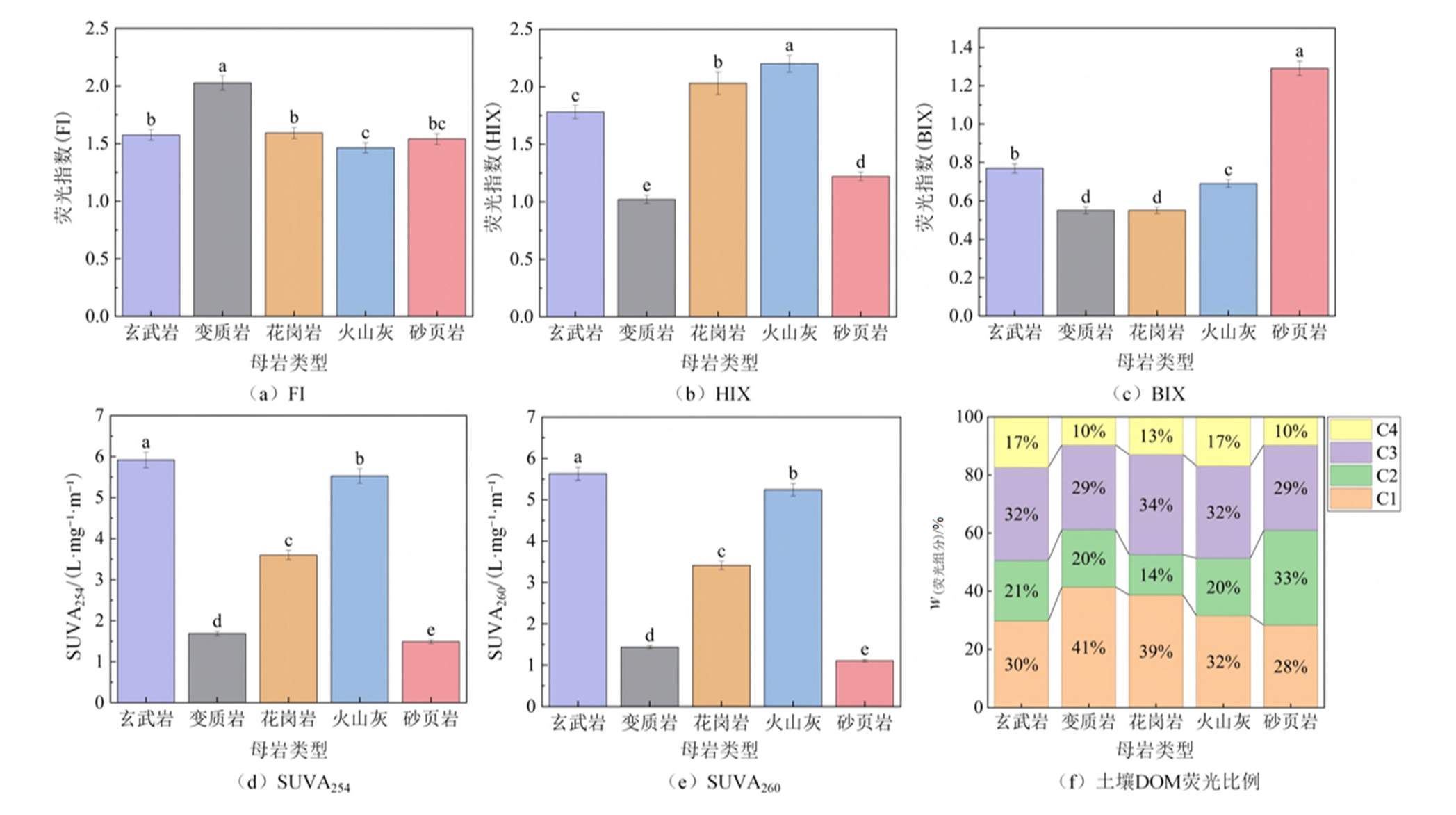
图2 不同母岩土壤DOM荧光组分及相关指数对比
Figure 2 Comparison of soil DOM fluorescence and related indices under different parent rocks’backgrounds
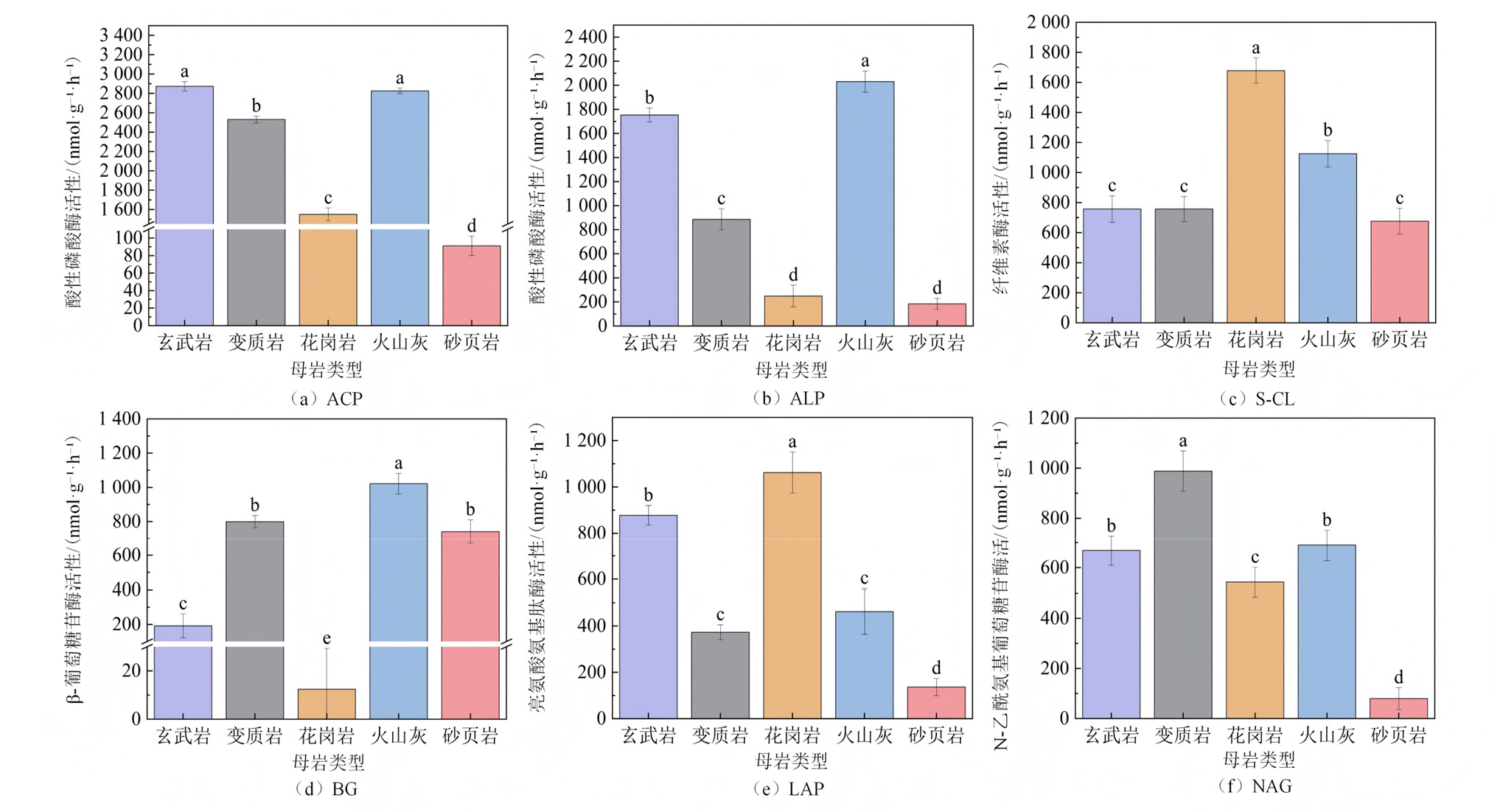
图3 不同母岩土壤酶活性差异
Figure 3 Differences in soil enzyme activities under different parent rocks’ backgrounds
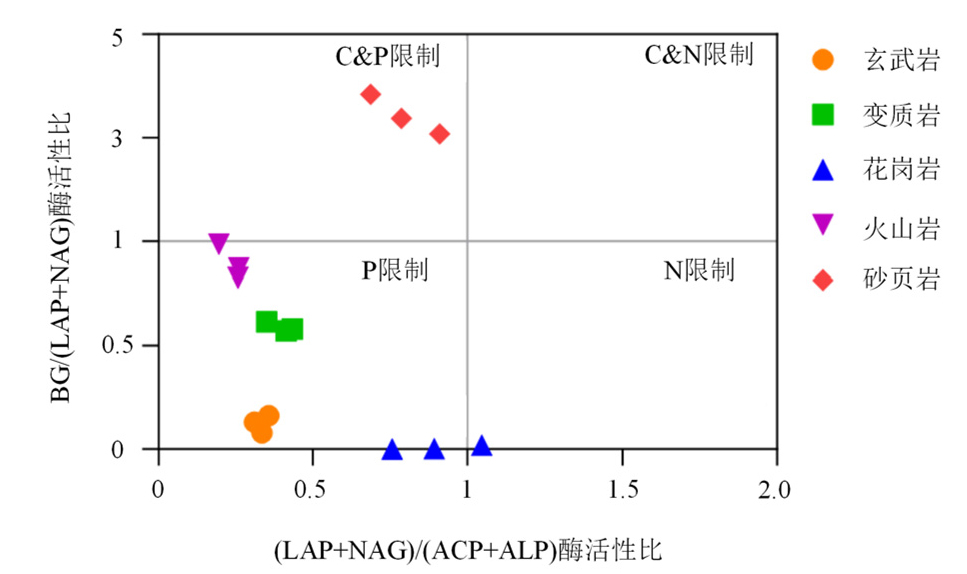
图4 研究地点的土壤生态酶化学计量散点图 图中比值为相应胞外酶活性之比
Figure 4 Scatter plot of soil ecological enzyme stoichiometry at the research site
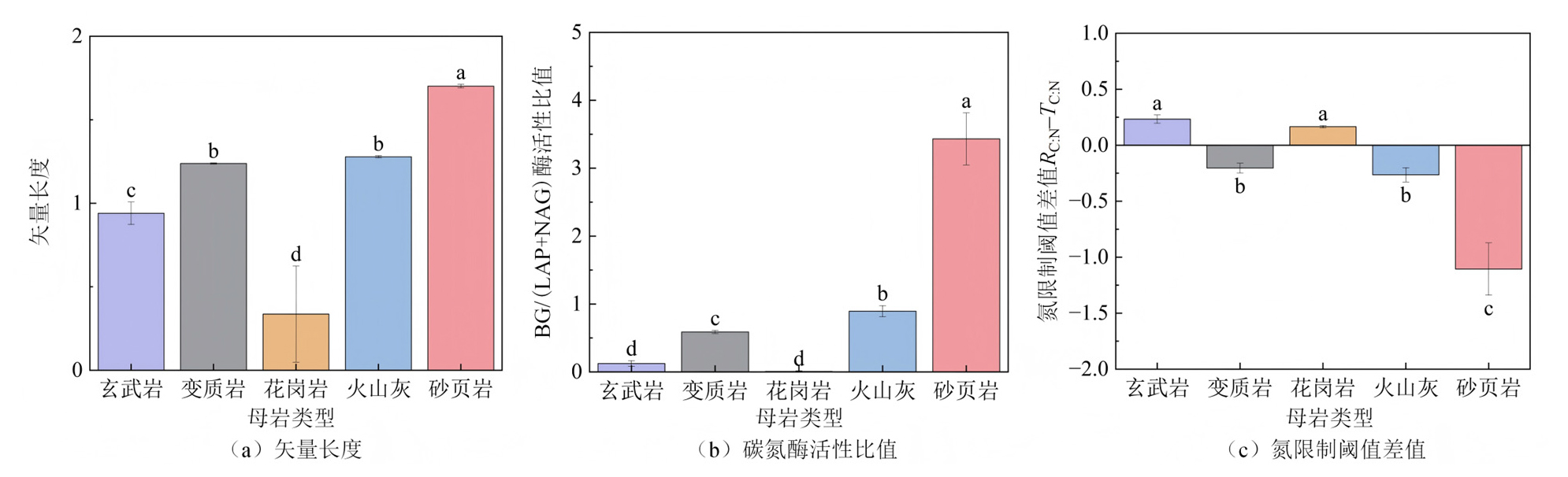
图5 母岩对微生物碳、氮限制指标的影响
Figure 5 Effects of parent rock on indicators of microbial carbon and nitrogen limitation
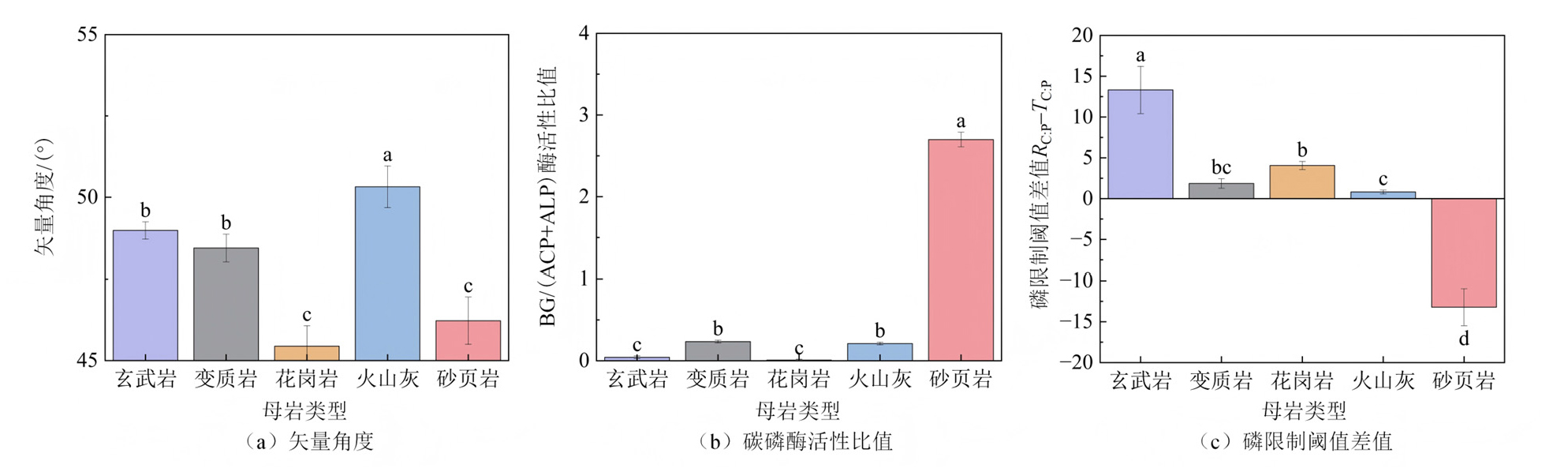
图6 母岩对微生物磷限制指标的影响
Figure 6 Effects of parent rock on indicators of microbial phosphorus limitation
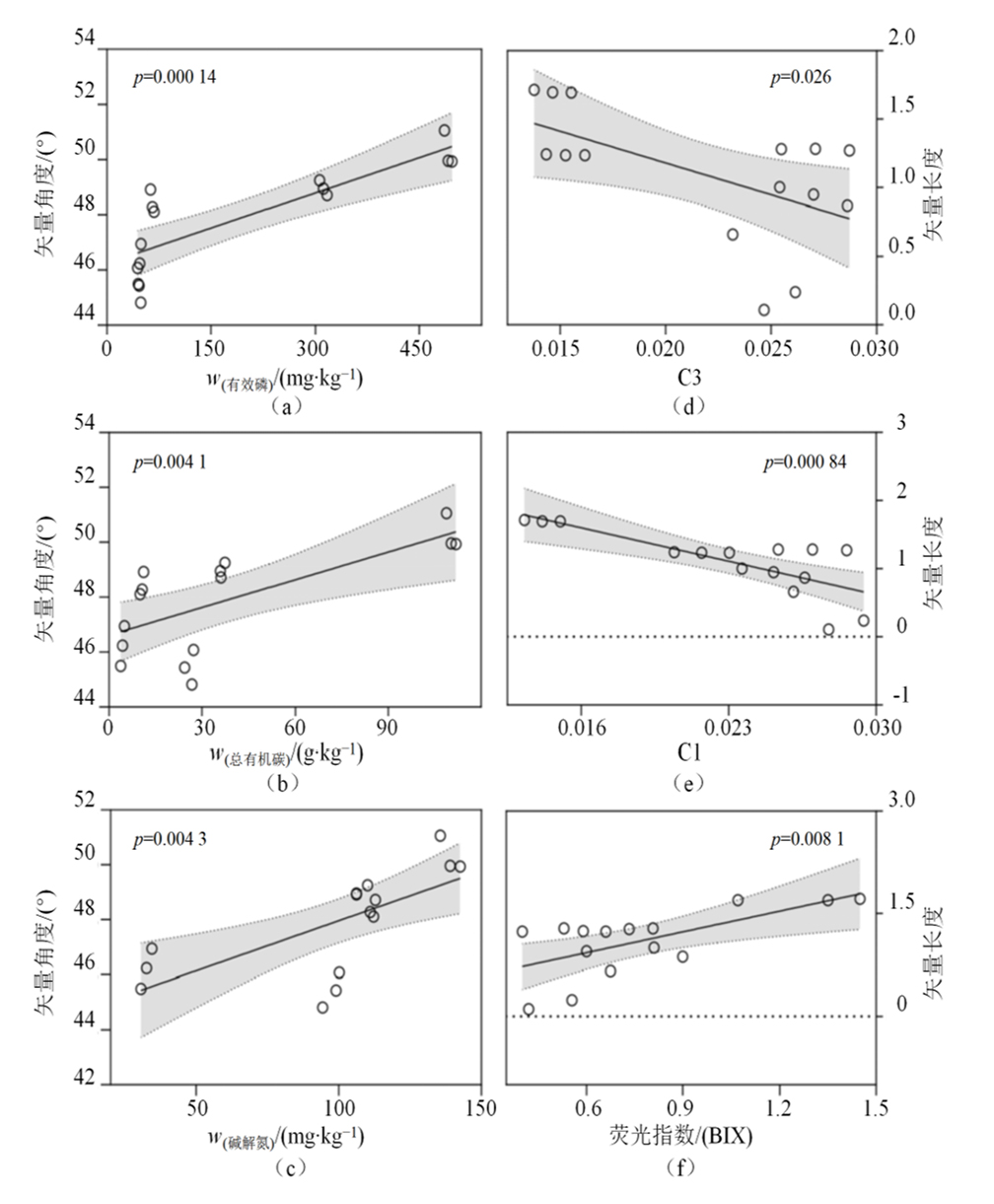
图7 向量角度、向量长度与土壤性质及DOM组分的相关性
Figure 7 Correlations of vector angle and vector length with soil properties and DOM components
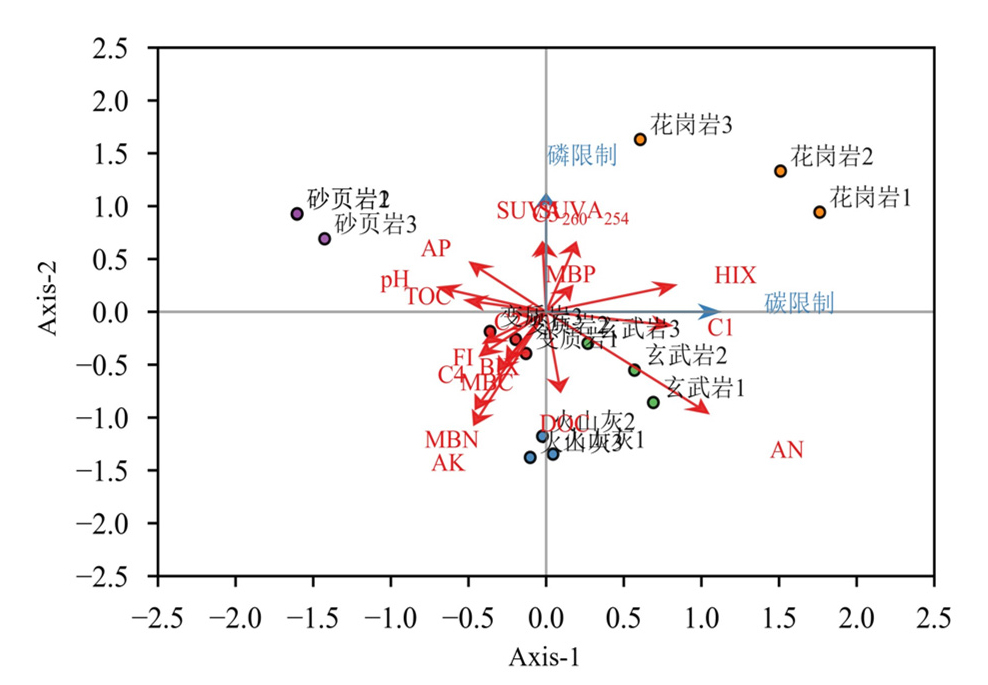
图8 土壤溶解性有机质(DOM)光谱特征与养分计量比对微生物养分限制指标影响的冗余分析 图中箭头表示解释变量,包括DOM光谱主成分、土壤理化性质和土壤养分化学计量比。样本点按成土母岩类型着色
Figure 8 Redundancy analysis (RDA) of the effects of dissolved organic matter (DOM) spectral characteristics and soil nutrient stoichiometric ratios on microbial nutrient limitation indices
| 方法 | 数据集组成 | 类别 | 有效指标 | 调整r2 | 解释比例 | p值 |
|---|---|---|---|---|---|---|
| 全变量RDA | 所有数据集 | 所有指标 | 所用指标 | 0.923 | 100.00 | <0.001 |
| 变量分割 | 土壤理化性质(LH) | TOC;DOC;pH;AN;AK;AP | 0.187 | 20.26 | <0.002 | |
| 微生物生物量(SW) | MBC;MBN;MBP | 0.125 | 13.54 | <0.001 | ||
| 光谱特性(GT) | FI;HIX;BIX;SUVA254;SUVA260 | 0.231 | 25.03 | <0.005 | ||
| 荧光组分(ZF) | C1;C2;C3;C4 | 0.328 | 35.54 | <0.001 | ||
| 交互作用 | LH-SW | 土壤理化性质—微生物生物量 | 0.021 | 2.28 | <0.003 | |
| LH-GT | 土壤理化性质—光谱特性 | 0.016 | 1.73 | <0.002 | ||
| LH-ZF | 土壤理化性质—荧光组分 | 0.015 | 1.63 | <0.004 |
表2 基于冗余分析方差分解的不同因子类别对微生物养分限制的独立贡献
Table 2 Independent contributions of different factor categories to microbial nutrient limitations based on redundancy analysis and variance partitioning
| 方法 | 数据集组成 | 类别 | 有效指标 | 调整r2 | 解释比例 | p值 |
|---|---|---|---|---|---|---|
| 全变量RDA | 所有数据集 | 所有指标 | 所用指标 | 0.923 | 100.00 | <0.001 |
| 变量分割 | 土壤理化性质(LH) | TOC;DOC;pH;AN;AK;AP | 0.187 | 20.26 | <0.002 | |
| 微生物生物量(SW) | MBC;MBN;MBP | 0.125 | 13.54 | <0.001 | ||
| 光谱特性(GT) | FI;HIX;BIX;SUVA254;SUVA260 | 0.231 | 25.03 | <0.005 | ||
| 荧光组分(ZF) | C1;C2;C3;C4 | 0.328 | 35.54 | <0.001 | ||
| 交互作用 | LH-SW | 土壤理化性质—微生物生物量 | 0.021 | 2.28 | <0.003 | |
| LH-GT | 土壤理化性质—光谱特性 | 0.016 | 1.73 | <0.002 | ||
| LH-ZF | 土壤理化性质—荧光组分 | 0.015 | 1.63 | <0.004 |
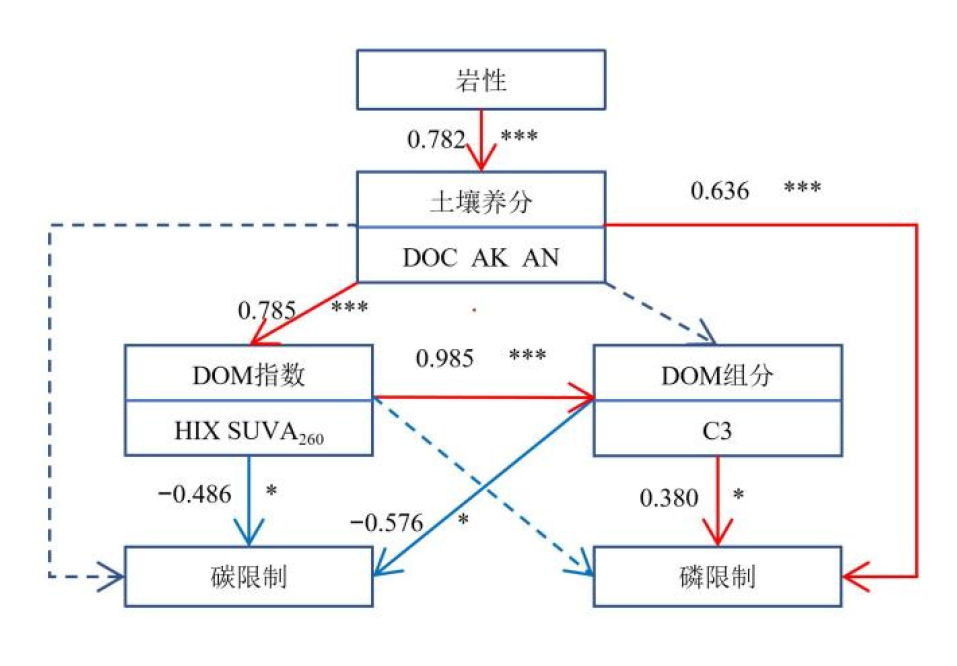
图9 母岩调控土壤DOM及微生物养分限制的偏最小二乘回归分析 图中数字为标准化路径系数;实线表示显著路径(p<0.05),虚线表示不显著路径
Figure 9 Partial least squares regression analysis of parent rock-regulated soil DOM and microbial nutrient limitations
| [1] | Brown M B, Forsythe A B, 1974. Robust tests for the equality of variances[J]. Publications of the American Statistical Association, 69(346): 364-367. |
| [2] |
Brookes P C, Landman A, Pruden G, et al., 1985. Chloroform fumigation and the release of soil nitrogen: A rapid direct extraction method to measure microbial biomass nitrogen in soil[J]. Soil Biology and Biochemistry, 17(6): 837-842.
DOI URL |
| [3] |
Brookes P C, Powlson D S, Jenkinson D S, 1982. Measurement of microbial biomass phosphorus in soil[J]. Soil Biology and Biochemistry, 14(4): 319-329.
DOI URL |
| [4] |
Chen C, Hall S J, Coward E, et al., 2020. Iron-mediated organic matter decomposition in humid soils can counteract protection[J]. Nature Communications, 11(1): 2255.
DOI PMID |
| [5] |
Chen H, LI D J, Mao Q G, et al., 2019. Resource limitation of soil microbes in karst ecosystems[J]. Science of The Total Environment, 650(Part 1): 241-248.
DOI URL |
| [6] |
Chen S, Klotzbücher T, Lechtenfeld O J, et al., 2022. Legacy effects of sorption determine the formation efficiency of mineral-associated soil organic matter[J]. Environmental Science & Technology, 56(3): 2044-2053.
DOI URL |
| [7] |
Cotrufo M F, Ranalli M G, Haddix M L, et al., 2019. Soil carbon storage informed by particulate and mineral-associated organic matter[J]. Nature Geoscience, 12(12): 989-994.
DOI |
| [8] |
Cui Y X, Moorhead D L, Guo X B, et al., 2021. Stoichiometric models of microbial metabolic limitation in soil systems[J]. Global Ecology and Biogeography, 30(11): 2297-2311.
DOI URL |
| [9] |
D’Amico M E, Catoni M, Terribile F, et al., 2016. Contrasting environmental memories in relict soils on different parent rocks in the south-western Italian Alps[J]. Quaternary International, 418: 61-74.
DOI URL |
| [10] |
Ding Y, SHI Z Q, 2025. The molecular composition of soil dissolved organic matter regulated by reactive mineral-associated organic matter under a broad range of climates[J]. Applied Geochemistry, 179: 106261.
DOI URL |
| [11] |
Duncan D B, 1955. Multiple range and multiple f tests[J]. Biometrics, 11(1): 1-42.
DOI URL |
| [12] |
Egli M, Nater M, Mirabella A, et al., 2008. Clay minerals, oxyhydroxide formation, element leaching and humus development in volcanic soils[J]. Geoderma, 143(1-2): 101-114.
DOI URL |
| [13] |
Hepper E N, Buschiazzo D E, Hevia G G, et al., 2006. Clay mineralogy, cation exchange capacity and specific surface area of loess soils with different volcanic ash contents[J]. Geoderma, 135: 216-223.
DOI URL |
| [14] |
Huguet A, Vacher L, Relexans S, et al., 2009. Properties of fluorescent dissolved organic matter in the Gironde Estuary[J]. Organic Geochemistry, 40(6): 706-719.
DOI URL |
| [15] |
Hill B H, Elonen C M, Seifert L R, et al., 2012. Microbial enzyme stoichiometry and nutrient limitation in US streams and rivers[J]. Ecological Indicators, 18: 540-551.
DOI URL |
| [16] |
Hu P, Zhang W, Nottingham A T, et al., 2024. Lithological controls on soil aggregates and minerals regulate microbial carbon use efficiency and necromass stability[J]. Environmental Science & Technology, 58(48): 21186-21199.
DOI URL |
| [17] | Jansen B, Kalbitz K, Mcdowell W H, 2014. Dissolved organic matter: Linking soils and aquatic systems[J]. Vadose Zone Journal, 13(7): 1-4. |
| [18] |
Kaiser K, Kalbitz K, 2012. Cycling downwards - dissolved organic matter in soils[J]. Soil Biology and Biochemistry, 52: 29-32.
DOI URL |
| [19] |
Kalbitz K, Solinger S, Park J H, et al., 2000. Controls on the dynamics of dissolved organic matter in soils: A review:[J]. Soil Science, 165(4): 277-304.
DOI URL |
| [20] |
Kellerman A M, Dittmar T, Kothawala D N, et al., 2014. Chemodiversity of dissolved organic matter in lakes driven by climate and hydrology[J]. Nature Communications, 5(1): 3804.
DOI |
| [21] |
Lapworth D J, Gooddy D C, Butcher A S, et al., 2008. Tracing groundwater flow and sources of organic carbon in sandstone aquifers using fluorescence properties of dissolved organic matter (DOM)[J]. Applied Geochemistry, 23(12): 3384-3390.
DOI URL |
| [22] |
Liu L, Gundersen P, Zhang T, et al., 2012. Effects of phosphorus addition on soil microbial biomass and community composition in three forest types in tropical China[J]. Soil Biology and Biochemistry, 44(1): 31-38.
DOI URL |
| [23] | Manzoni S, Taylor P, Richter A, et al., 2012. Environmental and stoichiometric controls on microbial carbon-use efficiency in soils[J]. New Phytologist, 196(1): 70-91. |
| [24] |
Marschner B, Kalbitz K, 2003. Controls of bioavailability and biodegradability of dissolved organic matter in soils[J]. Geoderma, 113(3-4): 211-235.
DOI URL |
| [25] |
Mcknight D M, Boyer E W, Westerhoff P K, et al., 2001. Spectrofluorometric characterization of dissolved organic matter for indication of precursor organic material and aromaticity[J]. Limnology and Oceanography, 46(1): 38-48.
DOI URL |
| [26] |
Moorhead D L, Rinkes Z L, Sinsabaugh R L, et al., 2013. Dynamic relationships between microbial biomass, respiration, inorganic nutrients and enzyme activities: informing enzyme-based decomposition models[J]. Frontiers in Microbiology, 4: 223.
DOI PMID |
| [27] |
Moorhead D L, Sinsabaugh R L, Hill B H, et al., 2016. Vector analysis of ecoenzyme activities reveal constraints on coupled C, N and P dynamics[J]. Soil Biology and Biochemistry, 93: 1-7.
DOI URL |
| [28] |
Murphy K R, Stedmon C A, Graeber D, et al., 2013. Fluorescence spectroscopy and multi-way techniques. PARAFAC[J]. Analytical Methods, 5(23): 6557-6566.
DOI URL |
| [29] | Nelson D W, Sommers L E, 2018. Total carbon, organic carbon, and organic Matter[M]. Sparks D L, Page A L, Helmke P A, et al. SSSA Book Series. Madison, WI, USA: Soil Science Society of America, American Society of Agronomy:961-1010 [2025-09-14]. |
| [30] | Onikura Y, 1964. Factors relating to labile phosphate levels in volcanic ash soils[J]. Soil Science and Plant Nutrition, 10(1): 20-27. |
| [31] |
Prasad S S, Motto H L, 1981. Evaluation of p as a limiting macronutrient in volcanic ash soils of Guatemala[J]. Communications in Soil Science and Plant Analysis, 12(10): 1021-1029.
DOI URL |
| [32] |
Qin X Q, Yao B, Jin L, et al., 2020. Characterizing soil dissolved organic matter in typical soils from China using fluorescence EEM-PARAFAC and UV-Visible absorption[J]. Aquatic Geochemistry, 26(1): 71-88.
DOI |
| [33] |
Schmidt S K, Porazinska D, Concienne B L, et al., 2016. Biogeochemical stoichiometry reveals P and N limitation across the post-glacial landscape of denali national park, Alaska[J]. Ecosystems, 19(7): 1164-1177.
DOI |
| [34] |
Shapiro S S, Wilk M B, 1965. An analysis of variance test for normality (complete Samples)[J]. Biometrika, 52(3-4): 591-611.
DOI URL |
| [35] |
Sinsabaugh R L, Hill B H, Follstad Shah J J, 2009. Ecoenzymatic stoichiometry of microbial organic nutrient acquisition in soil and sediment[J]. Nature, 462(7274): 795-798.
DOI |
| [36] |
Sinsabaugh R L, Follstad Shah J J, 2011. Ecoenzymatic stoichiometry of recalcitrant organic matter decomposition: the growth rate hypothesis in reverse[J]. Biogeochemistry, 102(1-3): 31-43.
DOI URL |
| [37] | Sparks D L, Page A L, Helmke P A, et al., 1996. Methods of Soil Analysis: Part 3 Chemical Methods[M]. Madison, WI, USA: Soil Science Society of America, American Society of Agronomy. |
| [38] | Sterner R W, Elser J J, 2002. Ecological Stoichiometry[M]. Princeton: Princeton University Press. |
| [39] |
Vance E D, Brookes P C, Jenkinson D S, 1987. An extraction method for measuring soil microbial biomass C[J]. Soil Biology and Biochemistry, 19(6): 703-707.
DOI URL |
| [40] |
Wang Y H, Zhang P, He C, et al., 2023. Molecular signatures of soil-derived dissolved organic matter constrained by mineral weathering[J]. Fundamental Research, 3(3): 377-383.
DOI URL |
| [41] |
Waring B G, Weintraub S R, Sinsabaugh R L, 2014. Ecoenzymatic stoichiometry of microbial nutrient acquisition in tropical soils[J]. Biogeochemistry, 117(1): 101-113.
DOI URL |
| [42] |
Wu J, Joergensen R G, Pommerening B, et al., 1990. Measurement of soil microbial biomass C by fumigation-extraction—an automated procedure[J]. Soil Biology and Biochemistry, 22(8): 1167-1169.
DOI URL |
| [43] | Zhang X Q, Li X, Li Y, et al., 2023. The characteristics of soil dissolved organic carbon and their influences on metal solid-solution partitioning in subtropics agricultural soils[J]. Water, Air, & Soil Pollution, 234(7): 441. |
| [44] | 鲍士旦, 2000. 土壤农化分析[M]. 北京: 中国农业出版社. |
| Bao S D, 2000. Soil and agricultural chemistry analysis[M]. Beijing: Soil and Agricultural Chemistry Analysis. | |
| [45] | 郭琦玲, 王建青, 毛娇艳, 等, 2025. 林火干扰下亚热带森林土壤胞外酶化学计量特征[J]. 水土保持学报, 39(1): 94-101. |
| Guo Q L, Wang J Q, Mao J Y, et al., 2025. Extracellular enzyme stoichiometric characteristics of subtropical forest soil under forest fire disturbance[J]. Journal of Soil and Water Conservation, 39(1): 94-101. | |
| [46] |
黄成, 吴月颖, 吉恒宽, 等, 2021. 海南典型水稻土厌氧铁还原特征对DOM分子特性的响应[J]. 生态环境学报, 30(5): 957-967.
DOI |
| Huang C, Wu Y Y, Ji H K, et al., 2021. Response of iron reduction characteristics to DOM molecular properties under anaerobic conditions in typical paddy soils of Hainan Island[J]. Ecology and Environmental Sciences, 30(5): 957-967. | |
| [47] | 黄成敏, 龚子同, 2001. 海南岛北部玄武岩发育而成的土壤粘土矿物研究[J]. 西南农业学报, 14(增刊): 1-4. |
| Huang C M, Gong Z T, 2001. Study on clay minerals in soils developed from basalt in Northern Hainan Island Southwest China[J]. Journal of Agricultural Sciences, 14(Suppl.): 1-4. | |
| [48] | 简正军, 徐健, 黄小兰, 2022. 基于三维荧光光谱的鄱阳湖湿地水体有色可溶性有机物的组成、分布及来源[D]. 南昌: 江西师范大学. |
| Jian Z J, Xu J, Huang X L, 2022. Composition, distribution, and sources of colored dissolved organic matter in Poyang lake wetlands based on three-dimensional fluorescence spectroscopy[D]. Nanchang: Jiangxi Normal University. | |
| [49] | 缪闯和, 吕贻忠, 2021. 黑土、潮土和红壤可溶性有机质的光谱特征及结构差异[J]. 土壤, 53(1): 168-172. |
| Miu C H, Lü Y Z, 2021. Spectral characteristics and structural differences of soluble organic matter in black soil, moist soil, and red soil[J]. Soil, 53(1): 168-172. | |
| [50] | 王媛, 邓磊, 陈海香, 等, 2026. 黄土高寒区针阔混交林植物叶-枯落物-土壤碳氮磷化学计量及内稳性特征[J]. 水土保持研究, 33(2): 80-88. |
| Wang Y, Deng L, Chen H X, et al., 2026. Stoichiometric and homeostatic characteristics of carbon, nitrogen, and phosphorus in plant leaves-litter-soil of mixed coniferous-broadleaf forests in the loess plateau[J]. Research of Soil and Water Conservation, 33(2): 80-88. | |
| [51] | 赵劲松, 张旭东, 2003. 土壤溶解性有机质的特性与环境意义[J]. 应用生态学报, 14(1): 126-130. |
| Zhao J S, Zhang X D, 2003. Characteristics and environmental significance of soil dissolved organic matter[J]. Chinese Journal of Applied Ecology, 14(1): 126-130. |
| [1] | 符小坤, 杜雨菲, 郑传洁, 贾文浩, 王旭程, 马旖旎, 黄开波. 热带岛屿不同水体溶解性有机质特征研究[J]. 生态环境学报, 2026, 35(5): 770-783. |
| [2] | 黄绍强, 江恒, 余世钦, 蒋新宇, 程炯, 陈三雄. 小球藻对广东红壤团聚体水稳性及其胞外聚合物组分的影响[J]. 生态环境学报, 2026, 35(3): 425-436. |
| [3] | 蒋凯, 柯常栋, 王丽萍, 李朋辉, 赖迪智, 张杨, 吴永洁, 吴仁人, 肖利平. 珠江广州河段粪便污染和溶解有机质的来源解析及分布特征[J]. 生态环境学报, 2025, 34(9): 1452-1462. |
| [4] | 贺环, 周丹丹, 马芷萱, 李芳芳, 秦珊珊, 豆思娴. 钙改性对生物炭中溶解性有机质与Cd(Ⅱ)结合的影响[J]. 生态环境学报, 2025, 34(7): 1121-1132. |
| [5] | 李海鹏, 黄月华, 孙晓东, 曹启民, 符芳兴, 孙楚涵. 海南农田不同质地砖红壤及其细菌群落与番茄青枯病发生的关联分析[J]. 生态环境学报, 2023, 32(6): 1062-1069. |
| [6] | 马飞扬, 樊团团, 孙小平, 明峻德, 王世同, 张英豪, 姚昕. 洞庭湖不同湖区水体DOM的荧光特征及来源[J]. 生态环境学报, 2021, 30(12): 2370-2379. |
| 阅读次数 | ||||||
|
全文 |
|
|||||
|
摘要 |
|
|||||
