
生态环境学报 ›› 2026, Vol. 35 ›› Issue (9): 1329-1341.DOI: 10.16258/j.cnki.1674-5906.2026.09.001
• 碳循环与碳减排专栏 •
下一篇
曹云1( ), 程春香2, 陈紫璇1, 博宇2, 孙应龙1, 于敏2,*()
收稿日期:2025-05-12
修回日期:2026-07-24
接受日期:2026-08-19
出版日期:2026-09-18
发布日期:2026-09-16
通讯作者:
于敏, E-mail: 作者简介:曹云(1977年生),男,正高级工程师,博士,主要从事生态系统与气候变化方面研究。E-mail: caoyuncy@sohu.com
基金资助:
Cao Yun1(), Cheng Chunxiang2, Chen Zixuan1, Bo Yu2, Sun Yinglong1, Yu Min2,*()
Received:2025-05-12
Revised:2026-07-24
Accepted:2026-08-19
Online:2026-09-18
Published:2026-09-16
摘要:
【目的】旨在系统揭示东北林区固碳能力的时空演变格局和地形分异特征,并定量识别气候因子的驱动作用。【方法】利用气象和遥感数据,基于净生态系统生产力(NEP)指标,结合空间聚类、偏相关分析与复相关分析,引入地形地貌因子,对东北林区进行研究。【结果】1)林区NEP年均值为301.2 g·m-2,92.2%的林区呈增加趋势,但年际波动较大,58.2%的林区稳定性偏低;固碳能力呈“东南高、西北低”的纬向递减格局。2)固碳能力呈显著空间自相关性,高值聚类区(40.3%)与低值聚类区(41.3%)形成“东高西低”集聚格局。3)地形调控效应显著,固碳能力、稳定性及高值聚类面积占比随地势起伏和坡度增加而增大,随海拔升高而减小;固碳变化速率随地势起伏和海拔增加呈先升后降的单峰模式。4)气候因子驱动的面积占比为42.6%,其中降水驱动最广(18.0%),主要分布于内蒙古东部和黑龙江东南部。气象驱动作用随地形的复杂化(地势起伏、海拔与坡度增加)而增强。【结论】东北林区固碳能力呈纬向递减格局且空间集聚明显,地形对固碳分布具有显著调控效应,降水为主要气候驱动因子,且地形复杂化会增强气候影响。上述结果可为复杂地形区的森林碳汇精准评估与差异化生态管理提供了科学依据。
中图分类号:
曹云, 程春香, 陈紫璇, 博宇, 孙应龙, 于敏. 东北林区固碳能力时空分异特征及其气候驱动研究[J]. 生态环境学报, 2026, 35(9): 1329-1341.
Cao Yun, Cheng Chunxiang, Chen Zixuan, Bo Yu, Sun Yinglong, Yu Min. Spatiotemporal Heterogeneity of Carbon Sequestration Capacity and Its Climatic Drivers in the Northeast Forest Region of China[J]. Ecology and Environmental Sciences, 2026, 35(9): 1329-1341.
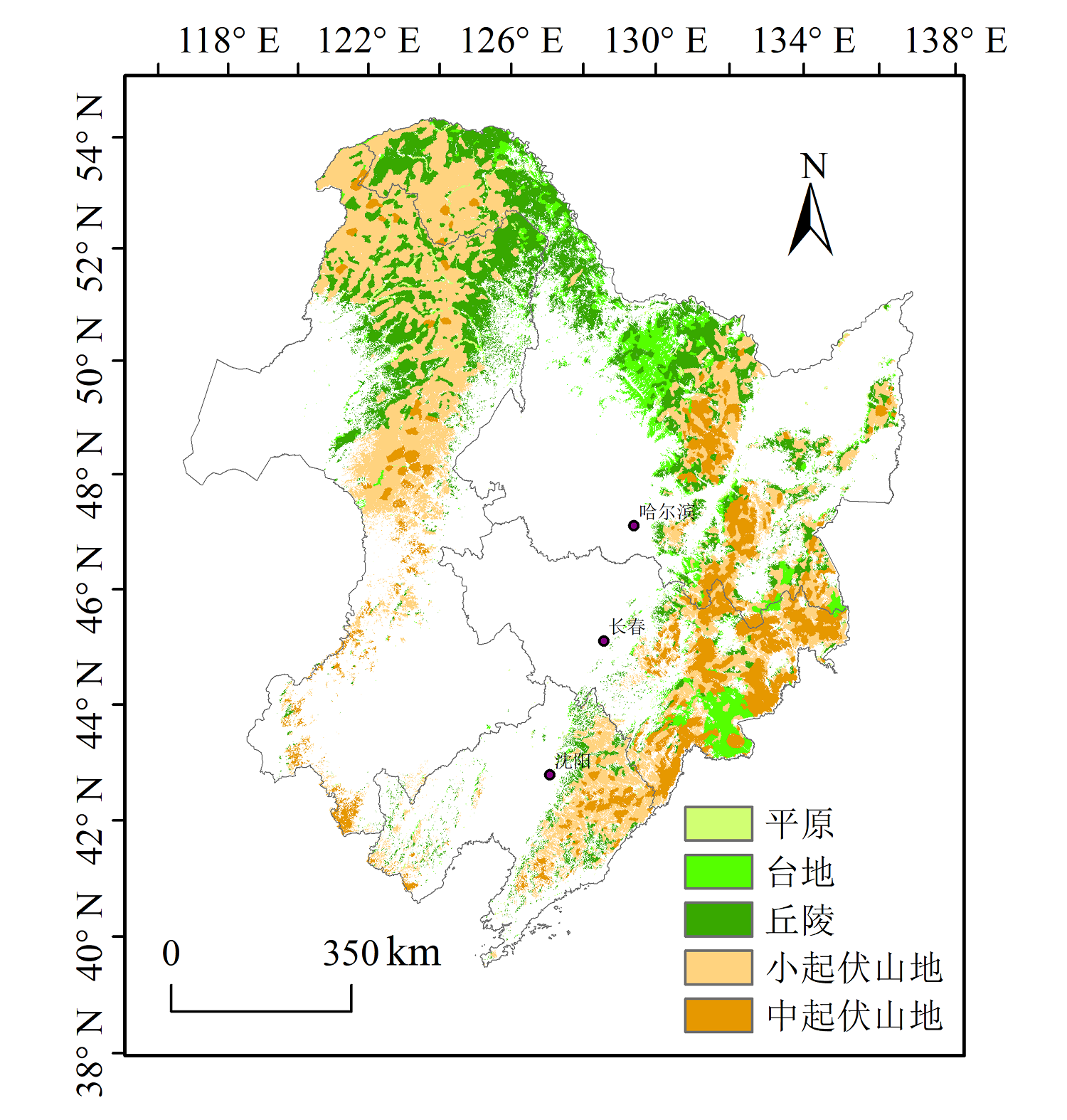
图1 研究区地貌分布图 底图来源于国家地理信息公共服务平台,审图号为GS(2019)3082号;底图边界无修改,下同
Figure 1 Topographic map of the study area
| 影响因素类型 | 显著性检验结果 | ||||
|---|---|---|---|---|---|
| RNEP-Tem | RNEP-Pre | RNEP-Sun | RNEP-Cli | ||
| 气象驱动影响 | 气温驱动 | <0.05 | ≥0.05 | ≥0.05 | <0.05 |
| 降水驱动 | ≥0.05 | <0.05 | ≥0.05 | <0.05 | |
| 日照驱动 | ≥0.05 | ≥0.05 | <0.05 | <0.05 | |
| 气温降水驱动 | <0.05 | <0.05 | ≥0.05 | <0.05 | |
| 气温日照驱动 | <0.05 | ≥0.05 | <0.05 | <0.05 | |
| 降水日照驱动 | ≥0.05 | <0.05 | <0.05 | <0.05 | |
| 光温水强驱动 | <0.05 | <0.05 | <0.05 | <0.05 | |
| 光温水弱驱动 | ≥0.05 | ≥0.05 | ≥0.05 | <0.05 | |
| 非气象驱动影响 | ≥0.05 | ≥0.05 | ≥0.05 | ≥0.05 | |
表1 NEP变化气候驱动因素分类依据
Table 1 Classification basis of climatic driving factors for dynamic change of NEP
| 影响因素类型 | 显著性检验结果 | ||||
|---|---|---|---|---|---|
| RNEP-Tem | RNEP-Pre | RNEP-Sun | RNEP-Cli | ||
| 气象驱动影响 | 气温驱动 | <0.05 | ≥0.05 | ≥0.05 | <0.05 |
| 降水驱动 | ≥0.05 | <0.05 | ≥0.05 | <0.05 | |
| 日照驱动 | ≥0.05 | ≥0.05 | <0.05 | <0.05 | |
| 气温降水驱动 | <0.05 | <0.05 | ≥0.05 | <0.05 | |
| 气温日照驱动 | <0.05 | ≥0.05 | <0.05 | <0.05 | |
| 降水日照驱动 | ≥0.05 | <0.05 | <0.05 | <0.05 | |
| 光温水强驱动 | <0.05 | <0.05 | <0.05 | <0.05 | |
| 光温水弱驱动 | ≥0.05 | ≥0.05 | ≥0.05 | <0.05 | |
| 非气象驱动影响 | ≥0.05 | ≥0.05 | ≥0.05 | ≥0.05 | |
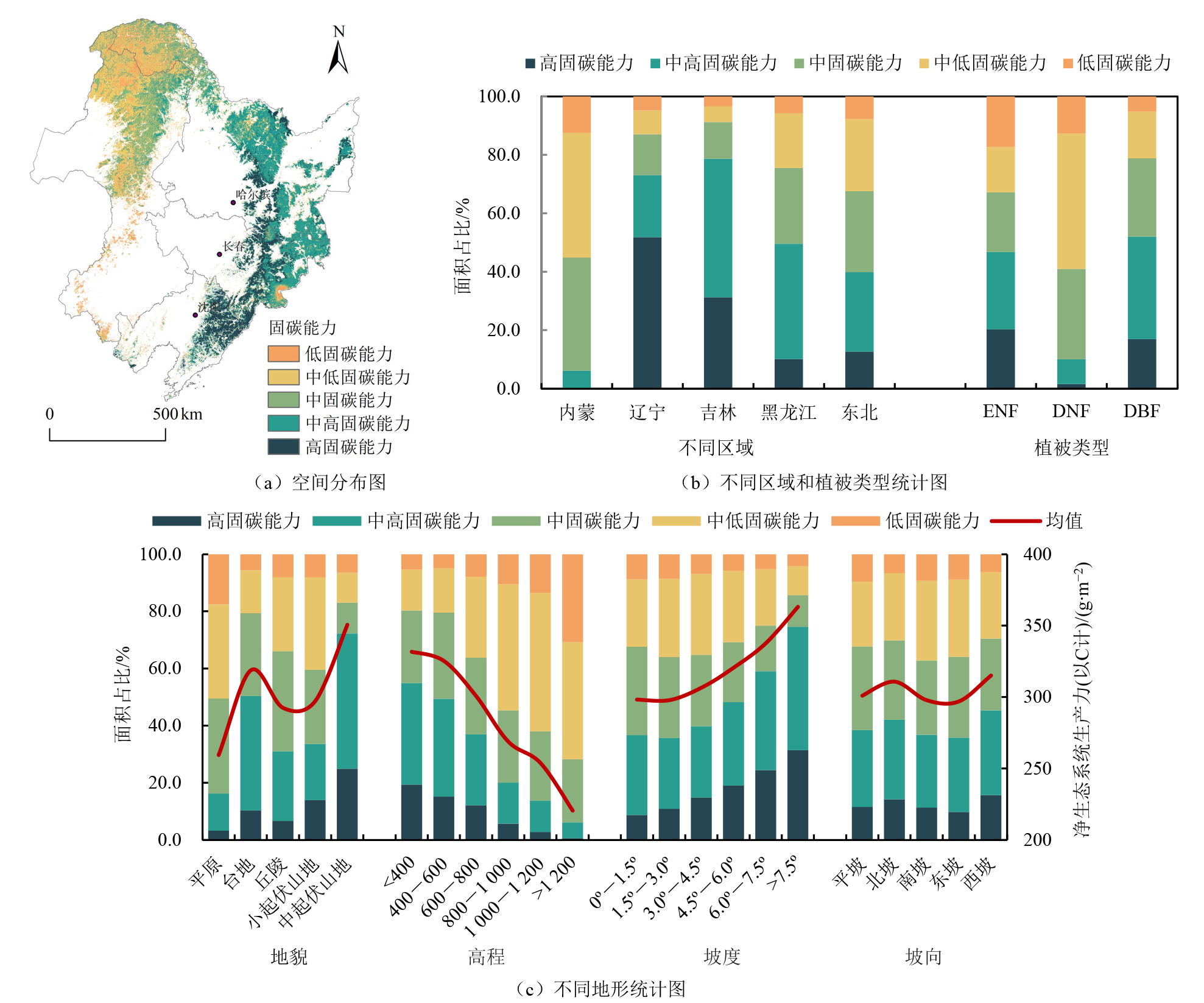
图2 东北林区固碳能力空间分异特征 ENF为常绿针叶林;DNF为落叶针叶林;DBF为落叶阔叶林
Figure 2 Spatial heterogeneity characteristics of carbon sequestration capacity in the Northeast Forest Region of China
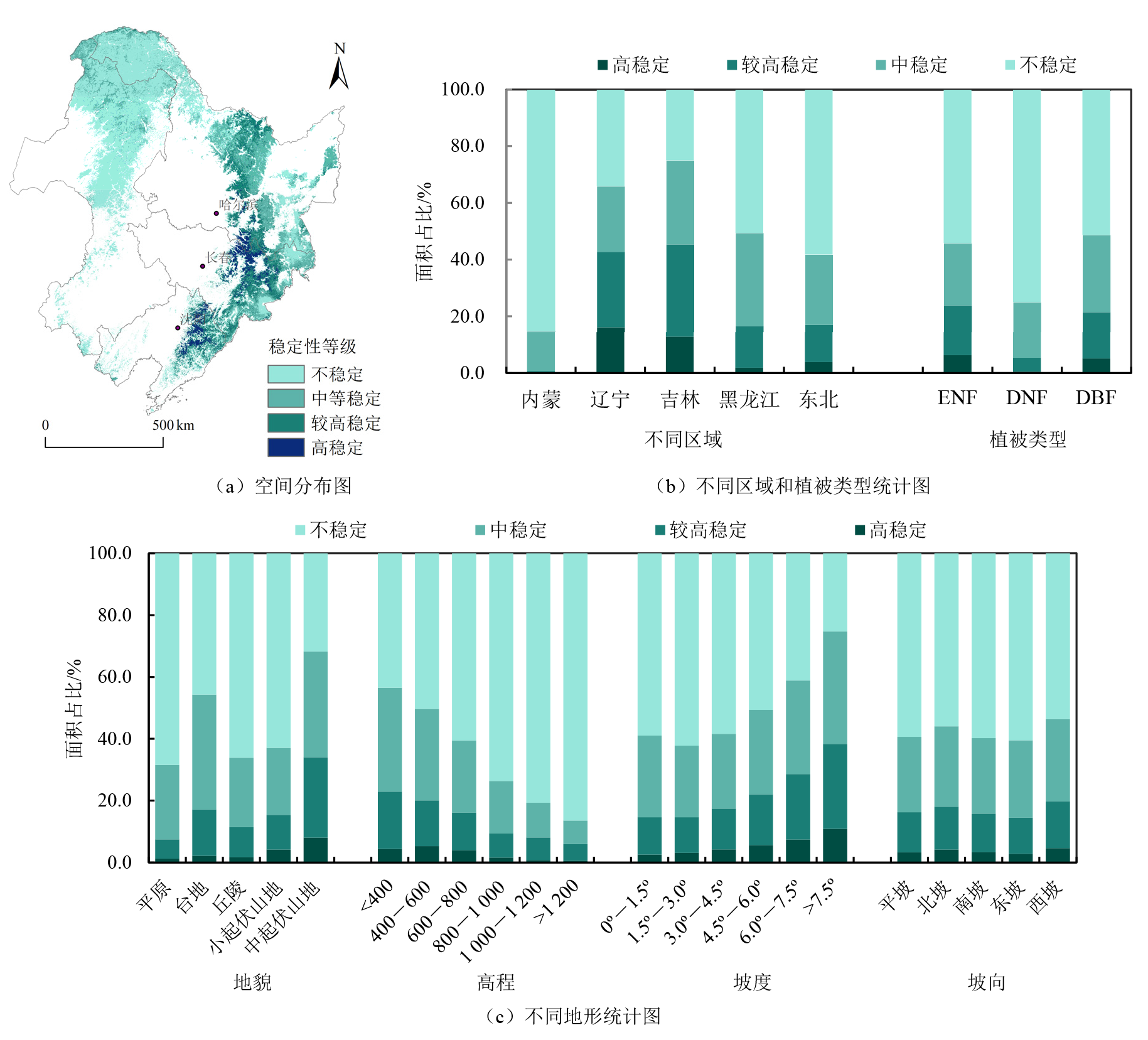
图3 东北林区固碳能力的稳定性空间分异特征
Figure 3 Spatial heterogeneity characteristics of the stability of carbon sequestration capacity in the Northeast Forest Region of China
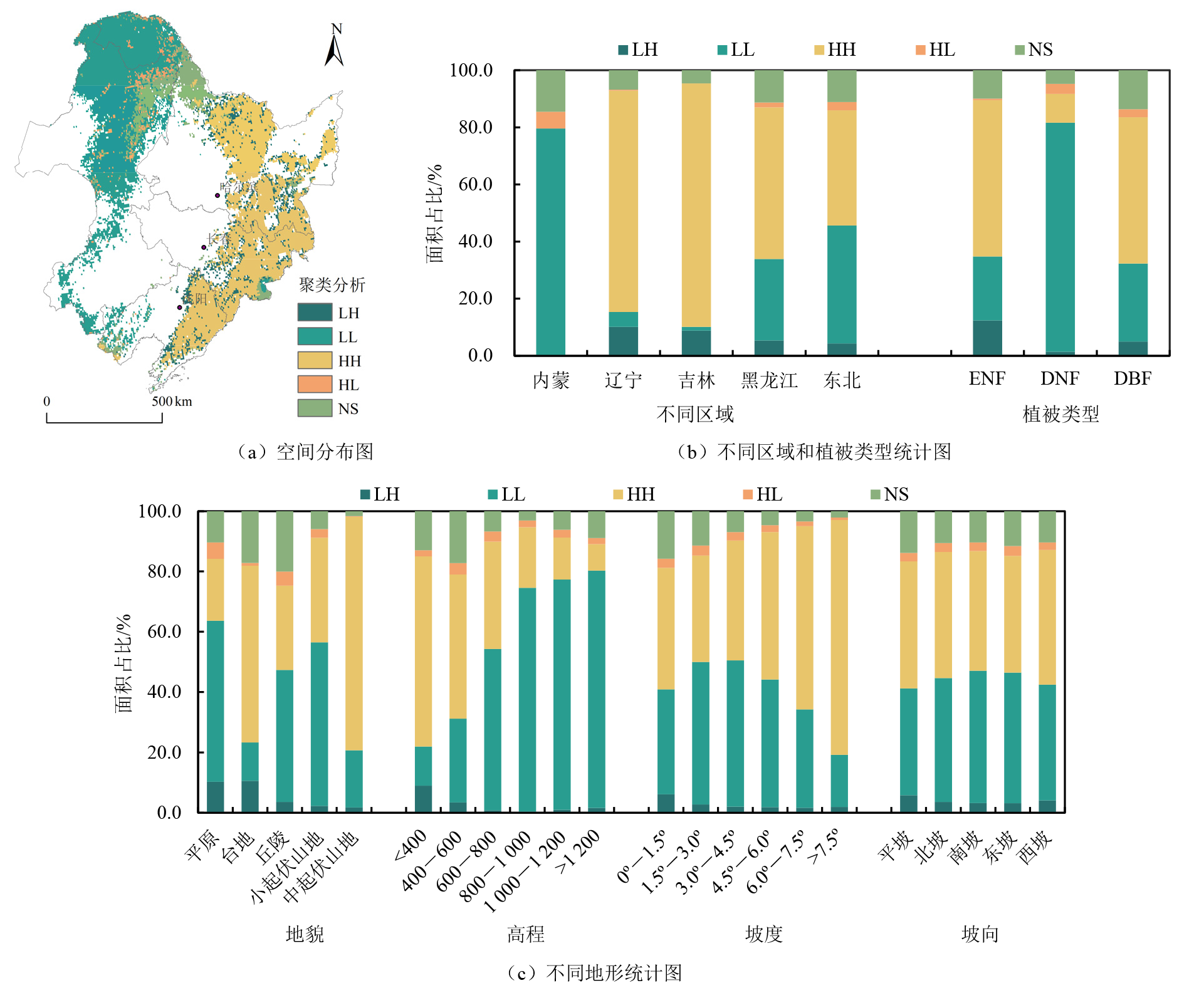
图4 东北林区固碳能力的空间聚类分异特征 HH为高值聚类区;LL为低值聚类区;HL为高值被低值包围聚类区;LH为低值被高值包围聚类区;NS为不显著类型
Figure 4 Spatial heterogeneity characteristics of the clustering patterns of carbon sequestration capacity in the Northeast Forest Region of China
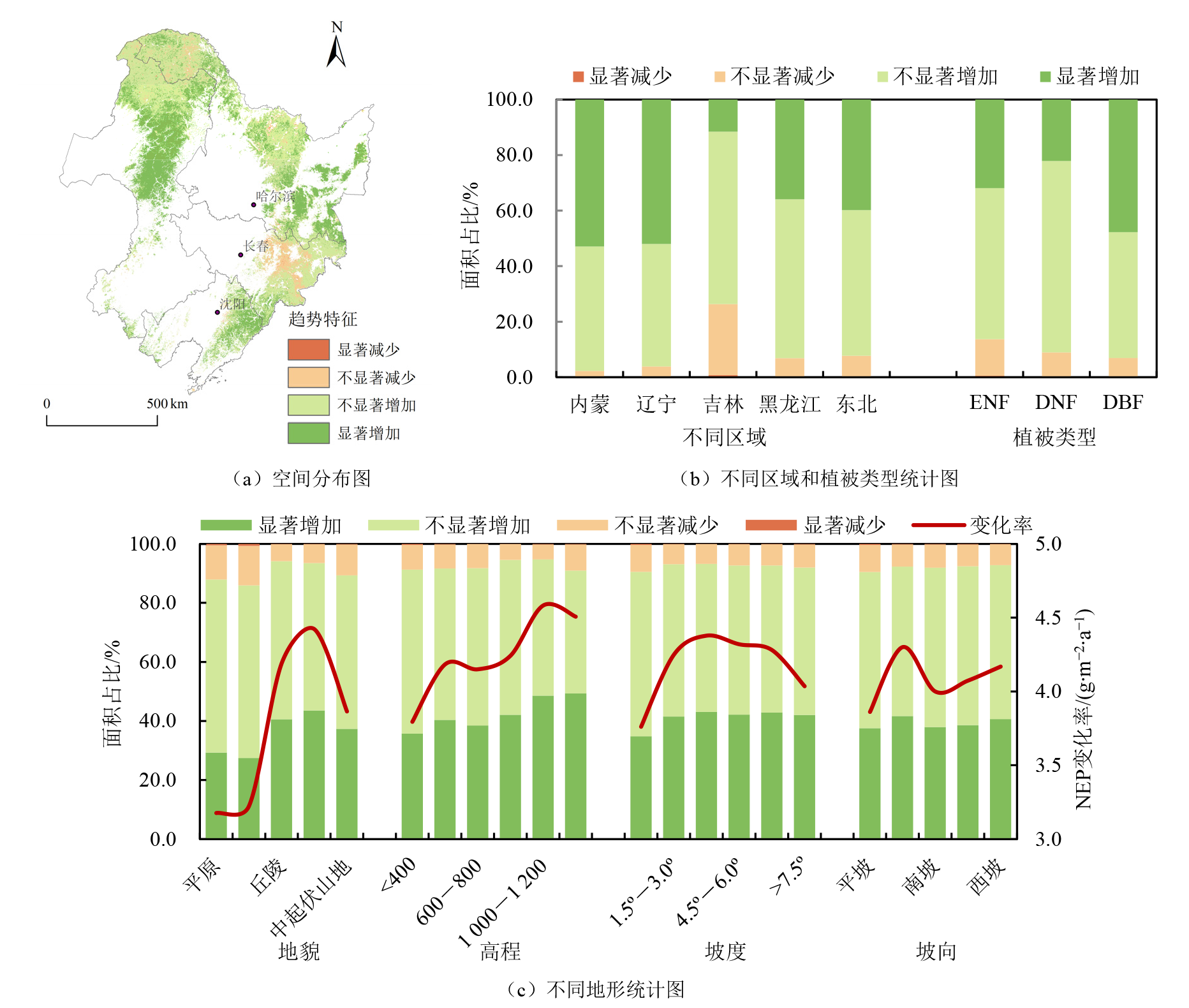
图5 2001-2020年东北林区固碳能力变化趋势的分异特征
Figure 5 Spatial heterogeneity characteristics of the change trend of carbon sequestration capacity in the Northeast Forest Region of China from 2001 to 2020
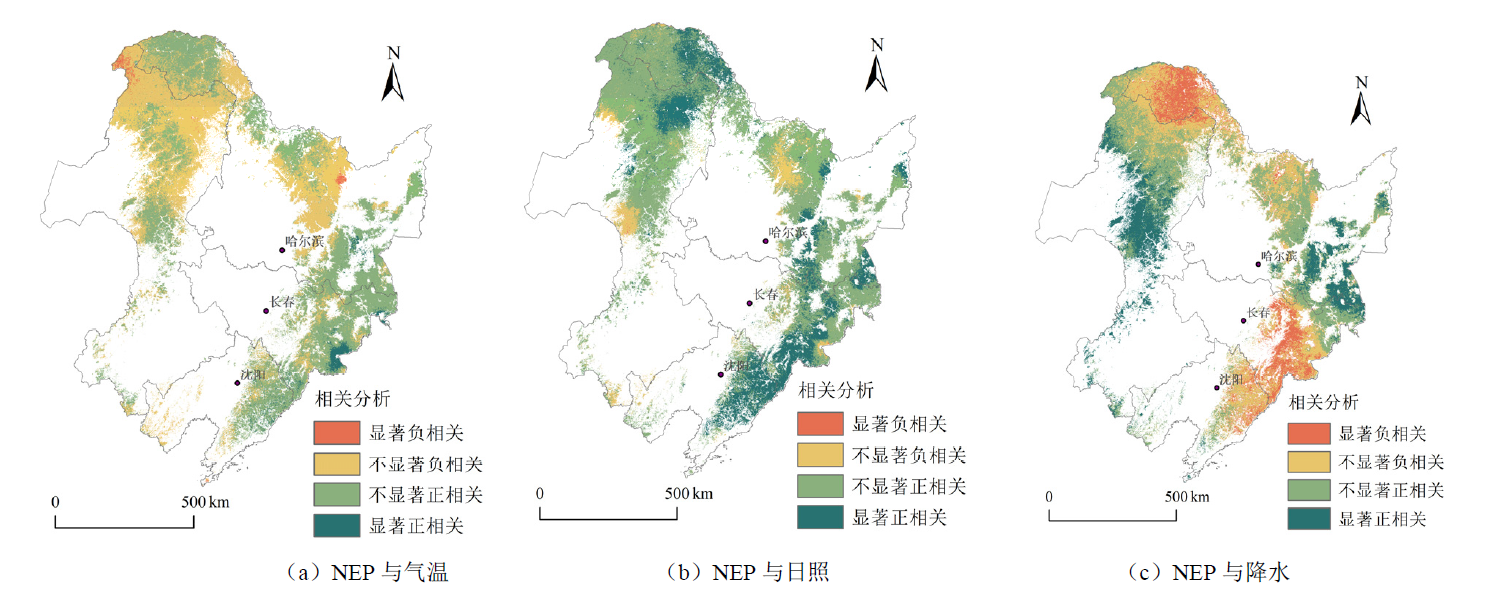
图6 东北林区NEP与各气象因子的偏相关分析
Figure 6 Partial correlation analysis of NEP with various meteorological factors in the Northeast Forest Region of China
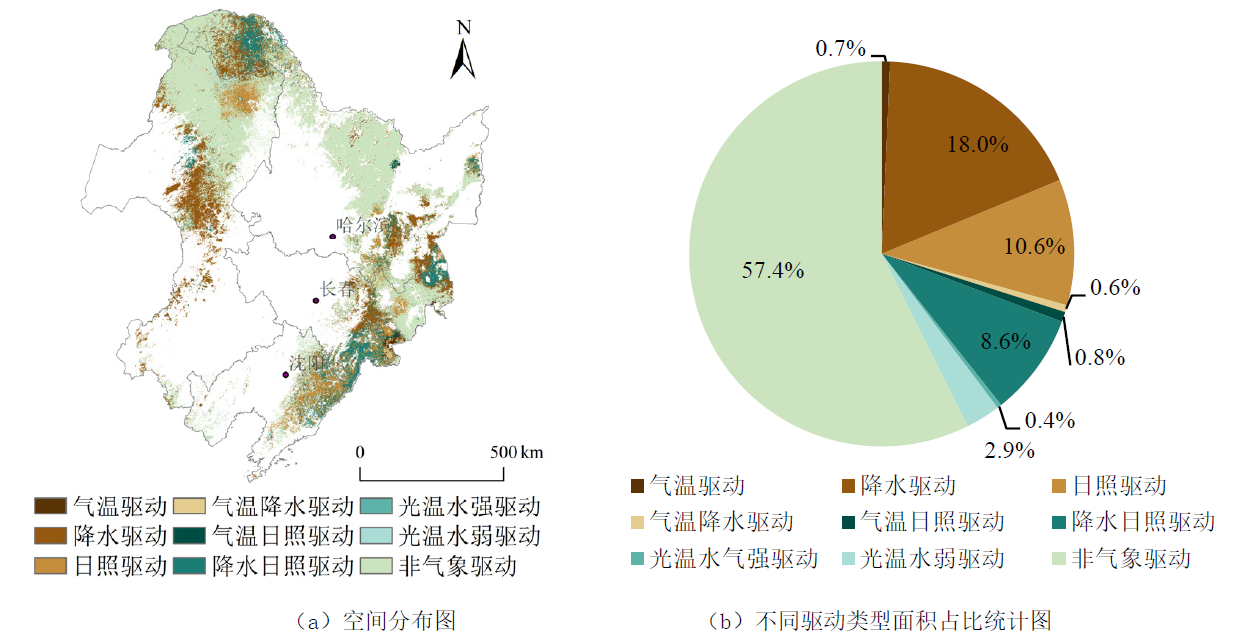
图7 东北林区NEP气候驱动影响分析
Figure 7 Analysis of the impact of climate drivers on NEP in the Northeast Forest Region of China
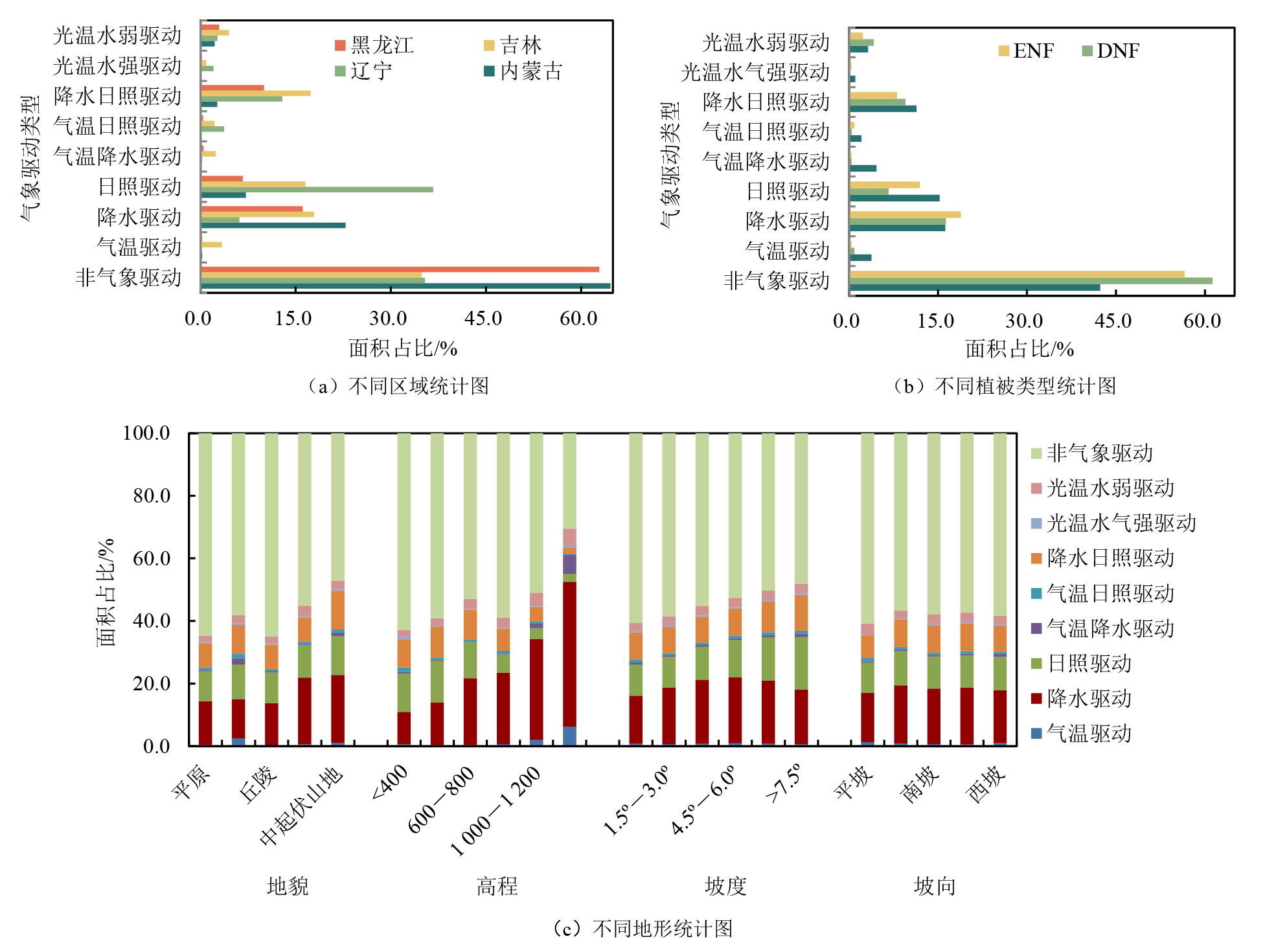
图8 东北林区固碳能力气候驱动类型的空间分异特征
Figure 8 Spatial heterogeneity characteristics of climate-driven types of carbon sequestration capacity in the Northeast Forest Region of China
| [1] |
Ahlström A, Raupach M R, Schurgers G, et al., 2015. The dominant role of semi-arid ecosystems in the trend and variability of the land CO2 sink[J]. Science, 348(6237): 895-899.
DOI PMID |
| [2] |
Au T F, Maxwell J T, Robeson S M, et al., 2022. Younger trees in the upper canopy are more sensitive but also more resilient to drought[J]. Nature Climate Change, 12(12): 1168-1174.
DOI |
| [3] |
Bonan G B, 2008. Forests and climate change: Forcings, feedbacks, and the climate benefits of forests[J]. Science, 320(5882): 1444-1449.
DOI PMID |
| [4] |
Bond-Lamberty B, Wang C K, Gower S T, 2004. A global relationship between the heterotrophic and autotrophic components of soil respiration?[J]. Global Change Biology, 10(10): 1756-1766.
DOI URL |
| [5] |
Bryan B A, Gao L, Ye Y, et al., 2018. China’s response to a national land-system sustainability emergency[J]. Nature, 559(7713): 193-204.
DOI |
| [6] |
Chen S T, Huang Y, Zou J W, et al., 2010. Modeling interannual variability of global soil respiration from climate and soil properties[J]. Agricultural and Forest Meteorology, 150(4): 590-605.
DOI URL |
| [7] |
Chimdessa T, 2023. Forest carbon stock variation with altitude in Bolale natural forest, Western Ethiopia[J]. Global Ecology and Conservation, 45: e02537.
DOI URL |
| [8] |
Dar A A, Parthasarathy N, 2022. Patterns and drivers of tree carbon stocks in Kashmir Himalayan Forests: Implications for climate change mitigation[J]. Ecological Processes, 11(1): 1-13.
DOI |
| [9] |
He H L, Wang S Q, Zhang L, et al., 2019. Altered trends in carbon uptake in China’s terrestrial ecosystems under the enhanced summer monsoon and warming hiatus[J]. National Science Review, 6(3): 505-514.
DOI URL |
| [10] |
Hou G L, Delang C O, Lu X X, 2020. Afforestation changes soil organic carbon stocks on sloping land: The role of previous land cover and tree type[J]. Ecological Engineering, 152: 105860.
DOI URL |
| [11] |
Keenan T F, Prentice I C, Canadell J G, et al., 2016. Recent pause in the growth rate of atmospheric CO2 due to enhanced terrestrial carbon uptake[J]. Nature Communications, 7: 13428.
DOI |
| [12] |
Kobler J, Zehetgruber B, Dirnböck T, et al., 2019. Effects of aspect and altitude on carbon cycling processes in a temperate mountain forest catchment[J]. Landscape Ecology, 34: 325-340.
DOI |
| [13] | Liu P, Zha T S, Black T A, et al., 2025. Seasonal warming responses of the carbon dioxide sink from northern forests are sensitive to stand age[J]. Communications Earth & Environment, 6: 43. |
| [14] |
Ma J, Bu R C, Liu M, et al., 2015. Ecosystem carbon storage distribution between plant and soil in different forest types in Northeastern China[J]. Ecological Engineering, 81: 353-362.
DOI URL |
| [15] |
Ouyang Z, Zheng H, Xiao Y, et al., 2016. Improvements in ecosystem services from investments in natural capital[J]. Science, 352(6292): 1455-1459.
DOI PMID |
| [16] | Pan S F, Yang J, Tian H, et al., 2020. Climate extreme versus carbon extreme: Responses of terrestrial carbon fluxes to temperature and precipitation[J]. Journal of Geophysical Research: Biogeosciences, 125(4): e2019JG005252. |
| [17] |
Pan Y, Birdsey R A, Fang J, et al., 2011. A large and persistent carbon sink in the world’s forests[J]. Science, 333(6045): 988-993.
DOI URL |
| [18] |
Pang B W, Liu Y L, An R, et al., 2024. Spatial and temporal divergence and driving mechanisms of carbon sinks in terrestrial ecosystems in the middle reaches of the Yangtze River urban agglomerations during 2008-2020[J]. Ecological Indicators, 165: 112205.
DOI URL |
| [19] |
Piao S L, Fang J Y, Philippe C, et al., 2009. The carbon balance of terrestrial ecosystems in China[J]. Nature, 458(23): 305-313.
DOI |
| [20] |
Reichstein M, Bahn M, Ciais P, et al., 2013. Climate extremes and the carbon cycle[J]. Nature, 500(7462): 287-295.
DOI |
| [21] |
Santosh G C, Kafle G, Ayer S et al., 2025. Landscape-level assessment of topographic influences on organic carbon storage in forests of far Western Nepal[J]. Plant-Environment Interactions, 6(2): e70039.
DOI URL |
| [22] |
Shang R, Chen J M, Xu M, et al., 2023. China’s current forest age structure will lead to weakened carbon sinks in the near future[J]. The Innovation, 4(6): 100515.
DOI URL |
| [23] |
Shangguan W, Dai Y J, Duan Q Y, et al., 2014. A global soil data set for earth system modeling[J]. Journal of Advances in Modeling Earth Systems, 6(1): 249-263.
DOI URL |
| [24] |
Shi M Y, Qi J G, Yin R S, 2016. Has China’s natural forest protection program protected forests? -Heilongjiang’s experience[J]. Forests, 7(10): 218.
DOI URL |
| [25] |
Simegn T Y, Soromessa T, 2015. Carbon stock variations along altitudinal and slope gradient in the forest belt of Simen Mountains National Park, Ethiopia[J]. American Journal of Environmental Protection, 4(4): 199-201.
DOI URL |
| [26] |
Singh R, Prakash P, Singh A K, et al., 2025. Altitudinal variation in carbon stocks of Quercus leucotrichophora forests in the Western Himalayas: Implications for climate change mitigation[J]. Trees, Forests and People, 22: 101059.
DOI URL |
| [27] |
Smith L A, Eissenstat D M, Kaye M W, 2017. Variability in aboveground carbon driven by slope aspect and curvature in an eastern deciduous forest, USA[J]. Canadian Journal of Forest Research, 47(2): 149-158.
DOI URL |
| [28] |
Song Y K, Yan X D, 2024. A high-resolution simulation of forest ecosystem carbon budget change with complex terrain[J]. Ecosystem Health and Sustainability, 10: 0192.
DOI URL |
| [29] |
Thapliyal S, Sati S P, Singh B, et al., 2024. Effect of altitudes and aspects on carbon sequestration potential of Quercus floribunda forests of Garhwal Himalayas[J]. Trees, Forests and People, 18: 100690.
DOI URL |
| [30] |
Wang C, Zhao W Z, Zhang Y Y, 2022. The change in net ecosystem productivity and its driving mechanism in a mountain ecosystem of arid regions, Northwest China[J]. Remote Sensing, 14(16): 4046.
DOI URL |
| [31] |
Wei D, Tao J, Wang Z Z, et al., 2024. Elevation-dependent pattern of net CO2 uptake across China[J]. Nature Communications, 15: 2489.
DOI PMID |
| [32] |
Yan H, Wang S Q, Billesbach D, et al., 2015. Improved global simulations of gross primary product based on a new definition of water stress factor and a separate treatment of C3 and C4 plants[J]. Ecological Modelling, 297: 42-59.
DOI URL |
| [33] |
Yan H, Wang S Q, Wang J B, et al., 2019. Multi-model analysis of climate impacts on plant photosynthesis in China during 2000-2015[J]. International Journal of Climatology, 39(15): 5539-5555.
DOI URL |
| [34] |
Ye L, Shi K, Zhang H R, et al., 2019. Spatio-temporal analysis of drought indicated by SPEI over northeastern China[J]. Water, 11(5): 908.
DOI URL |
| [35] |
Yu Z, Ciais P, Piao S L, et al., 2022. Forest expansion dominates China’s land carbon sink since 1980[J]. Nature Communications, 13(1): 5374.
DOI |
| [36] |
Zeng W S, Tomppo E, Healey S P, et al., 2015. The national forest inventory in China: History-results-international context[J]. Forest Ecosystems, 2(4): 23.
DOI URL |
| [37] |
Zhao M S, Running S W, 2010. Drought-induced reduction in global terrestrial net primary production from 2000 through 2009[J]. Science, 329(5994): 940-943.
DOI PMID |
| [38] |
曹云, 孙应龙, 姜月清, 等, 2022. 黄河流域净生态系统生产力的时空分异特征及其驱动因子分析[J]. 生态环境学报, 31(11): 2101-2110.
DOI |
| Cao Y, Sun Y L, Jiang Y Q, et al., 2022. Analysis on temporal-spatial variations and driving factors of net ecosystem productivity in the Yellow River Basin[J]. Ecology and Environmental Sciences, 31(11): 2101-2110. | |
| [39] | 曹云, 张称意, 孙应龙, 等, 2023. 2000-2020年华北地区植被固碳能力时空变化特征及其气象影响分析[J]. 生态学报, 43(9): 3488-3499. |
| Cao Y, Zhang C Y, Sun Y L, et al., 2023. Spatial and temporal patterns of carbon sequestration and their responses to climatic factors in North China from 2000 to 2020[J]. Acta Ecologica Sinica, 43(9): 3488-3499. | |
| [40] |
陈世亮, 李霞, 钱钊晖, 等, 2024. 澜沧江-湄公河流域干旱趋势及其对生态系统碳固定的影响[J]. 地理学报, 79(3): 747-764.
DOI |
|
Chen S L, Li X, Qian Z H, et al., 2024. Drought trend and its impact on ecosystem carbon sequestration in Lancang-Mekong River Basin[J]. Acta Geographica Sinica, 79(3): 747-764.
DOI |
|
| [41] |
陈智, 2019. 2000-2015年中国东北森林生产力和碳素利用率的时空变异[J]. 应用生态学报, 30(5): 1625-1632.
DOI |
| Chen Z, 2019. Spatiotemporal variation of productivity and carbon use efficiency of forests in Northeast China from 2000 to 2015[J]. Chinese Journal of Applied Ecology, 30(5): 1625-1632. | |
| [42] | 窦佳慧, 梁宇, 怀保娟, 等, 2024. 不同地形条件下青藏高原森林生产力和碳收支动态[J]. 生态学杂志, 43(6): 1521-1530. |
|
Dou J H, Liang Y, Huai B J, et al., 2024. Productivity and carbon budget dynamics of forests under different topographic conditions on Tibetan Plateau[J]. Chinese Journal of Ecology, 43(6): 1521-1530.
DOI |
|
| [43] | 李佳聪, 朱春雨, 郭波, 等, 2024. 太行山典型流域森林生态系统碳储量分布特征[J]. 中国生态农业学报(中英文), 32(8): 1302-1310. |
| Li J C, Zhu C Y, Guo B, et al., 2024. Distribution characteristics of carbon storage in forest ecosystems in typical watersheds of Taihang Mountains Basin[J]. Chinese Journal of Eco-Agriculture, 32(8): 1302-1310. | |
| [44] |
李曼, 吴东丽, 何昊, 等, 2025. 1990-2020年黄河流域碳储量时空演变及驱动因素研究[J]. 生态环境学报, 34(3): 333-344.
DOI |
| Li M, Wu D L, He H, et al., 2025. Spatio-temporal evolution and driving factors of carbon storage in the Yellow River Basin from 1990 to 2020[J]. Ecology and Environmental Sciences, 34(3): 333-344. | |
| [45] | 李美丽, 尹礼昌, 张园, 等, 2021. 基于MODIS-EVI的西南地区植被覆盖时空变化及驱动因素研究[J]. 生态学报, 41(3): 1138-1147. |
| Li M L, Yin L C, Zhang Y, et al., 2021. Spatio-temporal dynamics of fractional vegetation coverage based on MODIS-EVI and its driving factors in Southwest China[J]. Acta Ecologica Sinica, 41(3): 1138-1147. | |
| [46] | 刘凤, 曾永年, 2021. 2000-2015年青海高原植被碳源/汇时空格局及变化[J]. 生态学报, 41(14): 5792-5803. |
| Liu F, Zeng Y N, 2021. Analysis of the spatio-temporal variation of vegetation carbon source/sink in Qinghai Plateau from 2000-2015[J]. Acta Ecologica Sinica, 41(14): 5792-5803. | |
| [47] | 罗菊春, 2002. 大兴安岭森林火灾对森林生态系统的影响[J]. 北京林业大学学报, 24(Z1): 101-107. |
| Luo J C, 2002. Influence of forest fire disaster on forest ecosystem in Great Xing’anling[J]. Journal of Beijing Forestry University, 24(Z1): 101-107. | |
| [48] | 梅雪松, 董灵波, 陈冠谋, 2024. 基于结构方程模型的兴安落叶松天然林碳汇量驱动因素[J]. 北京林业大学学报, 46(9): 1-10. |
| Mei X S, Dong L B, Chen G M, 2024. Driving factors of carbon sink in natural Larix gmelinii forests based on structural equation models[J]. Journal of Beijing Forestry University, 46(9): 1-10. | |
| [49] | 朴世龙, 何悦, 王旭辉, 等, 2022. 中国陆地生态系统碳汇估算: 方法、进展、展望[J]. 中国科学: 地球科学, 52(6): 1010-1020. |
| Piao S, He Y, Wang X H, et al., 2022. Estimation of China’s terrestrial ecosystem carbon sink: Methods, progress and prospects[J]. Science China Earth Sciences, 52(6): 1010-1020. | |
| [50] | 孙滨峰, 赵红, 逯非, 等, 2018. 东北森林带森林生态系统固碳服务空间特征及其影响因素[J]. 生态学报, 38(14): 4975-4983. |
| Sun B F, Zhao H, Lu F, et al., 2018. Spatial and temporal patterns of carbon sequestration in the Northeastern Forest Regions and its impact factors analysis[J]. Acta Ecologica Sinica, 38(14): 4975-4983. | |
| [51] | 孙金兵, 徐嘉晖, 宋金凤, 等, 2018. 东北典型林区土壤黑碳分布特征及影响因素[J]. 环境科学学报, 38(8): 3313-3321. |
| Sun J B, Xu J H, Song J F, et al., 2018. Distribution characteristics and influence factors of soil black carbon of typical forest areas in northeast China[J]. Acta Scientiae Circumstantiae, 38(8): 3313-3321. | |
| [52] | 王超, 侯鹏, 刘晓曼, 等, 2023. 中国重要生态系统保护和修复工程区域植被覆盖时空变化研究[J]. 生态学报, 43(21): 8903-8916. |
| Wang C, Hou P, Liu X M, et al., 2023. Spatiotemporal changes in vegetation cover of the national key ecosystem protection and restoration project areas, China[J]. Acta Ecologica Sinica, 43(21): 8903-8916. | |
| [53] |
王成武, 罗俊杰, 唐鸿湖, 2023. 基于InVEST模型的太行山沿线地区生态系统碳储量时空分异驱动力分析[J]. 生态环境学报, 32(2): 215-225.
DOI |
| Wang C W, Luo J J, Tang H H, 2023. Analysis on the driving force of spatial and temporal differentiation of carbon storage in the Taihang Mountains based on InVEST model[J]. Ecology and Environmental Sciences, 32(2): 215-225. | |
| [54] | 王锴, 朴世龙, 何悦, 等, 2023. 中国陆地生态系统碳汇稳定性的空间分布特征及驱动机制[J]. 中国科学: 地球科学, 53(2): 216-226. |
| Wang K, Piao S L, He Y, et al., 2023. Spatial variations and mechanisms for the stability of terrestrial carbon sink in China[J]. Science China Earth Sciences, 53(2): 216-226. | |
| [55] | 王耀, 梁宇, 刘波, 等, 2025. 东北地区森林地上碳储量动态及固碳潜力预测[J]. 生态学杂志, 44(2): 353-364. |
|
Wang Y, Liang Y, Liu B, et al., 2025. Dynamic assessment and carbon sequestration potential prediction of forest aboveground carbon stock in Northeast China[J]. Chinese Journal of Ecology, 44(2): 353-364.
DOI |
|
| [56] | 徐雪, 罗娅, 杨胜天, 等, 2023. 全球不同气候带陆地植被净初级生产力变化趋势与可持续性[J]. 生态学报, 43(9): 3729-3743. |
| Xu X, Luo Y, Yang S T, et al., 2023. Change trend and sustainability of vegetation net primary productivity of terrestrial ecosystems in different global climatic zones[J]. Acta Ecologica Sinica, 43(9): 3729-3743. | |
| [57] | 徐勇, 黄雯婷, 郭振东, 等, 2023. 2000-2020年我国西南地区植被NEP时空变化及其驱动因素的相对贡献[J]. 环境科学研究, 36(3): 557-570. |
| Xu Y, Huang W T, Guo Z D, et al., 2023. Spatio-temporal variation of vegetation net ecosystem productivity and relative contribution of driving forces in Southwest China from 2000 to 2020[J]. Research of Environmental Sciences, 36(3): 557-570. | |
| [58] | 曾立雄, 雷蕾, 王晓荣, 等, 2018. 海拔梯度对祁连山青海云杉林乔木层和土壤层碳密度的影响[J]. 生态学报, 38(20): 7168-7177. |
| Zeng L X, Lei L, Wang X R, et al., 2018. Effect of altitudinal variation on carbon density in arbor layer and soil layer of Picea crassifolia forest in Qilian Mountains[J]. Acta Ecologica Sinica, 38(20): 7168-7177. | |
| [59] | 张璐, 王静, 施润和, 2015. 2000-2010年东北三省碳源汇时空动态遥感研究[J]. 华东师范大学学报(自然科学版), 2015(4): 164-173. |
| Zhang L, Wang J, Shi R H, 2015. Temporal-spatial variations of carbon sink/source in Northeast China from 2000 to 2010[J]. Journal of East China Normal University (Natural Science), 2015(4): 164-173. | |
| [60] | 张少伟, 张弓乔, 惠刚盈, 2019. 内蒙古大兴安岭森林净初级生产力时空格局分析[J]. 林业科学研究, 32(5): 74-82. |
| Zhang S W, Zhang G Q, Hui G Y, 2019. Analysis of spatial-temporal pattern of forest net primary productivity of the Great Khingan in Inner Mongolia[J]. Forest Research, 32(5): 74-82. | |
| [61] | 张宇, 余振, 栾军伟, 等, 2023. 1982-2020年东北森林带植被绿度时空变化特征[J]. 生态学报, 43(16): 6670-6681. |
| Zhang Y, Yu Z, Luan J W, et al., 2023. Spatiotemporal variations of vegetation greenness in the forest belt of Northeast China during 1982-2020[J]. Acta Ecologica Sinica, 43(16): 6670-6681. | |
| [62] | 甄贞, 黄杰, 刘佳宇, 等, 2025. 中国东北地区森林碳源汇时空格局变化及对极端气候的响应[J]. 森林工程., 41(5): 969-980. |
| Zhen Z, Huang J, Liu J Y, et al., 2025. Changes in the spatiotemporal pattern of forest carbon sources and sinks in Northeast China and their responses to extreme climate[J]. Forest Engineering, 41(5): 969-980. | |
| [63] | 朱教君, 张秋良, 王安志, 等, 2022. 东北地区森林生态系统质量与功能提升对策建议[J]. 陆地生态系统与保护学报, 2(5): 41-48. |
| Zhu J J, Zhang Q L, Wang A Z, et al., 2022. Suggestions for improving the qualities and functions of forest ecosystems in Northeast China[J]. Terrestrial Ecosystem and Conservation, 2(5): 41-48. | |
| [64] | 祝聪, 彭文甫, 张丽芳, 等, 2019. 2006-2016年岷江上游植被覆盖度时空变化及驱动力[J]. 生态学报, 39(5): 1583-1594. |
| Zhu C, Peng W F, Zhang L F, et al., 2019. Study of temporal and spatial variation and driving force of fractional vegetation cover in upper reaches of Minjiang River from 2006 to 2016[J]. Acta Ecologica Sinica, 39(5): 1583-1594. | |
| [65] |
左丽媛, 高江波, 2020. 基于地理探测器的喀斯特植被NPP定量归因[J]. 生态环境学报, 29(4): 686-694.
DOI |
| Zuo L Y, Gao J B, 2020. Quantitative attribution analysis of NPP in Karst peak cluster depression based on geographical detector[J]. Ecology and Environmental Sciences, 29(4): 686-694. |
| [1] | 张继, 杨世琦, 张天宇, 刘志强, 敖杨. 基于CASA-GSMSR模型的重庆市NEP时空演变特征及驱动因素分析[J]. 生态环境学报, 2026, 35(9): 1342-1355. |
| [2] | 姚旭兵, 张玲, 车四方, 邓晓霞. 数字乡村建设对农业生态效率的影响研究[J]. 生态环境学报, 2026, 35(7): 1045-1058. |
| [3] | 张涛, 杨慧, 曹建华, 周孟霞, 康志强. 基于岩性分区的广西植被净生态系统生产力时空演变特征研究[J]. 生态环境学报, 2026, 35(5): 702-713. |
| [4] | 石洪飞, 侯光良, 曹明珠, 关佳萌, 何家豪, 唐中华, 马曙光. 基于InVEST模型的三江源黄河流域水源涵养时空演变与驱动机制[J]. 生态环境学报, 2026, 35(5): 793-804. |
| [5] | 赵爽, 聂谦雨, 岳昂, 汪东川, 孙晓玮, 张昊天, 刘昊沺, 叶凯. 地形-经济驱动下北方典型农业区的耕地细碎化空间分布特征及驱动机制[J]. 生态环境学报, 2026, 35(4): 642-653. |
| [6] | 徐龙龙, 陈晓玲, 谢团辉, 姜超, 徐波, 石振华, 陈炎辉. 基于MaxEnt模型预测加拿大一枝黄花在福建的潜在入侵风险区[J]. 生态环境学报, 2026, 35(3): 414-424. |
| [7] | 余燕鞠, 丁雪. 滇中城市群森林植被净初级生产力时空变化特征及其影响因素研究[J]. 生态环境学报, 2026, 35(2): 209-222. |
| [8] | 许达, 宫程程, 张在勇, 冉彬, 胡月, 王寒冰, 陈晨. 毛乌素沙地植被净初级生产力的时空变化规律及影响因素[J]. 生态环境学报, 2025, 34(9): 1361-1372. |
| [9] | 李东熠, 李亭亭, 薛婉怡, 夏永知, 汪正祥. 气候变化下红豆杉潜在适宜生境分布预测分析——以湖北省为例[J]. 生态环境学报, 2025, 34(9): 1398-1409. |
| [10] | 丁馨, 刘健, 魏俐宏, 解德威, 郑昭佩. 基于GSMSR模型的山东省植被NEP时空格局及影响因素[J]. 生态环境学报, 2025, 34(7): 1079-1089. |
| [11] | 刘泽渊, 魏有海, 严旭发, 程亮, 侯璐, 严紫玮, 郭良芝. 气候变化对入侵杂草续断菊潜在地理分布的影响[J]. 生态环境学报, 2025, 34(6): 845-852. |
| [12] | 张亚丽, 黄柱军, 田义超, 林俊良, 覃彩焕. 极端气候对西南地区植被覆盖度变化的时滞与累积效应[J]. 生态环境学报, 2025, 34(5): 665-677. |
| [13] | 李曼, 吴东丽, 何昊, 余慧婕, 赵琳, 刘聪, 胡正华, 李琪. 1990-2020年黄河流域碳储量时空演变及驱动因素研究[J]. 生态环境学报, 2025, 34(3): 333-344. |
| [14] | 宋双双, 秦世姣, 孙彭成, 付兴涛. 基于多源遥感数据的汾河流域植被碳汇量估算及预测[J]. 生态环境学报, 2025, 34(3): 345-357. |
| [15] | 郭昭, 师芸, 刘铁铭, 张雨欣, 闫永智. 2001-2020年秦岭北麓NPP时空格局及驱动因素分析[J]. 生态环境学报, 2025, 34(3): 401-410. |
| 阅读次数 | ||||||
|
全文 |
|
|||||
|
摘要 |
|
|||||
