
生态环境学报 ›› 2026, Vol. 35 ›› Issue (10): 1522-1531.DOI: 10.16258/j.cnki.1674-5906.2026.10.003
穆君1,2( ), 李晓东1, 焦敏1, 王福麟1, 雷孟霖1, 肖宇童1, 余明娟1, 罗康2, 张慎2, 张仁波4, 严令斌3, 何跃军1,*()
收稿日期:2026-03-19
修回日期:2026-09-04
接受日期:2026-09-20
出版日期:2026-10-18
发布日期:2026-10-21
通讯作者:
E-mail: 作者简介:穆君(1979年生),男,高级工程师,硕士,主要从事森林生态系统保护研究与生态管理工作。E-mail: mujunisjoun@163.com
基金资助:
Mu Jun1,2(), Li Xiaodong1, Jiao Min1, Wang Fulin1, Lei Menglin1, Xiao Yutong1, Yu Mingjuan1, Luo Kang2, Zhang Shen2, Zhang Renbo4, Yan Lingbin3, He Yuejun1,*()
Received:2026-03-19
Revised:2026-09-04
Accepted:2026-09-20
Online:2026-10-18
Published:2026-10-21
摘要:
【目的】种间协变可维持群落物种共存、优化资源利用和促进植被稳定性。贵州黔北丹霞地貌分布的森林群落在长江中上游发挥着生态屏障功能,本研究旨在揭示该区域森林群落在不同结构层次上如何实现种间协变以维持群落稳定性。【方法】本研究通过贵州习水国家级自然保护区长嵌沟片区典型的常绿阔叶林为对象,设置群落样地调查,利用生态位宽度指数(B(S)、B(L))、生态位重叠指数(Oij)、方差比率法(R)、χ2检验和Spearman秩相关检验法,按群落垂直结构层次研究物种生态位、种间相互作用和群落稳定性。【结果】森林群落乔灌草3个层次重要值最高的分别是杉木(Cunninghamia lanceolata)、金佛山方竹(Chimonobambusa utilis)和红盖鳞毛蕨(Dryopteris erythrosora),生态位宽度值也较大,表明这几个物种是各自层次的优势种。群落不同结构层次Oij≥0.50的种对占比乔木层为70.53%、灌木层为43.68%和草本层为30.00%,表明乔灌草层种间竞争依次降低。乔木层和灌木层的种间协变和相关性强于草本层,乔灌层总体协变表现出显著正关联,而草本层为不显著正关联,表明乔木层和灌木层种间正协同作用较强。乔灌草各层次群落稳定点欧氏距离分别为21.5、24.2和24.6,说明乔灌层相对稳定性较高,而草本层稳定性最低。【结论】森林群落种间协变和稳定性随乔灌草层次改变逐渐降低,乔木层和灌木层种间竞争作用强而稳定性高,种间正相互作用明显而促进群落演化。研究结果可为自然保护区森林可持续管理提供参考。
中图分类号:
穆君, 李晓东, 焦敏, 王福麟, 雷孟霖, 肖宇童, 余明娟, 罗康, 张慎, 张仁波, 严令斌, 何跃军. 黔北丹霞地貌森林群落不同结构层次种间协变及稳定性[J]. 生态环境学报, 2026, 35(10): 1522-1531.
Mu Jun, Li Xiaodong, Jiao Min, Wang Fulin, Lei Menglin, Xiao Yutong, Yu Mingjuan, Luo Kang, Zhang Shen, Zhang Renbo, Yan Lingbin, He Yuejun. Interspecific Covariation and Stability of Different Structural Layers in the Forest Communities of the Danxia Landform in Northern Guizhou[J]. Ecology and Environmental Sciences, 2026, 35(10): 1522-1531.
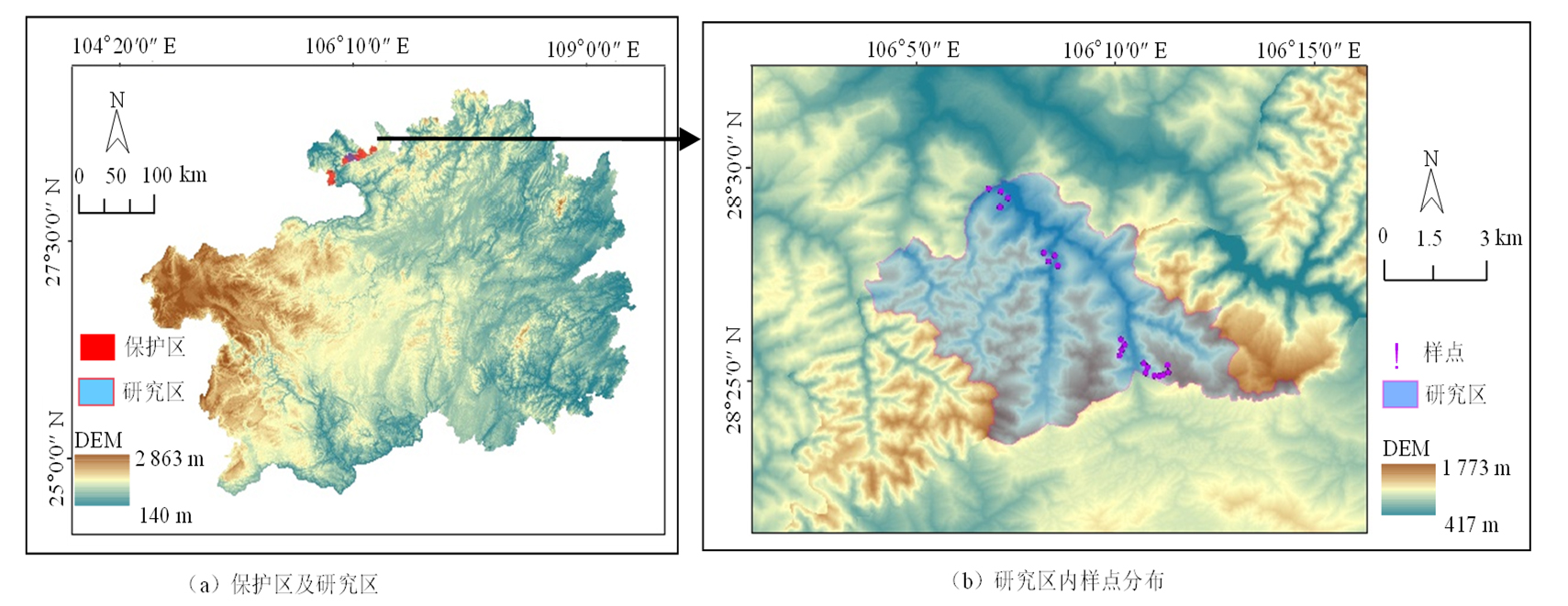
图1 研究区地理位置与样地分布示意图 审图号:GS(2020)4619号,底图边界无修改
Figure 1 Geographic location of the study area and distribution of sample plots
| 林层 | 物种名 | 缩写 | 重要值V | 生态位宽度 | |
|---|---|---|---|---|---|
| B(L) | B(S) | ||||
| 乔木层 | 杉木 Cunninghamia lanceolata | Cu | 0.318 | 6.628 | 2.151 |
| 星毛鹅掌柴 Heptapleurum minutistellatum | He | 0.193 | 4.438 | 1.737 | |
| 栲 Castanopsis fargesii | Ca | 0.186 | 5.085 | 1.816 | |
| 岩樟 Cinnamomum saxatile | Ci | 0.175 | 6.627 | 1.989 | |
| 细枝柃 Eurya loquaiana | Eu−l | 0.147 | 5.454 | 1.854 | |
| 木姜叶柯 Lithocarpus litseifolius | Li | 0.143 | 4.781 | 1.707 | |
| 短柱柃 Eurya brevistyla | Eu−b | 0.142 | 6.259 | 1.951 | |
| 灯台树 Bothrocaryum controversum | Bo | 0.129 | 6.000 | 1.792 | |
| 桫椤 Alsophila spinulosa | Al | 0.127 | 4.313 | 1.599 | |
| 四川山矾 Symplocos setchuensis | Sy | 0.125 | 3.571 | 1.457 | |
| 贵州毛柃 Eurya kueichowensis | Eu−k | 0.112 | 5.255 | 1.712 | |
| 川黔尖叶柃 Eurya acuminoides | Eu−a | 0.108 | 5.261 | 1.720 | |
| 鸭脚罗伞 Brassaiopsis glomerulata | Br | 0.091 | 4.000 | 1.494 | |
| 矩叶鼠刺 Itea omeiensis | It | 0.089 | 4.000 | 1.494 | |
| 腺柄山矾Symplocos adenopus | Sy−a | 0.080 | 3.756 | 1.352 | |
| 灰柯Lithocarpus henryi | Li−h | 0.078 | 2.632 | 1.030 | |
| 亮叶桦Betula luminifera | Be | 0.076 | 2.579 | 1.154 | |
| 白楠 Phoebe neurantha | Ph−n | 0.075 | 2.965 | 1.205 | |
| 湘楠 Phoebe hunanensis | Ph−h | 0.072 | 3.240 | 1.273 | |
| 毛桐 Mallotus barbatus | Ma | 0.072 | 3.571 | 1.332 | |
| 灌木层 | 金佛山方竹 Chimonobambusa utilis | Ch | 0.301 | 4.000 | 1.386 |
| 星毛鹅掌柴 Heptapleurum minutistellatum | He | 0.173 | 4.840 | 1.673 | |
| 杜茎山 Maesa japonica | Ma−J | 0.131 | 3.769 | 1.475 | |
| 四川山矾 Symplocos setchuensis | Sy | 0.109 | 4.235 | 1.517 | |
| 栲 Castanopsis fargesii | Ca | 0.099 | 5.000 | 1.609 | |
| 杉木 Cunninghamia lanceolata | Cu | 0.092 | 5.000 | 1.609 | |
| 木姜叶柯 Lithocarpus litseifolius | Li | 0.084 | 4.000 | 1.386 | |
| 桫椤 Alsophila spinulosa | Al | 0.081 | 2.579 | 1.004 | |
| 红雾水葛 Pouzolzia sanguinea | Po | 0.080 | 2.000 | 0.868 | |
| 短柱柃 Eurya brevistyla | Eu | 0.076 | 3.000 | 1.099 | |
| 十大功劳 Mahonia fortunei | Ma−f | 0.073 | 4.000 | 1.386 | |
| 鸭脚罗伞 Brassaiopsis glomerulata | Br | 0.061 | 2.667 | 1.040 | |
| 细枝柃 Eurya loquaiana | Eu−l | 0.057 | 2.667 | 1.040 | |
| 川黔尖叶柃 Eurya acuminoides | Eu−a | 0.053 | 2.000 | 0.693 | |
| 矩叶鼠刺 Itea omeiensis | It | 0.044 | 2.000 | 0.693 | |
| 狭叶润楠 Machilus rehderi | Ma−r | 0.038 | 2.000 | 0.693 | |
| 百两金 Ardisia crispa | Ar−c | 0.037 | 2.000 | 0.693 | |
| 灰柯 Lithocarpus henryi | Li−h | 0.037 | 2.000 | 0.693 | |
| 岩樟 Cinnamomum saxatile | Ci | 0.036 | 1.000 | 0.426 | |
| 杨梅 Morella rubra | Mo | 0.036 | 2.000 | 0.693 | |
| 草本层 | 红盖鳞毛蕨 Dryopteris erythrosora | Dr−e | 0.260 | 10.00 | 2.303 |
| 莲座蕨 Angiopteridaceae | An | 0.200 | 3.000 | 1.099 | |
| 线柱苣苔 Rhynchotechum ellipticum | Rh−e | 0.151 | 3.920 | 1.376 | |
| 竹叶草 Oplismenus compositus | Op | 0.145 | 4.500 | 1.561 | |
| 黄常山 Dichroa febrifuga | Di | 0.129 | 2.800 | 0.600 | |
| 里白 Hicriopteris glauca | Hi | 0.110 | 3.000 | 1.099 | |
| 观音莲座蕨 Angiopteris fokiensis | An−f | 0.108 | 3.267 | 1.277 | |
| 棕叶狗尾草 Setaria palmifolia | Se | 0.101 | 4.000 | 1.386 | |
| 鳞毛蕨 Dryopteris | Dr | 0.085 | 3.000 | 1.099 | |
| 蝴蝶花 Iris japonica | Ir | 0.087 | 3.000 | 1.099 | |
| 棕竹 Rhapis excelsa | Rh | 0.079 | 3.000 | 1.099 | |
| 寒梅 Armeniaca mume | Ar−m | 0.078 | 3.000 | 1.099 | |
| 淡绿短肠蕨 Allantodia viridissima | Al | 0.077 | 2.667 | 1.040 | |
| 狗脊蕨 Woodwardia japonica | Wo | 0.076 | 2.000 | 0.693 | |
| 碗蕨 Dennstaedtia scabra | De | 0.076 | 3.000 | 1.099 | |
| 华南紫萁 Osmunda vachellii | Os | 0.055 | 1.923 | 0.673 | |
| 箭竹 Fargesia | Fa | 0.055 | 1.800 | 0.637 | |
| 光里白 Hicriopteris laevissima | Hl | 0.055 | 1.800 | 0.637 | |
| 荩草 Arthraxon hispidus | Ah | 0.055 | 2.000 | 0.693 | |
| 爬山虎 Parthenocissus tricuspidata | Pa−t | 0.055 | 2.000 | 0.693 | |
表1 森林群落不同结构层次物种重要值及生态位宽度
Table 1 Species importance values and ecological niche widths of different structural layers in forest communities
| 林层 | 物种名 | 缩写 | 重要值V | 生态位宽度 | |
|---|---|---|---|---|---|
| B(L) | B(S) | ||||
| 乔木层 | 杉木 Cunninghamia lanceolata | Cu | 0.318 | 6.628 | 2.151 |
| 星毛鹅掌柴 Heptapleurum minutistellatum | He | 0.193 | 4.438 | 1.737 | |
| 栲 Castanopsis fargesii | Ca | 0.186 | 5.085 | 1.816 | |
| 岩樟 Cinnamomum saxatile | Ci | 0.175 | 6.627 | 1.989 | |
| 细枝柃 Eurya loquaiana | Eu−l | 0.147 | 5.454 | 1.854 | |
| 木姜叶柯 Lithocarpus litseifolius | Li | 0.143 | 4.781 | 1.707 | |
| 短柱柃 Eurya brevistyla | Eu−b | 0.142 | 6.259 | 1.951 | |
| 灯台树 Bothrocaryum controversum | Bo | 0.129 | 6.000 | 1.792 | |
| 桫椤 Alsophila spinulosa | Al | 0.127 | 4.313 | 1.599 | |
| 四川山矾 Symplocos setchuensis | Sy | 0.125 | 3.571 | 1.457 | |
| 贵州毛柃 Eurya kueichowensis | Eu−k | 0.112 | 5.255 | 1.712 | |
| 川黔尖叶柃 Eurya acuminoides | Eu−a | 0.108 | 5.261 | 1.720 | |
| 鸭脚罗伞 Brassaiopsis glomerulata | Br | 0.091 | 4.000 | 1.494 | |
| 矩叶鼠刺 Itea omeiensis | It | 0.089 | 4.000 | 1.494 | |
| 腺柄山矾Symplocos adenopus | Sy−a | 0.080 | 3.756 | 1.352 | |
| 灰柯Lithocarpus henryi | Li−h | 0.078 | 2.632 | 1.030 | |
| 亮叶桦Betula luminifera | Be | 0.076 | 2.579 | 1.154 | |
| 白楠 Phoebe neurantha | Ph−n | 0.075 | 2.965 | 1.205 | |
| 湘楠 Phoebe hunanensis | Ph−h | 0.072 | 3.240 | 1.273 | |
| 毛桐 Mallotus barbatus | Ma | 0.072 | 3.571 | 1.332 | |
| 灌木层 | 金佛山方竹 Chimonobambusa utilis | Ch | 0.301 | 4.000 | 1.386 |
| 星毛鹅掌柴 Heptapleurum minutistellatum | He | 0.173 | 4.840 | 1.673 | |
| 杜茎山 Maesa japonica | Ma−J | 0.131 | 3.769 | 1.475 | |
| 四川山矾 Symplocos setchuensis | Sy | 0.109 | 4.235 | 1.517 | |
| 栲 Castanopsis fargesii | Ca | 0.099 | 5.000 | 1.609 | |
| 杉木 Cunninghamia lanceolata | Cu | 0.092 | 5.000 | 1.609 | |
| 木姜叶柯 Lithocarpus litseifolius | Li | 0.084 | 4.000 | 1.386 | |
| 桫椤 Alsophila spinulosa | Al | 0.081 | 2.579 | 1.004 | |
| 红雾水葛 Pouzolzia sanguinea | Po | 0.080 | 2.000 | 0.868 | |
| 短柱柃 Eurya brevistyla | Eu | 0.076 | 3.000 | 1.099 | |
| 十大功劳 Mahonia fortunei | Ma−f | 0.073 | 4.000 | 1.386 | |
| 鸭脚罗伞 Brassaiopsis glomerulata | Br | 0.061 | 2.667 | 1.040 | |
| 细枝柃 Eurya loquaiana | Eu−l | 0.057 | 2.667 | 1.040 | |
| 川黔尖叶柃 Eurya acuminoides | Eu−a | 0.053 | 2.000 | 0.693 | |
| 矩叶鼠刺 Itea omeiensis | It | 0.044 | 2.000 | 0.693 | |
| 狭叶润楠 Machilus rehderi | Ma−r | 0.038 | 2.000 | 0.693 | |
| 百两金 Ardisia crispa | Ar−c | 0.037 | 2.000 | 0.693 | |
| 灰柯 Lithocarpus henryi | Li−h | 0.037 | 2.000 | 0.693 | |
| 岩樟 Cinnamomum saxatile | Ci | 0.036 | 1.000 | 0.426 | |
| 杨梅 Morella rubra | Mo | 0.036 | 2.000 | 0.693 | |
| 草本层 | 红盖鳞毛蕨 Dryopteris erythrosora | Dr−e | 0.260 | 10.00 | 2.303 |
| 莲座蕨 Angiopteridaceae | An | 0.200 | 3.000 | 1.099 | |
| 线柱苣苔 Rhynchotechum ellipticum | Rh−e | 0.151 | 3.920 | 1.376 | |
| 竹叶草 Oplismenus compositus | Op | 0.145 | 4.500 | 1.561 | |
| 黄常山 Dichroa febrifuga | Di | 0.129 | 2.800 | 0.600 | |
| 里白 Hicriopteris glauca | Hi | 0.110 | 3.000 | 1.099 | |
| 观音莲座蕨 Angiopteris fokiensis | An−f | 0.108 | 3.267 | 1.277 | |
| 棕叶狗尾草 Setaria palmifolia | Se | 0.101 | 4.000 | 1.386 | |
| 鳞毛蕨 Dryopteris | Dr | 0.085 | 3.000 | 1.099 | |
| 蝴蝶花 Iris japonica | Ir | 0.087 | 3.000 | 1.099 | |
| 棕竹 Rhapis excelsa | Rh | 0.079 | 3.000 | 1.099 | |
| 寒梅 Armeniaca mume | Ar−m | 0.078 | 3.000 | 1.099 | |
| 淡绿短肠蕨 Allantodia viridissima | Al | 0.077 | 2.667 | 1.040 | |
| 狗脊蕨 Woodwardia japonica | Wo | 0.076 | 2.000 | 0.693 | |
| 碗蕨 Dennstaedtia scabra | De | 0.076 | 3.000 | 1.099 | |
| 华南紫萁 Osmunda vachellii | Os | 0.055 | 1.923 | 0.673 | |
| 箭竹 Fargesia | Fa | 0.055 | 1.800 | 0.637 | |
| 光里白 Hicriopteris laevissima | Hl | 0.055 | 1.800 | 0.637 | |
| 荩草 Arthraxon hispidus | Ah | 0.055 | 2.000 | 0.693 | |
| 爬山虎 Parthenocissus tricuspidata | Pa−t | 0.055 | 2.000 | 0.693 | |
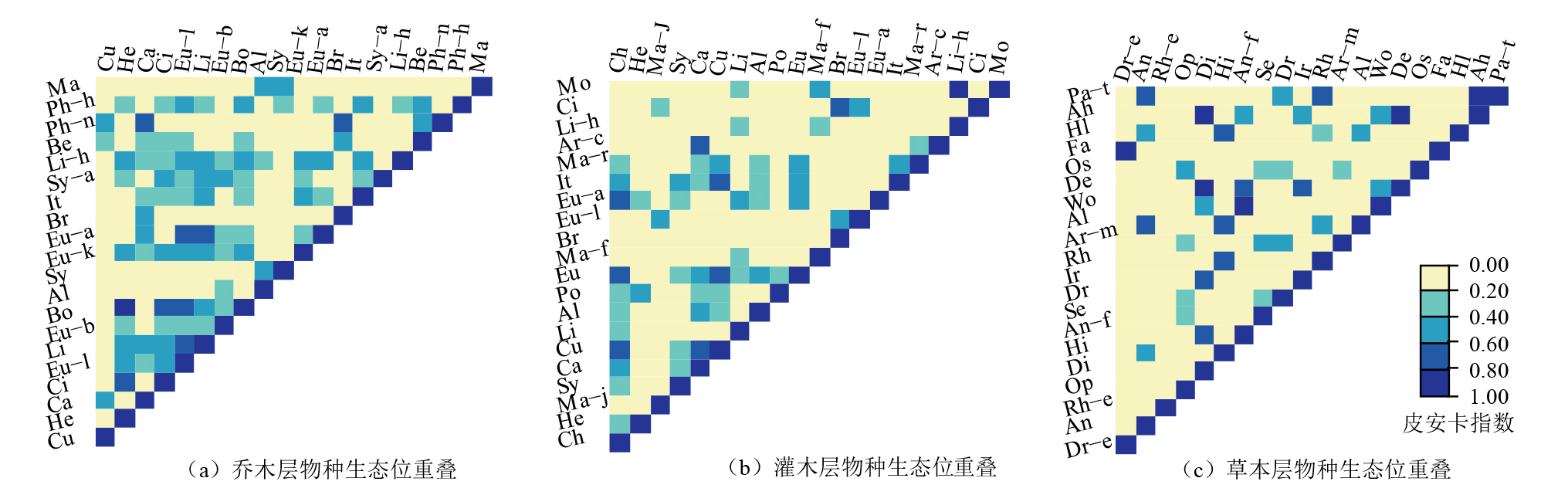
图2 森林群落不同结构层次物种生态位重叠
Figure 2 Ecological overlap for species of different structural layers in forest communities
| 林层 | R | W | χ2 | 检验结果 |
|---|---|---|---|---|
| 乔木层 | 2.89 | 57.80 | (8.91,32.85) | 显著正协变 |
| 灌木层 | 2.47 | 49.40 | (8.91,32.85) | 显著正协变 |
| 草本层 | 1.35 | 27 | (8.91,32.85) | 不显著正协变 |
表2 森林群落不同结构层次物种总体协变性
Table 2 Overall covariance for species of different structural layers in forest communities
| 林层 | R | W | χ2 | 检验结果 |
|---|---|---|---|---|
| 乔木层 | 2.89 | 57.80 | (8.91,32.85) | 显著正协变 |
| 灌木层 | 2.47 | 49.40 | (8.91,32.85) | 显著正协变 |
| 草本层 | 1.35 | 27 | (8.91,32.85) | 不显著正协变 |
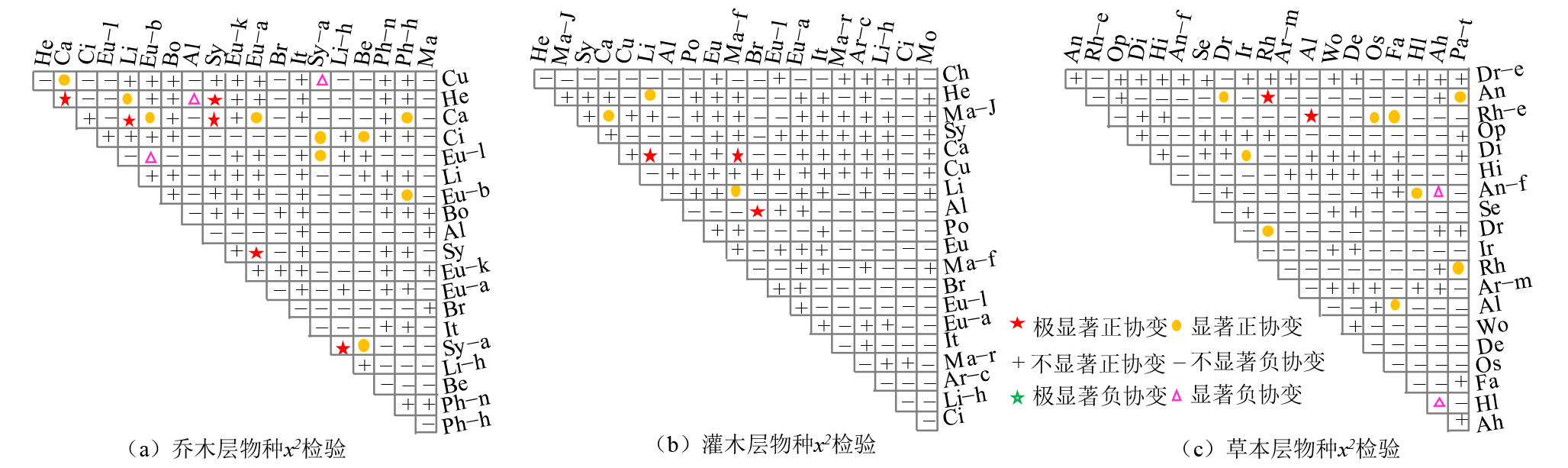
图3 森林群落不同结构层次物种χ2检验
Figure 3 χ2 test for species of different structural layers in forest communities
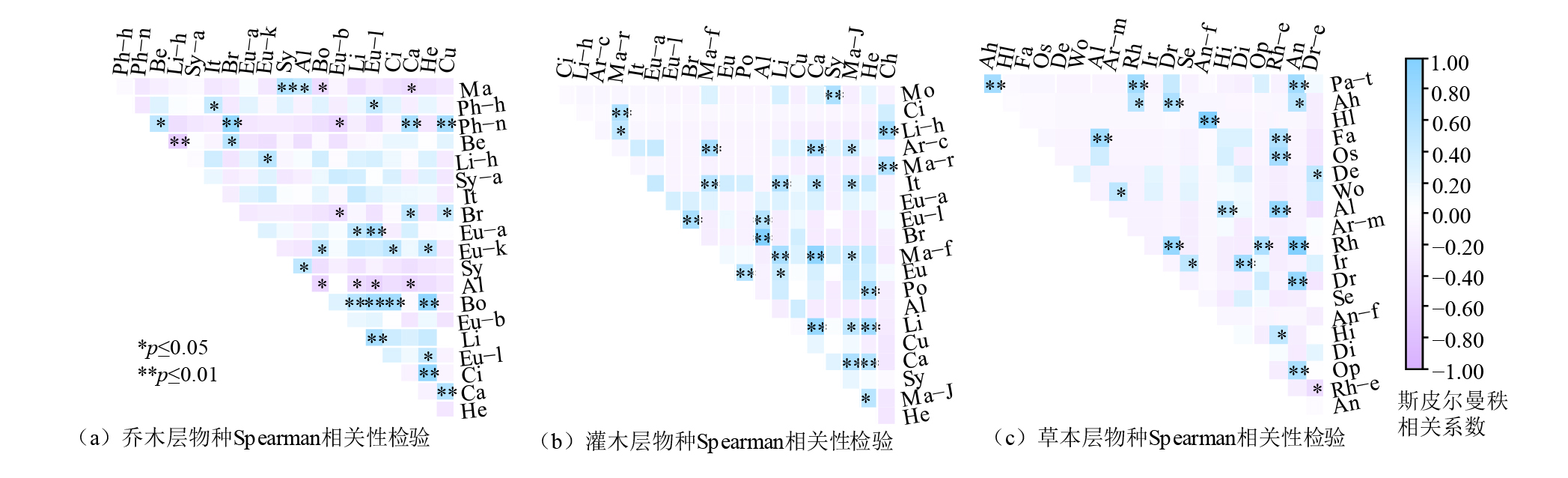
图4 森林群落不同结层次物种Spearman相关性检验
Figure 4 Spearman’s rank correlation test for species of different structural layers in forest communities

图5 森林群落不同结构层次群落稳定性
Figure 5 Community stability of different structural layers in forest communities
| [1] |
Arroyo C B, Jordano P, Bartomeus I, 2023. Intraspecific variation in species interactions promotes the feasibility of mutualistic assemblages[J]. Ecology Letters, 26(3): 448-459.
DOI URL |
| [2] |
Beaulieu C, Libourel C, Mbadinga Z D L, et al., 2025. The Marchantia polymorpha pangenome reveals ancient mechanisms of plant adaptation to the environment[J]. Nature Genetics, 57: 729-740.
DOI |
| [3] |
Bishara A J, Hittner J B, 2012. Testing the significance of a correlation with nonnormal data: Comparison of Pearson, Spearman, transformation, and resampling approaches[J]. Psychological Methods, 17(3): 399-417.
DOI PMID |
| [4] |
Bolnick D I, Amarasekare P, Araújo M S, et al., 2011. Why intraspecific trait variation matters in community ecology[J]. Trends in Ecology & Evolution, 26(4): 183-192.
DOI URL |
| [5] | Chen C, Yan G Y, Schmid B, et al., 2025. Understory shrub diversity: Equally vital as overstory tree diversity to promote forest productivity[J]. National Science Review, 12(7): nwaf093. |
| [6] |
Colpo A, Baldisserotto C, Pancaldi S, et al., 2022. Photosystem II photoinhibition and photoprotection in a lycophyte, Selaginella martensii[J]. Physiologia Plantarum, 174(1): e13604.
DOI URL |
| [7] |
Deng T T, Du Q Q, Zhu Y, et al., 2025. Environmental drivers of herbaceous plant diversity in the understory community of a warm-temperate forest[J]. Plant Diversity, 47(2): 282-290.
DOI URL |
| [8] | Ehlers B K, Damgaard C F, Laroche F, 2016. Intraspecific genetic variation and species coexistence in plant communities[J]. Biology Letters, 12(1): 20150853. |
| [9] |
Finke D L, Snyder W E, 2008. Niche partitioning increases resource exploitation by diverse communities[J]. Science, 321(5895): 1488-1490.
DOI PMID |
| [10] | Godron M, Daget P, Poissonet J J S E, 1972. Some aspects of heterogeneity in grasslands of Cantal[J]. Statistical Ecology, 3(3): 397-415. |
| [11] | Guo Y M, Zhou M, Sheng J, et al., 2023. Aboveground net primary productivity was not limited by phosphorus in a temperate typical steppe in Inner Mongolia[J]. Journal of Plant Ecology, 16(4): rtac085. |
| [12] |
Geng Q W, Arif M, Yin F, et al., 2024. Characteristics of forest understory herbaceous vegetation and its influencing factors in biodiversity hotspots in China[J]. Ecological Indicators, 167: 112634.
DOI URL |
| [13] |
He S C, Li D H, Yang X B, et al., 2025. Interspecific associations of dominant tree species at different structural levels and community stability in the habitat of endangered plant Hopea hainanensis Merr. & Chun[J]. Plants, 14(16): 2546.
DOI URL |
| [14] |
Ishii H, Azuma W, Nabeshima E, 2013. The need for a canopy perspective to understand the importance of phenotypic plasticity for promoting species coexistence and light-use complementarity in forest ecosystems[J]. Ecological Research, 28(2): 191-198.
DOI URL |
| [15] |
Itow S, 1991. Species turnover and diversity patterns along an evergreen broad‐leaved forest coenocline[J]. Journal of Vegetation Science, 2(4): 477-484.
DOI URL |
| [16] |
Laughlin D C, Mcgill B J, 2024. Trees have overlapping potential niches that extend beyond their realized niches[J]. Science, 385(6704): 75-80.
DOI PMID |
| [17] |
Lekberg Y, Bever J D, Bunn R A, et al., 2018. Relative importance of competition and plant-soil feedback, their synergy, context dependency and implications for coexistence[J]. Ecology Letters, 21(8): 1268-1281.
DOI PMID |
| [18] | Li X X, Liang E Y, Camarero J J, et al., 2023. Warming-induced phenological mismatch between trees and shrubs explains high-elevation forest expansion[J]. National Science Review, 10(10): nwad182. |
| [19] |
Lin D M, Lai J S, Mi X C, et al., 2013. Spatial variation in community structure of a subtropical evergreen broad-leaved forest: Implications for sampling design[J]. Chinese Science Bulletin, 58(10): 1181-1186.
DOI URL |
| [20] | Liu Y Z, Shen H H, Ge G, et al., 2023. Classification and distribution of evergreen broad-leaved forests in Jiangxi, East China[J]. Journal of Plant Ecology, 16(1): rtac059. |
| [21] |
Lü X Z, Zuo Z G, Sun J, et al., 2019. Spatial patterns of dominant species and their implication for natural secondary forest ecosystem dynamics in a reserved forest of north China[J]. Ecological Engineering, 127: 460-467.
DOI URL |
| [22] | Luo M, Hallett L M, Reuman D C, et al., 2025. Short time series obscure compensatory dynamics in ecological communities[J]. Nature Ecology & Evolution, 9(8): 1405-1413. |
| [23] |
Mensah S, Du Toit B, Seifert T, 2018. Diversity-biomass relationship across forest layers: Implications for niche complementarity and selection effects[J]. Oecologia, 187(3): 783-795.
DOI PMID |
| [24] |
Narayanan N, Lutz P, Shaw A K, 2025. Coexistence of coinvading species with mutualism and competition[J]. Ecology, 106(2): e70039.
DOI URL |
| [25] |
O’brien D A, Clements C F, 2025. Stability metrics behave predictably across data qualities but are sensitive to community size[J]. Biological Conservation, 307: 111191.
DOI URL |
| [26] |
Pianka E R, 1973. The structure of lizard communities[J]. Annual Review of Ecology, 4: 53-74.
DOI URL |
| [27] |
Pulla S, Suresh H S, Dattaraja H S, et al., 2017. Multidimensional tree niches in a tropical dry forest[J]. Ecology, 98(5): 1334-1348.
DOI PMID |
| [28] |
Rybar J, Bosela M, Marcis P, et al., 2023. Effects of tree canopy on herbaceous understorey throughout the developmental cycle of a temperate mountain primary forest[J]. Forest Ecology and Management, 546: 121353.
DOI URL |
| [29] |
Schellenberger C D, Gerschlauer F, Kiese R, et al., 2018. Plant niche breadths along environmental gradients and their relationship to plant functional traits[J]. Diversity Distributions, 24(12): 1869-1882.
DOI URL |
| [30] | Schluter D, 1984. A variance test for detecting species associations, with some example applications[J]. Ecology Letters, 65(3): 998-1005. |
| [31] |
Song K, Kohyama T S, Da L J, 2014. Transition patterns across an evergreen-deciduous broad-leaved forest ecotone: The effect of topographies[J]. Journal of Vegetation Science, 25(5): 1257-1266.
DOI URL |
| [32] |
Yang T, Shen Z H, Wang X F, et al., 2023. Characteristics of plant community diversity in a subtropical semi-humid evergreen broad-leaved forest in the Central Yunnan Plateau[J]. Biodiversity Science, 31(11): 23238.
DOI |
| [33] |
Thiel S, Tschapka M, Heymann E W, et al., 2021. Vertical stratification of seed-dispersing vertebrate communities and their interactions with plants in tropical forests[J]. Biological Reviews, 96(2): 454-469.
DOI URL |
| [34] |
Toju H, Guimaraes P R, Olesen J M, et al., 2014. Assembly of complex plant-fungus networks[J]. Nature Communications, 5(1): 5273.
DOI |
| [35] |
Wang T, Dong L B, Liu Z G, 2024a. Stand structure is more important for forest productivity stability than tree, understory plant and soil biota species diversity[J]. Frontiers in Forests Global Change, 7: 1354508.
DOI URL |
| [36] |
Wang M X, Baeten L, Van Coillie F, et al., 2024b. Tree species identity and interaction determine vertical forest structure in young planted forests measured by terrestrial laser scanning[J]. Forest Ecosystems, 11: 100196.
DOI URL |
| [37] | Zhu Y, Zhao G F, Zhang L W, et al., 2008. Community composition and structure of Gutianshan forest dynamic plot in a mid-subtropical evergreen broad-leaved forest East China[J]. Journal of Plant Ecology, 32(2): 262-273. |
| [38] |
陈雅轩, 韩雨音, 陈艳梅, 等, 2026. 华北不同林龄人工林植物功能性状与碳氮化学计量[J]. 植物生态学报, 50(2): 318-333.
DOI |
|
Chen Y X, Han Y Y, Chen Y M, et al., 2026. Plant functional traits and carbon-nitrogen stoichiometry of plantations at different forest ages in north China[J]. Chinese Journal of Plant Ecology, 50(2): 318-333.
DOI URL |
|
| [39] | 冯嘉谊, 练琚愉, 冯瑜莙, 等, 2024. 鼎湖山南亚热带常绿阔叶林群落垂直分层对群落结构及功能的影响[J]. 生物多样性, 32(12): 26-44. |
| Feng J Y, Lian J Y, Feng Y J, et al., 2024. Effects of vertical stratification on community structure and functions in a subtropical, evergreen broad-leaved forest in the Dinghushan National Nature Reserve[J]. Biodiversity Science, 32(12): 26-44. | |
| [40] | 何跃军, 钟章成, 刘锦春, 等, 2004. 桫椤群落的种内种间竞争研究[J]. 西南大学学报(自然科学版), 26(5): 589-593. |
| He Y J, Zhong Z C, Liu J C, et al., 2004. Intraspecific and interspecific competition in Alsophilaspinulosa community[J]. Journal of Southwest University (Natural Science Edition), 26(5): 589-593. | |
| [41] | 蒋长洪, 陈茗杨, 漆基海, 等, 2021. 黔北丹霞地貌桫椤群落优势木本植物的种间联结性[J]. 重庆师范大学学报(自然科学版), 38(3): 114-120. |
| Jiang C H, Chen M Y, Qi J H, et al., 2021. The interspecific association of the dominant xylophyta of Alsophila spinulosa community of Danxia Landform in north Guizhou, China[J]. Journal of Chongqing Normal University (Natural Science), 38(3): 114-120. | |
| [42] | 雷德芳, 王志杰, 2024. 黔中喀斯特地区马尾松群落主要物种种间联结、生态位及群落稳定性特征[J]. 生态学报, 44(10): 4353-4367. |
| Lei D F, Wang Z J, 2024. Interspecific associations, niches and community stability of main species in Pinus massoniana community in karst mountainous cities, the central Guizhou province[J]. Acta Ecologica Sinica, 44(10): 4353-4367. | |
| [43] | 李坚锋, 潘萍, 欧阳勋志, 等, 2022. 庐山常绿阔叶林种间联结性及物种共存机制[J]. 生态学杂志, 41(8): 1474-1481. |
|
Li J F, Pan P, Ouyang X Z, et al., 2022. Interspecific association and species coexistence mechanism of evergreen broad-leaved forest in Lushan Mountain[J]. Chinese Journal of Ecology, 41(8): 1474-1481.
DOI |
|
| [44] |
李珂佳, 蔡晨, 阮广鸣, 等, 2025. 小叶红豆群落主要树种的种间关系及群落稳定性[J]. 应用生态学报, 36(2): 427-436.
DOI |
| Li J K, Cai C, Ruan G M, et al., 2025. Interspecific association of main tree species in Ormosia microphylla community and its community stability[J]. Chinese Journal of Applied Ecology, 36(2): 427-436. | |
| [45] | 李茂, 邓伦秀, 姜运力, 等, 2013. 贵州习水自然保护区福建柏群落组成及结构研究[J]. 西北林学院学报, 28(1): 46-50, 57. |
| Li M, Deng L X, Jiang Y L, et al., 2013. Community composition and structure of Fokienia hodginsi community in Xishui Nature Reserve in Guizhou[J]. Journal of Northwest Forestry University, 28(1): 46-50, 57. | |
| [46] | 刘润红, 陈乐, 涂洪润, 等, 2020. 桂林岩溶石山青冈群落灌木层主要物种生态位与种间联结[J]. 生态学报, 40(6): 2057-2071. |
| Liu R H, Chen L, Xu H R, et al., 2020. Niche and interspecific association of main species in shrub layer of Cyclobalanopsis glauca community in karst hills of Guilin, southwest China[J]. Acta Ecologica Sinica, 40(6): 2057-2071. | |
| [47] |
刘雨婷, 侯满福, 贺露炎, 等, 2023. 滇东菌子山喀斯特森林群落乔木优势树种生态位和种间联结[J]. 应用生态学报, 34(7): 1771-1778.
DOI |
|
Liu Y T, Hou M F, He L Y, et al., 2023. Niche and interspecific association of dominant tree species in karst forest of Junzi Mountain, Eastern Yunnan, China[J]. Chinese Journal of Applied Ecology, 34(7): 1771-1778.
DOI |
|
| [48] |
刘嘉怡, 张军, 张帆, 等, 2025. 围封对短花针茅荒漠草原优势种群种间联结性的影响[J]. 生态环境学报, 34(2): 247-255.
DOI |
| Liu J Y, Zhang J, Zhang F, et al., 2025. Effects of enclosure on interspecific association of dominant species of Stipa breviflora in desert steppe[J]. Ecology and Environmental Sciences, 34(2): 247-255. | |
| [49] | 宋永昌, 2017. 植被生态学[M]. 上海: 华东师范大学出版社. |
| Song Y C, 2017. Vegetation Ecology[M]. Shanghai: East China Normal University Press. | |
| [50] |
王如, 农寿千, 彭文成, 等, 2023. 珍稀濒危植物海南粗榧群落树种组成与种间联结性[J]. 生态环境学报, 32(10): 1741-1749.
DOI |
| Wang R, Nong S Q, Peng W C, et al., 2023. Tree species composition and interspecific associations of rare and endangered plant Cephalotaxus hainanensis community[J]. Ecology and Environmental Sciences, 32(10): 1741-1749. | |
| [51] | 王宗庆, 马茂华, 陈春谛, 等, 2025. 桫椤生境草本层优势植物生态位特征与物种联结[J]. 生态学报, 45(21): 10757-10771. |
| Wang Z Q, Ma M H, Chen C D, et al., 2025. Study on the niche characteristics and species association of dominant plants in the herbaceous layer of Alsophila spinulosa habitat[J]. Acta Ecologica Sinica, 45(21): 10757-10771. | |
| [52] | 谢春平, 伊贤贵, 王贤荣, 2008. 野生早樱群落乔木层优势种群生态位研究[J]. 浙江大学学报(农业与生命科学版), 34(5): 578-585. |
| Xie C P, Yi X G, Wang X R, et al., 2008. Intraspecific and interspecific competition in Alsophilaspinulosa community[J]. Journal of Zhejiang University (Agriculture and Life Sciences), 34(5): 578-585. | |
| [53] | 徐德静, 郭能彬, 王鹏鹏, 等, 2014. 习水自然保护区桫椤种群结构与分布格局研究[J]. 西南大学学报(自然科学版), 36(11): 93-98. |
| Xu D J, Guo N B, Wang P P, et al., 2014. Structure and distribution pattern of Alsophila spinulosa populations in Danxia Landform in Xishui Nature Reserve[J]. Journal of Southwest University (Natural Science Edition), 36(11): 93-98. | |
| [54] | 薛卫星, 李春辉, 艾训儒, 等, 2023. 鹅掌楸天然林优势树种生态位与种间联结性[J]. 森林与环境学报, 43(1): 26-34. |
| Xie W X, Li C H, Ai X R, et al., 2023. Niche and interspecific association of dominant tree species in Liriodendron chinense natural forest[J]. Journal of Forest and Environment, 43(1): 26-34. | |
| [55] | 钟宇恒, 赖凌轩, 章雅茗, 等, 2026. 福建君子峰国家自然保护区紫玉盘柯天然种群生态位及种间联结性[J]. 生态学报, 46(10): 5510-5519. |
| Zhong Y H, Lai L X, Zhang Y M, et al., 2026. Niche and interspecific associations of the natural population of the Lithocarpus uvariifolius in Junzifeng National Nature Reserve, Fujian Province, China[J]. Acta Ecologica Sinica, 46(10): 5510-5519. | |
| [56] | 郑元润, 2000. 森林群落稳定性研究方法初探[J]. 林业科学, 36(5): 28-32. |
| Zheng Y R, 2000. Comparison of methods for studying stability of forest community[J]. Scientia Silvae Sinicae, 36(5): 28-32. | |
| [57] | 钟章成, 1992. 常绿阔叶林生态系统研究[M]. 重庆: 西南师范大学出版社. |
| Zhong Z C, 1992. Ecological study on evergreen broad-leafed forest[M]. Chongqing: Southwest Normal University Press. |
| [1] | 马雪莹, 杜宏茹, 马红莲, 赵雪纯, 林涛, 周耘天. 新疆景观生态风险评价及稳定性分析[J]. 生态环境学报, 2026, 35(9): 1393-1401. |
| [2] | 李梦, 韩亚峰, 胡艺宝, 姜梦晓, 张鑫, 高佳凯, 马任甜, 郑宾, 张烨, 孙丽蓉, 郭大勇, 石兆勇, 王旭刚. 不同化学结构外源碳添加对稻田土壤有机碳组分及碳排放的影响[J]. 生态环境学报, 2026, 35(6): 865-874. |
| [3] | 李琴, 郑强, 杨卫君, 张力月, 王梓, 赵立宁. 减量灌水配施生物炭对麦田土壤团聚体及其碳氮分布的影响[J]. 生态环境学报, 2026, 35(6): 875-884. |
| [4] | 李赢, 黄华丽, 张帆, 韩艳刚. 邻体相互作用对温带次生林树木生长及稳定性的影响[J]. 生态环境学报, 2026, 35(6): 922-927. |
| [5] | 童玮, 储晓燕, 童志鹏, 吴文骁, 吴家森. 基于生态位和随机森林的常绿落叶混交林演替规律研究[J]. 生态环境学报, 2026, 35(2): 199-208. |
| [6] | 李彦霖, 徐红伟, 徐琳, 骆紫藤, 袁亚玲, 谭波. 带状改造对柳杉人工林土壤水稳性团聚体组成及稳定性的影响[J]. 生态环境学报, 2026, 35(2): 223-231. |
| [7] | 屈高山, 程容, 王彩芳, 吕文静, 卓房, 王亚男, 马丹炜. 客土输入致城市绿地土荆芥入侵风险及阻控策略[J]. 生态环境学报, 2026, 35(10): 1555-1563. |
| [8] | 张义栋, 杨旭楠, 陈艳姣, 汪涛, 许玫英. FT-IR技术在水体沉积物有机碳分析中的应用研究进展[J]. 生态环境学报, 2025, 34(9): 1483-1494. |
| [9] | 李林, 张朝阳, 储小雪, 周景钢, 王雪, 魏识广. 鼎湖山不同类型森林物种多样性和功能多样性研究[J]. 生态环境学报, 2025, 34(8): 1219-1227. |
| [10] | 刘泽渊, 魏有海, 严旭发, 程亮, 侯璐, 严紫玮, 郭良芝. 气候变化对入侵杂草续断菊潜在地理分布的影响[J]. 生态环境学报, 2025, 34(6): 845-852. |
| [11] | 阿旺罗布, 王俊伟, 曾哲飞, 李伟, 闹增措, 谭鑫, 拉琼. 西藏雅尼湿地洲滩植物群落优势种生态位及种间联结性[J]. 生态环境学报, 2025, 34(10): 1558-1568. |
| [12] | 杜忠毓, 邢文黎, 党宁, 赵维彬, 谭许脉, 肖江, 盖旭, 陈光才. 甘肃西和锑矿生态破坏区优势物种生态位及种间联结性[J]. 生态环境学报, 2024, 33(7): 1036-1047. |
| [13] | 王亚军, 秦楚桐, 李肇隆, 杨胜, 姜舒恒, 王艳纯. 好氧颗粒污泥结构稳定强化策略研究评述[J]. 生态环境学报, 2024, 33(3): 478-486. |
| [14] | 王超, 杨倩楠, 张池, 刘同旭, 张晓龙, 陈静, 刘科学. 丹霞山不同土地利用方式土壤磷组分特征及其有效性[J]. 生态环境学报, 2023, 32(5): 889-897. |
| [15] | 周沁苑, 董全民, 王芳草, 刘玉祯, 冯斌, 杨晓霞, 俞旸, 张春平, 曹铨, 刘文亭. 放牧方式对高寒草地瑞香狼毒根际土壤团聚体及有机碳特征的影响[J]. 生态环境学报, 2023, 32(4): 660-667. |
| 阅读次数 | ||||||
|
全文 |
|
|||||
|
摘要 |
|
|||||
