
生态环境学报 ›› 2025, Vol. 34 ›› Issue (12): 1866-1878.DOI: 10.16258/j.cnki.1674-5906.2025.12.004
奥勇1,2,*( ), 倪赟1, 赵永华1,2, 丁志豪1, 黄福星1, 李敏1
收稿日期:2025-04-16
出版日期:2025-12-18
发布日期:2025-12-10
通讯作者:
*
作者简介:奥勇(1965年生),男,副教授,博士,研究方向为生态遥感。E-mail: aoyong@chd.edu.cn
基金资助:
AO Yong1,2,*(), NI Yun1, ZHAO Yonghua1,2, DING Zhihao1, HUANG Fuxing1, LI Min1
Received:2025-04-16
Online:2025-12-18
Published:2025-12-10
摘要: 在区域生态环境退化与快速城市化叠加压力下,生态韧性成为区域可持续发展的重要标尺,而绿色空间作为城市生态系统的核心载体,其韧性演变机制亟待系统性解析。从生态韧性视角,探讨了2000-2023年陕西省绿色空间生态韧性的时空演变特征及其驱动机制。基于多源遥感与统计数据,构建“抵抗力-适应力-恢复力”三维生态韧性评估框架,结合地理探测器与GWR方法,解析陕西省绿色空间生态韧性的时空演变特征及驱动机制。结果表明,1)2000-2023年陕西省绿色空间规模整体缩减1877 km2,但结构显著优化。其中耕地持续减少5096 km2(集中于关中平原),林地因退耕还林政策驱动稳步增加2206 km2,水域受气候与人为调控波动增长。2)生态韧性水平整体提升,但空间分异显著。高值区(0.46-0.86)集中于陕南秦巴山地(林地覆盖率高、景观连通性强)及延安南部退耕还林区,低值区(0-0.16)分布于关中平原(耕地主导型结构脆弱)和榆林北部(干旱与能源开发叠加压力)。3)驱动机制呈现显著空间分异。降水提升陕北生态韧性,陕南因水资源过剩存在风险;温度主要加剧汉中、安康、延安北部压力;坡度在榆林与延安交界处支撑韧性,而在延安中部削弱韧性。人口密度在榆林北部城区促进韧性,但在延安北部和关中(如西安、咸阳)加剧脆弱性;GDP与绿色空间生态韧性在榆林北部呈负相关,在延安以及部分陕南区域呈正向效应;土地利用强度在全省普遍削弱韧性,尤其在关中地区表现突出。
中图分类号:
奥勇, 倪赟, 赵永华, 丁志豪, 黄福星, 李敏. 生态韧性视角下陕西省绿色空间的时空演变特征及其驱动机制[J]. 生态环境学报, 2025, 34(12): 1866-1878.
AO Yong, NI Yun, ZHAO Yonghua, DING Zhihao, HUANG Fuxing, LI Min. Characteristics of Spatial and Temporal Evolution of Green Space and Its Driving Mechanism in Shaanxi Province under the Perspective of Ecological Resilience[J]. Ecology and Environmental Sciences, 2025, 34(12): 1866-1878.

图1 研究区区位图 审图号GS(2024)0650号;底图边界无修改
Figure 1 Overview map of the study area
| 生态服务功能 | 绿色空间类型 | ||||
|---|---|---|---|---|---|
| 耕地 | 林地 | 草地 | 水域 | ||
| 供给服务 | 食物生产 | 996.54 | 279.57 | 342.70 | 721.48 |
| 原料生产 | 220.95 | 640.31 | 505.03 | 207.42 | |
| 水资源供给 | −1176.91 | 333.68 | 279.57 | 7476.31 | |
| 调节服务 | 气体调节 | 802.64 | 2119.34 | 1776.64 | 694.42 |
| 气候调节 | 419.36 | 6339.98 | 4698.62 | 2065.23 | |
| 净化环境 | 121.75 | 1794.67 | 1551.18 | 5005.25 | |
| 水文调节 | 1348.26 | 3165.48 | 3445.05 | 92204.78 | |
| 支持服务 | 土壤保持 | 468.96 | 2579.28 | 2164.43 | 838.72 |
| 维持养分循环 | 139.79 | 198.41 | 162.33 | 63.13 | |
| 生物多样性 | 153.31 | 2344.80 | 1966.03 | 2299.71 | |
| 文化服务 | 美学景观 | 70.79 | 1028.10 | 865.77 | 1704.49 |
| 总价值 | 3565.45 | 20823.63 | 17757.36 | 113280.93 | |
表1 陕西省单位面积生态系统服务价值
Table 1 Ecosystem service value per unit area in Shaanxi Province yuan·hm?2
| 生态服务功能 | 绿色空间类型 | ||||
|---|---|---|---|---|---|
| 耕地 | 林地 | 草地 | 水域 | ||
| 供给服务 | 食物生产 | 996.54 | 279.57 | 342.70 | 721.48 |
| 原料生产 | 220.95 | 640.31 | 505.03 | 207.42 | |
| 水资源供给 | −1176.91 | 333.68 | 279.57 | 7476.31 | |
| 调节服务 | 气体调节 | 802.64 | 2119.34 | 1776.64 | 694.42 |
| 气候调节 | 419.36 | 6339.98 | 4698.62 | 2065.23 | |
| 净化环境 | 121.75 | 1794.67 | 1551.18 | 5005.25 | |
| 水文调节 | 1348.26 | 3165.48 | 3445.05 | 92204.78 | |
| 支持服务 | 土壤保持 | 468.96 | 2579.28 | 2164.43 | 838.72 |
| 维持养分循环 | 139.79 | 198.41 | 162.33 | 63.13 | |
| 生物多样性 | 153.31 | 2344.80 | 1966.03 | 2299.71 | |
| 文化服务 | 美学景观 | 70.79 | 1028.10 | 865.77 | 1704.49 |
| 总价值 | 3565.45 | 20823.63 | 17757.36 | 113280.93 | |
| 景观指数类型 | 景观指数及含义 | 权重 | |
|---|---|---|---|
| 景观异质性 | 香农多样性指数SHDI | 景观多样性指数 | 0.25 |
| 面积加权平均斑块分形维数AWMPFD | 某一斑块类型形状的复杂性,即人类活动干扰程度 | 0.25 | |
| 景观连通性 | 聚集指数AI | 景观中相同类型 斑块的聚合程度 | 0.25 |
| 蔓延度指数CONTAG | 不同类型斑块的空间 聚集性和相邻关系 | 0.25 | |
表2 景观指数及权重
Table 2 Landscape Index and Weight
| 景观指数类型 | 景观指数及含义 | 权重 | |
|---|---|---|---|
| 景观异质性 | 香农多样性指数SHDI | 景观多样性指数 | 0.25 |
| 面积加权平均斑块分形维数AWMPFD | 某一斑块类型形状的复杂性,即人类活动干扰程度 | 0.25 | |
| 景观连通性 | 聚集指数AI | 景观中相同类型 斑块的聚合程度 | 0.25 |
| 蔓延度指数CONTAG | 不同类型斑块的空间 聚集性和相邻关系 | 0.25 | |
| 绿色空间类型 | 耕地 | 林地 | 草地 | 水域 |
|---|---|---|---|---|
| 相对系数 | 0.3 | 0.8 | 0.5 | 0.8 |
表3 绿色空间恢复力相对系数
Table 3 Relative coefficient of green space resilience
| 绿色空间类型 | 耕地 | 林地 | 草地 | 水域 |
|---|---|---|---|---|
| 相对系数 | 0.3 | 0.8 | 0.5 | 0.8 |

图2 2000-2023年陕西省绿色空间演变
Figure 2 Evolution of green space in Shaanxi Province from 2000 to 2023

图3 2000-2023年陕西省绿色空间转移矩阵桑基图
Figure 3 Green space transfer matrix sankey diagram for Shaanxi Province from 2000 to 2023
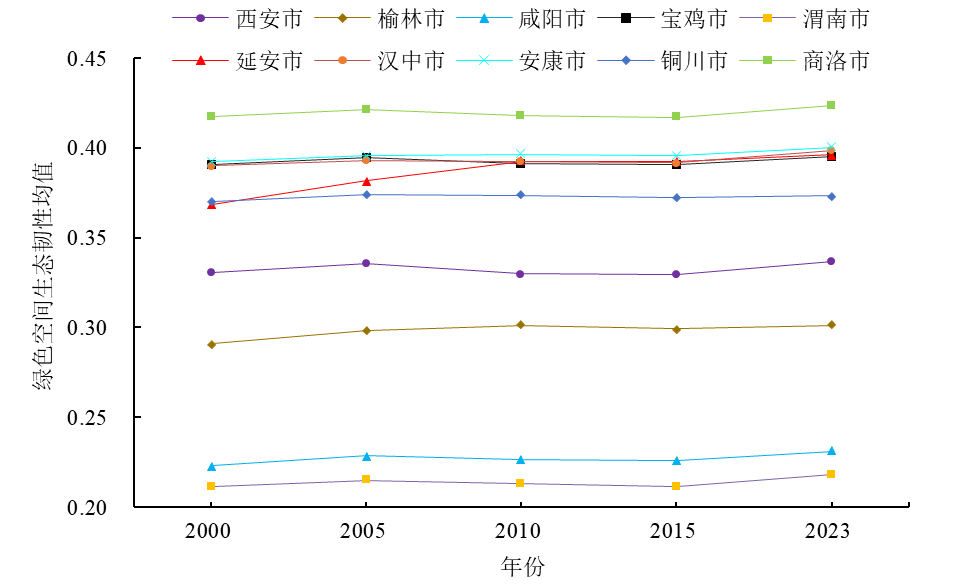
图4 2000-2023年陕西省绿色空间生态韧性水平
Figure 4 Ecological resilience level of green space in Shaanxi Province from 2000 to 2023

图5 2000-2023年陕西省绿色空间生态韧性水平演变
Figure 5 Evolution of ecological resilience level of green space in Shaanxi Province from 2000 to 2023

图6 2000-2023年陕西省绿色空间生态韧性变化弦图
Figure 6 Evolution of ecological resilience level of green space in Shaanxi Province from 2000 to 2023

图7 绿色空间生态韧性变化空间可视化
Figure 7 Spatial visualization of changes in ecological resilience in green spaces

图8 绿色空间生态韧性演变(按行政区划分)
Figure 8 Evolution of ecological resilience of green spaces (by administrative district)
| 指标 | 2000年 | 2005年 | 2010年 | 2015年 | 2023年 |
|---|---|---|---|---|---|
| Moran’s I | 0.809 | 0.804 | 0.796 | 0.797 | 0.803 |
| Z得分 | 138.370 | 137.550 | 136.150 | 136.280 | 137.220 |
| p | 0.000 | 0.000 | 0.000 | 0.000 | 0.000 |
表4 陕西省绿色空间生态韧性空间自相关结果
Table 4 Shaanxi Province green space ecological resilience space since the relevant results
| 指标 | 2000年 | 2005年 | 2010年 | 2015年 | 2023年 |
|---|---|---|---|---|---|
| Moran’s I | 0.809 | 0.804 | 0.796 | 0.797 | 0.803 |
| Z得分 | 138.370 | 137.550 | 136.150 | 136.280 | 137.220 |
| p | 0.000 | 0.000 | 0.000 | 0.000 | 0.000 |

图9 绿色空间生态韧性演变因子探测
Figure 9 Detection of evolutionary factors of ecological resilience in green spaces
| 年份 | R2 | Adjusted R2 | AICc | |||||
|---|---|---|---|---|---|---|---|---|
| OLS | GWR | OLS | GWR | OLS | GWR | |||
| 2000 | 0.743 | 0.873 | 0.742 | 0.871 | −21197.300 | −25805.200 | ||
| 2005 | 0.744 | 0.874 | 0.744 | 0.872 | −21398.200 | −25866.200 | ||
| 2010 | 0.739 | 0.859 | 0.739 | 0.856 | −21240.700 | −25163.400 | ||
| 2015 | 0.734 | 0.857 | 0.734 | 0.855 | −21058.400 | −24984.500 | ||
| 2023 | 0.744 | 0.857 | 0.744 | 0.855 | −21465.700 | −24467.400 | ||
表5 回归模型性能评价
Table 5 Evaluation of regression model performance
| 年份 | R2 | Adjusted R2 | AICc | |||||
|---|---|---|---|---|---|---|---|---|
| OLS | GWR | OLS | GWR | OLS | GWR | |||
| 2000 | 0.743 | 0.873 | 0.742 | 0.871 | −21197.300 | −25805.200 | ||
| 2005 | 0.744 | 0.874 | 0.744 | 0.872 | −21398.200 | −25866.200 | ||
| 2010 | 0.739 | 0.859 | 0.739 | 0.856 | −21240.700 | −25163.400 | ||
| 2015 | 0.734 | 0.857 | 0.734 | 0.855 | −21058.400 | −24984.500 | ||
| 2023 | 0.744 | 0.857 | 0.744 | 0.855 | −21465.700 | −24467.400 | ||

图10 陕西省绿色空间生态韧性演变驱动因子的回归系数
Figure 10 Regression coefficients of factors driving the evolution of green space ecological resilience in Shaanxi Province
| [1] |
ALBERTI M, MARZLUFF J M, SHULENBERGER E, et al., 2003. Integrating humans into ecology: Opportunities and challenges for studying urban ecosystems[J]. BioScience, 53(12): 1169-1179.
DOI URL |
| [2] |
DAKOS V, KÉFI S, 2022. Ecological resilience: What to measure and how[J]. Environmental Research Letters, 17(4): 043003.
DOI |
| [3] |
DONG J Q, PENG J, HE X R, et al., 2020. Heatwave-induced human health risk assessment in megacities based on heat stress-social vulnerability-human exposure framework[J]. Landscape and Urban Planning, 203: 103907.
DOI URL |
| [4] |
FOLKE C, 2006. Resilience: The emergence of a perspective for social-ecological systems analyses[J]. Global Environmental Change, 16(3): 253-267.
DOI URL |
| [5] |
PENG J, LIU Y X, WU J S, et al., 2015. Linking ecosystem services and landscape patterns to assess urban ecosystem health: A case study in Shenzhen City, China[J]. Landscape and Urban Planning, 143: 56-68.
DOI URL |
| [6] |
XIAO R, LIU Y, FEI X F, et al., 2019. Ecosystem health assessment: A comprehensive and detailed analysis of the case study in coastal metropolitan region, eastern China[J]. Ecological Indicators, 98: 363-376.
DOI URL |
| [7] | 奥勇, 张亦恒, 王晓峰, 等, 2024. 基于景观指数的关中地区耕地细碎化程度的时空变迁及其驱动因素[J]. 水土保持研究, 31(3): 401-411. |
| AO Y, ZHANG Y H, WANG X F, et al., 2024. Temporal and spatial variability of the degree of fine fragmentation of cropland and its driving factors in Guanzhong based on landscape index[J]. Soil and Water Conservation Research, 31(3): 401-411. | |
| [8] | 冯一凡, 冯君明, 李翅, 2023. 生态韧性视角下绿色空间时空演变及优化研究进展[J]. 生态学报, 43(14): 5648-5661. |
| FENG Y F, FENG J M, LI C, 2023. Progress in spatio-temporal evolution and optimization of green space from the perspective of ecological resilience[J]. Journal of Ecology, 43(14): 5648-5661. | |
| [9] | 苟爱萍, 李皖新, 王江波, 2024. 重庆市绿色空间景观格局与PM2.5浓度时空相关性[J]. 地球科学与环境学报, 46(1): 25-37. |
| GOU A P, LI W X, WANG J B, 2024. Spatial and temporal correlation between green space landscape pattern and PM2.5 concentration in Chongqing[J]. Journal of Earth Science and Environment, 46(1): 25-37. | |
| [10] | 国土资源部, 2017. 土地利用现状分类: GB/T 21010—2017[S]. 北京: 中国国家标准化委员会: 5-9. |
| Ministry of Land and Resources, 2017. Classification of land use status: GB/T 21010—2017[S]. Beijing: China National Committee for Standardization: 5-9. | |
| [11] | 耿甜伟, 陈海, 张行, 等, 2023. 基于GWR的陕西省生态系统服务价值时空演变特征及影响因素分析[J]. 自然资源学报, 35(7): 1714-1727. |
|
GENG T W, CHEN H, ZHANG X, et al., 2023. Characterization of spatial and temporal evolution of ecosystem service value and analysis of influencing factors in Shaanxi Province based on GWR[J]. Journal of Natural Resources, 35(7): 1714-1727.
DOI URL |
|
| [12] | 韩依纹, 戴菲, 2018. 城市绿色空间的生态系统服务功能研究进展: 指标、方法与评估框架[J]. 中国园林, 34(10): 55-60. |
| HAN Y W, DAI F, 2018. Research progress on ecosystem service functions of urban green spaces: Indicators, methods and assessment framework[J]. China Garden, 34(10): 55-60. | |
| [13] | 黄晓杰, 丁金华, 汪大庆, 2024. 苏南水网地区绿色空间景观生态风险时空演变与调控策略[J]. 浙江农林大学学报, 41(6): 1283-1292. |
| HUANG X J, DING J H, WANG D Q, 2024. Spatial and temporal evolution of ecological risk and regulation strategy of green space landscape in the water network area of Southern Jiangsu[J]. Journal of Zhejiang Agriculture and Forestry University, 41(6): 1283-1292. | |
| [14] | 黄智洵, 王飞飞, 曹文志, 2018. 耦合生态系统服务供求关系的生态安全格局动态分析——以闽三角城市群为例[J]. 生态学报, 38(12): 4327-4340. |
| HUANG Z X, WANG F F, CAO W Z, 2018. Dynamic analysis of ecological security patterns coupled with ecosystem service supply and demand: A case study of the Min-Delta urban agglomeration[J]. Journal of Ecology, 38(12): 4327-4340. | |
| [15] | 江曼琦, 田伟腾, 2024. 中国城市生态空间演进特征与优化研究[J]. 城市发展研究, 31(2): 115-122. |
| JIANG M Q, TIAN W T, 2024. Characteristics of ecological spatial evolution and optimization of Chinese cities[J]. Urban Development Research, 31(2): 115-122. | |
| [16] | 李方正, 解爽, 李雄, 2019. 基于PLSR模型的北京市中心城绿色空间演变驱动机制研究 (1992-2016年)[J]. 北京林业大学学报, 41(4): 116-126. |
| LI F Z, XIE S, LI X, 2019. Study on the driving mechanism of green space evolution in central city of Beijing based on PLSR model (1992-2016)[J]. Journal of Beijing Forestry University, 41(4): 116-126. | |
| [17] | 李魁明, 王晓燕, 李婷婷, 等, 2024. 黄河中游地区生态系统健康及其影响因子分析[J/OL]. 环境科学, 1-20 [2025-06-27]. https://doi.org/10.13227/j.hjkx.202408034. |
| LI K M, WANG X Y, LI T T, et al., 2024. Analysis of ecosystem health and its influencing factors in the middle reaches of the Yellow River[J/OL]. Environmental Science, 1-20 [2025-06-27]. https://doi.org/10.13227/j.hjkx.202408034. | |
| [18] | 林佳, 宋戈, 宋思铭, 2011. 景观结构动态变化及其土地利用生态安全——以建三江垦区为例[J]. 生态学报, 31(20): 5918-5927. |
| LIN J, SONG G, SONG S M, 2011. Dynamic change of landscape structure and its land use ecological security: The case of Jian Sanjiang reclamation area[J]. Journal of Ecology, 31(20): 5918-5927. | |
| [19] | 刘佳明, 王洁, 2024. Gtwr模型联合地理探测的长三角地区PM2.5驱动因素研究[J]. 长江流域资源与环境, 33(1): 139-149. |
| LIU J M, WANG J, 2024. Gtwr modeling combined with geodetection for the study of PM2.5 drivers in the Yangtze River Delta region[J]. Yangtze River Basin Resources and Environment, 33(1): 139-149. | |
| [20] | 鲁方圆, 张郴, 贾添羽, 等, 2024. 长江经济带城市生态韧性时空演化特征及其驱动机制[J/OL]. 环境科学, 1-15 [2025-06-27]. https://doi.org/10.13227/j.hjkx.202407165. |
| LU F Y, ZHANG C, JIA T Y, et al., 2024. Spatial and temporal evolution characteristics of ecological resilience of cities in the Yangtze River Economic Zone and its driving mechanism[J/OL]. Environmental Science, 1-15 [2025-06-27]. https://doi.org/10.13227/j.hjkx.202407165. | |
| [21] |
罗杨菲, 杨眉, 2021. 洪涝适应性景观设计的原则与策略[J]. 林业与生态科学, 36(2): 198-204.
DOI |
| LUO Y F, YANG M, 2021. Principles and strategies of flood-adapted landscape design[J]. Forestry and Ecological Science, 36(2): 198-204. | |
| [22] |
马睿, 张敏, 2024. 居民绿色空间接触对心理健康影响的动态地理情境: 研究进展与分析框架[J]. 地理研究, 43(6): 1522-1538.
DOI |
| MA R, ZHANG M, 2024. Dynamic geographic context of the impact of residents’ green space exposure on mental health: Research progress and analytical framework[J]. Geographic Research, 43(6): 1522-1538. | |
| [23] | 马耀壮, 李飞, 李梦飞, 等, 2023. 陕西省乡村聚落内部绿色空间的景观特征及区域差异[J]. 农业工程学报, 39(20): 244-254. |
| MA Y Z, LI F, LI M F, et al., 2023. Landscape characteristics and regional differences of green space within rural settlements in Shaanxi Province[J]. Journal of Agricultural Engineering, 39(20): 244-254. | |
| [24] | 潘悦, 王锦, 李婧熹, 等, 2023. 滇中城市群绿色空间生态系统服务价值时空演变及驱动分析[J]. 水土保持研究, 30(2): 352-360. |
| PAN Y, WANG J, LI J X, et al., 2023. Spatial and temporal evolution of the ecosystem service value of green space in the Dianzhong urban agglomeration and analysis of its drivers[J]. Soil and Water Conservation Research, 30(2): 352-360. | |
| [25] | 齐兰兰, 周素红, 张琳, 等, 2025. 城市绿色空间对青少年心理健康的影响: 性别和手机娱乐时间的调节作用[J]. 中山大学学报(自然科学版) (中英文), 64(1): 228-237. |
| QI L L, ZHOU S H, ZHANG L, et al., 2025. Effects of urban green space on adolescents' mental health: Moderating effects of gender and cell phone recreation time[J]. Journal of Sun Yat-sen University (Natural Science Edition), 64(1): 228-237. | |
| [26] | 邵大伟, 吴殿鸣, 2016. 基于景观指数的南京主城区绿色空间演变特征研究[J]. 中国园林, 32(2): 103-107. |
| SHAO D W, WU D M, 2016. Characterization of green space evolution in the main urban area of Nanjing based on landscape index[J]. China Garden, 32(2): 103-107. | |
| [27] | 史晨辰, 朱小平, 王辰星, 等, 2023. 韧性城市研究综述——基于城市复杂系统视角[J]. 生态学报, 43(4): 1726-1737. |
| SHI C C, ZHU X P, WANG C X, et al., 2023. A review of tough city research: Based on the perspective of urban complex system[J]. Journal of Ecology, 43(4): 1726-1737. | |
| [28] | 石龙宇, 郑巧雅, 杨萌, 等, 2022. 城市韧性概念、影响因素及其评估研究进展[J]. 生态学报, 42(14): 6016-6029. |
| SHI L Y, ZHENG Q Y, YANG M, et al., 2022. Advances in the concept of urban resilience, its influencing factors, and its assessment[J]. Journal of Ecology, 42(14): 6016-6029. | |
| [29] | 陶洁怡, 董平, 陆玉麒, 2022. 长三角地区生态韧性时空变化及影响因素分析[J]. 长江流域资源与环境, 31(9): 1975-1987. |
| TAO J Y, DONG P, LU Y Q, 2022. Temporal and spatial changes of ecological resilience in the Yangtze River Delta region and analysis of influencing factors[J]. Yangtze River Basin Resources and Environment, 31(9): 1975-1987. | |
| [30] |
王劲峰, 徐成东, 2017. 地理探测器: 原理与展望[J]. 地理学报, 72(1): 116-134.
DOI |
| WANG J F, XU C D, 2017. Geoprobes: Principles and perspectives[J]. Journal of Geography, 72(1): 116-134. | |
| [31] |
王少剑, 崔子恬, 林靖杰, 等, 2021. 珠三角地区城镇化与生态韧性的耦合协调研究[J]. 地理学报, 76(4): 973-991.
DOI |
| WANG S J, CUI Z T, LIN J J, et al., 2021. A coupled and coordinated study of urbanization and ecological resilience in the Pearl River Delta region[J]. Journal of Geography, 76(4): 973-991. | |
| [32] | 王松茂, 牛金兰, 2023. 黄河流域城市生态韧性时空演变及其影响因素[J]. 生态学报, 43(20): 8309-8320. |
| WANG S M, NIU J L, 2023. Spatial and temporal evolution of urban ecological resilience in the Yellow River Basin and its influencing factors[J]. Journal of Ecology, 43(20): 8309-8320. | |
| [33] | 王玺, 周亮, 唐相龙, 等, 2023. 西北典型山地城市绿色空间时空演化特征——以兰州市为例[J]. 干旱区资源与环境, 37(1): 106-112. |
| WANG X, ZHOU L, TANG X L, et al., 2023. Characteristics of spatial and temporal evolution of green space in a typical mountainous city in northwest China: The case of Lanzhou City[J]. Arid Zone Resources and Environment, 37(1): 106-112. | |
| [34] | 王新兴, 赵雪雁, 2024. 天山北坡经济带经济韧性与生态韧性的时空耦合研究[J]. 生态学报, 44(21): 9670-9683. |
| WANG X X, ZHAO X Y, 2024. Spatial and temporal coupling of economic and ecological resilience in the economic belt of the north slope of Tianshan Mountain[J]. Journal of Ecology, 44(21): 9670-9683. | |
| [35] | 王振报, 田琰, 张孝贤, 等, 2024. 基于EfficientNetV2模型用地分类的城市街区蓝绿空间质量评价——以邯郸市主城区为例[J]. 西部人居环境学刊, 39(5): 96-102. |
| WANG Z B, TIAN Y, ZHANG X X, et al., 2024. Evaluation of blue-green spatial quality of urban neighborhoods based on the EfficientNetV2 model for land use classification: A case study of the main urban area of Handan City[J]. Western Journal of Habitat, 39(5): 96-102. | |
| [36] | 王圳峰, 刘燕, 王欣珂, 等, 2022. 福建省绿色空间时空演变及驱动因素分析[J]. 广西师范大学学报(自然科学版), 40(4): 227-246. |
| WANG Z F, LIU Y, WANG X K, et al., 2022. Analysis of spatial and temporal evolution of green space and driving factors in Fujian Province[J]. Journal of Guangxi Normal University (Natural Science Edition), 40(4): 227-246. | |
| [37] | 夏楚瑜, 董照樱子, 陈彬, 2022. 城市生态韧性时空变化及情景模拟研究——以杭州市为例[J]. 生态学报, 42(1): 116-126. |
| XIA C Y, DONG Z Y Z, CHEN B, 2022. Spatial and temporal changes of urban ecological resilience and scenario simulation study: Hangzhou City as an example[J]. Journal of Ecology, 42(1): 116-126. | |
| [38] | 谢高地, 张彩霞, 张雷明, 等, 2015. 基于单位面积价值当量因子的生态系统服务价值化方法改进[J]. 自然资源学报, 30(8): 1243-1254. |
| XIE G D, ZHANG C X, ZHANG L M, et al., 2015. Improvement of ecosystem service valorization method based on unit area value equivalent factor[J]. Journal of Natural Resources, 30(8): 1243-1254. | |
| [39] | 薛飞, 张念慈, 夏楚瑜, 等, 2023. 城市生态韧性水平空间评估及其驱动力——以北京市通州区为例[J]. 生态学报, 43(16): 6810-6823. |
| XUE F, ZHANG N C, XIA C Y, et al., 2023. Spatial assessment of the level of urban ecological resilience and its driving forces: A case study of Tongzhou District, Beijing[J]. Journal of Ecology, 43(16): 6810-6823. | |
| [40] | 张博文, 唐相龙, 崔婕心, 2025. 西安市生态韧性与土地利用强度时空关系[J]. 环境科学, 46(4): 2463-2474. |
| ZHANG B W, TANG X L, CUI J X, 2024. Spatio-temporal relationship between ecological resilience and land use intensity in Xi’an[J]. Environmental Science, 46(4): 2463-2474. | |
| [41] | 张芳源, 贾艳艳, 郑海燕, 2024. 沿黄城市蓝绿空间时空演变及驱动力分析——以泰安市为例[J]. 西北林学院学报, 39(2): 148-155. |
| ZHANG F Y, JIA Y Y, ZHENG H Y, 2024. Spatial and temporal evolution of blue-green space in cities along the yellow and analysis of the driving force: Tai’an City as an example[J]. Journal of Northwest Forestry College, 39(2): 148-155. | |
| [42] |
张明斗, 任衍婷, 周亮, 2024. 黄河流域城市生态韧性时空演变特征及影响因素分析[J]. 干旱区地理, 47(3): 445-454.
DOI |
| ZHANG M D, REN Y T, ZHOU L, 2024. Characteristics of spatial and temporal evolution of urban ecological resilience in the Yellow River Basin and analysis of influencing factors[J]. Arid Zone Geography, 47(3): 445-454. | |
| [43] | 张文彬, 周旭, 袁稳玲, 等, 2024. 基于生态韧性的黔中城市群生态区划[J/OL]. 环境科学, 1-17 [2025-06-27]. https://doi.org/10.13227/j.hjkx.202408294. |
| ZHANG W B, ZHOU X, YUAN W L, et al., 2024. Ecological zoning of Qianzhong urban agglomeration based on ecological resilience[J/OL]. Environmental Science, 1-17 [2025-06-27]. https://doi.org/10.13227/j.hjkx.202408294. | |
| [44] | 赵霁雨, 崔柳, 王佳, 等, 2023. 基于土地利用模拟预测模型分析的城市绿色空间发展多情景模拟及建设时序研究——以湛江市中心城区为例[J]. 生态学报, 43(15): 6307-6320. |
| ZHAO J Y, CUI L, WANG J, et al., 2023. Multi-scenario simulation of urban green space development and construction time sequence based on land use simulation and prediction model analysis: Taking the example of Zhanjiang central city[J]. Journal of Ecology, 43(15): 6307-6320. | |
| [45] | 赵瑞东, 方创琳, 刘海猛, 2023. 城市韧性研究进展与展望[J]. 地理科学进展, 39(10): 1717-1731. |
| ZHAO R D, FANG C L, LIU H M, 2023. Progress and prospects of urban resilience research[J]. Progress in Geoscience, 39(10): 1717-1731. | |
| [46] | 支林蛟, 王锦, 刘敏, 等, 2021. 滇中城市群绿色空间格局动态变化多尺度研究[J]. 西南林业大学学报(自然科学), 41(5): 88-97. |
| ZHI L J, WANG J, LIU M, et al., 2021. Multi-scale study on the dynamics of green space pattern in Dianzhong urban agglomeration[J]. Journal of Southwest Forestry University (Natural Science), 41(5): 88-97. | |
| [47] | 周美玲, 冯秀丽, 刘恺恺, 等, 2021. 绿色空间与经济发展典型要素时空匹配性研究——以浙江省为例[J]. 中国土地科学, 35(3): 107-114. |
| ZHOU M L, FENG X L, LIU K K, et al., 2021. Study on the spatio-temporal match between green space and typical elements of economic development: Taking Zhejiang Province as an example[J]. China Land Science, 35(3): 107-114. |
| [1] | 冯珊珊, 陶亮, 梁俊芬. 高质量发展视角下县域农业产业集聚的时空演化与驱动机制——以广东省蔬菜生产为例[J]. 生态环境学报, 2025, 34(8): 1293-1304. |
| [2] | 奥勇, 张龙, 王晓峰, 吴彦芸, 唐冰倩, 张亦恒. 基于“自然-社会”视角的陕西省土地利用变化碳核算与演变格局分析[J]. 生态环境学报, 2024, 33(8): 1306-1317. |
| [3] | 耿雅妮, 吴韬, 姜培钊, 张腾飞. 陕西省新型城镇化与生态环境耦合关系及情景预测[J]. 生态环境学报, 2024, 33(12): 1874-1881. |
| [4] | 吴雅睿, 王美景, 王涛, 杨梅焕. 新冠疫情下NO2时空变化特征——以陕西省为例[J]. 生态环境学报, 2023, 32(3): 514-524. |
| [5] | 雷社平, 樊艳翔, 解建仓. 黄土高原城市工业污水排放脱钩分析及驱动效应分解--以陕西省为例[J]. 生态环境学报, 2023, 32(2): 351-360. |
| [6] | 王金杰, 赵安周, 胡小枫. 京津冀植被净初级生产力时空分布及自然驱动因子分析[J]. 生态环境学报, 2021, 30(6): 1158-1167. |
| 阅读次数 | ||||||
|
全文 |
|
|||||
|
摘要 |
|
|||||
