
生态环境学报 ›› 2026, Vol. 35 ›› Issue (5): 770-783.DOI: 10.16258/j.cnki.1674-5906.2026.05.010
符小坤1( ), 杜雨菲1, 郑传洁1, 贾文浩1, 王旭程2, 马旖旎1, 黄开波1,*()
收稿日期:2025-09-12
修回日期:2026-01-07
接受日期:2026-02-17
出版日期:2026-05-18
发布日期:2026-05-08
通讯作者:
*E-mail: 作者简介:符小坤(2000年生),女,硕士研究生,研究方向为新污染物环境行为。E-mail: 2533570783@qq.com
基金资助:
FU Xiaokun1(), DU Yufei1, ZHENG Chuanjie1, JIA Wenhao1, WANG Xucheng2, MA Yini1, HUANG Kaibo1,*()
Received:2025-09-12
Revised:2026-01-07
Accepted:2026-02-17
Online:2026-05-18
Published:2026-05-08
摘要:
为厘清人类活动与自然过程对热带岛屿水体溶解性有机质(DOM)特征的影响,选取典型水体(河流、湖泊、河口及近海),结合紫外-可见吸收光谱、三维荧光光谱和傅里叶变换离子回旋共振质谱(FT-ICR MS),系统解析DOM的来源、组成及转化机制。结果表明,DOM组成在不同水体间具有差异:紫外光谱显示河流与湖泊DOM芳香性较高(SUVA254为13.02-18.88 L∙mg−1·m−1),陆源特征显著;河口DOM芳香性异常升高(SUVA254达148.29-228.31 L∙mg−1·m−1),三维荧光光谱显示类蛋白组分增多,体现陆海混合与污水输入的共同作用;近海DOM则以低芳香性(SUVA254为7.85-14.63 L∙mg−1·m−1)、高自生源(FI为1.21-1.30)特征为主。而FT-ICR MS从分子层面表明:流域样品中异常荧光峰与高SUVA254、低FI值(0.10)的组合,对应分子组成中高丰度稠环芳香结构,表明可能存在多环芳烃污染;河口区检出苯并噻唑等人工有机硫化物,且与CHOS类化合物同步富集,表明存在污水输入的迹象。分子转化路径分析进一步表明,河口DOM转化网络最为复杂,同时存在氧化、还原、甲基化等多种反应,体现该区域在陆海交互与人为干扰下的活跃转化特征。该研究使用光学指标与分子指纹相结合的方法,可有效揭示DOM组成规律并识别人类活动影响,结果可为热带岛屿水环境保护及碳循环研究提供了科学依据。
中图分类号:
符小坤, 杜雨菲, 郑传洁, 贾文浩, 王旭程, 马旖旎, 黄开波. 热带岛屿不同水体溶解性有机质特征研究[J]. 生态环境学报, 2026, 35(5): 770-783.
FU Xiaokun, DU Yufei, ZHENG Chuanjie, JIA Wenhao, WANG Xucheng, MA Yini, HUANG Kaibo. Characteristics of Dissolved Organic Matter (DOM) in Different Tropical Water Bodies[J]. Ecology and Environmental Sciences, 2026, 35(5): 770-783.
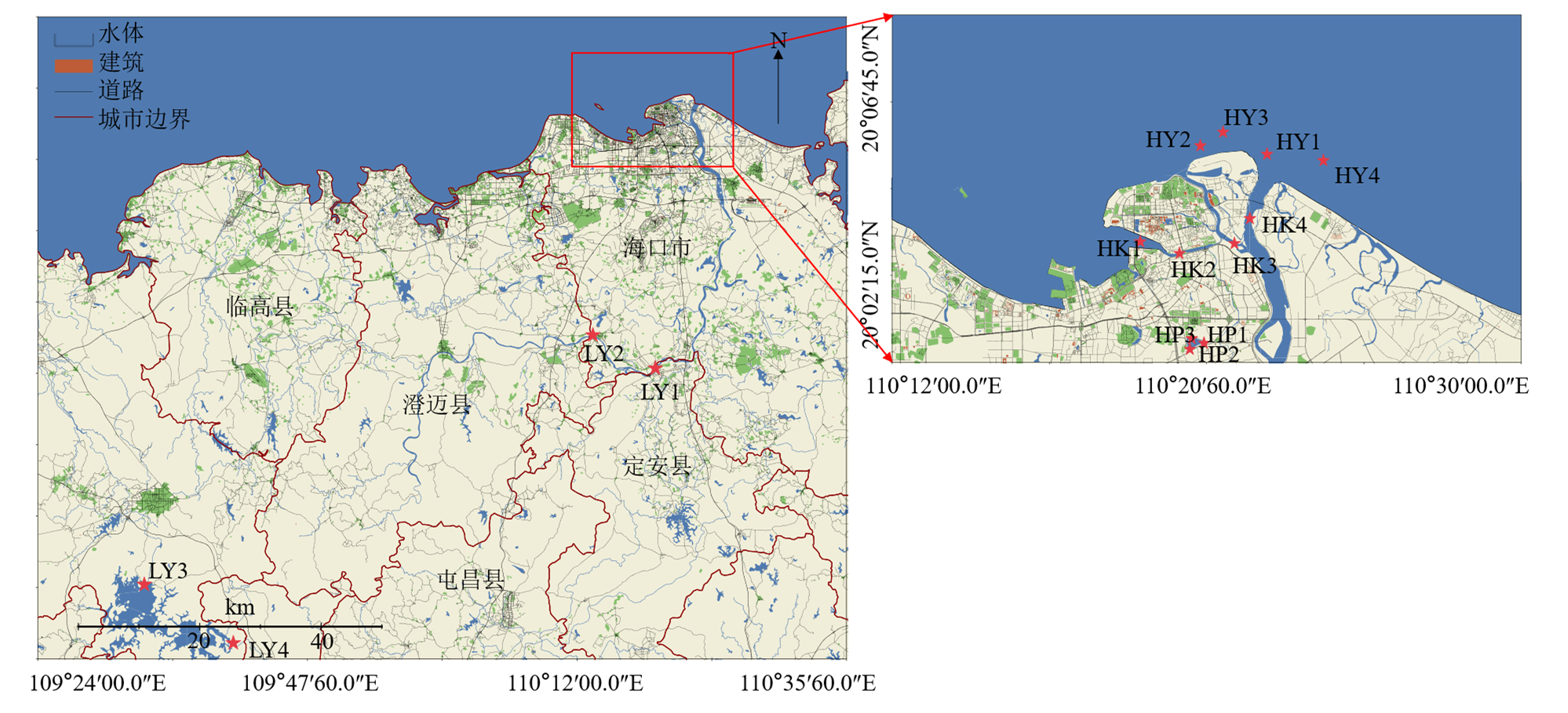
图1 南渡江流域-河口-延伸海域及红城湖采样点分布图 其中HP代表湖泊;LY代表流域;HK代表河口;HY代表海洋
Figure 1 Distribution map of sampling points in the Nandu River Basin-estuary-extended sea area and Hongcheng Lake
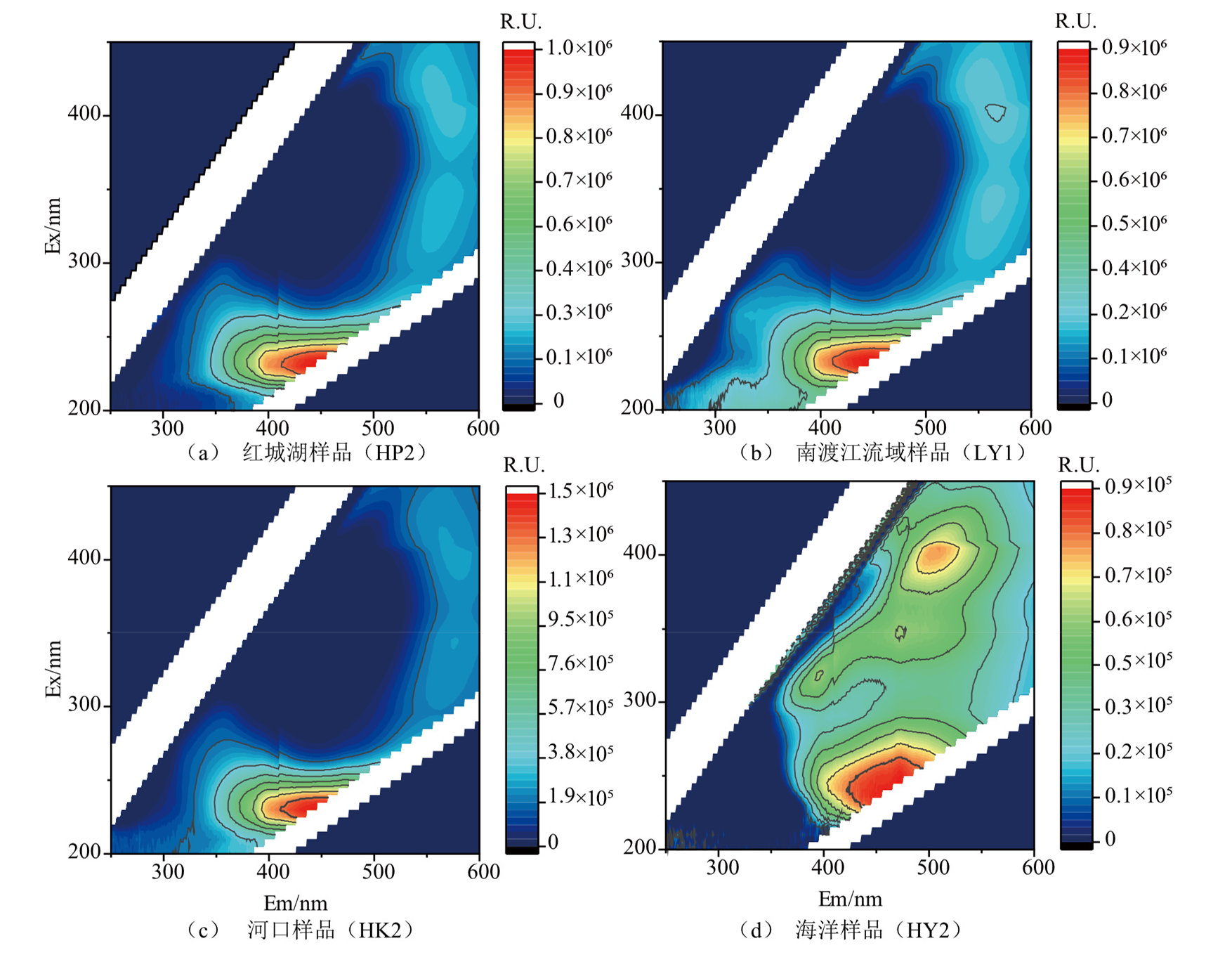
图2 不同水体DOM的三维荧光光谱特征 图中已去除拉曼散射及瑞利散射干扰;等高线表示荧光强度(R.U.)
Figure 2 Three-dimensional fluorescence spectral characteristics of DOM in different water bodies
| 参数指标 | 单位 | 采样点位 | |||||||
|---|---|---|---|---|---|---|---|---|---|
| HP1 | HP2 | LY1 | LY3 | HK2 | HK3 | HY2 | HY3 | ||
| CDOC (by C) | mg·L−1 | 3.286 | 58.772 | 15.074 | 29.754 | 7.977 | 3.374 | 13.399 | 34.920 |
| SUVA254 | L∙mg−1·m−1 | 141.651 | 10.527 | 18.876 | 13.025 | 148.288 | 228.311 | 7.845 | 14.630 |
| E254/E365 | - | 5.134 | 4.652 | 5.571 | 3.405 | 3.984 | 5.333 | 2.599 | 2.791 |
| E465/E665 | - | - | 2.587 | - | 1.509 | 2.240 | 3.391 | 1.517 | 2.341 |
| S275-295 | nm−1 | 0.017 | 0.016 | 0.019 | 0.016 | 0.016 | 0.018 | 0.012 | 0.009 |
| BIX | - | 1.838 | 2.111 | 3.302 | 1.071 | 3.954 | 8.161 | 1.170 | 1.196 |
| HIX | - | 1.583 | 1.866 | 1.767 | 1.143 | 0.702 | 1.807 | 1.220 | 1.123 |
| FI | - | 0.070 | 0.085 | 0.102 | 1.014 | 0.409 | 0.253 | 1.207 | |
表1 研究区部分水体DOM浓度及紫外-可见光谱及荧光光谱特征参数
Table 1 The DOM concentration of some water bodies in the study area and the characteristic parameters of ultraviolet-visible spectra and fluorescence spectra
| 参数指标 | 单位 | 采样点位 | |||||||
|---|---|---|---|---|---|---|---|---|---|
| HP1 | HP2 | LY1 | LY3 | HK2 | HK3 | HY2 | HY3 | ||
| CDOC (by C) | mg·L−1 | 3.286 | 58.772 | 15.074 | 29.754 | 7.977 | 3.374 | 13.399 | 34.920 |
| SUVA254 | L∙mg−1·m−1 | 141.651 | 10.527 | 18.876 | 13.025 | 148.288 | 228.311 | 7.845 | 14.630 |
| E254/E365 | - | 5.134 | 4.652 | 5.571 | 3.405 | 3.984 | 5.333 | 2.599 | 2.791 |
| E465/E665 | - | - | 2.587 | - | 1.509 | 2.240 | 3.391 | 1.517 | 2.341 |
| S275-295 | nm−1 | 0.017 | 0.016 | 0.019 | 0.016 | 0.016 | 0.018 | 0.012 | 0.009 |
| BIX | - | 1.838 | 2.111 | 3.302 | 1.071 | 3.954 | 8.161 | 1.170 | 1.196 |
| HIX | - | 1.583 | 1.866 | 1.767 | 1.143 | 0.702 | 1.807 | 1.220 | 1.123 |
| FI | - | 0.070 | 0.085 | 0.102 | 1.014 | 0.409 | 0.253 | 1.207 | |
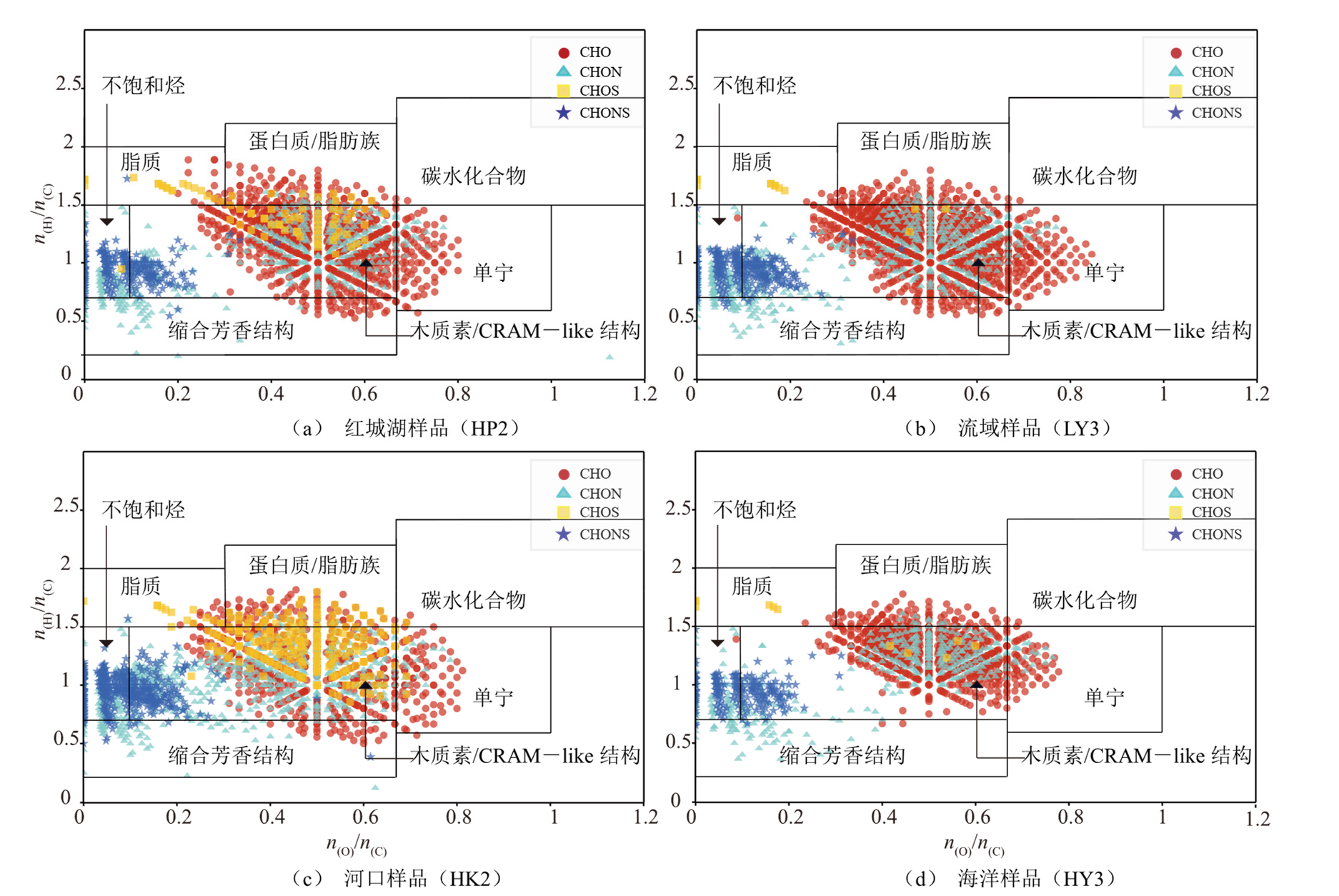
图3 基于FT-ICR MS的不同水体DOM分子Van Krevelen图 背景区域表示不同分子类别:脂质(Lipids,H/C:1.5-2.0;O/C:0-0.3);蛋白质/脂肪族(Aliphatic/proteins,H/C:1.5-2.2;O/C:0.3-0.67);碳水化合物(Carbohydrates,H/C:1.5-2.0;O/C:0.67-1.0);木质素/CRAM-like结构(Lignins/CRAM-like structures,H/C:0.7-1.5;O/C:0.1-0.67);单宁(Tannins,H/C:0.6-1.2;O/C:0.5-0.9);芳香结构(Aromatic structures,H/C:0.3-0.7;O/C:0.1-0.67)。每个点代表一个独特的分子式
Figure 3 The VK diagrams of DOM molecules in different water bodies based on FT-ICR MS
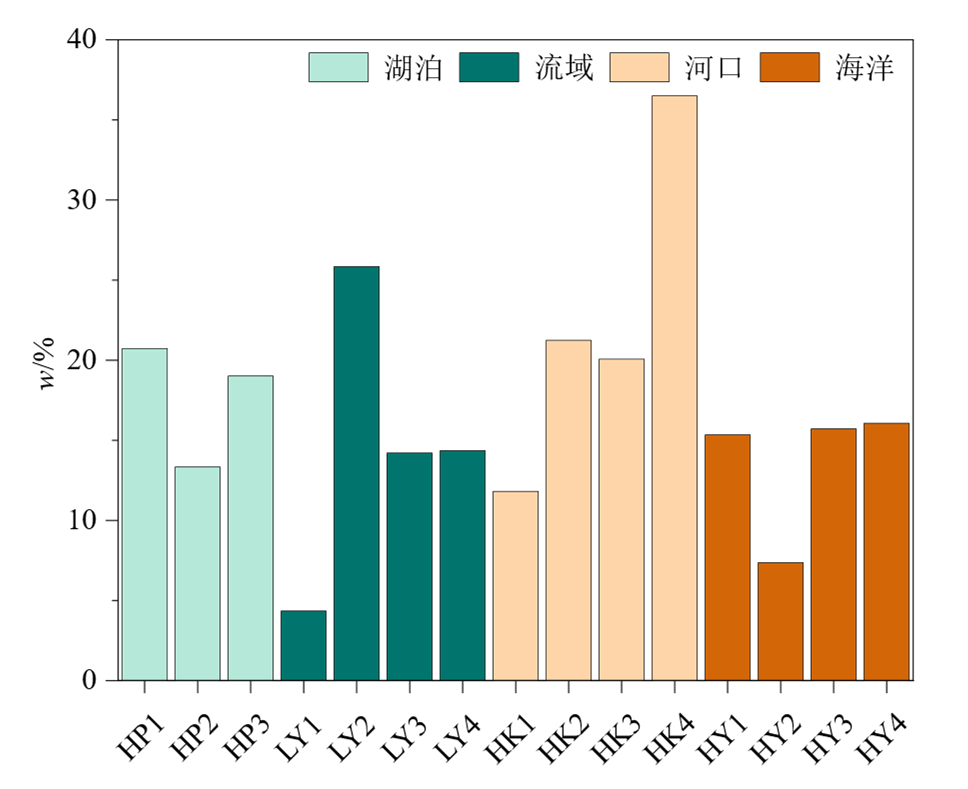
图4 不同水体DOM中含氮化合物(CHON2)的相对丰度
Figure 4 The relative abundance of nitrogen-containing compounds (CHON2) in DOM of different water bodies
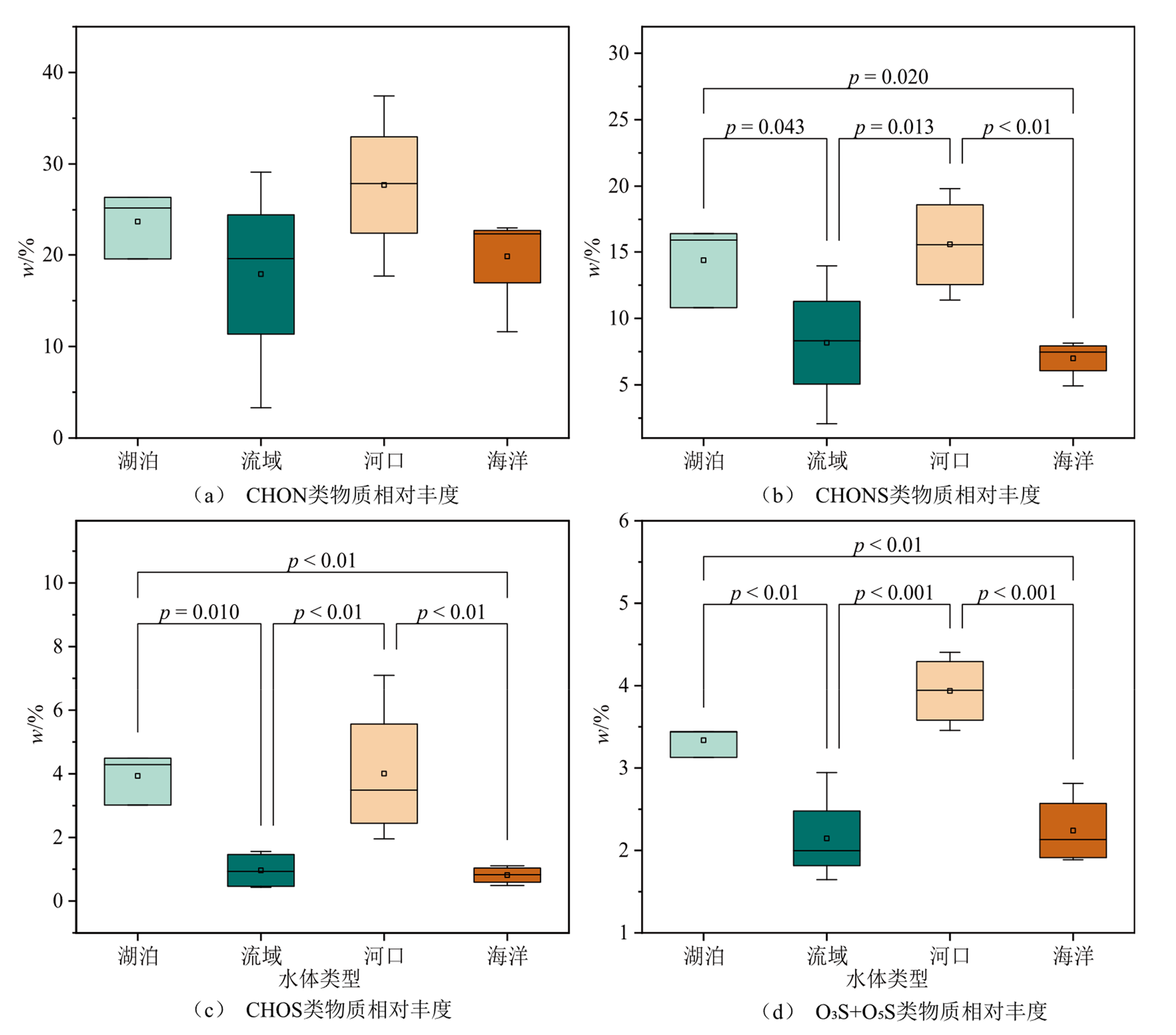
图5 不同水体中组分差异
Figure 5 Percentage changes of components in different water bodies

图6 DOM分子结构特征不同水体间差异
Figure 6 Differences in DOM molecular structure characteristics among different water bodies
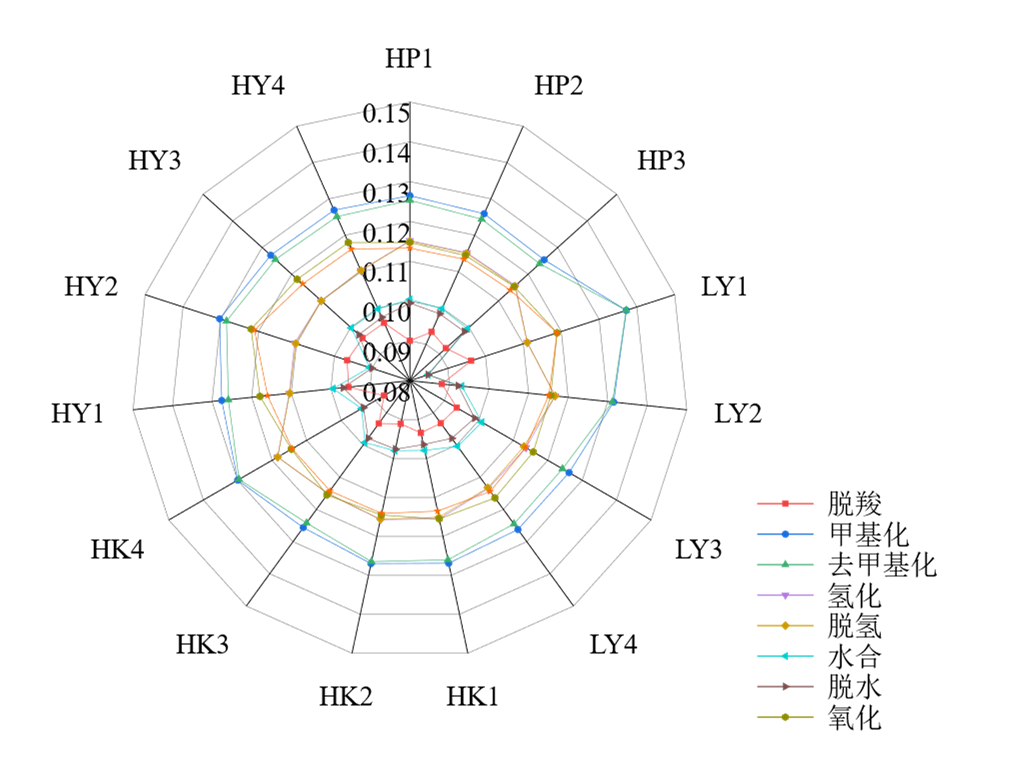
图7 不同水体DOM分子转化路径相对占比雷达图
Figure 7 Radar chart of the relative proportion of DOM molecular transformation pathways in different water bodies
| 点位 | HP1 | HP2 | HP3 | LY1 | LY2 | LY3 | LY4 | HK1 | HK2 | HK3 | HK4 | HY1 | HY2 | HY3 | HY4 |
|---|---|---|---|---|---|---|---|---|---|---|---|---|---|---|---|
| 节点数 | 2014 | 1761 | 1997 | 203 | 1732 | 1918 | 1749 | 1410 | 2045 | 2062 | 2032 | 1455 | 636 | 1400 | 1380 |
| 边数 | 12580 | 11208 | 12898 | 1035 | 8614 | 11945 | 10851 | 8301 | 12832 | 12808 | 10630 | 8639 | 3336 | 8339 | 8208 |
| 网络密度 | 0.003 | 0.004 | 0.003 | 0.025 | 0.003 | 0.003 | 0.004 | 0.004 | 0.003 | 0.003 | 0.003 | 0.004 | 0.008 | 0.004 | 0.004 |
表2 各采样点分子转化网络定量参数
Table 2 Quantitative parameters of molecular transformation networks at sampling points
| 点位 | HP1 | HP2 | HP3 | LY1 | LY2 | LY3 | LY4 | HK1 | HK2 | HK3 | HK4 | HY1 | HY2 | HY3 | HY4 |
|---|---|---|---|---|---|---|---|---|---|---|---|---|---|---|---|
| 节点数 | 2014 | 1761 | 1997 | 203 | 1732 | 1918 | 1749 | 1410 | 2045 | 2062 | 2032 | 1455 | 636 | 1400 | 1380 |
| 边数 | 12580 | 11208 | 12898 | 1035 | 8614 | 11945 | 10851 | 8301 | 12832 | 12808 | 10630 | 8639 | 3336 | 8339 | 8208 |
| 网络密度 | 0.003 | 0.004 | 0.003 | 0.025 | 0.003 | 0.003 | 0.004 | 0.004 | 0.003 | 0.003 | 0.003 | 0.004 | 0.008 | 0.004 | 0.004 |

图8 不同水体DOM的分子转化网络
Figure 8 Molecular transformation networks of DOM in different water bodies
| [1] |
AIKEN G R, HSU-KIM H, RYAN J N, 2011. Influence of dissolved organic matter on the environmental Fate of Metals, Nanoparticles, and Colloids[J]. Environmental Science & Technology, 45: 3196-3201.
DOI URL |
| [2] |
BAI L L, LIU X, HUA K, et al., 2022. Seasonal variations of fluorescent dissolved organic matter control estrone biodegradation potential in eutrophic waters affected by allochthonous and autochthonous sources[J]. Journal of Hydrology, 612: 128227.
DOI URL |
| [3] |
BAKER A, CURRY M, 2004. Fluorescence of leachates from three contrasting landfills[J]. Water Research, 38: 2605-2613.
PMID |
| [4] |
BENNER R, AMON R M W, 2015. The size-reactivity continuum of major bioelements in the ocean[J]. Annual Review of Marine Science, 7: 185-205.
DOI PMID |
| [5] |
BERCOVICI S K, WIEMERS M, DITTMAR T, et al., 2023. Disentangling biological transformations and photodegradation processes from marine dissolved organic matter composition in the global ocean[J]. Environmental Science & Technology, 57(50): 21145-21155.
DOI URL |
| [6] |
BIRDWELL J E, ENGEL A S, 2010. Characterization of dissolved organic matter in cave and spring waters using UV-Vis absorbance and fluorescence spectroscopy[J]. Organic Geochemistry, 41(3): 270-280.
DOI URL |
| [7] |
CAMPANA S, RIESGO A, JONGEPIER E, et al., 2022. Meta-transcriptomic comparison of two sponge holobionts feeding on coral- and macroalgal-dissolved organic matter[J]. BMC Genomics, 23(1): 674.
DOI PMID |
| [8] |
CHEN Q, CHEN F, GONSIOR M, et al., 2021. Correspondence between DOM molecules and microbial community in a subtropical coastal estuary on a spatiotemporal scale[J]. Environment International, 154: 106558.
DOI URL |
| [9] |
CHEN S, XIE Q R, SU S H, et al., 2022. Source and formation process impact the chemodiversity of rainwater dissolved organic matter along the Yangtze River Basin in summer[J]. Water Research, 211: 118024.
DOI URL |
| [10] |
COBLE P G, 2007. Marine optical biogeochemistry: The chemistry of ocean color[J]. Chemical Reviews, 107: 402-418.
DOI URL |
| [11] |
COBLE P G, DEL CASTILLO C E, AVRIL B, 1998. Distribution and optical properties of CDOM in the Arabian Sea during the 1995 Southwest Monsoon[J]. Deep Sea Research Part II: Topical Studies in Oceanography, 45: 2195-2223.
DOI URL |
| [12] | DITTMAR T, LENNARTZ S T, BUCK-WIESE H, et al., 2021. Enigmatic persistence of dissolved organic matter in the ocean[J]. Nature Reviews Earth & Environment, 2: 570-583. |
| [13] |
FOURRIER P, DULAQUAIS G, 2024. Low-molecular-weight reduced sulfur substances: A major component of nonvolatile dissolved organic sulfur in the Pacific Ocean[J]. Limnology and Oceanography Letters, 9: 735-744.
DOI URL |
| [14] |
GHOLAMI S, BEHNAMI A, HESAMI ARANI M, et al., 2024. Impact of humic substances on the bioremediation of polycyclic aromatic hydrocarbons in contaminated soils and sediments: A review[J]. Environmental Chemistry Letters, 22: 889-918.
DOI |
| [15] |
GUAN Y Y, YU G L, JIA N N, et al., 2024. Spectral characteristics of dissolved organic matter in Plateau Lakes: Identifying eutrophication indicators in Southwest China[J]. Ecological Informatics, 82: 102703.
DOI URL |
| [16] |
HAN L M, KAESLER J, PENG C, et al., 2021. Online counter gradient LC-FT-ICR-MS enables detection of highly polar natural organic matter fractions[J]. Analytical Chemistry, 93(3): 1740-1748.
DOI PMID |
| [17] |
HANSELL D A, 2013. Recalcitrant dissolved organic carbon fractions[J]. Annual Review of Marine Science, 5: 421-445.
DOI PMID |
| [18] |
HE J, WU X, ZHI G Q, et al., 2022. Fluorescence characteristics of DOM and its influence on water quality of rivers and lakes in the Dianchi Lake basin[J]. Ecological Indicators, 142: 109088.
DOI URL |
| [19] |
HELMS J R, STUBBINS A, RITCHIE J D, et al., 2008. Absorption spectral slopes and slope ratios as indicators of molecular weight, source, and photobleaching of chromophoric dissolved organic matter[J]. Limnology and Oceanography, 53(3): 955-969.
DOI URL |
| [20] |
HENGKUAN J, HUA W, ZHIPENG W, et al., 2023. Source, composition and molecular diversity of dissolved and particulate organic matter varied with riparian land use in tropical coastal headstreams[J]. The Science of the Total Environment, 908: 168577-168577.
DOI URL |
| [21] | HUANG K X, JIANG Y X, DANG Y R, et al., 2024. Release of intracellular enzymes increases the total extracellular activities of carbohydrate-processing enzymes in marine environment[J]. FEMS Microbiology Letters, 371: fnae077. |
| [22] |
JI C X, YANG G P, CHEN Y, et al., 2023. Contrast the distribution, transformation, and degradation of dissolved and particulate organic matter in the South Yellow Sea, the East China Sea, and its adjacent Kuroshio Current[J]. Marine Chemistry, 248: 104210.
DOI URL |
| [23] |
JI X, LIU K, ZHU Q Q, et al., 2022. Spatio-temporal variation of dissolved organic matter (DOM) in the Bohai Sea and the Yellow Sea[J]. Journal of Marine Systems, 234: 103777.
DOI URL |
| [24] |
JIAO N, HERNDL G J, HANSELL D A, et al., 2010. Microbial production of recalcitrant dissolved organic matter: Long-term carbon storage in the global ocean[J]. Nature Reviews Microbiology, 8: 593-599.
DOI PMID |
| [25] |
KELLERMAN A M, HERNES P J, MCKENNA A M, et al., 2023. Mixing behavior of dissolved organic matter at the Yukon and Kolyma land ocean interface[J]. Marine Chemistry, 255: 104281.
DOI URL |
| [26] |
KIM S, KRAMER R W, HATCHER P G, 2003. Graphical method for analysis of ultrahigh-resolution broadband mass spectra of natural organic aatter, the Van Krevelen diagram[J]. Analytical Chemistry, 75(20): 5336-5344.
DOI URL |
| [27] |
KUJAWINSKI E B, BEHN M D, 2006. Automated analysis of electrospray ionization Fourier Transform Ion Cyclotron Resonance Mass Spectra of natural organic matter[J]. Analytical Chemistry, 78(13): 4363-4373.
PMID |
| [28] |
LEGENDRE L, 2024. Jigsaw puzzle of the interwoven biologically-driven ocean carbon pumps[J]. Progress in Oceanography, 229: 103338.
DOI URL |
| [29] |
LIN H, GUO L D, 2020. Variations in colloidal DOM composition with molecular weight within individual water samples as characterized by flow field-flow fractionation and EEM-PARAFAC analysis[J]. Environmental Science & Technology, 54(3): 1657-1667.
DOI URL |
| [30] |
LIN X W, WU X D, CHEN B F, et al., 2025. Deciphering the impacts of main inflowing rivers on dissolved organic matter in Lake Daye using isotopes, optical spectroscopy, and FT-ICR MS during non-flood season[J]. Journal of Hydrology, 663(Part A): 134090.
DOI URL |
| [31] |
LIU S S, HOU J W, SUO C Y, et al., 2022. Molecular-level composition of dissolved organic matter in distinct trophic states in Chinese lakes: Implications for eutrophic lake management and the global carbon cycle[J]. Water Research, 217: 118438.
DOI URL |
| [32] |
LIU Y J, CHEN Z L, ZHANG Z K, et al., 2025. Size and structure-dependent molecular fingerprint transformation of microplastic-derived dissolved organic matter in Sunlit seawater: Implication for marine carbon cycles[J]. Environmental Science & Technology, 59(35): 18846-18856.
DOI URL |
| [33] |
LÓPEZ-SÁNCHEZ R, REBOLLAR E A, GUTIÉRREZ-RÍOS R M, et al., 2024. Metagenomic analysis of carbohydrate-active enzymes and their contribution to marine sediment biodiversity[J]. World Journal of Microbiology and Biotechnology, 40: 95.
DOI |
| [34] |
MCKNIGHT D M, BOYER E W, WESTERHOFF P K, et al., 2001. Spectrofluorometric characterization of dissolved organic matter for indication of precursor organic material and aromaticity[J]. Limnology and Oceanography, 46(1): 38-48.
DOI URL |
| [35] |
MORAN M A, FERRER-GONZÁLEZ F X, FU H, et al., 2022. The Ocean’s labile DOC supply chain[J]. Limnology and Oceanography, 67(5): 1007-1021.
DOI URL |
| [36] |
MORAN M A, ZEPP R G, 1997. Role of photoreactions in the formation of biologically labile compounds from dissolved organic matter[J]. Limnology and Oceanography, 42(6): 1307-1316.
DOI URL |
| [37] |
MOUFARREJ L, LIMOUSIN G, CASTILLA C, et al. 2025. Identification of industrial fire-related chemical markers in French rivers and underground water using chromatography hyphenated to high-resolution mass spectrometry systems for nontarget screening[J]. Environmental Science and Pollution Research, 32: 20971-20990.
DOI |
| [38] |
MUSCHKET M, NEUWALD I J, ZAHN D, et al., 2024. Fate of persistent and mobile chemicals in the water cycle: From municipal wastewater discharges to river bank filtrate[J]. Water Research, 266: 122436.
DOI URL |
| [39] |
NIU X Z, HARIR M, SCHMITT-KOPPLIN P, et al., 2018. Characterisation of dissolved organic matter using Fourier-transform ion cyclotron resonance mass spectrometry: Type-specific unique signatures and implications for reactivity[J]. Science of The Total Environment, 644: 68-76.
DOI URL |
| [40] |
OHNO T, SLEIGHTER R L, HATCHER P G, 2016. Comparative study of organic matter chemical characterization using negative and positive mode electrospray ionization ultrahigh-resolution mass spectrometry[J]. Analytical and Bioanalytical Chemistry, 408: 2497-2504.
DOI PMID |
| [41] |
PANETTA R J, IBRAHIM M, GÉLINAS Y, 2008. Coupling a high-temperature catalytic oxidation total organic carbon analyzer to an isotope ratio mass spectrometer to measure natural-abundance δ13C-dissolved organic carbon in marine and freshwater samples[J]. Analytical Chemistry, 80(13): 5232-5239.
DOI URL |
| [42] |
PAPADOPOULOS L S, SCHRAMM T, STEUER-LODD K, et al., 2024. Two-dimensional liquid chromatography tandem mass spectrometry untangles the deep metabolome of marine dissolved organic matter[J]. Environmental Science & Technology, 58(43): 19289-19304.
DOI URL |
| [43] | PARRA M, PARRA L, JIMENEZ J M, et al., 2022. Analysis of the evolution of sea water quality in the Spanish coast from satellite images before and during a confinement period[J]. Journal of Sensors, 2022: 1-20. |
| [44] |
PETERSON B M, MCNALLY A M, CORY R M, et al., 2012. Spatial and temporal distribution of singlet oxygen in Lake Superior[J]. Environmental Science & Technology, 46(13): 7222-7229.
DOI URL |
| [45] |
SCHAFER T, POWERS L, GONSIOR M, et al., 2021. Contrasting responses of DOM leachates to photodegradation observed in plant species collected along an estuarine salinity gradient[J]. Biogeochemistry, 152: 291-307.
DOI |
| [46] |
STUBBINS A, SPENCER R G M, CHEN H M, et al., 2010. Illuminated darkness: Molecular signatures of Congo River dissolved organic matter and its photochemical alteration as revealed by ultrahigh precision mass spectrometry[J]. Limnology and Oceanography, 55(4): 1467-1477.
DOI URL |
| [47] |
SULLIVAN S N, BOWEN J C, KAPLAN L A, et al., 2025. Seasonal and longitudinal dynamics of DOM within headwater streams of a tropical evergreen forest[J]. Water Research, 281: 123668.
DOI URL |
| [48] | SUN T T, WU D D, WU N Y, et al., 2023. The effects of organic matter and anaerobic oxidation of methane on the microbial sulfate reduction in cold seeps[J]. Frontiers in Marine Science, 10: 111113. |
| [49] |
SUO C Y, ZHAO W S, LIU S S, et al., 2024. Molecular insight into algae-derived dissolved organic matters via Fourier-transform ion cyclotron resonance mass spectrometry: Effects of pretreatment methods and electrospray ionization modes[J]. Journal of Hazardous Materials, 480: 136220.
DOI URL |
| [50] |
WANG L Y, LIN Y, YE L, et al., 2021. Microbial roles in dissolved organic matter transformation in full-scale wastewater treatment processes revealed by reactomics and comparative genomics[J]. Environmental Science & Technology, 55(16): 11294-11307.
DOI URL |
| [51] |
WANG Q, LIU L, XU J T, et al., 2023. Release of dissolved organic matter from wetland plants and its interaction with polycyclic aromatic hydrocarbons[J]. Environmental Research, 237(Part A): 116913.
DOI URL |
| [52] |
WEISHAAR J L, AIKEN G R, BERGAMASCHI B A, et al., 2003. Evaluation of specific ultraviolet absorbance as an indicator of the chemical composition and reactivity of dissolved organic carbon[J]. Environmental Science & Technology, 37(20): 4702-4708.
DOI URL |
| [53] |
WU Y, LYU L N, LIN M Q, et al., 2026. Microbial processing of organic matter in cold seep sediments revealed by amino compound distributions and degradation indices[J]. Marine Pollution Bulletin, 222(Part 2): 118763.
DOI URL |
| [54] |
WU Y P, ZHANG X S, HAO R, et al., 2023. Rethinking terrestrial dissolved organic matter in dam reservoirs before mixing: Linking photodegradation and biodegradation and the phenanthrene binding behavior[J]. Science of The Total Environment, 904: 166653.
DOI URL |
| [55] |
XIE R R, QI J B, SHI C C, et al., 2023. Changes of dissolved organic matter following salinity invasion in different seasons in a nitrogen rich tidal reach[J]. Science of The Total Environment, 880: 163251.
DOI URL |
| [56] |
XU R L, SONG J Q, LI D H, et al., 2025. Traceability analysis and risk assessment of river antibiotics based on dissolved organic matter spectral features and the positive matrix factorization receptor model[J]. Journal of Contaminant Hydrology, 272: 104549.
DOI URL |
| [57] |
YAN W M, HE X Y, CHEN M S, et al., 2024. High arsenic pollution of the eutrophic Lake Taihu and its relationship with iron, manganese, and dissolved organic matter: High-resolution synchronous analysis[J]. Journal of Hazardous Materials, 467: 133644.
DOI URL |
| [58] |
YIN X J, LIN Y P, LI Y H, et al., 2021. Sulfate reduction and its important role in organic carbon mineralization in sediments of the Pearl River Estuary[J]. Estuarine, Coastal and Shelf Science, 260: 107511.
DOI URL |
| [59] |
YU M, PETRICK L, 2020. Untargeted high-resolution paired mass distance data mining for retrieving general chemical relationships[J]. Communications Chemistry, 3: 157.
DOI |
| [60] |
ZARK M, DITTMAR T, 2018. Universal molecular structures in natural dissolved organic matter[J]. Nature Communications, 9: 3178.
DOI PMID |
| [61] |
ZHANG B L, SHAN C, WANG S, et al., 2021. Unveiling the transformation of dissolved organic matter during ozonation of municipal secondary effluent based on FT-ICR-MS and spectral analysis[J]. Water Research, 188: 116484.
DOI URL |
| [62] |
ZHANG J X, XIE X J, LI J X, et al., 2025b. Natural organic matter drives nitrogen biogeochemical cycling in groundwater of the Hetao Basin: Evidence from multi-isotopes and FT-ICR MS[J]. Journal of Hydrology, 662(Part B): 133957.
DOI URL |
| [63] |
ZHANG X X, KANG J, CHU W, et al., 2020. Spectral and mass spectrometric characteristics of different molecular weight fractions of dissolved organic matter[J]. Separation and Purification Technology, 253: 117390.
DOI URL |
| [64] |
ZHANG Y X, CHENG D D, SONG J X, et al., 2023. How does anthropogenic activity influence the spatial distribution of dissolved organic matter in rivers of a typical basin located in the Loess Plateau, China[J]. Journal of Environmental Management, 340: 117984.
DOI URL |
| [65] | ZHANG Y X, LIU S S, QIU Y, et al., 2025a. New insight into the source contribution of dissolved and particulate organic matter in a typical macrophyte-dominated lake using Optical Spectroscopy, Stable Isotopes, and FT-ICR MS[J]. ACS ES & T Water, 5(4): 1862-1873. |
| [66] |
ZHAO P P, DU Z L, FU Q L, et al., 2023. Molecular composition and chemodiversity of dissolved organic matter in waste watersludge via Fourier transform ion cyclotron resonance mass spectrometry: Effects of extraction methods and electrospray ionization modes[J]. Water Research, 232: 119687.
DOI URL |
| [67] |
ZHENG X X, CAI R H, YAO H W, et al., 2022. Experimental insight into the enigmatic persistence of marine refractory dissolved organic matter[J]. Environmental Science & Technology, 56(23): 17420-17429.
DOI URL |
| [68] | 高静湉, 汤世科, 刘文理, 等, 2025. 不同类型湖泊DOM光谱特征及来源的季节性变化[J]. 环境科学, 46(4): 2154-2164. |
| GAO J T, TANG S K, LIU W L, et al., 2025. Seasonal variation in DOM spectral characteristics and sources in different types of lakes[J]. Environmental Science, 46(4): 2154-2164. | |
| [69] | 何杰, 朱学惠, 魏彬, 等, 2021. 基于EEMs与UV-vis分析苏州汛期景观河道中DOM光谱特性与来源[J]. 环境科学, 42(4): 1889-1900. |
| HE J, ZHU X H, WEI B, et al., 2021. A spectral characteristics and sources of dissolved organic matter from landscape river during flood season in Suzhou based on EEMs and UV-Vis[J]. Environmental Science, 42(4): 1889-1900. | |
| [70] |
蒋凯, 柯常栋, 王丽萍, 等, 2025. 珠江广州河段粪便污染和溶解有机质的来源解析及分布特征[J]. 生态环境学报, 34(9):1452-1462.
DOI |
| JIANG K, KE C D, WANG L P, et al., 2025. Source analysis and distribution characteristics of fecal pollution and dissolved organic matter in the Guangzhou section of the Pearl River[J]. Ecology and Environmental Sciences, 34(9): 1452-1462. | |
| [71] |
刘晨, 白雪冬, 赵海超, 等, 2023. 寒旱区春玉米秸秆还田方式对土壤DOM光谱特征的影响机制[J]. 生态环境学报, 32(8): 1419-1432.
DOI |
| LIU C, BAI X D, ZHAO H C, et al., 2023. The effect mechanism of spring maize straw returning method on soil DOM spectral characteristics in cold and arid regions of China[J]. Ecology and Environmental Sciences, 32(8): 1419-1432. | |
| [72] | 刘晓晴, 包锐, 2024. 再悬浮沉积物是海洋深层惰性溶解有机质的潜在来源[J]. 中国科学: 地球科学, 54(11): 3674-3676. |
| LIU X Q, BAO R, 2024. Resuspended sediment in marine bottom water as a potential source for refractory dissolved organic matter[J]. Science China Earth Sciences, 54(11): 3674-3676. | |
| [73] |
马飞扬, 樊团团, 孙小平, 等, 2021. 洞庭湖不同湖区水体DOM的荧光特征及来源[J]. 生态环境学报, 30(12): 2370-2379.
DOI |
| MA F Y, FAN T T, SUN X P, et al., 2021. DOM fluorescence characteristics and sources in different regions of Dongting Lake[J]. Ecology and Environmental Sciences, 30(12): 2370-2379. | |
| [74] | 王明阳, 王立成, 莫凌, 等, 2024. 热带岛屿流域水生态评价理论研究与实践——以海南岛为例[J]. 中国环境科学, 44(6): 3334-3341. |
| WANG M Y, WANG L C, MO L, et al., 2024. Theoretical research and practice of water ecological assessment in tropical island watershed: A case study in Hainan Province[J]. China Environmental Science, 44(6): 3334-3341. | |
| [75] |
张丽聪, 肖凯, 张鹏, 等, 2022. 淤泥质潮滩重金属和溶解性有机质的潮汐变化特征及其环境影响评价[J]. 生态环境学报, 31(11): 2169-2179.
DOI |
| ZHANG L C, XIAO K, ZHANG P, et al., 2022. Tidal variation characteristics of heavy metals and dissolved organic matter and environmental impact in a silt tidal flat[J]. Ecology and Environmental Sciences, 31(11): 2169-2179. | |
| [76] | 张子寒, 陈星, 李海彬, 等, 2025. 长江流域溶解性有机质光谱特征及其对自然和人为活动的响应[J]. 环境科学, 46(4): 2135-2144. |
| ZHANG Z H, CHEN X, LI H B, et al., 2025. Spectral characteristics of dissolved organic matter in the Yangtze River Basin and its response to natural and anthropogenic activities[J]. Environmental Science, 46(4): 2135-2144. |
| [1] | 蒋凯, 柯常栋, 王丽萍, 李朋辉, 赖迪智, 张杨, 吴永洁, 吴仁人, 肖利平. 珠江广州河段粪便污染和溶解有机质的来源解析及分布特征[J]. 生态环境学报, 2025, 34(9): 1452-1462. |
| [2] | 贺环, 周丹丹, 马芷萱, 李芳芳, 秦珊珊, 豆思娴. 钙改性对生物炭中溶解性有机质与Cd(Ⅱ)结合的影响[J]. 生态环境学报, 2025, 34(7): 1121-1132. |
| [3] | 马飞扬, 樊团团, 孙小平, 明峻德, 王世同, 张英豪, 姚昕. 洞庭湖不同湖区水体DOM的荧光特征及来源[J]. 生态环境学报, 2021, 30(12): 2370-2379. |
| 阅读次数 | ||||||
|
全文 |
|
|||||
|
摘要 |
|
|||||
