
生态环境学报 ›› 2026, Vol. 35 ›› Issue (4): 654-664.DOI: 10.16258/j.cnki.1674-5906.2026.04.015
• 研究论文【环境科学】 •
上一篇
周致泺1,2,3( ), 杨秋1,*(), 刘晓煌2,3, 刘润2,3, 刘玖芬2,3, 马敏2,3, 祝萍2,3, 李朝柱2,3
收稿日期:2025-07-13
修回日期:2026-02-25
接受日期:2026-03-10
出版日期:2026-04-18
发布日期:2026-04-14
通讯作者:
*E-mail: 作者简介:周致泺(2000年生),男,硕士研究生,研究方向为土地生态与生态空间。E-mail: zzl31869093@gmail.com
基金资助:
ZHOU Zhiluo1,2,3(), YANG Qiu1,*(), LIU Xiaohuang2,3, LIU Run2,3, LIU Jiufen2,3, MA Min2,3, ZHU Ping2,3, LI Chaozhu2,3
Received:2025-07-13
Revised:2026-02-25
Accepted:2026-03-10
Online:2026-04-18
Published:2026-04-14
摘要:
该研究以海南岛为研究区,以乡镇为分析单元,以该岛2000-2020年土地利用数据为基础,分析海南岛“三生空间”(生产、生活、生态空间)的时空分布和耦合协调关系。通过构建“三生空间”功能评分表测算生产、生活、生态功能得分,利用探索性空间数据分析方法识别出生产、生活、生态功能的冷热点分布及其变化,引入耦合协调度模型计算各乡镇“三生空间”功能耦合协调水平。研究发现,海南岛生产和生活空间功能逐年增强,但生态空间功能有所下降,特别是在沿海地区和城市化程度较高的区域。整体来看,海南岛的“三生空间”格局呈现出“生产-生活向外扩展,生态空间受挤压”的典型发展特征。通过耦合协调度模型分析,海南岛整体耦合协调水平逐步提高,表现出较为良好的区域协调发展态势。但中部生态保护区及部分沿海经济开发区域的耦合协调水平相对较低,反映出在生态保护与经济社会发展之间仍存在功能不均衡的问题。该文提出了优化生态保护与土地利用政策的建议,以实现区域的可持续发展,也为其他生态敏感地区的生态保护和土地合理利用提供参考。
中图分类号:
周致泺, 杨秋, 刘晓煌, 刘润, 刘玖芬, 马敏, 祝萍, 李朝柱. 海南岛乡镇尺度上“三生空间”时空分布变化与耦合协调分析[J]. 生态环境学报, 2026, 35(4): 654-664.
ZHOU Zhiluo, YANG Qiu, LIU Xiaohuang, LIU Run, LIU Jiufen, MA Min, ZHU Ping, LI Chaozhu. Spatio-temporal Distribution Changes and Coupling Coordination Analysis of the “Production-Living-Ecological Space” at the Township Scale on Hainan Island[J]. Ecology and Environmental Sciences, 2026, 35(4): 654-664.
| 编号 | 土地利用分类系统的二级分类 | 生产分值 | 生活分值 | 生态分值 |
|---|---|---|---|---|
| 11 | 水田 | 3 | 0 | 3 |
| 12 | 旱地 | 3 | 0 | 3 |
| 21 | 有林地 | 0 | 0 | 5 |
| 22 | 灌木林 | 0 | 0 | 5 |
| 23 | 疏林地 | 0 | 0 | 5 |
| 24 | 其它林地 | 0 | 1 | 3 |
| 31 | 高覆盖度草地 | 1 | 0 | 5 |
| 32 | 中覆盖度草地 | 1 | 0 | 5 |
| 33 | 低覆盖度草地 | 1 | 0 | 3 |
| 41 | 河渠 | 1 | 0 | 5 |
| 42 | 湖泊 | 0 | 0 | 1 |
| 43 | 水库坑塘 | 1 | 0 | 5 |
| 44 | 永久性冰川雪地 | 0 | 0 | 3 |
| 45 | 滩涂 | 0 | 0 | 5 |
| 46 | 滩地 | 0 | 0 | 5 |
| 51 | 城镇用地 | 3 | 5 | 0 |
| 52 | 农村居民点 | 3 | 5 | 0 |
| 53 | 其它建设用地 | 5 | 1 | 0 |
| 61 | 沙地 | 0 | 0 | 5 |
| 62 | 戈壁 | 0 | 0 | 5 |
| 63 | 盐碱地 | 0 | 0 | 5 |
| 64 | 沼泽地 | 0 | 0 | 5 |
| 65 | 裸土地 | 0 | 0 | 5 |
| 66 | 裸岩石质地 | 0 | 0 | 5 |
| 67 | 其它未利用地 | 0 | 0 | 5 |
| 99 | 海洋 | 0 | 0 | 5 |
表1 “三生空间”功能初始赋分表
Table 1 Score table of initial value for production-living-ecological spatial function
| 编号 | 土地利用分类系统的二级分类 | 生产分值 | 生活分值 | 生态分值 |
|---|---|---|---|---|
| 11 | 水田 | 3 | 0 | 3 |
| 12 | 旱地 | 3 | 0 | 3 |
| 21 | 有林地 | 0 | 0 | 5 |
| 22 | 灌木林 | 0 | 0 | 5 |
| 23 | 疏林地 | 0 | 0 | 5 |
| 24 | 其它林地 | 0 | 1 | 3 |
| 31 | 高覆盖度草地 | 1 | 0 | 5 |
| 32 | 中覆盖度草地 | 1 | 0 | 5 |
| 33 | 低覆盖度草地 | 1 | 0 | 3 |
| 41 | 河渠 | 1 | 0 | 5 |
| 42 | 湖泊 | 0 | 0 | 1 |
| 43 | 水库坑塘 | 1 | 0 | 5 |
| 44 | 永久性冰川雪地 | 0 | 0 | 3 |
| 45 | 滩涂 | 0 | 0 | 5 |
| 46 | 滩地 | 0 | 0 | 5 |
| 51 | 城镇用地 | 3 | 5 | 0 |
| 52 | 农村居民点 | 3 | 5 | 0 |
| 53 | 其它建设用地 | 5 | 1 | 0 |
| 61 | 沙地 | 0 | 0 | 5 |
| 62 | 戈壁 | 0 | 0 | 5 |
| 63 | 盐碱地 | 0 | 0 | 5 |
| 64 | 沼泽地 | 0 | 0 | 5 |
| 65 | 裸土地 | 0 | 0 | 5 |
| 66 | 裸岩石质地 | 0 | 0 | 5 |
| 67 | 其它未利用地 | 0 | 0 | 5 |
| 99 | 海洋 | 0 | 0 | 5 |

图1 海南岛“三生空间”功能空间分布
Figure 1 Spatial distribution for function of “production-living-ecological” space in Hainan island
| 空间类型 | 年份 | 全局莫兰指数 (Global Moran’s I) | Z值 | p值 |
|---|---|---|---|---|
| 生产空间 | 2000 | 0.6870 | 19.2840 | 0.0000 |
| 2010 | 0.6996 | 19.6180 | 0.0000 | |
| 2020 | 0.7460 | 20.9012 | 0.0000 | |
| 生活空间 | 2000 | 0.7514 | 21.5360 | 0.0000 |
| 2010 | 0.8107 | 23.1202 | 0.0000 | |
| 2020 | 0.8485 | 24.1434 | 0.0000 | |
| 生态空间 | 2000 | 0.7203 | 20.4857 | 0.0000 |
| 2010 | 0.7636 | 21.6499 | 0.0000 | |
| 2020 | 0.8105 | 22.9552 | 0.0000 |
表2 “三生”空间全局自相关检验结果
Table 2 Analysis results of global space autocorrelation
| 空间类型 | 年份 | 全局莫兰指数 (Global Moran’s I) | Z值 | p值 |
|---|---|---|---|---|
| 生产空间 | 2000 | 0.6870 | 19.2840 | 0.0000 |
| 2010 | 0.6996 | 19.6180 | 0.0000 | |
| 2020 | 0.7460 | 20.9012 | 0.0000 | |
| 生活空间 | 2000 | 0.7514 | 21.5360 | 0.0000 |
| 2010 | 0.8107 | 23.1202 | 0.0000 | |
| 2020 | 0.8485 | 24.1434 | 0.0000 | |
| 生态空间 | 2000 | 0.7203 | 20.4857 | 0.0000 |
| 2010 | 0.7636 | 21.6499 | 0.0000 | |
| 2020 | 0.8105 | 22.9552 | 0.0000 |

图2 海南岛“三生空间”功能冷热点分析
Figure 2 Cold and hot spot of the “production-living-ecological” space in Hainan island
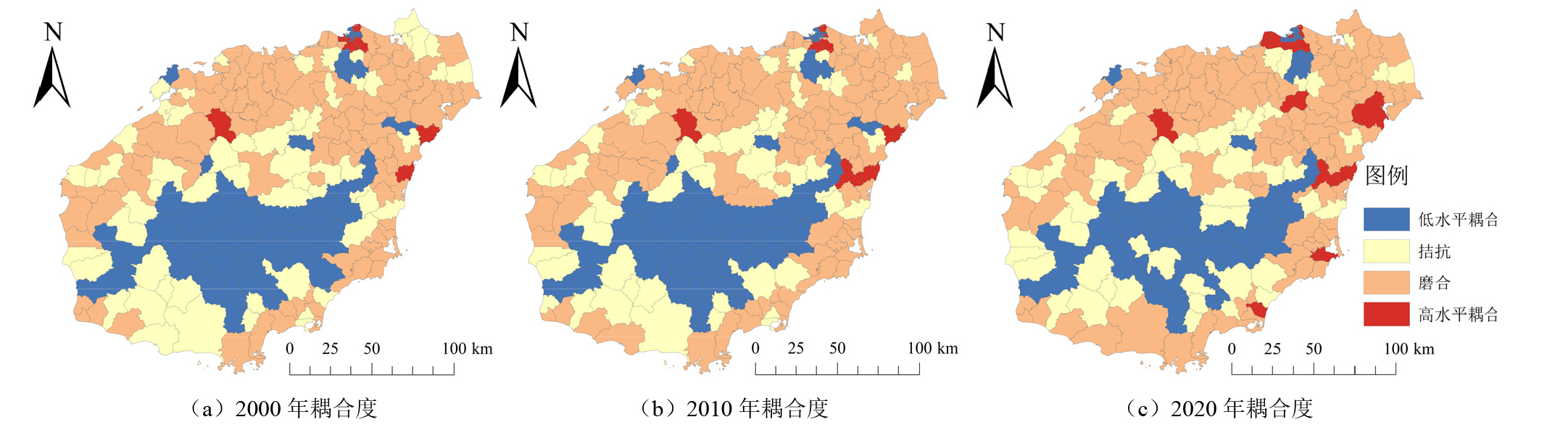
图3 海南岛“三生空间”功能耦合度
Figure3 Degree of coupling of the “production-living-ecological” space in Hainan island

图4 海南岛“三生空间”功能耦合协调度
Figure 4 Degree of coupling Coordination of the “production-living-ecological” space in Hainan island
| [1] |
GETIS A, ORD J K, 1992. The analysis of spatial association by use of distance statistics[J]. Geographical Analysis, 24(3): 189-206.
DOI URL |
| [2] |
HOU Y Z, ZHANG Z L, WANG Y R, et al., 2022. Function Evaluation and coordination analysis of production-living-ecological space based on the perspective of Type-Intensity-Connection: A case study of Suzhou, China[J]. Land, 11(11): 1954.
DOI URL |
| [3] |
LI J S, SUN W, LI M Y, et al., 2021. Coupling coordination degree of production, living and ecological spaces and its influencing factors in the Yellow River Basin[J]. Journal of cleaner production, 298: 126803.
DOI URL |
| [4] |
PENG Y C, LUAN Q L, XIONG C S, 2023. Evaluation of spatial functions and scale effects of “production-living-ecological” space in Hainan Island[J]. Land, 12(8): 1637.
DOI URL |
| [5] |
SHI K F, YANG Q Y, LI Y Q, et al., 2019. Mapping and evaluating cultivated land fallow in Southwest China using multisource data[J]. Science of the Total Environment, 654: 987-999.
DOI URL |
| [6] |
XU H W, ZHANG F, LI W P, et al., 2024. Spatial-temporal pattern of change in production-living-ecological space of Nanchong City from 2000 to 2020 and underlying factors[J]. Environmental Monitoring and Assessment, 196(1): 94.
DOI |
| [7] |
ZHANG X L, JIN X B, LIANG X Y, et al., 2024. Assessment and management for future habitat risks under the implementation of China’s territorial spatial planning: A case study from Hainan Island[J]. Environmental Impact Assessment Review, 106: 107474.
DOI URL |
| [8] |
ZHANG X S, XU Z J, 2021. Functional coupling degree and human activity intensity of production-living-ecological space in underdeveloped regions in China: Case study of Guizhou Province[J]. Land, 10(1): 56.
DOI URL |
| [9] |
陈洁茹, 叶长盛, 魏嶶, 等, 2025. 环鄱阳湖城市群县域 “三生空间” 耦合协调性及影响因素分析[J]. 生态环境学报, 34(5): 807-818.
DOI |
| CHEN J R, YE C S, WEI W, et al., 2025. Analysis of “production-living-ecological space” coupling coordination and influencing factors in county areas of Poyang Lake city cluster[J]. Ecology and Environmental Sciences, 34(5): 807-818. | |
| [10] | 程明洋, 2022. 地理学视角下中国新型城镇化研究进展[J]. 地域研究与开发, 41(2): 46-51. |
| CHENG M Y, 2022. Research progress on China’s new-type urbanization from a geographical perspective[J]. Areal Research and Development, 41(2): 46-51. | |
| [11] | 崔家兴, 顾江, 孙建伟, 等, 2018. 湖北省三生空间格局演化特征分析[J]. 中国土地科学, 32(8): 67-73. |
| CUI J X, GU J, SUN J W, et al., 2018. Analysis of the evolution characteristics of the “production-living-ecological” space pattern in Hubei Province[J]. China Land Science, 32(8): 67-73. | |
| [12] | 崔树强, 朱佩娟, 周国华, 等, 2020. “三生” 视角下的城市空间功能变化及调控路径——以长沙市为例[J]. 长江流域资源与环境, 29(8): 1733-1745. |
| CUI S Q, ZHU P J, ZHOU G H, et al., 2020. Urban spatial function change and regulation path from the perspective of “production-living-ecological” space: A case study of Changsha City[J]. Resources and Environment in the Yangtze Basin, 29(8): 1733-1745. | |
| [13] |
付晶莹, 郜强, 江东, 等, 2022. 黑土保护与粮食安全背景下齐齐哈尔市国土空间优化调控路径[J]. 地理学报, 77(7): 1662-1680.
DOI |
| FU J Y, GAO Q, JIANG D, et al., 2022. Optimization and regulation path of territorial spatial planning in Qiqihar City under the background of black soil protection and food security[J]. Acta Geographica Sinica, 77(7): 1662-1680. | |
| [14] | 耿静, 徐栋, 吴御豪, 等, 2022. 海南岛生态环境质量时空变化及其对气候变化与人类活动的响应[J]. 生态学报, 42(12): 4795-4806. |
| GENG J, XU D, WU Y G, et al., 2022. Spatio-temporal evolution of eco-environment quality and the response to climate change and human activities in Hainan Island[J]. Acta Ecologica Sinica, 42(12): 4795-4806. | |
| [15] |
贺三维, 邵玺, 2018. 京津冀地区人口-土地-经济城镇化空间集聚及耦合协调发展研究[J]. 经济地理, 38(1): 95-102.
DOI |
|
HE S W, SHAO X, 2018. Spatial clustering and coupling coordination of Population-Land-Economic urbanization in Beijing-Tianjin-Hebei Region[J]. Economic Geography, 38(1): 95-102.
DOI |
|
| [16] | 胡兴定, 白中科, 2016. 基于耕作半径的采矿复垦区农村居民点安置规模预测[J]. 农业工程学报, 32(3): 259-266. |
| HU X D, BAI Z K, 2016. Prediction for relocation scale of rural settlements based on farming radius in reclamation area of open-pit coal mine[J]. Transactions of the Chinese Society of Agricultural Engineering (Transactions of the CSAE), 32(3): 259-266. | |
| [17] | 胡耀文, 尹强, 2016. 海南省空间规划的探索与实践——以《海南省总体规划(2015-2030)》为例[J]. 城市规划学刊 (3): 55-62. |
| HU Y W, YIN Q, 2016. Exploration and practice of spatial planning in Hainan Province: A case study of the Hainan Provincial Master Plan (2015-2030)[J]. Urban Planning Forum (3): 55-62. | |
| [18] |
李建新, 杨永春, 蒋小荣, 等, 2018. 中国制造业产业结构高级度的时空格局与影响因素[J]. 地理研究, 37(8): 1558-1574.
DOI |
| LI J X, YANG Y C, JIANG X R, et al., 2018. Spatio-temporal patterns and influencing factors of the industrial structure sophistication in China’s manufacturing industry[J]. Geographical Research, 37(8): 1558-1574. | |
| [19] | 李凯, 侯鹰, 付奇, 等, 2023. 都市圈 “三生空间” 协同变化及其对生态系统服务的影响[J]. 水土保持研究, 30(3): 430-439. |
| LI K, HOU Y, FU Q, et al., 2023. Synergistic changes of production-living-ecological space and their influences on ecosystem services in the metropolitan area[J]. Research of Soil and Water Conservation, 30(3): 430-439. | |
| [20] | 李科, 毛德华, 李健, 等, 2020. 湘江流域 “三生” 空间时空演变及格局分析[J]. 湖南师范大学自然科学学报, 43(2): 9-19. |
| LI K, MAO D H, LI J, et al., 2020. On the evolution of Spatial-temporal patterns of production-living-ecological space in Xiangjiang River Basin[J]. Journal of Natural Science of Hunan Normal University, 43(2): 9-19. | |
| [21] | 李强, 苏迎庆, 冯珍珍, 等, 2021. 汾河流域三生空间功能耦合协调研究[J]. 中国水土保持科学, 19(5): 115-125. |
| LI Q, SU Y Q, FENG Z Z, et al., 2021. Study on the coupling coordination of “production-living-ecological” space functions in the Fenhe River Basin[J]. Science of Soil and Water Conservation, 19(5): 115-125. | |
| [22] |
李欣, 方斌, 殷如梦, 等, 2020. 村域尺度 “三生” 功能与生活质量感知空间格局及其关联——以江苏省扬中市为例[J]. 地理科学, 40(4): 599-607.
DOI |
| LI X, FANG B, YIN R M, et al., 2020. Spatial pattern and correlation between “production-living-ecological” functions and perceived quality of life at the village scale: A case study of Yangzhong City, Jiangsu Province[J]. Scientia Geographica Sinica, 40(4): 599-607. | |
| [23] | 李奕淇, 蒋卫国, 邓雅文, 2023. 河北雄安新区 “三生空间” 人地系统及耦合协调度探究[J]. 地理与地理信息科学, 39(6): 91-97. |
| LI Y Q, JIANG W G, DENG Y W, 2023. Study on the human-land system and coupling coordination degree of “production-living-ecological” space in Xiong’an New Area, Hebei Province[J]. Geography and Geo-Information Science, 39(6): 91-97. | |
| [24] | 刘传明, 范观宇, 王呈祥, 等, 2022. 淮河生态经济带城镇化与粮食生产耦合协调性时空特征[J]. 地域研究与开发, 41(1): 38-44. |
| LIU C M, FAN G Y, WANG C X, et al., 2022. Spatio-temporal characteristics of the coupling coordination between urbanization and grain production in the Huaihe River Ecological Economic Belt[J]. Areal Research and Development, 41(1): 38-44. | |
| [25] |
刘继来, 刘彦随, 李裕瑞, 2017. 中国 “三生空间” 分类评价与时空格局分析[J]. 地理学报, 72(7): 1290-1304.
DOI |
| LIU J L, LIU Y S, LI Y R, 2017. Classification evaluation and spatio-temporal pattern analysis of production-living-ecological space in China[J]. Acta Geographica Sinica, 72(7): 1290-1304. | |
| [26] |
廖李红, 戴文远, 陈娟, 等, 2017. 平潭岛快速城市化进程中三生空间冲突分析[J]. 资源科学, 39(10): 1823-1833.
DOI |
|
LIAO L H, DAI W Y, CHEN J, et al., 2017. Spatial conflict between ecological-production-living spaces on Pingtan Island during rapid urbanization[J]. Resources Science, 39(10): 1823-1833.
DOI |
|
| [27] | 刘涛, 侯兰功, 2021. 成都平原城市群 “三生” 空间功能耦合协调的时空演化[J]. 湖北农业科学, 60(16): 76-83, 105. |
| LIU T, HOU L G, 2021. Spatial-temporal evolution characteristics of the production-living-ecological spatial function coupling coordination in the western Sichuan urban agglomeration[J]. Hubei Agricultural Sciences, 60(16): 76-83, 105. | |
| [28] | 刘莹, 耿文亮, 邵静文, 等, 2021. “三生空间” 视角下土地利用变化与生态系统服务价值响应——以黄河下游地区为例[J]. 地域研究与开发, 40(4): 129-135. |
| LIU Y, GENG W L, SHAO J W, et al., 2021. Land use change and response of ecosystem service value from the perspective of production-living-ecological space: A case study of the lower Yellow River region[J]. Areal Research and Development, 40(4): 129-135. | |
| [29] |
刘耀林, 张扬, 张琰, 等, 2018. 特大城市 “三线冲突” 空间格局及影响因素[J]. 地理科学进展, 37(12): 1672-1681.
DOI |
| LIU Y L, ZHANG Y, ZHANG Y, et al., 2018. Spatial pattern and influencing factors of “three-line conflict” in megacities[J]. Progress in Geography, 37(12): 1672-1681. | |
| [30] |
马晓熠, 裴韬, 2010. 基于探索性空间数据分析方法的北京市区域经济差异[J]. 地理科学进展, 29(12): 1555-1561.
DOI |
| MA X Y, PEI T, 2010. Regional economic disparity in Beijing based on exploratory spatial data analysis[J]. Progress in Geography, 29(12): 1555-1561. | |
| [31] | 冉娜, 2018. 江苏省国土空间 “三生” 功能评价及耦合协调特征分析[D]. 南京: 南京大学. |
| RAN N, 2018. Analysis on the Function Evaluation and Coupling Features of “production-living-ecological” in Jiangsu Province[D]. Nanjing: Nanjing University. | |
| [32] | 武爱彬, 2019. 京津冀区域 “三生空间” 分类评价与格局演变[J]. 中国农业资源与区划, 40(11): 237-242. |
| WU A B, 2019. Classification evaluation and pattern evolution of “production-living-ecological” space in the Beijing-Tianjin-Hebei region[J]. China Agricultural Resources and Regional Planning, 40(11): 237-242. | |
| [33] | 吴姬, 伍成成, 唐闻雄, 2023. 海南省农产品基地土壤理化指标和主要无机元素监测与评价[J]. 安徽农业科学, 51(4): 68-72. |
| WU J, WU C C, TANG W X, 2023. Monitoring and evaluation of soil physical and chemical indexes and main inorganic elements of agricultural products base in Hainan Province[J]. Journal of Anhui Agricultural Sciences, 51(4): 68-72. | |
| [34] | 王强, 陈田田, 李爱迪, 等, 2020. “三生” 视角下的国土空间利用质量评价——以攀西地区为例[J]. 山地学报, 38(2): 290-302. |
| WANG Q, CHEN T T, LI A D, et al., 2020. Evaluation of territorial spatial use quality from the “production-living-ecological” perspective: A case study of the Panxi region[J]. Journal of Mountain Research, 38(2): 290-302. | |
| [35] | 许景权, 沈迟, 胡天新, 等, 2017. 构建我国空间规划体系的总体思路和主要任务[J]. 规划师, 33(2): 5-11. |
| XU J Q, SHEN C, HU T X, et al., 2017. Overall framework and main tasks for building China's spatial planning system[J]. Planners, 33(2): 5-11. | |
| [36] |
杨金礼, 吴洋洋, 李思亮, 等. 2024. 雄安新区 “三生空间” 耦合协调评估及生态安全格局优化[J]. 生态环境学报, 33(11): 1816-1826.
DOI |
| YANG J L, WU Y Y, LI S L, et al., 2024. Assessing the coupling and coordination of ‘production-living-ecological’ spaces in Xiong’an New Area: Towards an optimized ecological security pattern[J]. Ecology and Environmental Sciences, 33(11): 1816-1826. | |
| [37] | 尹琴, 黄娟, 陈亚颦, 等. 2023. 西南地区 “三生” 空间功能耦合协调发展水平及时空分异特征[J]. 乐山师范学院学报, 38(4): 107-115. |
| YIN Q, HUANG J, CHEN Y P, et al., 2023. Coupling coordination level and spatio-temporal differentiation characteristics of “production-living-ecological” space functions in Southwest China[J]. Journal of Leshan Normal University, 38(4): 107-115. | |
| [38] | 杨政琨, 张雪松, 雷自耕, 等, 2024. 鄂北低丘岗地乡村三生空间功能耦合协调度时空变化研究——以湖北省广水市长岭镇为例[J]. 长江流域资源与环境, 33(6): 1354-1368. |
| YANG Z K, ZHANG X S, LEI Z G, et al., 2024. Spatio-temporal variation in the coupling coordination degree of rural “production-living-ecological” space functions in the low hilly areas of northern Hubei: A case study of Changling Town, Guangshui City[J]. Resources and Environment in the Yangtze Basin, 33(6): 1354-1368. | |
| [39] | 张雪松, 徐梓津, 2021. 少数民族聚集区 “三生空间” 功能耦合协调度时空演变及与人类活动强度关系——以贵州省少数民族自治州为例[J]. 水土保持研究, 28(6): 268-273. |
| ZHANG X S, XU Z J, 2021. Spatio-temporal evolution of the coupling coordination degree of “production-living-ecological” space functions in ethnic minority areas and its relationship with human activity intensity: A case study of ethnic autonomous prefectures in Guizhou Province[J]. Research of Soil and Water Conservation, 28(6): 268-273. | |
| [40] | 张扬, 陈雨露, 张杨, 等, 2022. 成渝城市群 “三生空间” 时空格局与耦合协调分析[J]. 地域研究与开发, 41(5): 119-125. |
| ZHANG Y, CHEN Y L, ZHANG Y, et al., 2022. Spatio-temporal pattern and coupling coordination analysis of “production-living-ecological” space in the Chengdu-Chongqing urban agglomeration[J]. Areal Research and Development, 41(5): 119-125. | |
| [41] | 张永蕾, 栾乔林, 熊昌盛, 等, 2021. 基于多源空间数据的 “三生” 空间异质性评价与分区划定[J]. 农业工程学报, 37(10): 214-223, 317. |
| ZHANG Y L, LUAN Q L, XIONG C S, et al., 2021. Spatial heterogeneity evaluation and zoning of production-living-ecological space based on multi-source spatial data[J]. Transactions of the Chinese Society of Agricultural Engineering, 37(10): 214-223, 317. | |
| [42] | 邹艳, 张绍良, 谢译诣, 等, 2020. 徐州市三生空间分布格局与时空演化特征分析[J]. 测绘科学, 45(7): 154-162. |
| ZOU Y, ZHANG S L, XIE Y Y, et al., 2020. Spatial distribution pattern and spatio-temporal evolution characteristics of “production-living-ecological” space in Xuzhou City[J]. Science of Surveying and Mapping, 45(7): 154-162. |
| [1] | 杨红, 刘拥春, 王如, 黎伟, 雷金睿. 基于GIS和GWR的琼北火山熔岩区古树空间分布格局及其影响因素探析[J]. 生态环境学报, 2026, 35(3): 403-413. |
| [2] | 林卫, 周金星, 何荣晓, 陈宗铸, 陈毅青, 王韫镭, 钟云芳, 雷金睿. 琼北地区“三生”空间生态系统服务价值时空演变及其驱动因素探测[J]. 生态环境学报, 2025, 34(8): 1317-1328. |
| [3] | 陈家东, 张鹏, 郭建超, 齐实, 卢旭东, 左琴, 吴慧, 陈益壮. 海南岛生态清洁小流域功能分区与治理措施功能匹配性研究[J]. 生态环境学报, 2025, 34(5): 743-753. |
| [4] | 陈洁茹, 叶长盛, 魏嶶, 蔡鑫, 汪礼丽. 环鄱阳湖城市群县域“三生空间”耦合协调性及影响因素分析[J]. 生态环境学报, 2025, 34(5): 807-818. |
| [5] | 董元火, 蔡方陶, 白雪依, 宋呈钰, 宁婷婷, 熊飞, 曾长立. 濒危植物邢氏水蕨和海南岛水蕨叶绿体序列rbcL比较及隐种分析[J]. 生态环境学报, 2024, 33(1): 28-34. |
| [6] | 田成诗, 孙瑞欣. 长江经济带市域生态环境质量空间分异与影响因素分析——基于三生空间的土地利用转型[J]. 生态环境学报, 2023, 32(7): 1173-1184. |
| [7] | 范清瑶, 夏卫生, 莫成鑫, 周浩. 基于“三生空间”的土地利用转型时空演变及其碳排放效应研究——以福建省为例[J]. 生态环境学报, 2023, 32(12): 2183-2193. |
| [8] | 雷金睿, 陈宗铸, 陈毅青, 陈小花, 李苑菱, 吴庭天. 1990—2018年海南岛湿地景观生态安全格局演变[J]. 生态环境学报, 2020, 29(2): 293-302. |
| [9] | 雷金睿, 陈宗铸, 陈毅青, 陈小花, 李苑菱, 吴庭天. 1990—2018年海南岛湿地景观格局演变及其驱动力分析[J]. 生态环境学报, 2020, 29(1): 59-70. |
| 阅读次数 | ||||||
|
全文 |
|
|||||
|
摘要 |
|
|||||
